
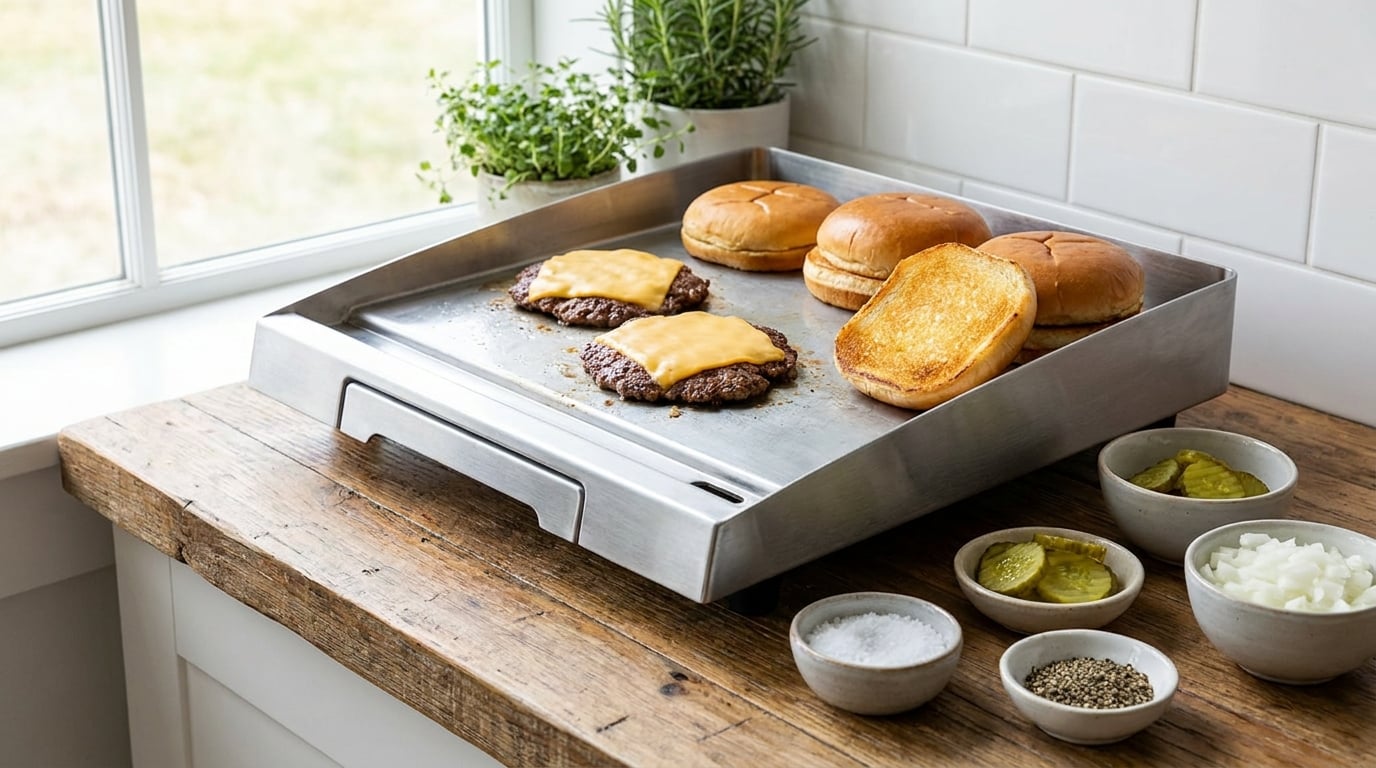
To make smash burgers on a griddle, heat the surface to 400-450F, drop loosely rolled 2.5-3 ounce balls of 80/20 ground beef, and press each one flat within five seconds. Leave them alone until the first side is deeply browned, then flip for 60-90 seconds and add cheese. The whole burger cooks in under four minutes.
The reason it works is surface area. A thin patty hits hot metal across its whole surface at once, so the browning you want happens in seconds instead of minutes. Press harder than feels reasonable and you get those lacy, crisp edges that a thick formed patty never develops.
It is also a forgiving technique. Six steps, one hot surface, and about fifteen minutes of setup. Once you know the cues, you stop watching the clock and start watching the meat.
What You Need
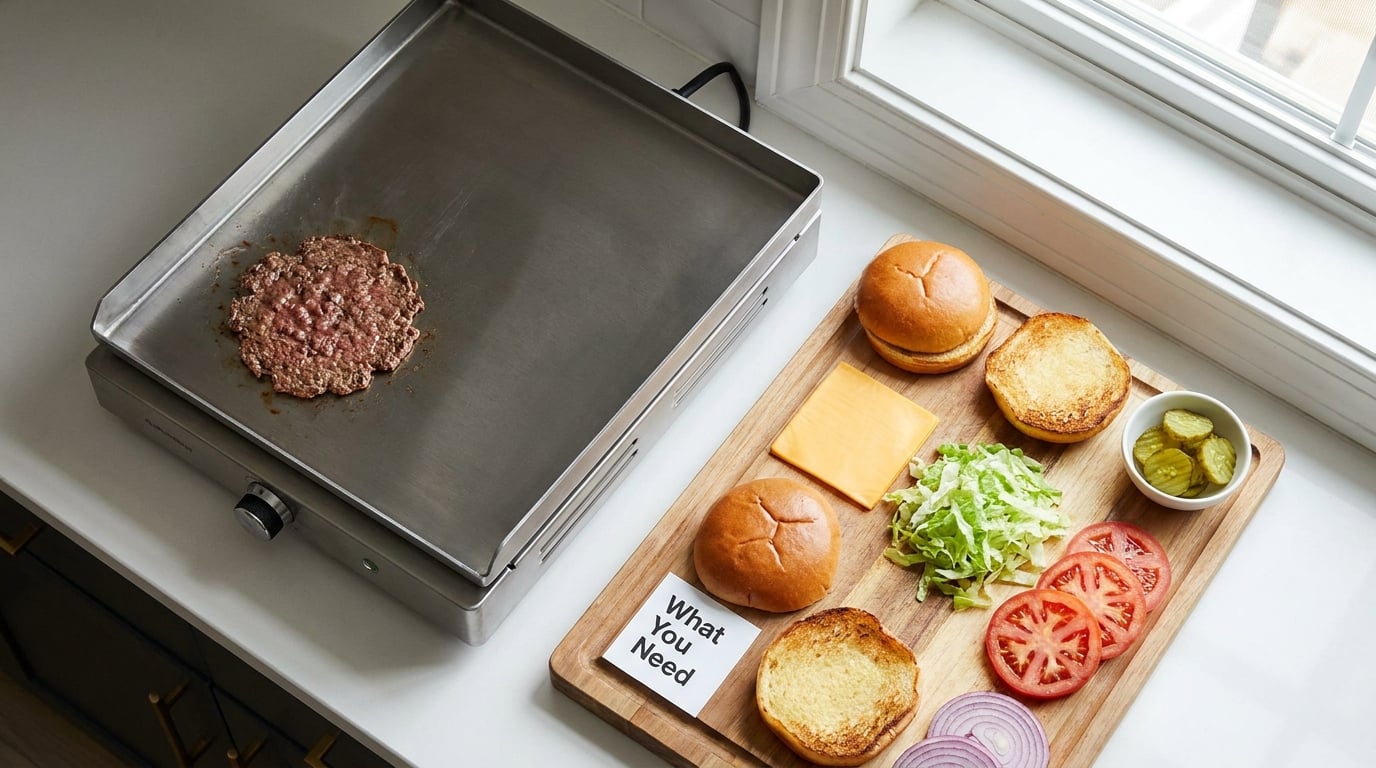
You need very little, and most of it you probably already own. The griddle does the work; the rest is support.
Equipment
- A flat top grill, cast iron griddle, or heavy skillet. A cast iron or stainless pan holds heat far better than thin nonstick, and that heat retention is what keeps the patty cooking while you move it. A single cast iron skillet works fine on a stovetop burner on medium-high.
- A burger press or two stiff spatulas. The press is faster and more even. If you do not own one, cross two spatulas in an X and press down on the crossing point with your weight.
- Parchment or wax paper squares. These sit between the meat and the press so the patty releases cleanly. A square of cooking spray on the press face works as a backup.
- A thin, stiff griddle spatula and a metal scraper. A thin edge is what slides under a 1/4 inch patty without tearing it. The scraper handles the cooked batches and griddle cleanup.
- A 1/3 cup measuring cup. Fill it loosely with beef and level the top to get consistent 2.5-3 ounce balls without a scale. A 1/4 cup gives you a slightly smaller patty.
Ingredients
- Ground chuck, 80/20 fat ratio. This is the single biggest factor in whether the burger tastes like a burger. Leaner blends go dry on a flat top because there is not enough fat to stay juicy in a 90 second cook. Chuck holds the flavor and stays loose.
- Salt and coarse ground black pepper. Salt goes on after the smash, on the raw top side only. Seasoning the whole ball traps steam and dulls the crust.
- American cheese, one or two slices per burger. American is the standard because it melts evenly and its mild tang sits under the beef rather than competing with it. Provolone and Swiss work if you want something sharper.
- Potato buns or brioche buns. Potato buns are sturdier and toast better on the flat top. Brioche is softer and sweeter, so toast them lightly.
- Optional toppings. Thinly sliced onion, dill pickle, shredded lettuce, tomato, and a sauce you like. Keep the toppings minimal so the crust is what you taste first.
Skip the oil on the cooking surface. The beef supplies all the fat the griddle needs, and a clean dry surface is what releases a patty properly.
Step-by-Step: How to Make Smash Burgers on a Griddle
1. Preheat the Griddle and Gather the Ingredients
Set the griddle to 400-450F and give it a full 5-10 minutes. Outdoor flat top burners stay on even on the lowest setting, so a 36 inch griddle on low often runs well above 425F, which is why an outdoor griddle sometimes needs extra spacing between patties.
While it heats, put out everything within arm’s reach. Roll the balls, lay out the buns, salt the shaker, and set the press with parchment squares on it. Once the meat hits hot metal, you have about ninety seconds of focused work, and walking to the fridge for the cheese is how batches get cold.
2. Shape the Patties Thinly
Fill the 1/3 cup with chuck and level it with your palm, then slide the ball out into your hand. Do not squeeze it. The ball needs to stay loose and ragged, because a densely packed ball smashes into a dense puck that stays pale and chewy.
A golf ball sized portion is right. If it feels denser than a golf ball, you packed it too tight, so break it apart and roll it again.
3. Season and Place the Patties
Put the ball on the griddle, then immediately press a sheet of parchment over it and smash. The ball should be flattened to about 1/4 inch, wider than the bun so the edges overhang. Press from the center outward rather than only in the middle, since that is what spreads the meat evenly.
Hold full pressure for about ten seconds, then lift the press straight up. Pull it away rather than sliding it, so the patty stays bonded to the griddle instead of tearing at the edge.
Now season the raw top side with salt and pepper, and work on the next ball. You are racing the clock here, which is the point. A ball that sits on hot metal for more than about five seconds before the press comes down will sear into a round puck that tears when you flip it.
Leave four or five inches between patties. Two to four patties is a comfortable batch on most home setups, and it is worth cooking in batches rather than crowding. More patties means more heat pulled out of the surface, more drippings in the way, and a longer wait before the crust forms.
4. Cook the First Side Until Crispy
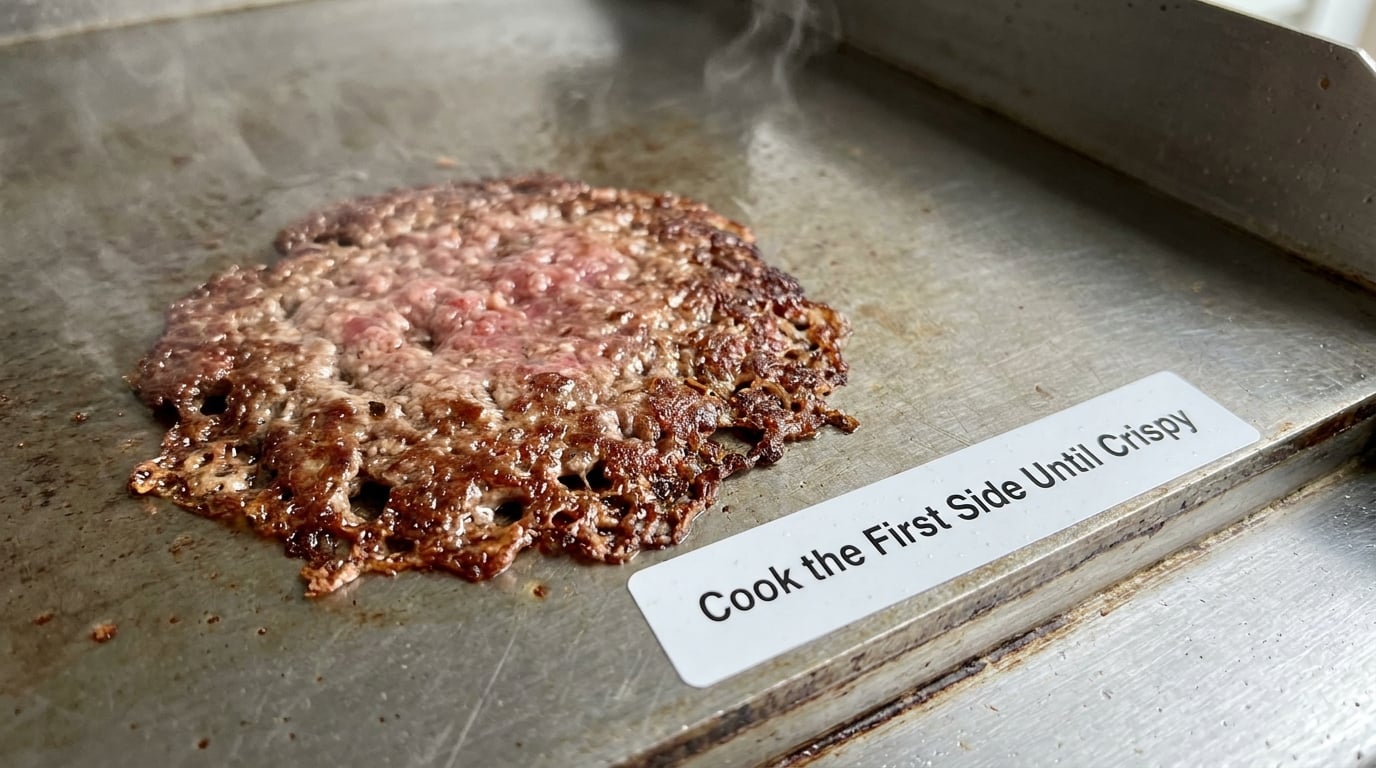
Do not touch the patty. Not to check it, not to press it again, not to move it. The crust forms between 2 and 3 minutes, and every time you break contact you tear the top layer that is trying to set.
You will know it is close when the edges turn dark brown and pull away from the surface on their own, often lifting slightly as the fat renders out. Lift an edge with the spatula; if the meat resists and the underside is still pale, give it another 20 seconds.
When the edges look like brown lace, flip. The top of the patty will still look a little pink, and that is correct. It finishes on the second side.
5. Flip, Season, and Add Cheese
Slide the spatula all the way under the patty and flip in one confident motion. Resist the urge to flip and then press it flat again, since that squeezes out the juice you kept in.
Season the second side right away, then put a slice of American cheese on within a few seconds. The patty is hot enough to start melting the cheese on contact. If you want it fully soft, lay a dome or a lid over the patty for 15-20 seconds, or stand the patty up against something while you work on the batch.
The second side only needs 60-90 seconds. It is thinner than the first and sitting on the hottest part of the surface, so it goes fast.
For food safety, ground beef should reach 160F internally. A thermometer is awkward to use on a 1/4 inch patty, so judge by color and time: the second side loses all pink and firms up slightly.
6. Toast the Buns and Assemble
Move the patties to a cooler edge of the griddle and lay the buns cut side down in the rendered fat. Thirty seconds is enough. If you are out of rendered fat, a thin smear of butter works and adds a little nuttiness.
Build in this order: bottom bun, sauce, patty and cheese, top bun. A second thin patty is a legitimate double smash, and adding it now while the first is still hot is the easiest way to do it.
Serve right away. A smash burger waits badly, since the steam softens the bun and the crust starts to steam out.
Smashing Without a Press
If you do not have a burger press, cross two spatulas in an X over the ball and press straight down on the crossing point with both hands. Put a small square of parchment on top first. The technique is a little slower, which is the main reason home cooks who try it once often switch to a press.
Common Mistakes
1. The griddle is not hot enough. If the patty cooks slowly and stays pale, the surface was under 400F. Give a home griddle a full 5-10 minutes and test with a drop of water, which should skate and sizzle rather than sit. On a cast iron skillet, medium-high for several minutes gets you there.
2. You are pressing the patty too early. Meat that hits the griddle and sits for more than five seconds develops a seared skin that tears apart under the press. If your patties fall into pieces, this is usually the cause, along with a too-cool surface.
3. The patty is sticking to the griddle. Sticking to the surface and sticking to the press are different problems, and they have different fixes. A patty that welds to the griddle usually means the surface needs more heat or more seasoning, or you moved it before a crust formed. Clean the griddle well, make sure it is fully preheated, and leave the patty alone until the edges release. A griddle that has been well seasoned for a week or two releases patties noticeably better than a brand new one.
4. The meat sticks to the press or parchment. Here the fix is the parchment square. Put the paper on the press before the ball goes down, press, then lift straight up. If you forget the paper entirely, a light coat of cooking spray on the press face helps. You can also let the ball sear for a few seconds first, flip it onto its uncooked side, then smash the seared face down.
5. The balls were packed too tightly. Dense meat smashes unevenly, pucks in the middle, and the thin edges burn before the center cooks. Roll loosely and break up any compressed spots before placing the ball.
6. You crowded the griddle. Six patties on a small surface drop the temperature and flood the zone with grease. Cook two to four at a time and keep the next batch portioned and waiting on the counter.
7. You pressed the patty a second time. The press goes down once, hard, for about ten seconds. Repeated pressing squeezes the juice out and the result is a dry burger with a pale center.
8. The cheese went on too late. Cheese added after the patty has left the heat will not melt properly. Put it on within seconds of the flip.
9. The patties tore when you flipped them. Use a thin, stiff spatula and slide it the full width of the patty before lifting. Flip in one motion, never scoop and turn.
Frequently Asked Questions
What is the trick to making smash burgers on a griddle?
Heat, thin meat, and patience. A griddle at 400-450F, a loosely packed 2.5-3 ounce ball, and a hard press within five seconds give you a 1/4 inch patty with maximum contact. Then leave it completely alone until the edges are dark brown and lifting on their own, usually 2-3 minutes. The crust cannot form if you keep moving it.
Is 400 degrees hot enough for smash burgers?
Yes, 400F is about the floor. Most of the time you want 400-450F, which means about medium-high on a stovetop or a medium setting on a flat top. If the patty cooks slowly and stays pale, give the surface more time; a drop of water should skate across it and sizzle. Outdoor griddles on low often run hotter than the dial suggests.
Should I oil my griddle before making smash burgers?
Skip the oil. Ground chuck is about 20 percent fat, and that fat is what the griddle needs. Oiling adds a film that softens the browning and makes a patty more likely to slide instead of sear. Toast buns in rendered fat or a thin butter coating after the patties come off instead.
Can I cook smash burgers on a cast iron skillet?
Yes, and cast iron is the best home option of all, because it holds heat far better than thin nonstick. Heat it on medium-high for several minutes until a water drop skates across it, then cook two patties at a time so the temperature holds. A cast iron skillet runs hotter than a flat top dial suggests, so check the crust early and pull it sooner if the edges darken fast.
How long do you cook smash burgers on a griddle?
The first side takes 2-3 minutes at 400-450F, until the edges brown and the patty releases from the surface. The second side needs only 60-90 seconds once you flip and add cheese. Total time per burger is around four minutes, and cooking two to four at a time keeps the surface hot enough for the crust to develop properly.
How big should smash burger balls be?
Two and a half to three and a half ounces, which is roughly a golf ball. Fill a 1/3 cup measuring cup loosely with ground chuck and level the top to portion without a scale. Keep the ball loose rather than squeezing it, since a tightly packed ball smashes into a dense puck that stays pale and dries out.
Conclusion
Start with heat. A griddle that is properly preheated to 400-450F is the difference between a patty that browns in two minutes and one that steams gray on a cold pan, and it is the step most beginners shorten.
Everything after that is simple and quick. Roll a loose 2.5-3 ounce ball, smash it within five seconds, salt the top, and walk away for two to three minutes. Flip while the crust is dark brown at the edges, season, add cheese right away, and give it another 60-90 seconds. Toast the buns in the beef fat, stack, and eat it before the bun softens.
If the burgers stick to your press, add the parchment square. If they stick to the griddle, the surface needs more time or a cleaner, better seasoned finish. Fix those two things and the rest takes care of itself.