
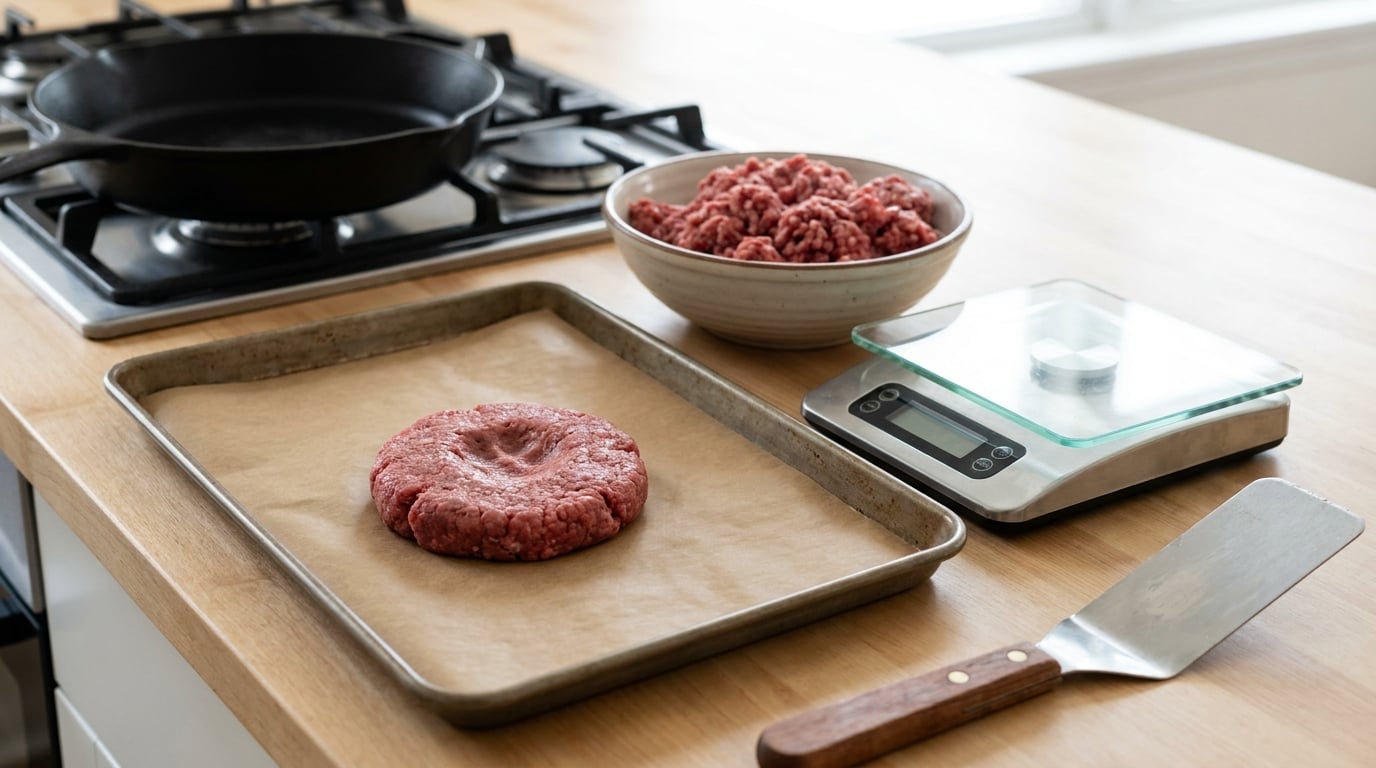
To keep burgers from puffing up in the middle, press a shallow indent into the center of each raw patty with your thumb before it hits the heat. It takes about ten seconds per patty and it is the difference between a burger you can stack and a meatball that slides off the bun.
Here is why it works. When ground beef heats, the proteins denature and contract, so the edges of the patty pull inward and shove the softer, juicier center straight up. A thumb indent gives that center somewhere to go, so the burger rises evenly around the dent instead of ballooning in the middle.
A domed patty is more than an appearance problem. It shrinks hard in diameter, cooks unevenly from the outside in, and sends juices pooling into the middle, which is why so many people chase a done center and end up with a dry, overcooked edge.
What You Need
The whole setup is small. You need decent beef, a way to make portions the same size, and a hot flat surface.
- Ground beef at 80/20 or 85/15. Around 15 to 20 percent fat shapes easily and stays tender. Leaner blends have less fat to keep the patty supple, so they need gentler hands and they dome more readily.
- A kitchen scale, or a portion guide. A 5 to 6 ounce ball is the sweet spot for a standard bun. Even weight is the cheapest fix for uneven cooking.
- A wide, flat spatula. Thin and rigid, so you can slide under a patty without scraping or tilting it.
- A cast iron skillet, a griddle, or a gas grill. Something flat that you can preheat properly and hold at temperature.
- An instant-read thermometer. Ground beef is safe to eat at 160F internal. Chasing the dome by eye is how people overshoot.
- Salt and pepper. Season the outside, not the raw surface you’re about to indent, and season right before cooking.
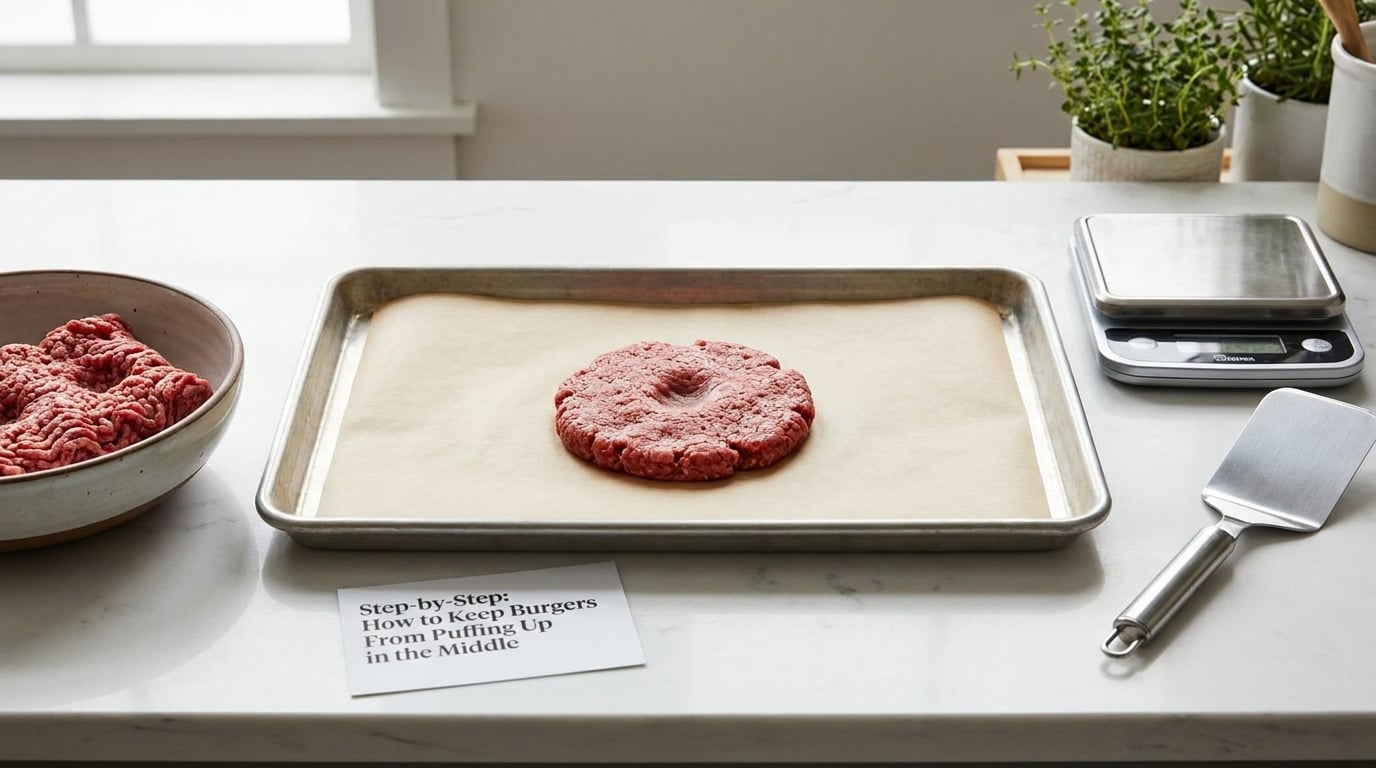
Step-by-Step: How to Keep Burgers From Puffing Up in the Middle
Choose Ground Beef With Enough Fat
An 80/20 blend gives you the two things you want: enough fat to stay moist and enough structure to hold a shape under heat. Fat also renders at the surface and slows the browning of the very edges, which slows down the inward pull that causes the dome in the first place.
Going to 90/10 is where I see problems start. Very lean patties tighten fast, shrink more, and usually need the dimple more than fattier ones do, not less. If you’re stuck with lean beef, chill it briefly so it firms up, handle it as little as possible, and add a tablespoon of olive oil to the bowl before mixing.
Weigh Each Patty and Keep the Edges Rounded
Divide the beef into equal balls with a scale. Even portions cook at the same rate, and an even patty is the whole starting point for staying flat.
Press each ball into a patty about three-quarters of an inch thick and a little wider than your bun, since you know it’s going to shrink. Round the edges with your fingertips rather than leaving a thick rim, because a thick edge cooks faster and pulls harder than the center. A gentle press of the palm is enough. If the meat springs back, you pressed too hard.
Make a Shallow Indent to Stop Burgers Puffing Up
This is the step that actually does the work. Using your thumb or the back of a spoon, press a shallow dimple into the center of one raw patty, roughly 1 inch across and about a quarter inch deep. It should look like a firm thumbprint, not a well.
Two rules matter here. Dimple one side only, and dimple it before the patty hits the heat. Pressing both sides halves the useful depth and gives you a thin, fragile center that can cook through unevenly or crack on the flip. A thin layer of oil in the bowl helps the beef release from the lid if you use that method, and it leaves the surface seasoned for the crust.
If you shape the patty inside an inverted plastic-wrapped lid instead, the handle leaves a natural center indentation. That method gets you even thickness and a dent in one pass, which is why it’s the one alternative worth stealing.
Cook on Moderate Heat Without Pressing
Preheat the surface fully before the meat goes down, aiming for roughly 450 to 460F on a grill or a well-heated skillet. A cold or lukewarm surface is a big reason patties balloon: the meat sits and steams, renders its fat slowly, and swells instead of forming a crust that pins the edges in place.
Set the patty down and walk away. Do not press it with the spatula, and do not reshape it mid-cook. Pressure pushes liquid around inside and encourages the center to rise. Flip once, cook the second side, and pull it at 160F. One flip gives you an even cook and a crust that holds its shape.
Rest Before Adding Toppings or Serving
Give the patty a minute or two off the heat before it hits the bun. Resting lets the muscle fibers relax and the juices redistribute instead of running out the moment you slice or bite. Skipping the rest is one of the easiest ways to make a good burger taste dry and thin.
The Technique by Cooking Method
The indent works everywhere, but the details change with the heat source.
- Gas grill: full preheat, 450 to 460F, patty down, one flip, lid closed for the second side.
- Cast iron skillet: heat the pan until a drop of water skitters, add a thin film of oil, then the patty. Sear about 3 to 4 minutes a side.
- Flat top griddle: 400 to 425F is plenty. Smash-style patties at about a quarter inch are too thin to dome much at all, so the dimple matters less than weight.
- Oven broiler: 6 inches under the element, patty 3 to 4 inches, about 3 to 5 minutes a side depending on thickness. Watch it closely; broiler heat is fierce.
- Air fryer: 375 to 400F for 9 to 12 minutes depending on thickness, flipped once. Air frying dries the surface more than it domes, so keep the indent shallow.
Thin smash patties are the one case where puffing is basically solved by geometry. A quarter-inch patty pressed onto a hot griddle has nowhere to swell, which is exactly why fast-food chains run them that thin and why so many home cooks chasing that look get a dry result.
Common Mistakes
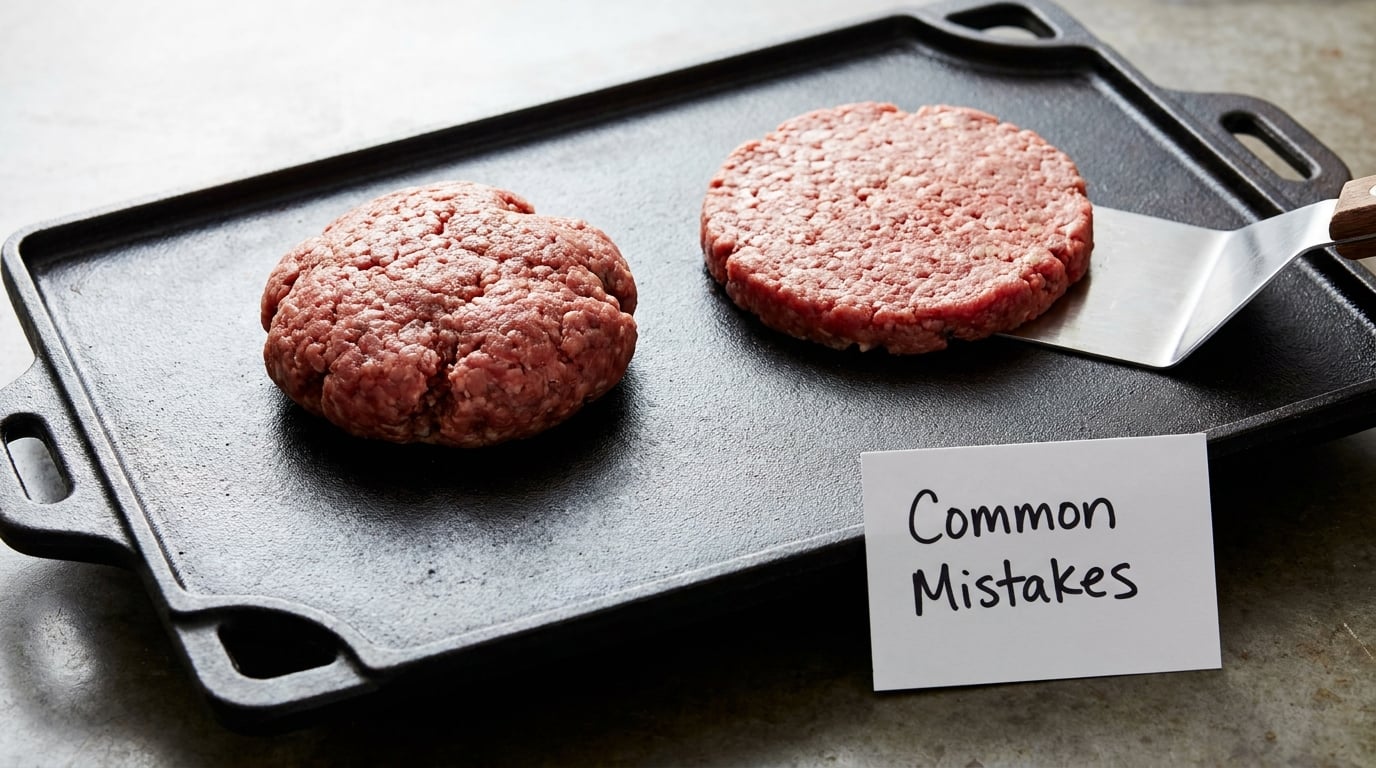
Almost every domed burger I have seen trace back to one of these.
Dimpling both sides
It feels thorough, so people do it. It halves the thickness of the center and can split at the flip line. One side, thumbprint depth, done.
Pressing the patty with a spatula
Flattening it after it hits the heat squeezes juices to the middle and gives the dome a shove. A press is only legitimate on a griddle at the moment of contact, as part of smashing a deliberately thin patty.
Overworking or kneading the meat
Kneading warms the fat and makes it emulsify into a bready, springy mass that tightens and balls up under heat. Mix gently, shape lightly, stop as soon as it holds together.
Uneven portions
A thick patty and a thin one on the same grill cannot both come out right. The thin one is done before the thick one has set its crust, and the thick one is still pink inside when you finally flip it. Weigh them.
Cooking cold or from a cold pan
Very cold meat on a lukewarm surface spends its first minutes rendering water instead of browning. Let the beef sit out about 20 minutes and give the pan real time to heat. Room temperature meat helps, but it is not the cure it gets sold as.
Repeated flipping and topping too early
Every flip resets the crust, which is the only thing holding the edges in. Cheese and toppings on a domed patty just slide off. Cook it flat, flip once, rest it, then assemble.
Two more notes. For frozen patties, thaw them in the refrigerator rather than at room temperature, press the indent in while they’re still slightly firm, and give them a minute longer on the grill. For a big cookout, form patties the day before and keep them on a sheet pan in single layers in the fridge; they hold their shape well and cook more evenly straight from cold than patties that have warmed up and dried out.
Frequently Asked Questions
Should I make an indentation in the center of a burger patty?
Yes. Press a shallow indent roughly 1 inch wide and a quarter inch deep into one side of the raw patty before cooking. It gives the center room to expand as the proteins contract, so the burger rises around the dent instead of doming into a meatball. Keep it shallow, and never dimple both sides.
Why do my burgers puff up even though I shaped them flat?
Two things are working against you. The beef is probably being handled too much, which tightens it, and it may be hitting a surface that is not fully preheated, which lets the meat swell before a crust forms. Shape gently, preheat the grill or skillet properly, and press the indent before the patty goes down.
Does smashing a burger patty make it puff up in the middle?
No. Smashing on a hot griddle at the moment of contact is designed to stop puffing, because a very thin patty has no volume left to expand. The dome usually appears when people press a patty after it has started cooking, which squeezes liquid toward the middle and lifts the center.
Can I fix a burger that is already puffing up while it cooks?
Barely. You cannot reshape a patty mid-cook without tearing it, and pressing it flat just drives the problem deeper. Focus on an even finish instead: flip once, pull it at 160F internal, rest it a minute, and place it on the bun domed side up so the flatter base sits against the bread.
Does lean ground beef cause burgers to dome in the center?
Lean beef makes doming more likely. With less fat to keep the meat supple, the patty tightens and contracts harder as it heats, pulling the edges in and pushing the center up. Use 80/20 or 85/15 if you can, handle the meat as little as possible, and keep the indent.
The Short Version
Start with the thumb indent. Weigh your portions, use beef around 20 percent fat, and press a thumbprint about a quarter inch deep into one side of each patty before the heat is on.
Then do not touch it. Fully preheat the surface, no spatula pressing, one flip, pull at 160F, rest a minute. Those five habits cover most of what goes wrong, and they cost nothing but a little patience at the grill.