
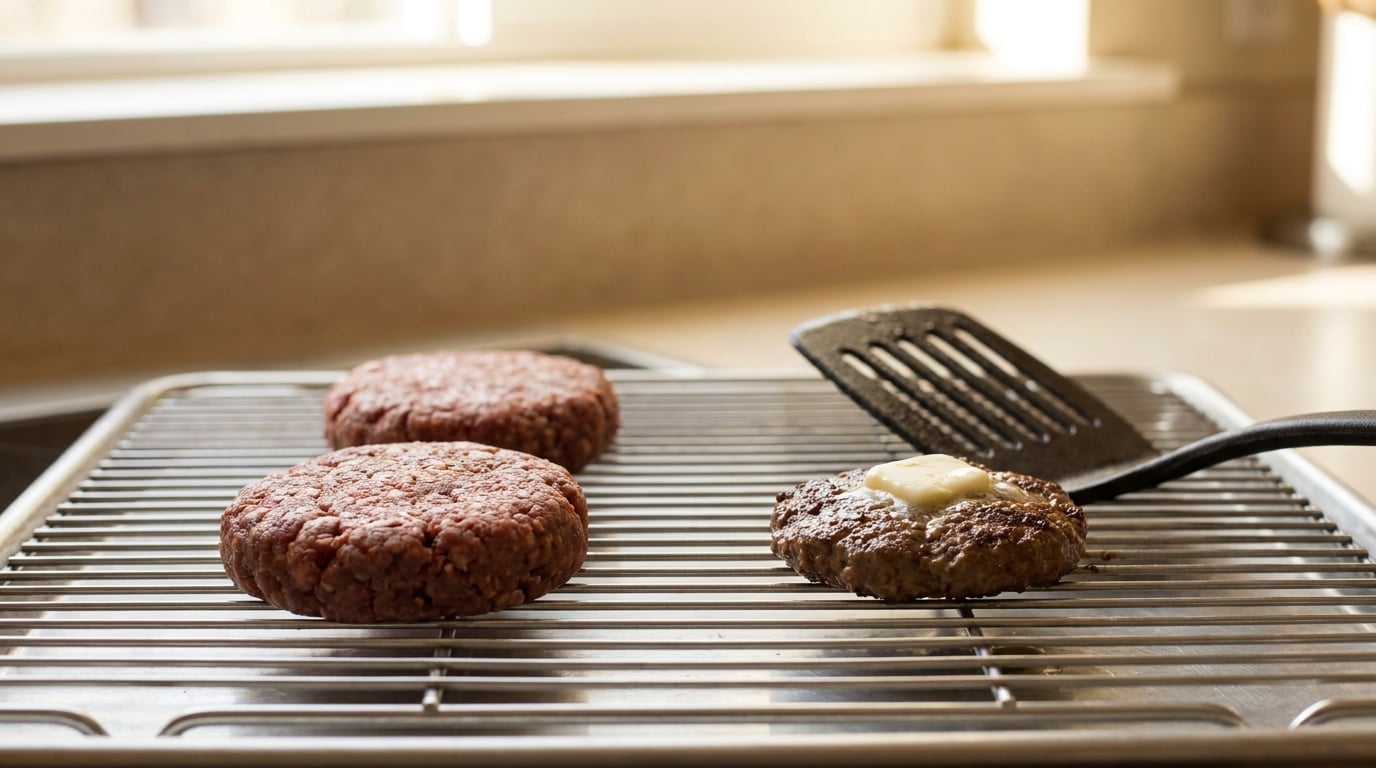
Burgers shrink because heat pushes out three things at once: fat melts and drips away, water turns to steam and escapes, and the meat proteins tighten up as they cook. That is normal, and a well-made patty loses roughly a quarter of its raw diameter. The patties that end up as hockey pucks are usually too lean, overworked, or cooked hard enough to drive off most of their water.
So why do my burgers shrink so much on the grill? Once you know which of those three forces is doing the damage, you can pick the fix that matters most for your setup.
Table of Contents
- What Makes Burgers Shrink on the Grill?
- How Does Heat Make a Burger Shrink?
- Why Does the Inside of a Burger Lose Water?
- How Much Shrinkage Is Normal?
- Does Pressing or Flipping a Burger Make It Shrink More?
- How Can You Keep Burgers From Shrinking Too Much?
- Why Do Restaurant Burgers Stay Large?
- Frequently Asked Questions
- Conclusion
What Makes Burgers Shrink on the Grill?
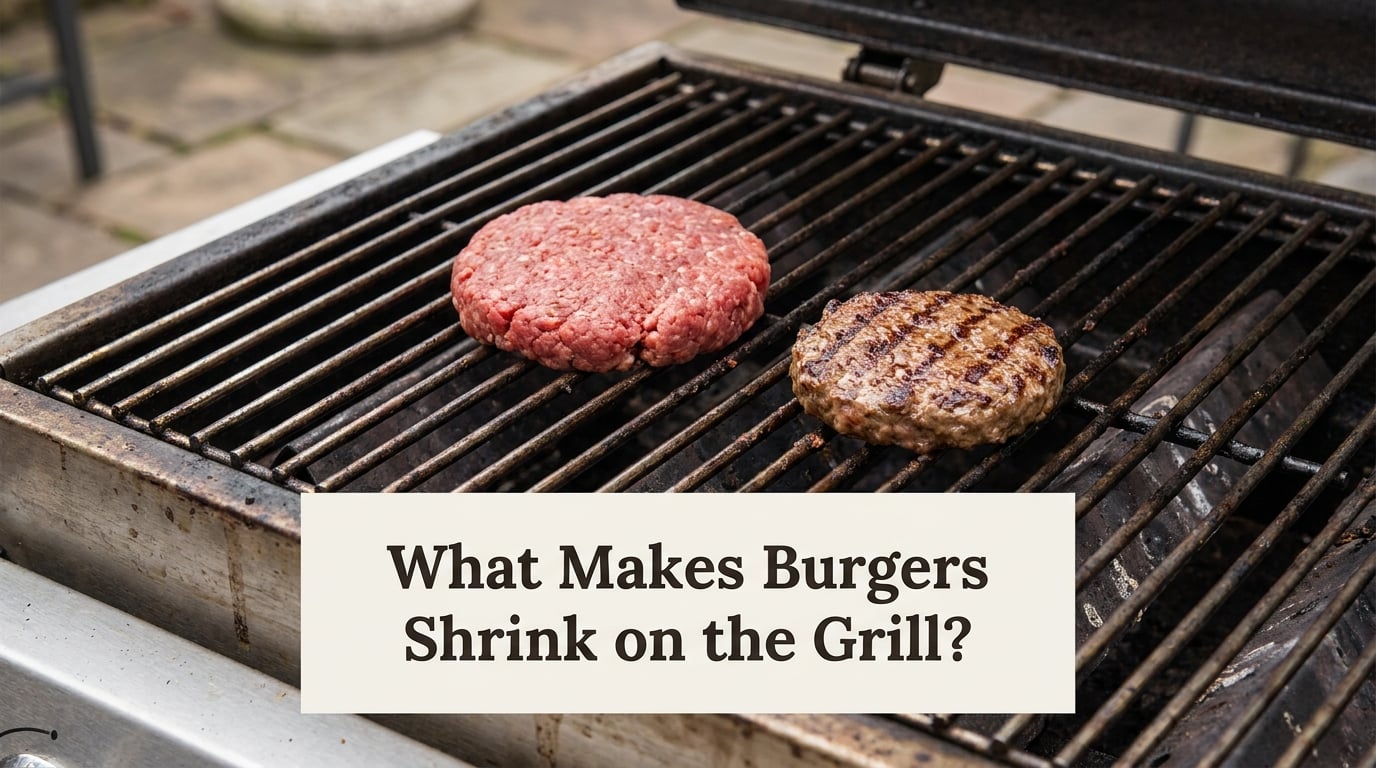
Why do my burgers shrink so much on the grill? Four forces pull the patty inward. Each one is normal on its own, and together they add up.
- Moisture evaporates. Water in the patty heats up, becomes steam, and leaves through the surface.
- Fat renders out. Ground beef fat melts somewhere around 130 to 150 degrees F and runs off the patty or onto the grate.
- Proteins contract. Muscle proteins unwind as they heat, then link together and squeeze the whole patty tighter.
- Collagen and connective tissue tightens. As it cooks, that tissue shrinks like a rope under tension and pulls the edges inward.
Notice that none of these four is a mistake on your part. A patty that goes from 4 inches wide to 3 inches wide is doing exactly what ground beef is supposed to do. The problem is when you lose half your width, and that almost always means the fat was too lean or the heat was too aggressive for too long.
How Does Heat Make a Burger Shrink?
Heat does damage in layers. The searing surface hits the patty first and starts the Maillard browning, which is where flavor comes from.
Under that crust, the temperature climbs from cold to somewhere around 160 degrees F for a well-done beef patty, and the USDA minimum safe internal temperature for ground beef is 160 F. Along the way, dissolved collagen and the protein network tighten and physically compress the meat.
Water that was locked inside gets pushed toward the surface and eventually boils out. A high, fast sear locks in less than most people think, which is why a hard sear followed by a long, hot finish dries the patty through. Long cooking times matter more than searing temperature, so the fix is a shorter total cook rather than a gentler sear.
Why Does the Inside of a Burger Lose Water?
The inside of your burger is mostly water, held in place by two things: the fat and the protein network. Take either of those away and the water has nowhere to sit.
Lean beef has less fat to hold it, so it squeezes harder and loses more. Well-seasoned beef stays looser. And heavily salted patties lose more juice than lightly salted ones, because salt draws water out of the cells and out of the patty.
Grind matters too. A coarse grind keeps more fat and air pockets intact, so coarse-ground chuck holds onto juice better than a fine grind that compresses everything into a dense puck.
How Much Shrinkage Is Normal?
For a standard 5 to 6 ounce beef patty cooked to 160 degrees F, expect a diameter loss of about 20 to 30 percent and a weight loss in the same ballpark. Here is how the usual blends compare, based on how much fat each one renders and how much its structure can hold together.
| Ground beef blend | Typical diameter loss | What it cooks like |
|---|---|---|
| 70/30 chuck | 10 to 15 percent | Very juicy, soft texture, shrinks least |
| 75/25 chuck | 15 to 20 percent | Rich and juicy, easy handling |
| 80/20 chuck | 20 to 25 percent | The all-round burger blend |
| 85/15 | 30 to 35 percent | Firmer, drier, better for sausage |
| 90/10 ground sirloin | 40 percent or more | Very lean, noticeably tight and dry |
Two more variables shift these numbers. Thickness matters, because a thin smash burger cooks in under a minute and loses less water than a 3/4 inch patty that spends four minutes on the grill. And grill temperature matters, since a patty over screaming-hot charcoal can shed moisture before the center ever cooks through.
Does Pressing or Flipping a Burger Make It Shrink More?
Pressing with a spatula definitely makes it shrink more. Flattening a patty on the grill squeezes liquid out of it and onto the grate, and that liquid carries fat and flavor with it. On a griddle it becomes a layer of burnt grease on your cooking surface.
Flipping several times is a different problem. Repeated flips tear the crust that has just set and expose raw meat to the hot surface again, so more of that surface area browns and dries. One or two flips is fine; four is where things fall apart.
Piercing a patty to check doneness lets juices run out through the hole. Use a thermometer instead, or press the surface lightly with a finger and judge by feel.
How Can You Keep Burgers From Shrinking Too Much?
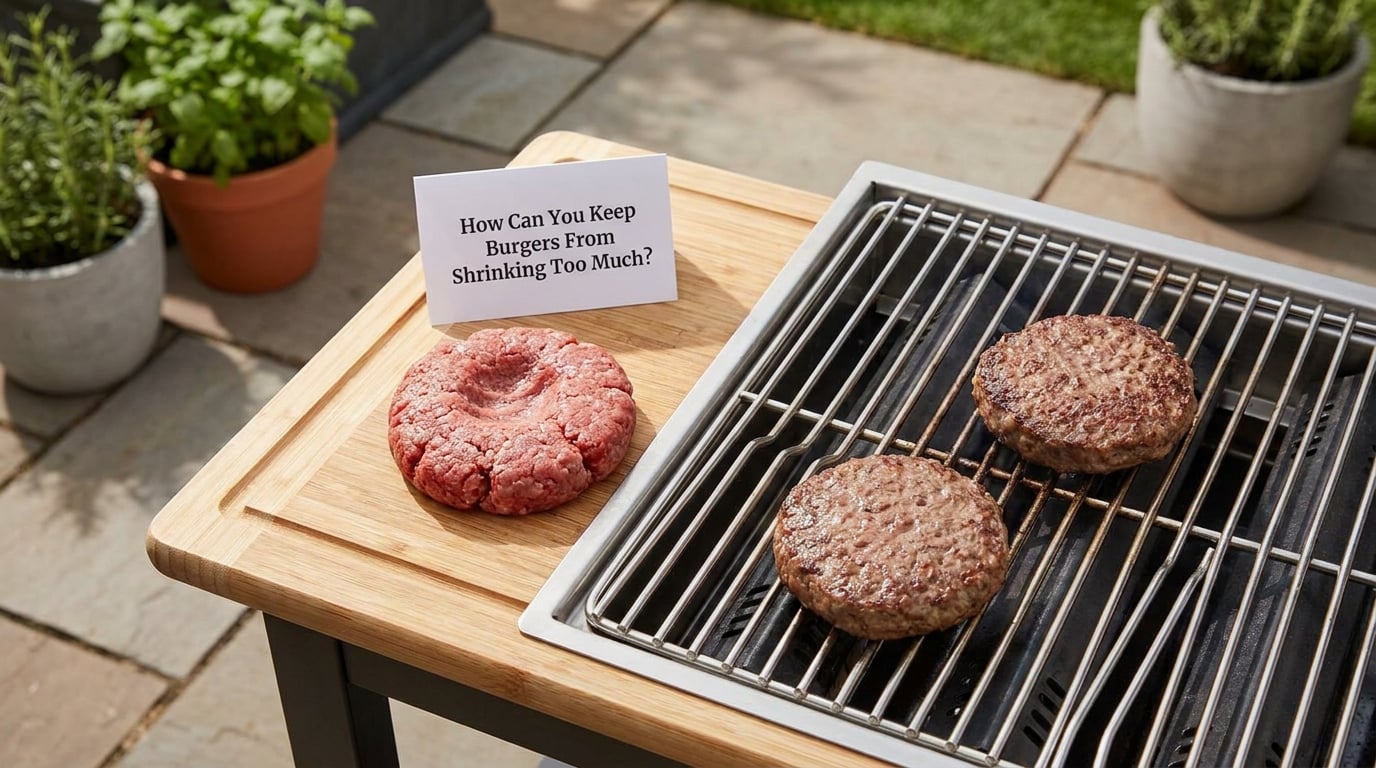
These fixes work in order of how much they change the result. Start at the top.
Pick an 80/20 blend, not a lean one
Fat is the moisture reservoir. An 80/20 ground chuck gives you enough fat to stay juicy through the cook while still holding a shape. Most home cooks see the biggest improvement just by switching away from 90/10.
Handle the meat as little as possible
Work it just until it holds together. Overworking warms the fat, breaks the cold fat into smaller pieces and squeezes out air, which is exactly the dense puck that shrinks hardest.
Make a shallow dimple in the center
Press your thumb about a quarter inch into the middle of the patty. The thinner center cooks through at the same rate as the edges, so the patty stays flat instead of doming into a meatball.
Shape it about an inch wider than your bun
Size for the cooked patty, not the raw one. If the finished patty will be 3.5 inches wide, form a 4.5 inch puck.
Salt lightly and season right before it hits the grill
Salt draws moisture out of the meat. A light sprinkle on the surface at cook time seasons without turning the patty into a sponge. Save the heavy seasoning for after cooking if you prefer.
Use two-zone heat
Sear over high heat for a minute or two, then move the patty to a cooler side or lower the heat and close the lid. The gentle finish cooks the center to 160 F without scorching the edges.
Let it rest two minutes
A short rest lets the juices redistribute instead of running out the moment you cut into it. A grill thermometer that reads 160 F for beef, or 165 F for poultry and turkey patties, is the easiest way to time all of this.
Why Do Restaurant Burgers Stay Large?
Restaurant burgers stay big because of the patty formula and the pace of the kitchen, not because of special equipment. Restaurants grind chuck fresh on a coarse plate and blend it to roughly 80/20, sometimes with a little salt and water mixed in to help the patty hold together.
They form patties loosely and fast, press a shallow dimple, and cook them on a flat top at moderate heat for a short, predictable window. Because every patty gets the same treatment, they turn out consistent, and they serve them within a minute or two of cooking.
You can copy all of that on a home grill with a store-bought 80/20 coarse grind, gentle hands and a two-zone setup.
Frequently Asked Questions
How do I keep my burgers from shrinking on the grill?
Start with an 80/20 ground chuck and handle it as little as possible. Form the patty an inch wider than your bun, press a shallow dimple in the center, salt lightly right before cooking, then sear over high heat and finish on a cooler side of the grill. Avoid pressing with a spatula and limit yourself to one or two flips.
Is it better to grill burgers with the lid open or closed?
Closed for the gentle part, open for the sear. A closed lid on medium-low indirect heat finishes the center evenly without scorching the edges, and it also bounces heat off the lid so the patty cooks from both sides. Open the lid for the first minute or two when you want a crust, then close it and pull the patty to the cool side.
Why do my burgers puff up in the middle?
Because the thick center is still catching up to the cooked edges. The edges lose their water and tighten first, while the center stays cold and thick, so the patty bows upward into a dome. A shallow dimple in the center equalizes the thickness, and cooking over gentler heat or moving the patty to a cooler zone lets the middle finish without the edges overcooking.
Why do frozen burgers shrink more than fresh ones?
Freezing forms ice crystals that rupture muscle cells and push water out of the patty. That released water thaws on the grill surface and evaporates, so a frozen patty carries extra moisture that turns into shrinkage. Thawing overnight in the refrigerator and patting the surface dry before cooking gives you back most of that lost edge.
Does adding egg or breadcrumbs to patties prevent shrinkage?
Barely. Egg and breadcrumbs hold shape through the first flip and can make a loose blend workable, but they do not stop fat rendering, evaporation or protein contraction, which are the real forces. For shrinkage specifically, fat content and gentle handling matter far more than binders. Season the surface lightly and skip the filler if you want the best result.
Conclusion
Fix fat content first, then handling, then heat. An 80/20 blend shaped loosely with a dimple and cooked gently will still shrink a bit, and that is fine. Expecting a quarter of your diameter to go is how you judge a good burger instead of a disappointing one.