
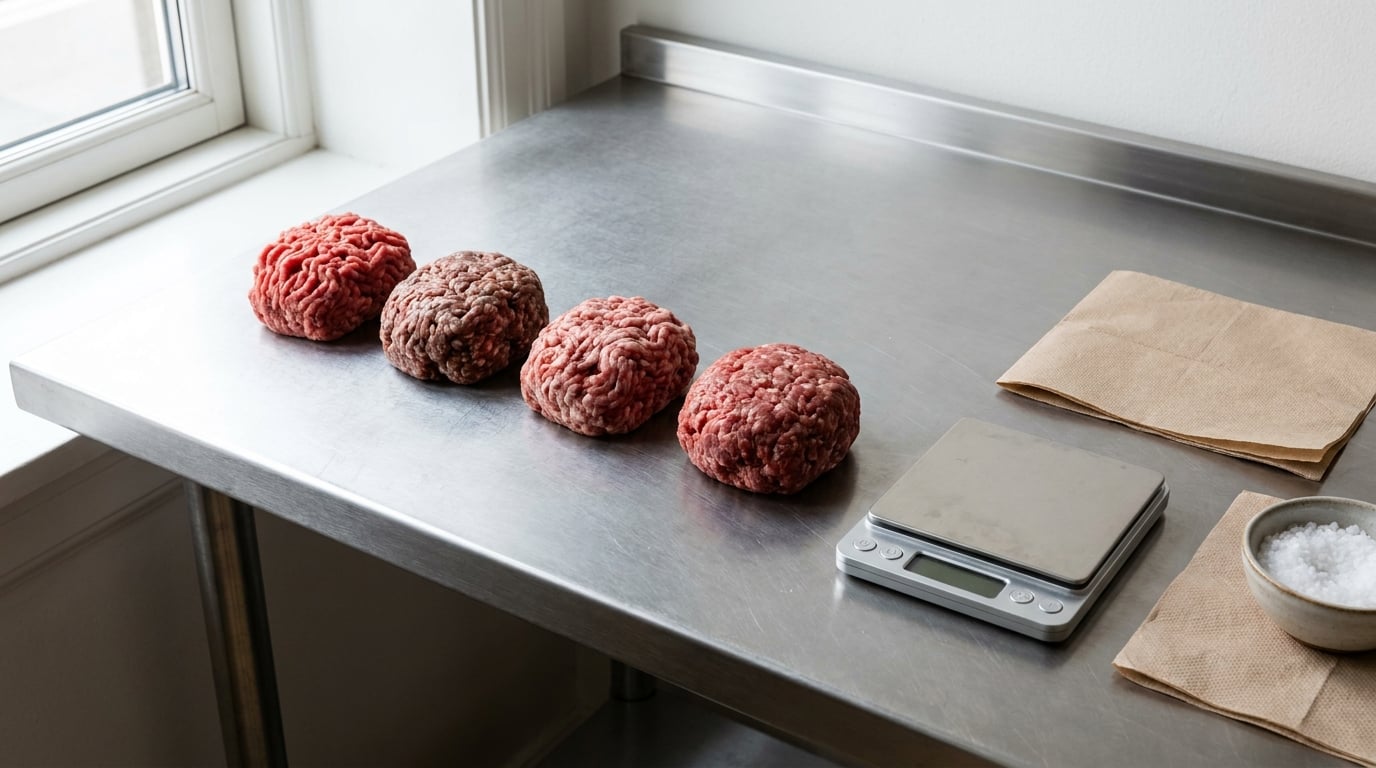
If you want the straight answer: the best beef to fat ratio for juicy burgers is 80/20, meaning 80 percent lean and 20 percent fat by weight. It is the blend most cooks land on because the fat renders as the patty cooks and bastes the meat from the inside. Drop to 85/15 when you are cooking over an open flame or loading the burger with bacon and cheese, and go to 75/25 for thin smash patties on a hot flat top. Leaner than 85/15 and you will chase moisture you never get back.
Everything past that is fine-tuning, and the fine-tuning is where this gets interesting, because the right beef to fat ratio changes with how you cook. A blend that behaves beautifully in cast iron turns into a flare-up machine over live charcoal.
Table of Contents
- Best Beef to Fat Ratio for Juicy Burgers at a Glance
- What Does 80/20 Mean for a Burger?
- Which Fat Ratio Works Best for Juicy Burgers?
- How Fat Content Changes Burger Texture and Flavor
- How to Choose the Right Blend for Your Cooking Method
- What to Look for When Buying Ground Beef
- How to Cook a Juicy Burger Without Losing Moisture
- Frequently Asked Questions
- What fat ratio is best for juicy burger patties?
- Is 80/20 ground beef the best for burgers?
- Is 90/10 ground beef healthier than 80/20 for burgers?
- Does a higher fat percentage make a burger taste better?
- Should I use ground chuck or ground beef for juicy burgers?
- What internal temperature should I use when cooking ground beef burgers?
- Conclusion
Best Beef to Fat Ratio for Juicy Burgers at a Glance
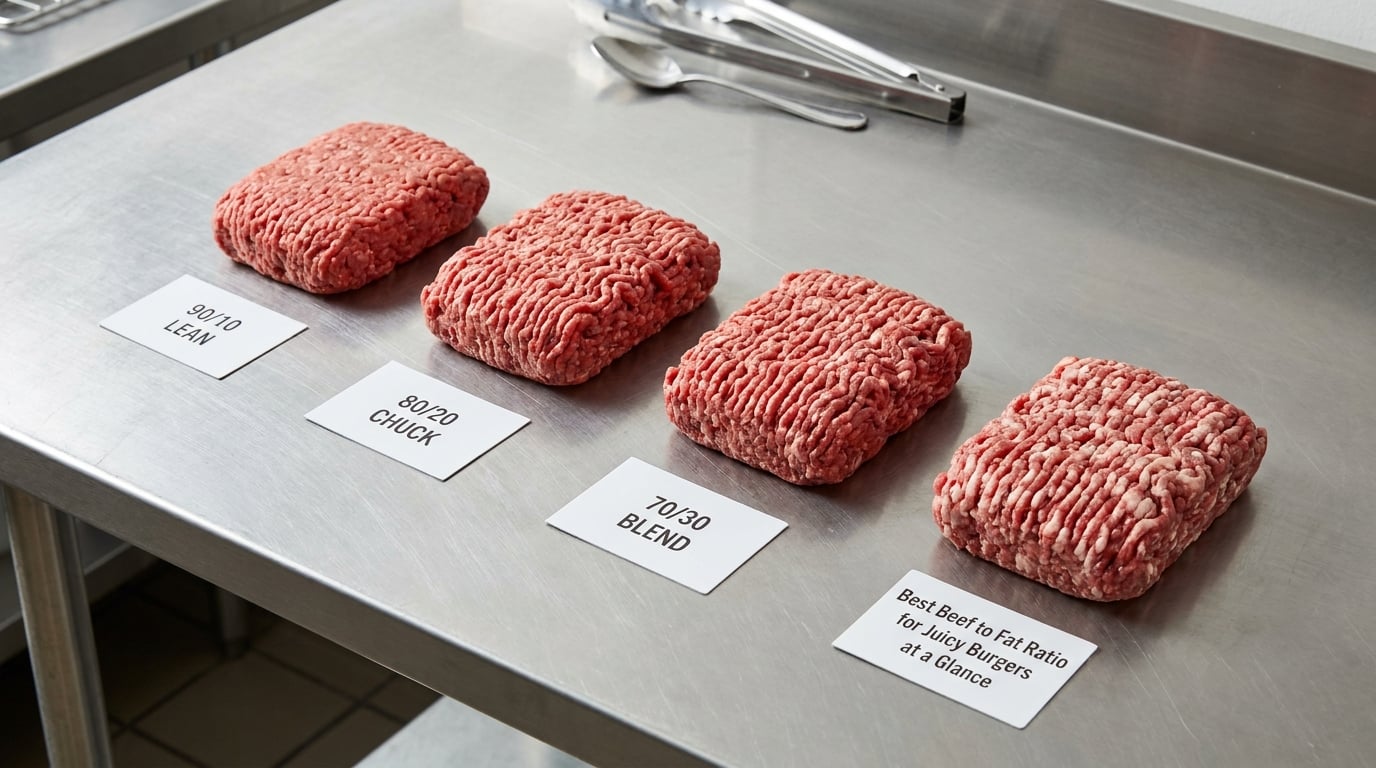
Here is the whole spread in one place. No major publication competing for this topic publishes a chart like it, which is odd, because the ratio is the single variable that decides whether a homemade burger is dry or drippy.
| Lean to fat ratio | Fat content | How it eats | Risk | Best for |
|---|---|---|---|---|
| 70/30 | 30 percent | Very rich, loose texture, needs a technique adjustment to stay together | Major shrinkage, greasy plate, flare-ups over open flame | Smash burgers, sausage, meatball mixes |
| 73/27 | 27 percent | Rich and beefy, very moist | Noticeable shrinkage, flare-ups on a grill | Thin griddle patties, stuffed burgers |
| 75/25 | 25 percent | Rich, juicy, soft and forgiving | Greasy if overcooked or cooked thin over high heat | Smash burgers, well-done patties, Wagyu and bison blends |
| 80/20 | 20 percent | Juicy, beefy, holds its shape, good crust | Low; flare-ups on direct coal heat only | Everything else. The default burger blend |
| 85/15 | 15 percent | Clean and beefy, still moist, tighter texture | Mild flare-ups, less forgiving of long cooks | Open-flame grilling, rich toppings, high heat sear-and-finish |
| 90/10 | 10 percent | Lean, less juicy, still workable for burgers | Dries out, crumbles on the flip | Tacos, chili, meatloaf, meatball mixes, lower-fat plates |
| 93/7 | 7 percent | Very lean, close to a dry hockey puck | Dries out badly, falls apart | Ground turkey and chicken blends, meatloaf binders |
If you read nothing else on this page, read that row for 80/20 and move on with your life. It is the answer to the question in about nine words.
What Does 80/20 Mean for a Burger?
A lean-to-fat ratio is a percentage of the final weight of the grind. So 80/20 is 80 percent lean meat and 20 percent fat. 85/15 is 85 percent lean with 15 percent fat. 90/10 has just 10 percent fat, which is where a lot of grocery store ground beef sits by default.
The numbers come from the ratio of lean muscle and fat trim going into the grinder, measured by weight before grinding. They are not a quality grade and they say nothing about how the animal was raised or how the meat was handled. A 20 percent fat paste from an indifferent feedlot and a properly hung chuck blend can taste nothing alike, but the label will read the same on both.
Why your butcher hands you 90 percent lean by default
This one catches a lot of home cooks out. Most butchers and grocery meat counters default to a lean grind because it sells as an all-purpose product. Long threads on Smoking Meat Forums describe exactly this: you ask for hamburger meat, you get something lean, and then you wonder why the patties eat like sand.
The fix is to say the number out loud. Ask for an 80 percent lean 20 percent fat grind by weight, and if you are mixing your own, ask them to hold back the fat trimmings in a separate bag. A butcher working on a quarter, half, or whole beef order can usually plan for your ratio if you ask well ahead of the pickup, since it changes what they set aside.
Why 80/20 is the standard for juicy burgers
You are not wasting meat by keeping 20 percent fat. You are adding flavor and moisture that lean muscle alone does not carry. Pitmaster posters on Smoking Meat Forums make that argument cleanly: more fat in does not mean less meat on the plate, it means fat flavoring and juiciness on the plate. A pitmaster named mcokevin, who has been grilling for 20 years, said he normally likes 70/30 but will not complain about 80/20, and that anything leaner than 20 percent fat he does not want for burgers.
Which Fat Ratio Works Best for Juicy Burgers?
Four blends cover almost everything a home cook does. Here is what each one actually gives you, including the failure modes that people only discover after the second bite.
90/10 ground beef: workable, but you manage it
Ninety percent lean with 10 percent fat still makes a fine burger. It will not fall apart if you keep the meat cold, handle it gently, and stop cooking it the moment it hits temperature. The cost is margin: there is no spare moisture, so every extra minute on the grill comes straight out of the patty. Expect a firmer bite and a slightly drier center than an 80/20.
Use 90/10 when the patty is one component of a bigger dish, or when the rest of the meal is rich. Tacos, chili, and meatball mixes all benefit from the lower fat, and so do burgers under a heavy stack of cheese and bacon.
85/15 ground beef: the griller’s blend
Eighty-five fifteen is the ratio a lot of grill cooks defend, and it has a real argument behind it. Over an open flame, drippings that fall onto hot coals turn to smoke and flare, and 20 percent fat gives a fire department more to manage. Several editors who write about grilling recommend a 15 to 20 percent fat range for patties headed to a grate, which is a hedge across both of the popular answers rather than a firm pick.
It is also firmer, which means it takes a sear better, and it holds together on a thin patty. If your grill runs hot and you like a hard crust, this is a good place to live.
80/20 ground beef: the answer most of the time
This is the ratio Ina Garten, Alton Brown, and Bobby Flay are all quoted recommending, and it is the blend behind the 80/20 standard at the big burger chains. It renders enough fat to baste the meat and flavor the crust, keeps enough structure to survive a flip, and shrinks noticeably less than anything richer.
One smoker on Smoking Meat Forums put it as the number he would not go below, and another said that when he is cooking plain burgers he asks for 80/20, then moves to 85/15 or even 90/10 only when he is mixing in pork or sausage, because the added fat changes the math. That is a good instinct to borrow: a blend already carrying fat from another meat needs a leaner base.
75/25 ground beef: rich, and it needs a lighter hand
Seventy-five twenty-five is delicious and slightly dangerous. It is the right call for very thin smash patties on a screaming hot flat top, where the rendered fat fries the edges into lacy crisp bits and most of it ends up in the pan rather than on your plate.
It is the wrong call over direct coal heat. A smoker named chef jimmyj tried 75/25 on a Chargrill and reported flare-ups, a huge puddle of fat in the pan, and major shrinkage, then said never again. He went back to 80/20. What you need in exchange is a technique adjustment: press the patty thin and even, keep it moving, and expect to lose some volume.
Is 80/20 the best beef to fat ratio, or is 85/15 better?
Both are defensible, and the difference between them is smaller than most arguments online make it sound. Pick 80/20 as your default for cast iron, a griddle, or a well-managed gas grill. Pick 85/15 when you are over charcoal with a lot of direct heat, or when the burger is carrying bacon, cheese, aioli, and a buttered bun on top.
If a source tells you 85/15 is the only correct answer, ask what they are cooking it on. The disagreement exists because the sources are answering different cooking methods, not because one of them is wrong about beef.
How Fat Content Changes Burger Texture and Flavor
Fat does several jobs at once, which is why removing it changes the patty in more ways than one. It renders at cooking temperature and bastes the outside of the meat. It carries flavor compounds that water cannot. And it lubricates the muscle fibers so they stay tender instead of tightening up into a dense, chewy block.
Structure comes from a different place, mostly collagen and the way the coarse grind interlocks. That is why a moderate fat blend holds together better than a very lean one even though both use the same chuck. The lean meat has something to bind to.
Browning is also a fat story. Fat carries heat into the surface and gives the crust somewhere for the Maillard reaction to happen, and it is the fat that browns and crisps, not the lean. A 90/10 patty still forms a crust, just a thinner, more fragile one.
Shrinkage is the part that surprises people. Every ground patty loses weight to rendered fat and evaporating water. More fat means more loss, which is why a 70/30 burger can come off the grill 20 percent smaller and a 93/7 barely shrinks at all. High heat cooks off water faster, so a hard sear shrinks a fat patty more than a gentle one, even though the sear is what gives you flavor.
More fat is not automatically better, though. Past about 25 percent, richness starts to cover up the meat instead of enhancing it, and a plate starts to look greasy before the burger is finished. One poster described a spouse who insisted on the leanest grind available, and a patty that needed added fat to avoid eating like sand; 85/15 was, in that person’s words, marginal at best.
How to Choose the Right Blend for Your Cooking Method
This is the part most guides skip, and it is the part that matters most once you are past your first few dozen burgers.
| Cooking method | Recommended ratio | Notes |
|---|---|---|
| Charcoal grill, direct heat | 85/15 | Fewer flare-ups, still enough fat to baste |
| Gas grill, moderate heat | 80/20 | The easy default, very forgiving |
| Cast iron skillet | 80/20 | Crisp bottom, juicy center, best all-round result |
| Flat top griddle or smash burger | 75/25 | Thin patties cook fast; rendered fat fries the edges |
| Thick gourmet patty, low and slow | 80/20 | Long cook, needs the fat to stay moist |
| Cooking burgers well-done | 80/20 or fatter | More time on the heat means less margin for dryness |
| Frozen preformed patties | Check the label, prefer 80/20 | Often drier than fresh; freezing and pressing cost you moisture |
| Rich toppings: bacon, cheese, aioli | 85/15 | The burger is not carrying the whole meal |
On a screaming hot griddle, fat ratio matters less than on an open flame because nothing is dripping into a fire. What matters more there is that the patty is thin and uniform, because a thick center on a flat top steams in its own moisture before the edges crisp.
Cooking time is harder to pin down than ratio, because patty thickness and pan temperature vary more than people expect. The old 5-6-7 rule is a rough ceiling for a cast-iron patty on a screaming hot pan, not a timer: about five minutes total for a very thin patty, six for a standard quarter-pounder, seven for a thick burger, counting both sides. Press the patty, feel the resistance, and stop on temperature rather than the clock.
For a thin 80/20 patty on a grill, expect roughly three to four minutes per side over medium-high heat, and use an instant-read thermometer rather than a poke test. A poke tells you pressure, not temperature, and only a thermometer tells you the truth.
What to Look for When Buying Ground Beef
Chuck is the workhorse. It usually runs about 15 to 25 percent fat with good marbling, and it is what most burger blends are built on. Sirloin is leaner, commonly 10 to 15 percent fat, and adds a cleaner, more defined beef flavor when you mix it in. Brisket and short rib bring deeper, almost smoky flavor and more intermuscular fat. Round is the leanness of the group and is rarely the star of a burger blend.
How to hit your target ratio by mixing two cuts
Buy chuck and sirloin and make your own blend. Roughly two parts chuck to one part sirloin lands you near 80/20, and it is a blend you can adjust after tasting. Three parts chuck to one part sirloin pushes you richer, closer to 85/15 with extra flavor punch from the chuck.
Combining a leaner ground sirloin with a fattier ground is exactly the approach a TODAY food editor describes, targeting 85/15 by combining two cuts rather than hunting for a pre-made grind at the counter. If you want to go richer, a brisket, short rib, and chuck combination is the version most people end up improvising at home once they stop buying the packaged stuff.
Reading the package
Fresh ground beef is sold in two ways. Retail packs are labeled with a percentage and a weight, like 80 percent lean, 20 percent fat. Butcher-counter grinds are specified by request, and that is where the 90 percent lean default does its damage. Store-bought patties are a third category, and they tend to be leaner, denser, and more preformed than anything a counter will grind for you.
Color tells you less than people think. Bright red is fresh but not automatically good, and a darker pack is often just older beef that will still cook fine. Marbling and smell matter more. A blend that smells clean and slightly meaty rather than sour is the one worth taking home.
Grind size, coarse versus fine
A coarse grind leaves more visible fat and connective tissue in the patty, which means better structure and more even rendering. Fine grind makes a smoother, denser patty that shrinks more and dries out faster, and that is part of why preformed patties can be disappointing. Most burger meat at the counter is ground medium, which works.
Grinding your own and adding fat back
Home grinding is straightforward: keep the beef cold, cut it into strips that fit your grinder feed tube, and grind it twice for a finer texture. If you started from very lean meat, you can add fat back, and pitmasters do exactly that. The method that comes up repeatedly is to ask the butcher to save the fat trimmings, freeze them, and run them through the grinder with the lean meat. A smoker on Smoking Meat Forums described the routine as the fix for a grind that came out too dry.
The one reality check on buying a quarter or half beef is cost. Packer brisket and similar cuts have climbed a long way, and on a bulk order the fat is already in the animal whether you want it or not. Talk to the butcher ahead of time about how much fat your steer actually carries, because one poster on that same forum noted that a lean animal means you may have to bring fat in from elsewhere.
How to Cook a Juicy Burger Without Losing Moisture
The ratio sets your ceiling. Technique decides whether you actually reach it.
Keep the meat cold right up until it hits the pan. Warm beef melts the fat before it can render properly in the pan, which is the start of a greasy patty. Work it with your fingertips, never a mixer, and handle it as little as possible. Overworked ground beef turns gluey, and gluey meat squeezes out its own moisture.
Make a shallow indentation in the center of each patty with your thumb. The middle is the last part to cook, and a slight dish keeps the patty from doming and cooking unevenly, which also reduces shrinkage on the edges.
Season close to cooking time, not when the meat comes out of the fridge. Salt applied an hour ahead pulls moisture to the surface of the patty, and you do not want that moisture on the part that should be searing. Salt and pepper only, applied generously on both sides once the patty is in the pan, works better than a complex rub for a plain patty.
Do not flip more than once. Every flip costs you heat and starts tearing the crust. Press the patty flat with a spatula for the first 15 seconds to set it and build a base, then leave it alone.
Cook ground beef to 160 F, which is the USDA minimum safe internal temperature no matter which ratio you picked. Keep in mind that carryover cooking adds roughly 5 to 10 F after the pan comes off the heat, so many cooks pull a few degrees earlier and let it finish on the board. Rest the patty two to five minutes on a rack or a board, not a stack of other patties, which steams the bottom and softens the crust.
If you are stuck with a lean blend, the rescue moves are real and they work. Grate a little cheese into the meat before forming patties, fold in diced onion, mix in a small amount of olive oil, or press an ice cube into the center of each patty before cooking. None of these fix a badly lean ratio, but each buys you moisture the meat is otherwise going to lose.
Frequently Asked Questions
What fat ratio is best for juicy burger patties?
80/20 ground beef is the standard for juicy burger patties at home. The 20 percent fat renders as the patty cooks and bastes the meat, which keeps the center moist and helps a proper crust form. Go to 75/25 for thin smash patties on a hot flat top, and drop to 85/15 when you are grilling over an open flame or piling on bacon and cheese.
Is 80/20 ground beef the best for burgers?
For most home cooks, yes. It is the ratio Ina Garten, Alton Brown, and Bobby Flay are all quoted recommending, and it is what the big burger chains run on. The fat gives you moisture and flavor, the lean gives the patty structure so it survives a flip, and shrinkage stays manageable. Leaner blends need more technique to land at the same place.
Is 90/10 ground beef healthier than 80/20 for burgers?
Lower fat means fewer calories per cooked ounce, so on paper 90/10 is the lighter option. Whether that is better for you depends on what you are optimizing for. Health guidance in general terms suggests watching overall diet patterns rather than one food, and a 90/10 burger is a fine choice for tacos, chili, and meatball mixes where the patty is not the point.
Does a higher fat percentage make a burger taste better?
Up to a point, yes. Fat carries flavor, keeps the meat tender, and browns into a better crust. Past roughly 25 percent, richness starts to mask the meat and the patty greases the plate, so 70/30 and 75/25 suit smash burgers and sausage more than a plain dinner burger. The sweet spot most cooks settle on is 20 percent.
Should I use ground chuck or ground beef for juicy burgers?
Ground chuck is ground beef, and it is usually the best single cut for juicy burgers because it runs about 15 to 25 percent fat with good marbling. Prepackaged 80/20 or 85/15 blends often contain chuck anyway. If you want more control, ask the butcher to grind fresh chuck, or mix chuck with sirloin yourself to land on the ratio you want.
What internal temperature should I use when cooking ground beef burgers?
The USDA minimum safe internal temperature for ground beef is 160 F, and that is the number to cook to regardless of ratio. Use an instant-read thermometer in the thickest part of the patty rather than cutting into it or poking it, since carryover cooking will add a few more degrees after the pan comes off the heat.
Conclusion
Buy fresh 80/20 ground beef and start there for most burgers, cooked in cast iron or on a moderate gas grill. Adjust in one direction only: move to 85/15 over a hot charcoal fire or under heavy toppings, and move to 75/25 when you are pressing thin patties on a flat top.
Ask your butcher for the ratio by number, because the default is leaner than you want. Keep the meat cold, work it gently, and pull it at 160 F. The rest of your burger lives in those three details, not in a fancier cut.