
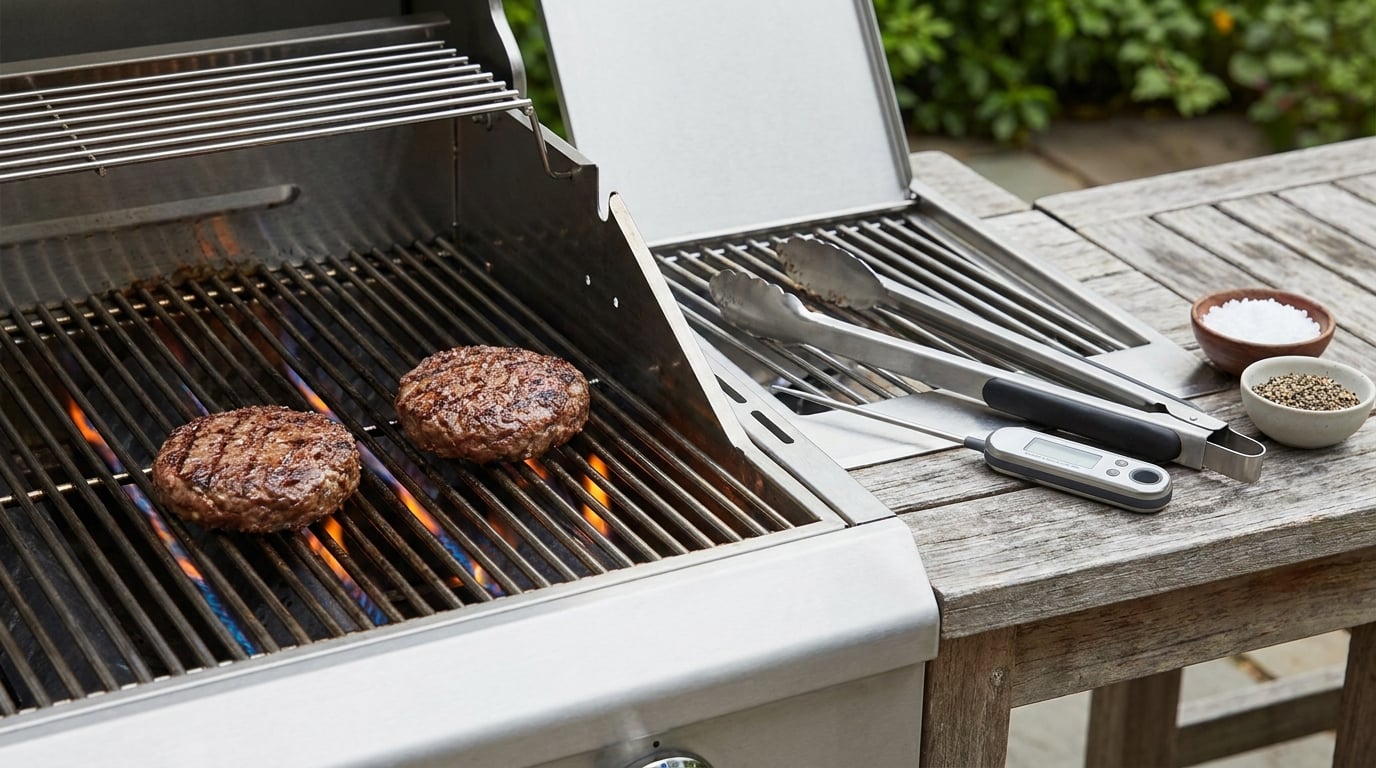
How long to cook burgers on a gas grill comes down to one number for most people: 3 to 6 minutes per side for a standard three-quarter-inch patty, or 6 to 12 minutes total, on a grill preheated to medium-high heat between 375°F and 450°F, flipped once. Patty thickness changes the clock more than anything else, so treat those numbers as a starting estimate and confirm doneness with an instant-read thermometer.
Most failed burgers are not failures of heat. They are failures of timing applied carelessly, a three-minute rule stretched across a patty twice as thick as the one the rule was written for.
Three variables decide how long a burger takes: how thick the patty is, how hot the grill actually is, and how much fat is in the meat. A lean 90/10 patty and an 80/20 patty of identical size can be three minutes apart on the same grate. Once you know which variable you are dealing with, the rest is a simple routine of preheat, one flip, and a temperature check.
Table of Contents
- What You Need
- Step-by-Step: How Long to Cook Burgers on a Gas Grill
- Common Mistakes
- Frequently Asked Questions
- How long should I cook a standard burger on a gas grill?
- How do I cook frozen burgers on a gas grill?
- How many times should I flip a burger on a gas grill?
- Should I close the grill lid while cooking burgers?
- When should I add cheese to a grilled burger?
- How do I stop my burgers from drying out on the grill?
- Conclusion
What You Need
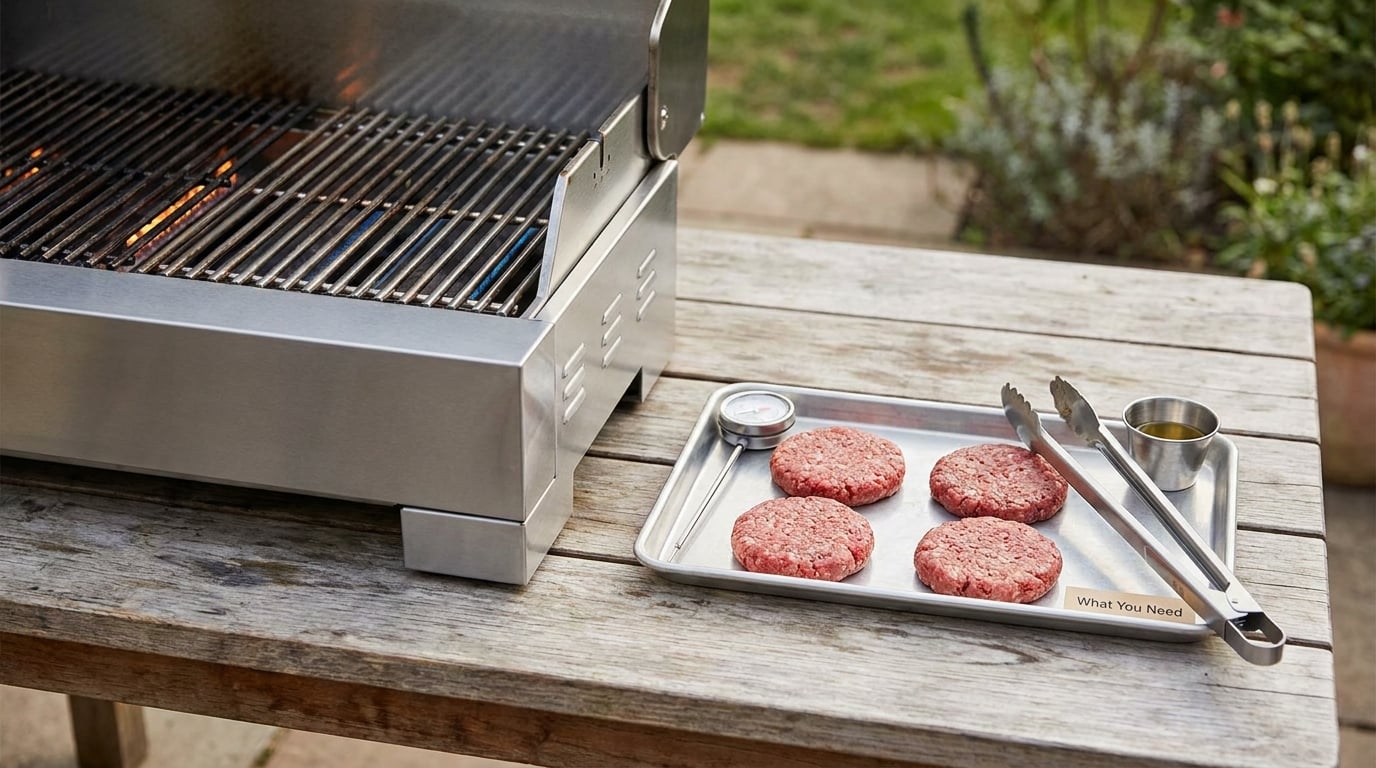
A gas grill with at least two burners, metal tongs, an instant-read thermometer, a clean plate for cooked patties, and a small tray or sheet of foil for the indirect zone. A wire rack set over that tray keeps the second side of the meat from steaming.
Keep a light oil on hand for the grates. Beef carries enough fat to season itself, but leaner blends and the first patty of the cook dry out and stick without a quick wipe.
The thermometer is the one tool worth insisting on. It is cheap, it takes two seconds, and it is the only thing standing between you and a grey patty you paid for. Cook time is an estimate; internal temperature is a fact.
Thickness matters more than any other variable. The heat has to travel from the surface to the center of the patty, and that distance is what sets the clock. A thin quarter-inch smash patty is heated almost entirely by the two seared faces. A one-inch patty spends most of its time conducting heat inward, and it will burn outside while the middle is still cold unless you move it off direct heat partway through.
Starting temperature matters too, and it is the one most people get wrong. A grill that has been preheating for a full 10 to 15 minutes behaves nothing like one that was just lit. Cold grates and an underheated firebox produce a pale, steamed patty with no crust at all, and then the cook reaches for longer cooking times to compensate. That is how dry burgers happen.
Step-by-Step: How Long to Cook Burgers on a Gas Grill
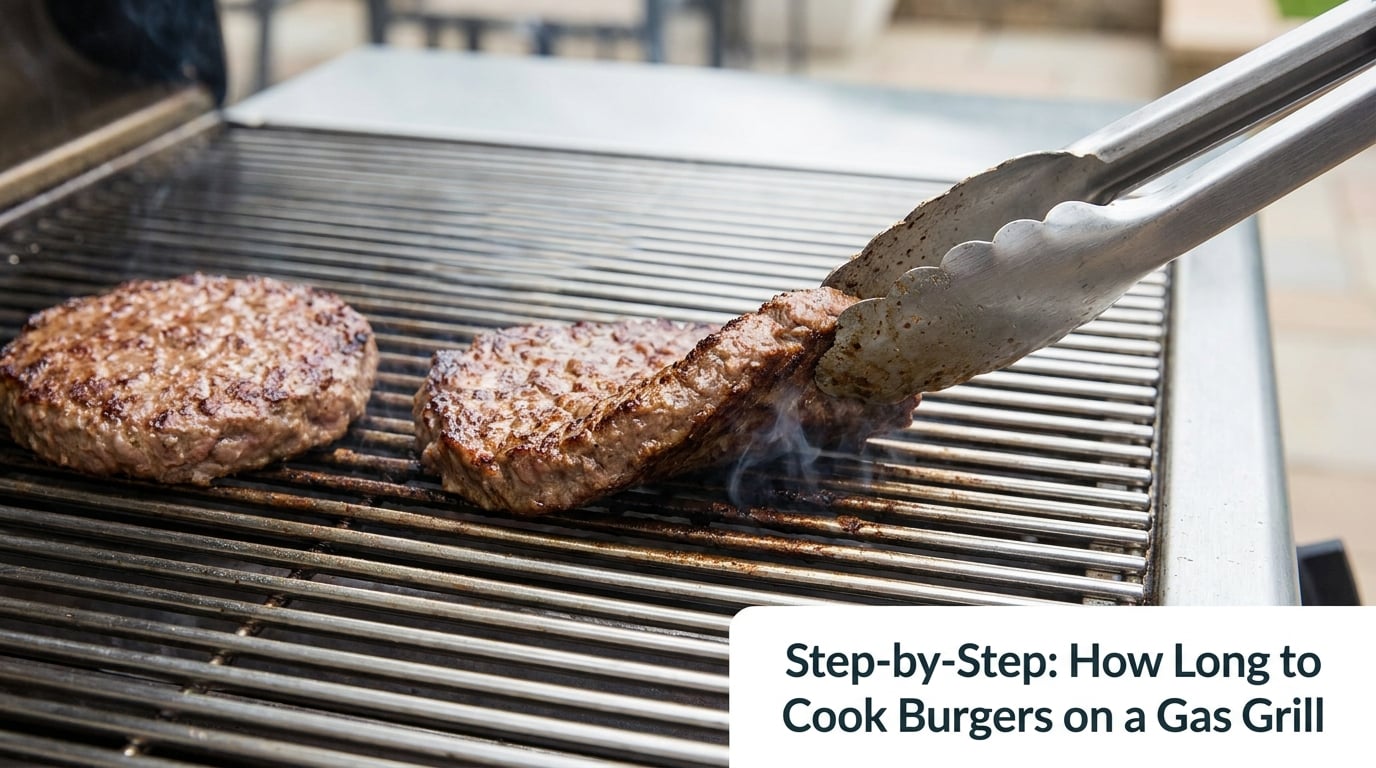
1. Preheat the Grill and Build Two Heat Zones
Preheat the grill for 10 to 15 minutes on high, then dial down to medium-high. Verify with a grill thermometer rather than trusting the lid indicator, which measures the air inside the lid and routinely reads 50 to 100 degrees off the surface you are actually cooking on.
Set up two zones before the patties go down. Leave one burner on medium-high under the far side of the grate for searing, and turn the other burner off or down to medium-low to create a cooler indirect area where thick patties can finish without their outsides catching.
If you are grilling a standard three-quarter-inch patty, you may never use the cool zone. If you are cooking anything an inch thick or more, you almost certainly will.
So which number should the dial actually read? Between 350°F and 450°F is the range that works for nearly every patty, and most people do best around 400°F. At 350°F the patty cooks gently and evenly with a modest crust, which suits a thick patty finishing on indirect heat. At 400°F you get browning fast enough to build flavor while the center still has time to catch up. Those are the two temperatures I use, and the difference between them barely matters as long as you are consistent.
Above that it gets faster and less forgiving. At 450°F a patty sears hard in about 3 minutes per side, and that is not too hot for a standard patty, but it leaves no margin. You need the patty to release from the grate on schedule, and a thinner or leaner patty will overcook before you get there. Reserve 450°F for confident, evenly sized patties and lean blends you want to move through quickly.
At 500°F a standard patty takes roughly 2 to 3 minutes per side. It works, and plenty of people run burgers that hot, but you are cooking with a much smaller buffer than any chart suggests. The fat renders fast, flare-ups are common, and the window between perfect and overcooked is measured in seconds. If you are new to gas grill burger timing, run 400°F and learn the rhythm first.
Grill temperature and internal temperature are different numbers answering different questions. The grill temperature decides how fast the outside browns. The internal temperature decides when the meat is done. Chasing the first with the second is why so many people cook burgers too long.
2. Prepare Burgers for Even Cooking
Form patties of even thickness, about four inches wide and no larger than eight ounces, and do not compress them. Loose meat cooks faster and holds more moisture. Pressing the patty tight squeezes out juice before it ever reaches the grill.
Make a shallow dimple in the center with a thumb. Without it, the patty domes as it cooks, the edges hit the grate first, and the center sits above the heat steaming in its own rising dome. A dimple keeps the flat contact that builds crust.
Press a small dimple into the raw patty, not a deep one. You are flattening the top, not making a bowl.
Season with salt and pepper right before the patties go on. Salting too early draws moisture out of the surface and the patties lose their ability to sear.
Wipe the grates with an oiled paper towel, then lay the patties down away from you. Leave space between them. Patties crowded together share drippings and steam instead of searing, and the ones in the middle cook slower than the ones on the edge.
3. Sear, Turn, and Move: How Long Per Side?
Leave the first side alone. Resist the urge to lift a corner and peek, every peek drops the surface temperature and costs you crust.
- Thin smash, 1/4 inch: 60 to 90 seconds on the first side, 60 to 90 seconds on the second, 2 to 3 minutes total.
- Standard, 1/2 inch: 2 to 3 minutes a side, 4 to 6 minutes total.
- Standard, 3/4 inch: 3 to 5 minutes a side, 6 to 10 minutes total.
- Thick, 1 inch and up: 4 to 5 minutes on the first side, then 4 to 6 minutes on the second side over indirect heat, 8 to 12 minutes total.
- Frozen, 1/3 pound: 6 minutes a side, about 12 minutes total.
These are start times for a grill running at 375°F to 450°F. Frozen patties need roughly double the per-side time of fresh ones, which is why a frozen patty that seems like a shortcut ends up drier. The ice has to cook off before the meat does.
Flip once, when the first side is well browned and no longer releases freely. If it sticks, it needs another 30 to 60 seconds, not more force. Tearing a patty means the crust has not set yet.
After the flip, thick patties move to the indirect zone for their second side. The outside keeps its sear while the center finishes without the edges burning. Close the lid for that leg, since a closed grill keeps a steadier, more even temperature than open air.
Thickness is the piece almost every guide skips, and it is the one that decides whether you end up with a juicy burger or a grey one. The same six minutes that produces a perfect three-quarter-inch patty leaves a one-inch patty raw in the middle and turns a quarter-inch patty into a cracker.
The shorthand you may have seen, often called the 5-6-7 rule, gives about 5 minutes per side for medium, 6 for medium-well, and 7 for well-done. Treat it as a starting point and nothing more. It assumes a specific patty thickness, a specific grill temperature, and a single flip with the lid open the whole time. Change any one of those and the numbers slide, which is why a rule that feels precise on paper can leave you ten minutes into a cook with a raw center.
There is a place for it, though. As a memory device for a standard three-quarter-inch patty on a grill you already know runs 400°F, it is genuinely useful. As your only reference on a grill you have never used, or for a patty you just formed yourself, it is not. The thickness list above is the same information with the assumptions written down.
Want a doneness target to aim at while you cook? Here is the tier most home cooks actually want.
- Medium-rare: finished at 130°F to 135°F / 54°C to 57°C, so pull it off the grill at 125°F to 130°F. Very juicy, and not for children or pregnancy.
- Medium: finished at 140°F to 145°F / 60°C to 63°C, so pull it at 135°F to 140°F. Juicy with a hint of pink.
- Medium-well: finished at 150°F to 155°F / 65°C to 68°C, so pull it at 145°F to 150°F. Firm, with a trace of pink.
- Well-done: 160°F / 71°C and up, and pull it at 160°F. Dry, no pink, safest for everyone.
Resting counts as carryover cooking. Meat keeps climbing after it leaves the heat, so pulling a patty at 145°F lands at medium when it reaches the plate.
4. Check Temperature and Rest
Push the probe into the thickest part of the patty, from the side, aiming for the center without touching the grate. Temperature read through the side gives you the truest number. Do not cut the patty open to look; that drains the juice you spent the whole cook protecting.
The USDA safe minimum internal temperature for ground beef is 160°F, or 71°C. That is the food-safety floor, not a quality target. Many home cooks eat burgers medium and are perfectly fine doing so, and for most people the pink center is the whole point. Anyone pregnant, anyone immunocompromised, anyone cooking for young children or an elderly relative, and anyone who is simply not comfortable with pink meat should cook to 160°F without hesitation.
That confusion is worth naming plainly. 160°F is not the same as well-done. A 160°F burger is at the safe end of what the guidelines permit, and taking it past that is where dry texture comes from. Shoot for 160°F if safety is the priority, and 145°F if it is not.
Rest the patties on a warm plate for 3 to 5 minutes before topping and serving. That short pause lets the juices settle back into the meat instead of running out onto the cutting board.
Add cheese in the final 30 to 60 seconds with the lid closed, so the melt comes from trapped heat rather than direct radiant heat. Cheese added early slides off and dries at the edges before the patty finishes cooking.
Common Mistakes
Patties going on a grill that was not fully preheated. This is the single biggest cause of pale, steamed, dry burgers. A grate that has not reached temperature has no searing power to spare, so the patty slowly cooks instead of searing, and only lengthening the cook fixes it. Give the grill a full 10 to 15 minutes and check with a thermometer.
Pressing down with a spatula. Every press squeezes juice out of the patty onto the coals. Use the spatula to lift and turn, never to squeeze.
Skipping the dimple. The patty domes, the edges cook, the center sits in steam. One thumbprint fixes it.
Patties sticking and tearing apart. Sticking means the crust has not formed yet. Give it another 30 to 60 seconds, and oil the grates before the cook rather than during it.
Salting early. Salt applied 20 minutes or more ahead draws surface moisture and prevents a good sear. Season right before the patties hit the grate.
Cutting the patty to check it. You lose the juice and then wonder why it tastes dry. Use a thermometer or a firm touch instead.
Overcooking by fear. The 160°F safety number gets treated as a flavor target by a lot of people, and the patty sits on the grate long after it is done. Aim, check, and pull.
A few more things that change results:
Batch cooking for a group means cooking in small groups rather than one large one. Patties cooked in a single crowded batch take longer, cook unevenly, and steam each other. Six patties at a time, twice, beats twelve patties at once every time. Have the next batch seasoned and waiting on a tray, and start it as the first batch comes off.
The opposite approach also works well for a crowd, and it is the one regulars reach for. Set both burners to medium-low, shut the lid, and cook at roughly 275°F until the patties read 150°F to 155°F internally. Take them off, and the temperature keeps climbing to 160°F while they rest. The cook takes longer and the crust is gentler, but the patties come out noticeably juicier because nothing was seared hard.
Use it for thick patties and for anyone cooking more than a dozen at a time. For a quick weeknight cook, the direct two-zone method is faster and gives a better crust.
Keep the cooler zone running the whole cook. Thick patties start there if the direct side is running hot, and the zone doubles as a landing spot for anything that needs another minute.
Watch for flare-ups. Dripping fat ignites, and the burst of flame scorches the bottom of a patty. Move the patty to the other zone until the coals settle, and let the fat render back into the meat instead of burning off.
Add toppings that benefit from residual heat. Onions and pickles can go during the last minute of the rest. Lettuce and tomato go on after, right before serving, so they stay crisp.
For turkey and bison patties, expect a shorter cook than the list suggests. Both are lean, and both hit 160°F quickly, which is why the thermometer matters even more with them.
Frequently Asked Questions
How long should I cook a standard burger on a gas grill?
A standard three-quarter-inch patty takes 3 to 5 minutes per side, 6 to 10 minutes total, on a gas grill preheated to 375°F to 450°F. Flip once, and check the internal temperature in the thickest part with an instant-read thermometer. If you are learning how long to cook burgers on a gas grill, run the first patty a minute under the time on the chart and pull it early, since carryover cooking keeps raising the temperature after the patty leaves the grate.
How do I cook frozen burgers on a gas grill?
Cook frozen patties from frozen with no thawing. They need roughly double the per-side time, so allow about 6 minutes on the first side and 6 on the second, and they cook best on direct heat because they render less fat of their own. Salt them right before they go on, since the surface needs to be dry to sear. Check temperature early, because the frozen center is hard to read and easy to overshoot.
How many times should I flip a burger on a gas grill?
Once. A single flip gives you a seared crust on both sides without repeatedly dropping the surface temperature. Flipping every minute slows the cook and produces a pale, mottled patty instead of a clean browning. If the first side is not releasing from the grate after 3 to 4 minutes on a three-quarter-inch patty, wait another 30 to 60 seconds. It is not stuck yet, the crust simply has not set.
Should I close the grill lid while cooking burgers?
Open for the first side, closed for the second. The open lid gives you direct radiant heat for searing and crust development. Closing the lid for the second side stabilizes the temperature and cooks the patty more evenly, which is especially useful for thick patties finishing on indirect heat. It is also how you melt cheese properly, with 30 to 60 seconds of closed lid right before you take the patty off.
When should I add cheese to a grilled burger?
In the last 30 to 60 seconds, with the lid closed. The cheese melts from the trapped heat and the residual warmth of the patty rather than from direct flame, which keeps it from burning at the edges or sliding off. Thin slices like provolone melt fastest and can go on right as you flip. Thicker slices like cheddar usually need the full 60 seconds. Set the patties on a warm plate after so the cheese stays soft while the burgers rest.
How do I stop my burgers from drying out on the grill?
Keep the fat and the cook short. Use 80/20 ground beef, handle the meat as little as possible so you do not squeeze out juice, and cook only to 145°F if you are comfortable with a pink center, since 160°F is the USDA safe minimum for ground beef rather than a flavor target. Dimple the patty, flip once, never press, and rest the cooked patties 3 to 5 minutes so the juices settle back in.
Conclusion
Start by preheating a two-zone gas grill for a full 10 to 15 minutes and verifying it with a thermometer. Use the timing list as a starting estimate for your patty’s thickness, flip once, and let the instant-read thermometer make the final call. That single habit, pulling the patty at the temperature you actually want instead of the time you hope works, is the difference between a juicy burger and a dry one every single cook.