
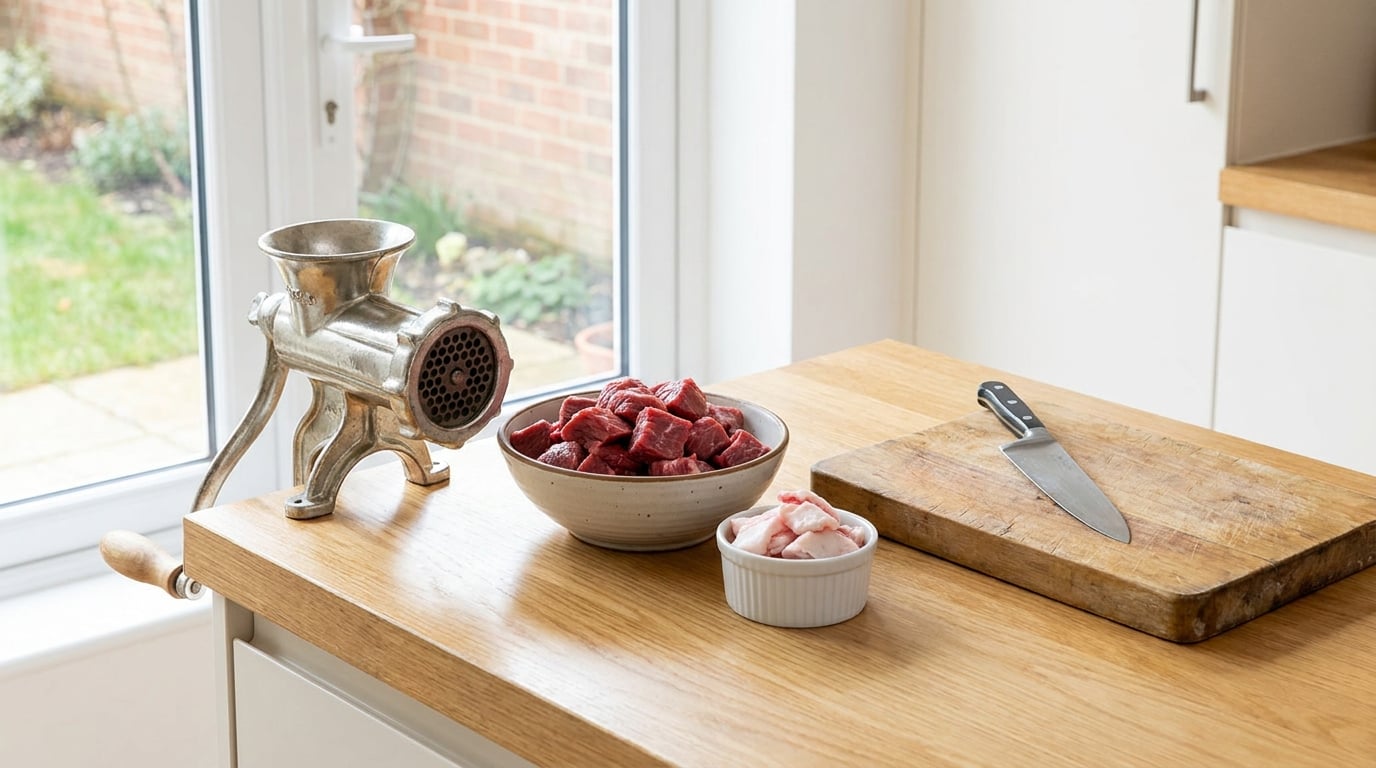
Grinding your own beef for burgers takes about 30 minutes of hands-on work and one afternoon of your time. You trim cold chuck, brisket, sirloin or short rib, cut it into strips that fit the grinder, and run it through a coarse plate for fresh ground beef with a fat ratio you picked yourself. The rule that matters more than any other: keep the meat cold from the counter to the bowl.
The three failures I see over and over are warm meat, a lean cut, and a fine plate used for burgers. Fix those and home-ground patties beat anything in a foam tray. This guide walks through the whole process, and it also covers how to grind your own beef for burgers at home when you do not own a grinder. Last checked for 2026.
Table of Contents
- What You Need
- Step-by-Step
- Common Mistakes
- Frequently Asked Questions
- What is the best beef cut for grinding at home?
- How much fat should ground beef have for burgers?
- Should I freeze beef before putting it through a grinder?
- What grinder setting is best for homemade burgers?
- Can I use a food processor instead of a meat grinder?
- How long can I keep beef that I grind at home?
- Conclusion
What You Need
The equipment list is short, and only one item is genuinely required: a meat grinder. Everything else is stuff you probably already own. Budget an hour the first time you set up, because the first grind is always slower than the tenth.
- A grinder. A hand-crank manual grinder costs the least, needs no outlet, and handles a pound or two at a time. A stand-mixer attachment grinds faster and takes less arm work, but you are tied to the mixer’s bowl and speed. An electric grinder is the fastest and easiest, and it is the only one of the three that handles a large cookout batch without a break.
- Two plates. A coarse plate with roughly 3/8 inch holes for the first pass and a finer 1/4 inch plate for a second, even grind. Manual grinders often include both. If you only have one plate, keep the coarse one and run it twice.
- Sharp knife and a large cutting board. You will be cutting silver skin and cartilage off more meat than you expect.
- A cold bowl. Wide and shallow works best, and it helps to have two so you can grind in batches while the first batch chills.
- Freezer space. Enough to lay chunks of beef flat and freeze them solid before grinding.
- Paper towels or newspaper. A grinder throws blood and fat droplets across the counter and sometimes the wall.
- Optional: a kitchen scale. If you want to know your actual fat percentage instead of guessing, a cheap scale is how you do it.
- Salt and black pepper. That is what most people at the grill table want mixed in. Heavy sauces and premixed burger seasoning are a different conversation, and a popular one.
On the meat, aim for roughly 20% to 25% fat for juicy burgers. Chuck usually lands near 15% to 20% on its own, so many people add a little extra fat or mix in a fattier cut. If your grind is going to be leaner than that, expect a drier patty no matter how well you grind it.
Step-by-Step
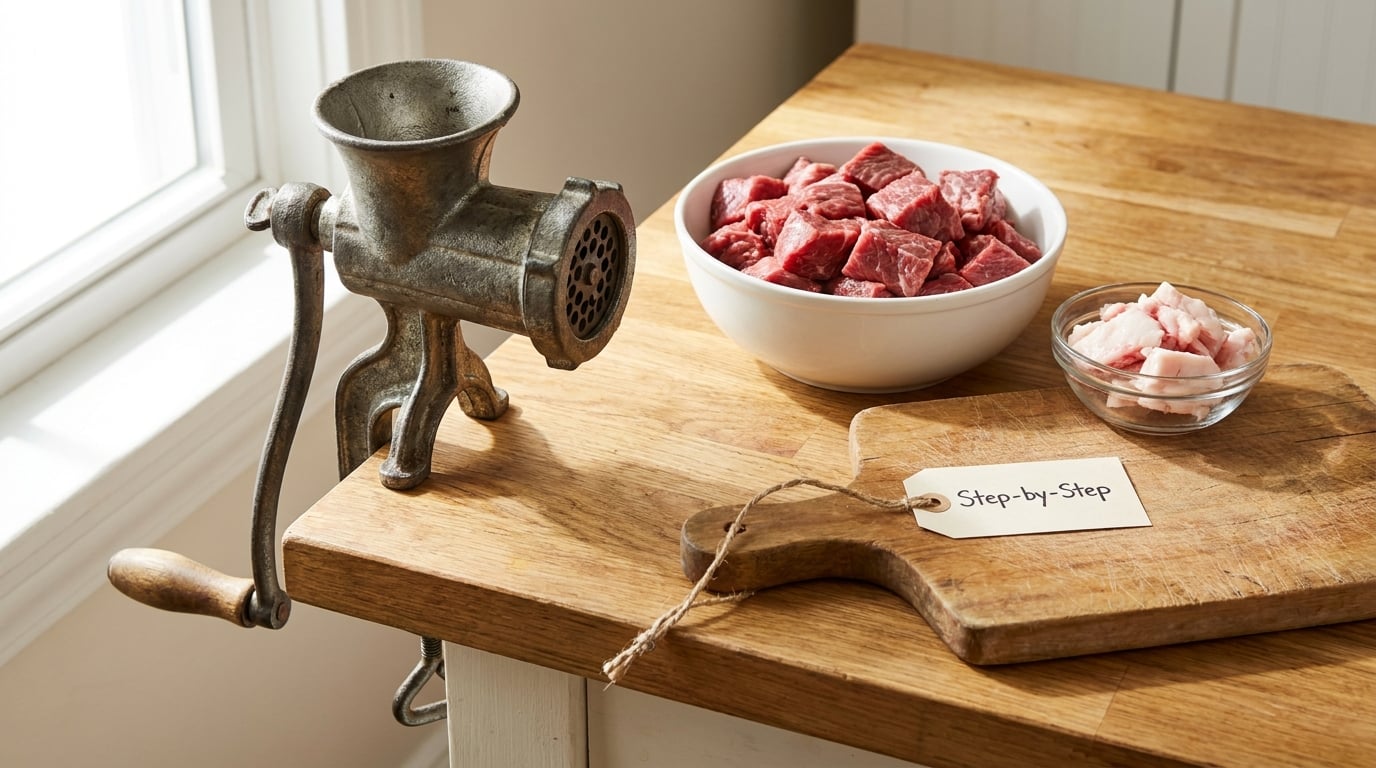
Here is the whole method in order: chill the meat, trim it, cut it into strips that fit the throat, freeze it until firm, grind it cold through a coarse plate, mix the fat back through by hand while it is still cold, form loose patties, and cook them to a safe internal temperature. The order matters more than the equipment.
How to choose and trim the beef
Chuck is the workhorse. It carries enough fat and enough connective tissue to stay juicy, and it is usually the cheapest cut per pound that still grinds into good burger meat. Brisket is richer and more flavorful, sirloin is leaner and cheaper, and short rib brings a lot of marbled flavor for very little money. What meat to grind for burgers comes down to how much fat you want and what you are paying.
| Cut | Typical fat | What it brings | Best for |
|---|---|---|---|
| Chuck roast or chuck roll | 15-20% | Balanced fat and flavor, stays juicy | The everyday all-purpose burger |
| Brisket (flat or point) | 20% and up | Deep beefy flavor, fattier | Rich burgers and chili |
| Sirloin | 10-12% | Lean, mild, quick to grind | Blended with chuck or brisket |
| Boneless short rib | 20-30% | Marbled, very rich | Premium blends, no more than a third |
| Top round | 10-12% | Lean and a little springy | Cheaper blends, bulks out fat |
| Eye of round | 8-10% | Very lean, best used sparingly | Stretching a chuck blend, not leading it |
Trim the meat while it is still cold and still on the cutting board, not after it warms up. Pull off the silver skin, the loose outer membrane, any cartilage, and large veins. Those are the bits that make a home-ground burger turn to leather when someone bites into it.
Leave the fat that runs between the muscles. That intramuscular fat is what makes the patty taste like beef instead of like a beef-flavoured sponge. The trimmed fat you pull off the outside is a different story, and it is worth saving in a separate bowl rather than throwing it away, because you may want to grind it back in to hit your target percentage.
How to set up the grinder for burger meat
Work on a tray or sheet pan lined with paper towels, and put a cold bowl under the output. Chilling the metal parts matters more than most people expect. If the plate and the auger come out of a warm cupboard, they will warm the meat within a few pounds, and warm meat smears instead of grinding cleanly.
Assemble the grinder per the manufacturer’s instructions, fit the coarse plate, and run a piece of stale bread or a couple of carrots through it. That clears out any manufacturing residue or loose plastic from the packaging, and it is a habit worth keeping for every session.
The plate decides the texture, and the hole size is the whole story:
| Plate | Hole size | Resulting texture | Best use |
|---|---|---|---|
| Coarse | about 3/8 inch | Craggy, aerated, loose strands | Burgers and smash burgers |
| Medium | about 1/4 inch | Even, still visibly textured | All-purpose burger meat |
| Fine | about 1/8 inch | Smooth and paste-like | Sausage, meatloaf, meat sauce |
For burgers you want the coarse or medium plate. A fine plate turns beef into something closer to sausage meat, and that is exactly the wrong direction for a patty you want to grill.
Cut the trimmed beef into strips roughly one inch thick and as long as your grinder throat is deep, so they feed straight through without you pushing. Long strips need much less knife work than cubes, which is a small trick that saves real time when you are doing five pounds.
Then chill the strips. Spread them on a tray, freeze them until firm and slightly solid, usually 20 to 30 minutes, and grind while they are still hard. Meat that is cold enough to snap but not so frozen that it is rock solid grinds fastest and smears least.
How to grind the beef evenly
Feed the meat in steadily. Keep the feed tube clear, never reach in with your fingers while the auger is turning, and let the grinder pull the meat rather than shoving it. If you have to force it, something is wrong: the strips are too wide, the plate is too fine, or the meat has warmed up.
Ground beef should come out as loose, distinct strands, not a paste. Watch for two signs that the meat is getting warm: the strands start sticking to the plate, and the fat begins to smear into the lean instead of staying in visible pieces. Both mean stop, spread the meat back on the tray, and chill it again.
One pass through the coarse plate is genuinely enough for burgers, and that is what many experienced grinders recommend. A second pass is optional, and when you do it, use the same plate. The advice that circulates on grilling forums is worth repeating: sizing down to a finer plate for the second grind can make the texture worse, not better, because it smears the fat into the lean.
If you do want a finer, more uniform result, run the same coarse plate twice, spreading the meat out on a tray between passes so it stays cold. If you are grinding for chili or a meat sauce, grind coarse on purpose. There is no benefit to a fine grind for anything that simmers.
How to season and form burger patties
Mix the ground beef with your hands while it is still cold, and touch it as little as possible. Overworking ground beef is the single most common reason home patties turn into dense hockey pucks that are hard to chew and dry out fast. You are distributing fat, not kneading dough.
Light seasoning goes in the meat: salt and coarse ground black pepper, worked in gently, maybe a little garlic powder. Many experienced burger people salt the outside of the patty right before it hits the grill instead, which keeps the inside juicy and gives you a better crust. Both approaches work. Mixing in a lot of Worcestershire or a bottled burger blend is a matter of taste, and plenty of people find it overpowering.
Divide the beef into loose balls, then press each one into a patty just wide enough to cover the bun. Press gently. A tightly packed patty shrinks on the grill, so leave a little room. For a thick restaurant-style burger, press a shallow indentation into the centre of each one; that stops the middle from cooking through before the edges are done.
Rest the formed patties in the fridge for 20 to 30 minutes before cooking, loosely covered. Cold, slightly firmed patties hold their shape better and lose less moisture on the grill than patties that go straight from the bowl to the heat.
How to store ground beef safely
Treat your ground beef the same as any store-bought ground beef, because once it is ground it is a perishable, surface-contaminated product. Refrigerate it promptly, no more than about two hours at room temperature, and use it within one to two days of grinding.
For longer storage, press out the air and freeze in flat one-pound bags or in a vacuum sealer, which stops the ground beef from freezer-burning and lets you break off exactly what you need. Label each bag with the date and the blend. Ground beef keeps well frozen for three to four months, and it loses quality noticeably after that.
Thaw it in the refrigerator, on a plate set in the sink, or in cold water. Thawing on the counter is the one shortcut not worth taking. When you grind a large batch, portioning it into meal-sized bags on the same afternoon is the difference between a Tuesday night cook and a freezer archaeology project.
How to cook self-ground burgers
Your grind changes how you cook it. A coarse grind with 20% fat has open texture and renders fat as it cooks, which is what gives you a browned, crusty exterior and a juicy centre. A fine grind behaves more like a thick sausage patty and wants gentler heat.
Do not press the patties down with a spatula. Let the crust build, and only flip once you can see the juices running clear on the surface. Whether to add a second sear depends on the fat you used. Lean blends benefit from a hotter, faster finish.
Ground beef needs to reach 160°F (71°C) internal temperature for safety, measured at the thickest part with an instant-read thermometer. Cooking it to that temperature is the standard guidance for food safety, no matter how well you know the animal the meat came from.
Method is a matter of what you own. A skillet or griddle over medium-high heat takes three to four minutes a side. A grill works the same way over direct heat with the lid closed. For a cookout of twenty or more, a sheet pan at 425°F (220°C) will cook a whole tray at once, usually 15 to 20 minutes, and gives every patty the same treatment.
Common Mistakes
Almost every disappointing home-ground burger traces back to one of these. Each has a simple fix.
Working with warm meat. This is the number one cause of smearing, a dull finish, and a texture that feels pasty instead of ground. Meat that has been on the counter for 30 minutes, or meat that warms up in the auger, loses its ability to break apart cleanly. Chill the meat, chill the grinder, and if the strands start sticking mid-session, stop and put everything back in the freezer for 10 minutes.
Grinding too fine. A fine plate produces a paste that compacts into a dense patty. For burgers, use the coarse or medium plate and consider stopping after one pass. Reserve the fine plate for sausage and meat sauce.
Using a lean cut. Round and eye of round alone make dry burgers. They are useful as part of a blend that brings the fat percentage up, not as the whole batch. If your patties shrink and taste tough, lean meat is the first thing to check.
Sizing down the plate for a second grind. The second pass through a finer plate is a common habit and a common mistake. Use the same plate for both passes if you grind twice, and spread the meat back out cold in between.
Overworking the patties. Compacting the beef too tightly when you shape it squeezes out air and pushes out fat during cooking. Shape loosely with a light hand, and leave the patties a little wider than the bun.
Forcing the meat through the throat. If you have to push, the strips are too big or the plate is too fine. Cut strips that fit the throat lengthwise and let the auger do the work. Never put a hand or utensil near the feed tube while it is running.
Cooking too hard. High heat is useful for the crust, not for cooking the patty all the way through. A moderate cook, flipped once, gives you an even result without squeezing the juices out.
Skipping the cleanup. Raw beef travels through the plate, the auger, and the feed tube, and those surfaces need proper attention. Take the grinder apart fully after each use, wash every removable part with hot soapy water, rinse, and let them air-dry. Wipe the motor housing with a damp cloth and sanitize the counter, bowl and cutting board that touched raw beef. Never run water into a motor unit. Once it is clean and dry, many people store the parts in the fridge in a covered container, which is a better habit than leaving them out for a week.
Two more habits worth adopting. Buy your meat from a butcher who will let you watch it being cut, and ask for a chuck roll specifically, since it is harder to find than a whole chuck roast. And buy more than you think you need. Leftover ground beef is chili, meatloaf, meat sauce, or meatballs, which is the easiest argument for grinding a full three pounds at once.
If you do not own a grinder, there are workarounds. A blender works if you use the pulse function and short bursts rather than running it continuously, and you freeze the meat in advance so it is solid enough not to turn to puree. A food processor is the same idea: use the pulse button, work in short bursts, and stop before it becomes a paste. A clean meat cleaver with a rocking motion on a flat surface, or a knife-chop followed by a rolling pin, gives you coarse hand-ground beef for chili and meat sauce, but nothing as even as a grinder. Past a certain point, though, the honest answer is that a hand-crank grinder costs less than most people expect and lasts for years.
Frequently Asked Questions
What is the best beef cut for grinding at home?
Chuck is the best starting point for most people, usually running 15-20% fat with a lot of flavor and a fair price. Brisket is richer and more beefy, short rib is very fatty and inexpensive, and sirloin and round are lean and best blended with something fattier. Aim for a total blend near 20-25% fat for juicy burgers.
How much fat should ground beef have for burgers?
Roughly 20% to 25% fat, which is a ratio some cooks call 80/20 or 75/25. Chuck alone often lands closer to 15-20%, so save the trimmed fat or add brisket or short rib until you hit the target. You can work it out exactly with a cheap scale: weigh the lean and the fat separately before you mix them.
Should I freeze beef before putting it through a grinder?
Yes, chill it at minimum and freeze it briefly for the best results. Partly frozen meat is firm enough to grind cleanly and stays cold through the auger, which prevents smearing. About 20 to 30 minutes in the freezer after cutting the meat into strips is usually enough. Meat that is rock solid is harder to feed through the throat.
What grinder setting is best for homemade burgers?
The coarse plate, which is about 3/8 inch holes, or the medium plate at about 1/4 inch. A fine plate makes texture too smooth and pasty, closer to sausage meat than to a burger. One pass through the coarse plate is enough. If you grind twice, use the same plate for the second pass, since switching to a finer plate can smear the fat and hurt the texture.
Can I use a food processor instead of a meat grinder?
Yes, with a light touch. Cut the beef into small pieces, partly freeze them, then use short pulses rather than running the motor continuously. Stop as soon as the texture looks like coarse ground meat, because a few extra seconds turns it into puree. A blender works the same way, and a sharp rocking cleaver plus a rolling pin is a good last resort for chili and meat sauce.
How long can I keep beef that I grind at home?
Refrigerate it promptly and cook it within one to two days, the same window you would use for store-bought ground beef. For longer storage, press out the air and freeze it in flat one-pound bags or a vacuum sealer, where it keeps well for three to four months. Label and date each bag, and thaw it in the refrigerator rather than on the counter.
Conclusion
Start with a small batch: a chuck roast, trimmed of silver skin and cartilage, cut into strips, chilled for half an hour, and run once through the coarse plate. Check the fat level with your fingers, or weigh it, and adjust the blend on the next batch. Form the patties loosely, chill them, and cook them to 160°F (71°C) without pressing them down.
Once you have done it twice, the whole job takes less time than the drive to the butcher. What you get is a burger you built from the fat percentage up, and that is not something a foam tray can offer.