
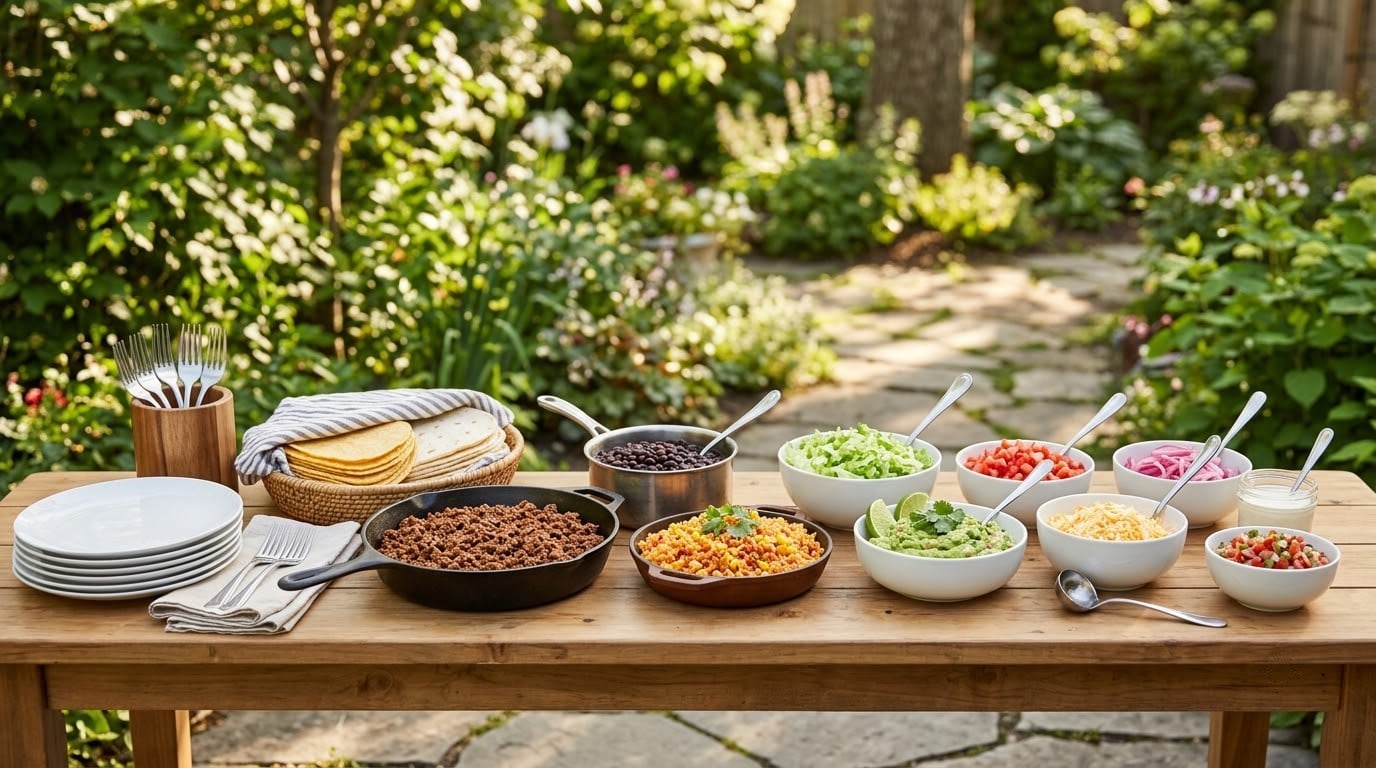
A taco bar works because it turns serving a crowd into an assembly line: warm protein, tortillas and fresh toppings laid out in order, and every guest builds what they want. To set up a taco bar that runs smoothly, plan quantities before you shop, arrange the table in one direction, and hold hot food above 140°F (60°C) and cold toppings below 40°F (4°C). Most hosts spend about 45 minutes on setup the day of, plus two hours of cooking the day before.
What You Need is the part everyone underestimates. The list below works for a Tuesday family dinner with 10 people or a backyard party with 100, and the same math scales either way.
What You Need
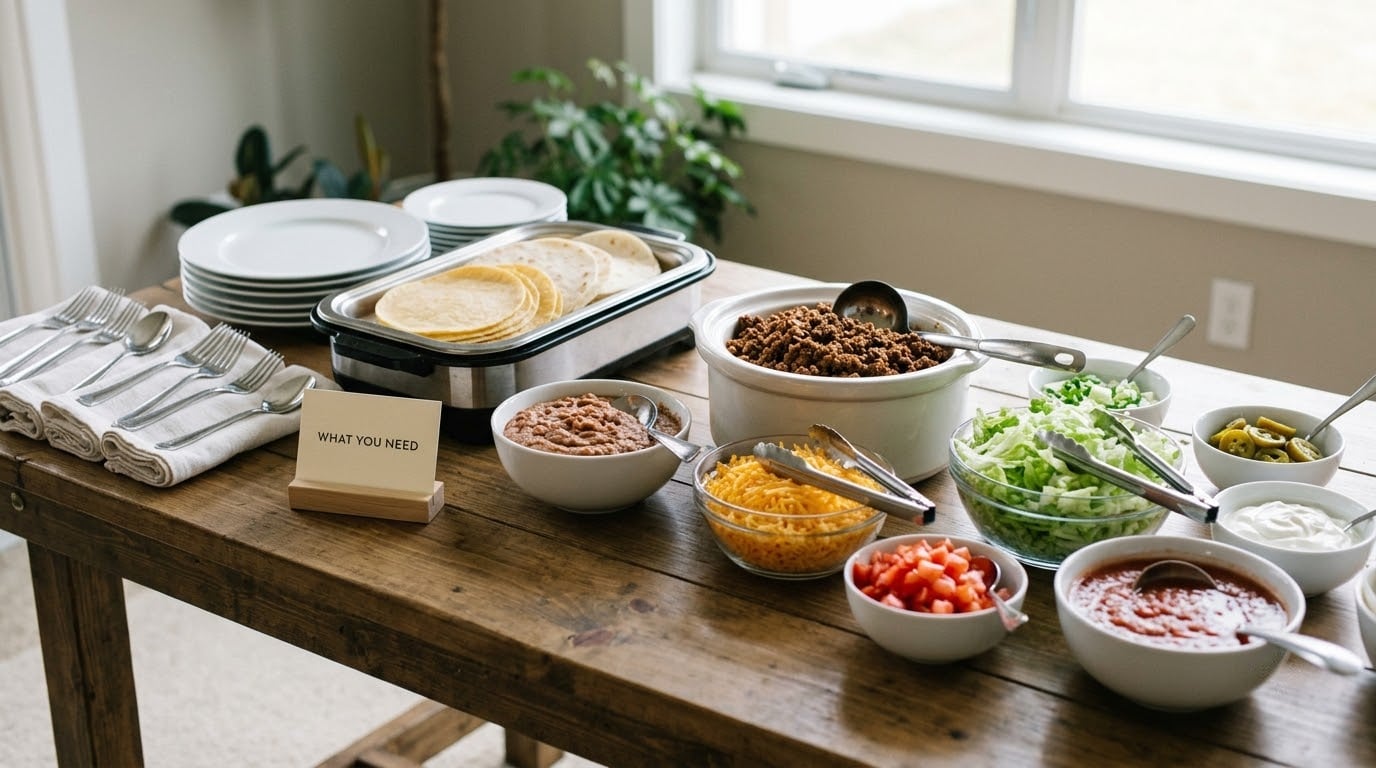
Start with food in five groups: bases, proteins, hot sides, cold toppings and condiments. Two or three proteins is plenty, because guests taste everything and a crowded tray slows the line.
| Item | Per adult | Per child (about 10) | What it covers |
|---|---|---|---|
| Corn or flour tortillas | 3-4 | 2-3 | Bases, plus a few extra for the inevitable dropped taco |
| Cooked protein | 4-6 oz (115-170 g) | 3 oz (85 g) | Roughly 1/4 lb per person, split across your proteins |
| Refried or black beans | 1/2 cup (120 g) | 1/3 cup (80 g) | Cheapest filling, and the one people take twice |
| Mexican rice | 1/3 cup (80 g) | 1/4 cup (60 g) | Scoopable side, holds heat well |
| Shredded cheese | 1/4 cup (28 g) | 2 tbsp (14 g) | Cotija or a Mexican blend |
| Shredded lettuce | 1 cup loosely packed | 3/4 cup | Buy iceberg or romaine, not soft-leaf |
| Diced tomato | 1/3 cup | 1/4 cup | Plus onion and jalapenos |
| Salsa | 1/4 cup (60 g) | 2 tbsp (30 g) | One mild, one hot, one verde if you like |
| Sour cream | 2 tbsp (30 g) | 1 tbsp (15 g) | Plus queso or crema |
| Guacamole | 2 tbsp (30 g) | 1 tbsp (15 g) | Browns fast, so keep it in a bowl over ice |
| Tortilla chips | 1/2 cup (40 g) | 1/3 cup | For scooping salsa and beans |
| Plates and napkins | 1.5 each | 1.5 each | Round up; nobody takes just one |
Add 10% to those numbers before you shop. If you are expecting 20 people, buy for 22, and if your crowd is mostly teenagers or adults drinking, push the tortilla count up instead of the protein.
On the equipment side you need serving pans with lids, a spoon or tongs for every single dish (one utensil per tray, no sharing), a cutting board and knife, small bowls for toppings, label cards or a marker on tape, a trash can and a compost or recycling bin within a few steps, and the warming gear listed in step 2. If a tray does not have its own spoon, guests will use their hands or the wrong one, and that is how a vegetarian tray gets contaminated.
How to Set Up a Taco Bar Step by Step
1. How to Set Up a Taco Bar Layout
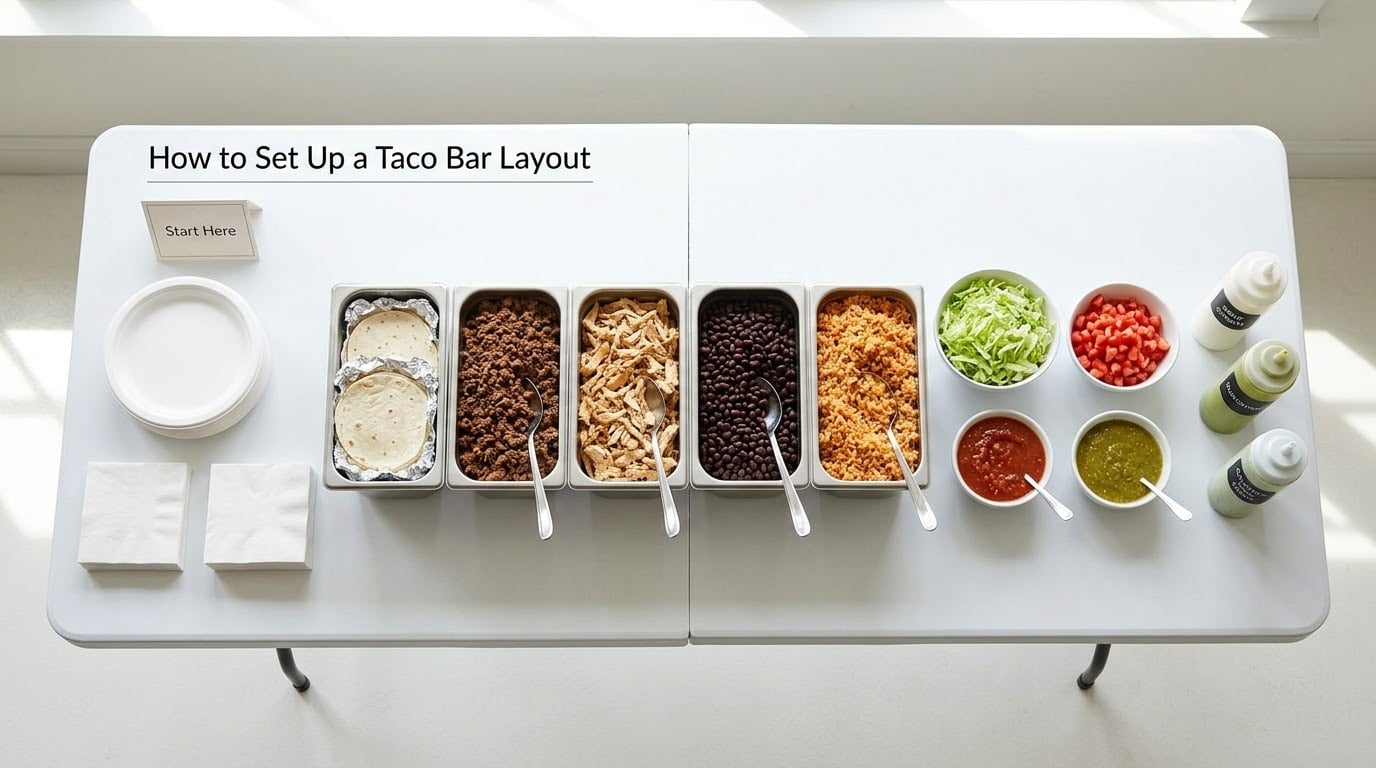
Budget about 2 feet (60 cm) of table per 10 guests, and start at the end nearest the kitchen so you can restock without crossing the line. One long table works up to about 40 guests; past that, or if you have more than one, split it into a taco station plus a separate sides, drinks and dessert table.
Build the table in assembly order, left to right, and it works like this:
- Plates, napkins and forks at the very start
- Tortillas next, still wrapped in a clean towel or foil
- Hot proteins in warming pans
- Beans and rice
- Cold toppings in bowls, lettuce and tomato first since they go on nearly every taco
- Cheese, then salsas and dips
- Sour cream, hot sauce, lime wedges and cilantro at the far end
- Drinks and trash off the main table so the line does not back up
If you can serve from both sides, do. Two-sided service doubles the number of guests who can reach a tray at once and is the single fastest way to fix a bottleneck at the protein. Leave about 2 feet (60 cm) of walking room behind the table so people taking photos are not shoved aside.
2. Choose the Main Fillings
Two or three proteins work best: one crowd-pleaser, one with more character, and one substantial vegetarian option that could stand alone as a taco. Common pairings are seasoned ground beef with carnitas, or shredded chicken tinga alongside carne asada. Guests notice a bar with two real choices more than one with six.
Make the vegetarian option a protein, not a side. Shredded jackfruit, seitan, mushrooms cooked down until they taste like meat, or a second bean dish all work, and a real vegetarian filling is what gets eaten at a kid party.
| Food | Cook to (USDA minimum) |
|---|---|
| Ground beef or pork | 160°F (71°C) |
| Chicken, turkey or any poultry | 165°F (74°C) |
| Whole cuts of beef, pork or lamb | 145°F (63°C) with a 3-minute rest |
| Fish and shrimp | 145°F (63°C) |
| Reheated leftovers | 165°F (74°C) |
Then hold it. Food safety guidance from the USDA says hot food should stay at 140°F (60°C) or above, and cold toppings at 40°F (4°C) or below. Get there with the right gear:
| Guests | Warming gear | Cold holding |
|---|---|---|
| Up to 15 | 1 small slow cooker on warm, or 1 pan of hot water on the stove in a tray | 1 small tray with a few ice packs under the bowl |
| 15-30 | 2 slow cookers on warm, or 1 round chafing dish | 1 full sheet pan of ice with bowls set into it |
| 30-60 | 3-4 warming pans or 2 chafing dishes | 2 sheet pans, replenished as they frost over |
| 60-100 | 4-5 chafing dishes | 3 sheet pans of ice plus a backup bowl in the cooler |
A round chafing dish holds roughly 10 to 15 pounds (4.5-7 kg) of cooked meat, so one dish comfortably feeds about 25 to 30 guests. For 100 people with three proteins, plan on four dishes plus at least two fuel cans per dish. A 7-ounce fuel can burns about four to six hours.
A slow cooker on the warm setting is easier and cheaper than a chafing dish for home hosts. The catch is capacity: most six- and eight-quart models feed 20 to 25 guests if you refill in two batches rather than filling once and letting the bottom scorch.
3. Add the Toppings
Six to eight toppings is the sweet spot. Beyond that, you are paying for food nobody eats and creating bowls guests have to negotiate around. A solid set: shredded lettuce, diced tomato, diced white onion, shredded cheese, pickled jalapenos or pickled onions, guacamole, and two salsas (one mild, one hot).
Prep-ahead work pays here. Shred lettuce, wash and drain tomato, dice onion, grate cheese and mix guacamole the day before. Cut tomato no earlier than the morning of the party, or it starts weeping and turning watery in the bowl.
Two habits keep it looking fresh and tasting right:
- Drain tomatoes and use iceberg or romaine lettuce. Wet lettuce is the fastest route to a soggy taco.
- Put wet toppings in their own smaller bowls rather than one big mixed bowl, and give each one its own spoon.
Group by color instead of by category. All the red things next to each other, all the green things together, makes the table look better and makes it obvious to guests with dietary restrictions what they can safely pick from.
Do not stack wet toppings directly over dry ones. Put salsa and sour cream in small bowls toward the end so guests spoon them onto their own plates rather than dousing the whole tray.
4. Set Up Condiments and Extras
The small items are what separate a nice bar from a flat one: sour cream or Mexican crema, hot sauce, lime wedges, fresh cilantro, pickled jalapenos, and a bowl of tortilla chips. Guacamole belongs here too, in a bowl nested in ice.
Squeeze bottles work well for hot sauce and crema because they cut down on scooping and spilling. Keep one spoon in every bowl regardless, since not everyone wants to squeeze.
Put lime wedges in a separate bowl rather than scattering them next to the salsa. Guests will eat them, and if they sit in the salsa bowl the whole thing gets bitter from the pith.
Tortilla chips go at the end near the beans and rice so they double as a scoop. Keep them in a shallow bowl rather than a tall one so guests can reach without disturbing anything else.
5. Stock Plates, Utensils, and Napkins
One plate per guest, plus a buffer, because people take a fresh one for a second round. Same math for napkins: one per taco is closer to the truth than one per guest, so a taco table needs more napkins than a plate-and-fork table.
| Guests | Plates | Napkins | Forks |
|---|---|---|---|
| 10 | 15 | 25 | 10 |
| 20 | 30 | 50 | 20 |
| 40 | 60 | 100 | 40 |
| 100 | 150 | 250 | 100 |
Forks are mostly for the rice and for guests who want to eat their taco over a plate. Put one out per guest anyway; they cost almost nothing and it avoids the awkward moment where someone is scooping rice with a spoon.
Lay plates out in short stacks of five rather than one 100-plate tower, which collapses. Put utensils in a cup next to the plates, not on the food table where someone will knock them into the beans.
Put the trash and recycling at both ends of the line if you can. One bin at one end means half your guests walking back through the food line with sticky hands.
6. Label Foods and Plan Refills
Small label cards or a strip of masking tape and a Sharpie fix most of the anxiety around a self-serve table. Flag anything spicy, anything vegetarian or vegan, anything containing dairy, and anything with nuts. One line each is enough: Spicy, Vegetarian, Contains Dairy, Contains Nuts.
Corn tortillas are the gluten-free option and work for anyone avoiding wheat. If you serve flour tortillas too, say so clearly, and put the corn in its own basket that is easy to point at.
Backup food stays in the refrigerator, covered, until you need it. Cold toppings can sit out and get topped off; hot proteins are better replenished in small batches so you are not reheating a whole tray that has dried out on the edges.
The two-hour rule is the one to remember: perishable food should not sit at room temperature for more than two hours, or one hour if it is above 90°F (32°C) outdoors. That means checking on the beans and the guacamole around the one-hour mark and dumping anything that has been sitting in the sun, no matter how it looks.
Prepared meat and rice that never leave a warm holding dish or a refrigerator go into leftovers within two hours. Anything that sat out past the limit goes in the trash; smell and appearance are not reliable safety tests.
7. Finish the Table Just Before Guests Arrive
Fifteen minutes before anyone arrives, run this list:
- Hot proteins are in warmers above 140°F (60°C) and burning fuel cans are lit
- Ice trays under cold toppings still have ice
- Tortillas are wrapped and warm, not sitting in an open stack
- Toppings are in assembly order, wet items separated from dry ones
- Every tray has a spoon, and labels are on the spicy and vegetarian items
- Plates and napkins are at the start, trash is at the end
- Drinks are off the taco table in their own spot
- Walking room behind the table is clear
Then the best test there is: build one yourself. Walk the table start to finish as if you were a guest, pick up each item, and assemble a taco with no hand-washing in between. Anything awkward about that walkthrough is exactly what twenty hungry people will hit in the first two minutes.
Worked Examples: 20, 40 and 100 Guests
| Item | 20 guests | 40 guests | 100 guests |
|---|---|---|---|
| Tortillas | 75 | 150 | 360 |
| Cooked protein total | 8-10 lb (3.6-4.5 kg) | 17-20 lb (7.7-9 kg) | 40-45 lb (18-20 kg) |
| Beans | 2 1/2 qt (2.4 L) | 5 qt (4.7 L) | 3 x 5 lb (23 kg) cases |
| Mexican rice | 3 qt (2.8 L) | 6 qt (5.7 L) | 4 x 5 lb trays |
| Shredded cheese | 1 lb (450 g) | 2 lb (900 g) | 5 lb (2.3 kg) |
| Salsa | 1 qt (950 ml) | 2 qt (1.9 L) | 3 x 32 oz jars |
| Sour cream | 1 pt (470 ml) | 2 pt (950 ml) | 1 gallon (3.8 L) |
| Tortilla chips | 1 lb (450 g) | 2 lb (900 g) | 5 lb (2.3 kg) |
| Chafing dishes or slow cookers | 2 | 3-4 | 4-5 |
Ten pounds of meat covers about 30 adults at three tacos each, which is the number that answers most planning questions. Twenty pounds will feed roughly 60 people. For 100 guests, buying one large protein and one smaller one plus a strong vegetarian filling beats three proteins spread thin, because leftovers come back to you and guests fill up on sides anyway.
Common Mistakes
The most common problem is a table that is too small. Everyone arrives at the same minute and the line stops at the protein tray, which is why plates come first and why the protein should never be the first thing they reach.
Dry tortillas are the second most reported complaint. Corn tortillas dry out fast, so keep them wrapped in a damp towel inside a basket, or wrap the whole stack in foil and hold it in a low oven. Warming them according to the package directions takes a minute and covers the tortillas.
Hard shells go soggy in humidity and outdoors, which is not an argument against them, just a reason to serve them in a basket at the end so guests take one only when they are about to eat it.
Wet toppings sitting over dry ones is the fourth. Guacamole, salsa and sour cream all leak, and once lettuce has been under a pile of guacamole nobody eats it. Small bowls, placed at the end of the line, solve it.
Cold protein is the fifth. Meat placed in a pan with no heat source drops below safe holding temperature within an hour, and by the time the second round of guests arrives it is lukewarm. Warmers, or at minimum the hot-water-tray trick, are not optional.
Too many complicated ingredients is the sixth. Six toppings that people recognize beat twelve that need a sign to explain. The same goes for proteins: a carnitas dish with no name tag gets passed over and lands in your leftovers.
Running out of tortillas and napkins is the seventh, and it is a purchasing problem, not a serving one. Tortillas and napkins are the two things you cannot improvise once you are down to the last two.
Tips for a Smooth Taco Bar
Prep and refrigerate backups, then bring them out in batches. Nothing makes a table look more inviting than full trays, and nothing is worse than a scraped pan with the bottom showing.
Warm tortillas according to the package directions rather than guessing, and refresh the whole stack every 30 minutes or so. A basket with a towel over it keeps them pliable; a bare stack on a table does not.
Serve wet sauces on the side. It looks less like a photo-ready pile and it means a taco that travels to the couch still has crisp lettuce in it.
Keep tortillas warm the whole event, not just at the start. A low oven with the stack wrapped in foil, or a basket lined with a damp towel and covered, both work; a corded tortilla warmer needs no outlet so it travels to the patio. Refresh the stack every half hour.
Build one sample taco before anyone arrives. Put it on a plate at the start of the line. It tells guests exactly how much of each topping is normal, which quietly cuts overloading, and it takes thirty seconds.
Open the drinks early and put them somewhere away from the taco line. Most taco bar traffic jams are really people stepping backward with a cup in one hand and a taco in the other.
For a potluck version, assign each guest one topping or one base and label it before the party. You handle the proteins, the tortillas and the hot holding, and the room fills in the rest without you buying a bar’s worth of lettuce.
Frequently Asked Questions
How much food should I prepare for a taco bar?
Plan on 3-4 tortillas and 4-6 oz (115-170 g) of cooked protein per adult, plus about a half cup of beans and a third cup of rice. Add 10% to everything before you shop. For 20 guests that works out to roughly 75 tortillas and 8-10 lb of meat; for 40 guests, 150 tortillas and 17-20 lb of meat. Kids eat about a third less than adults.
Should I keep taco toppings separate?
Yes, and it is the one rule that fixes both flavor and line flow. Keep each topping in its own small bowl with its own spoon, and group them by color: all the reds together, all the greens together. It stops guests from putting a ladle of salsa into the lettuce, and it makes it obvious which bowls are safe for someone avoiding meat or dairy.
How long can cooked taco meat sit out?
Cooked meat held at room temperature should be discarded after two hours, or one hour if it is above 90°F (32°C) outdoors. USDA guidance is to keep hot food at 140°F (60°C) or above and cold food at 40°F (4°C) or below, so the real answer is that it should never leave that range. Anything that sat out past the limit goes in the trash, even if it smells fine.
How do I handle dietary restrictions at a taco bar?
Corn tortillas are naturally gluten-free, so serve them in a separate, clearly labeled basket. Make one filling a real vegetarian or vegan protein such as shredded jackfruit, seitan or sauteed mushrooms instead of relying on beans alone, and label anything with dairy, nuts or gluten. Separate spoons on every tray are what actually prevent cross-contact; labels alone do not.
How do you keep tortillas warm for a taco bar?
Three methods work well. Wrap the whole stack in foil and hold it in a low oven, following the package directions. Or keep them in a basket or box lined with a damp towel, covered, which is cheapest and works for about an hour. A corded tortilla warmer with a towel on top is the third option and needs no outlet, so it works on a patio. Refresh the stack every half hour.
Conclusion
Start with three things: choose the menu and buy for your guest count plus 10%, reserve table space at two feet (60 cm) per 10 guests, and prepare labeled serving dishes in one left-to-right flow. That setup is what keeps the line moving.
The simplest taco bar uses two or three dependable fillings, six or seven fresh toppings, proper hot and cold holding, and enough backup in the refrigerator to refill in small batches. Get the table right and the tacos take care of themselves.