

How to become a bartender: get hired into an entry-level bar role such as barback, busser or host, finish any alcohol server training your state requires, and practice the core drinks until you can make them accurately under pressure. Most people are pouring behind a bar within three to six months of their first application, and a few get there faster.
That is the honest version. There is no degree you need and no test you have to pass, but there is a stretch where you are the least useful person in the building, fetching ice and cutting fruit while you figure out who drinks what.
This guide walks through that stretch, step by step: what to have ready before you apply, which training route to pick, how to build a resume with no bartending on it, and what the job actually looks like once you are behind the bar. Expect to work nights and weekends, stand for hours, and get judged on every drink you hand over.
Table of Contents
- What You Need Before You Start
- Step-by-Step: How to Become a Bartender
- Step 1: Decide Which Bartending Path Fits You
- Step 2: Learn the Core Bartending Skills
- Step 3: Practice With a Reliable Drink Menu
- Step 4: Get Hands-On Experience
- Step 5: Complete Any Required Training or Certification
- Step 6: Create a Resume and Professional Profile
- Step 7: Apply for Bartending Jobs
- Step 8: Keep Improving After Your First Shift
- Common Mistakes
- Frequently Asked Questions
- Where to Start Tomorrow
What You Need Before You Start

A bartending job needs almost nothing you cannot buy or borrow: no degree, no license of your own, no resume full of hospitality titles.
Personal qualities that decide whether you get hired
Social stamina and the ability to hold several conversations while your hands stay busy. Managers hire for temperament first and technique second, because a bartender who is pleasant gets a second visit from guests.
A workable schedule that includes evenings and weekends. That single factor rules out more applicants than any other, because bars are open when most people are asleep.
Steadiness with alcohol, both on the floor and off it. Drinking on the job is not part of the job in almost any venue with a responsible service program, and getting caught does end the job.
Willingness to clean. Glass bins, ice wells, drains and sticky floors are a bigger share of the shift than anyone expects on day one.
Documents and legal minimums
You need to be at or above the legal drinking age in your country, and a few states set a higher minimum for bartending specifically. Some places let you serve alcohol as a minor under supervision but do not let you tend bar, so check your state or province rules rather than assuming.
Have a photo ID, a resume you can print the morning of an interview, and any certification you have finished. Most venues will ask for proof of age on day one, not week one.
Tools you can start with at home
A jigger, a mixing glass, a shaker, a Hawthorne strainer, a bar spoon, a muddler, a speed pourer or two, a paring knife and a cutting board will cover almost every drink on a standard menu. Cheap bottles of vodka, gin, rum, tequila, whiskey and vermouth are enough to practice on.
What a well-stocked home bar setup looks like matters less than repetition. You want the same tools in the same place so your hands stop thinking about where things are.
Entry-level options that lead to the bar
Barback is the classic route and the one veterans on r/bartenders keep recommending, because it puts you in the middle of the bar’s operation and you learn the inventory without being judged on a drink. Busser, host, runner, cocktail server and door staff all work too.
Banquet and wedding venues are the easiest hiring door for beginners, as a former bar manager told me, because the drinks are simpler and the volume is predictable.
Step-by-Step: How to Become a Bartender
Step 1: Decide Which Bartending Path Fits You
There are four realistic routes, and they cost very different amounts of time and money.
On-the-job training is free, takes as long as it takes, and puts you in a real service environment from week one. It is the right choice if you need income soon and are comfortable learning under pressure.
Responsible alcohol service certification is a short online course that teaches the legal and safety side: recognizing intoxication, refusing service properly, preventing drink spiking. Many venues and several states require it, and it takes only a few hours.
A longer bartending school runs anywhere from a weekend workshop to a multi-week program. You get recipes, technique, a small class and sometimes job placement help. The variable is the quality of the school, not the length of it.
A culinary program costs the most and takes months, but it teaches food safety, knife work, costing and kitchen management. Jeffrey Morgenthaler argued for years that cooking is the best background for a career bartender, and restaurant managers tend to agree when they are hiring someone for a craft bar rather than a volume bar.
How to choose? If you can get an entry-level job now, start there and take a certification alongside. Save the expensive school for when you know you want this for years.
Step 2: Learn the Core Bartending Skills
Learn to measure first. A jigger is the fastest way to a consistent drink, and free-pouring is a shortcut you earn later once you can pour a measured ounce without looking.
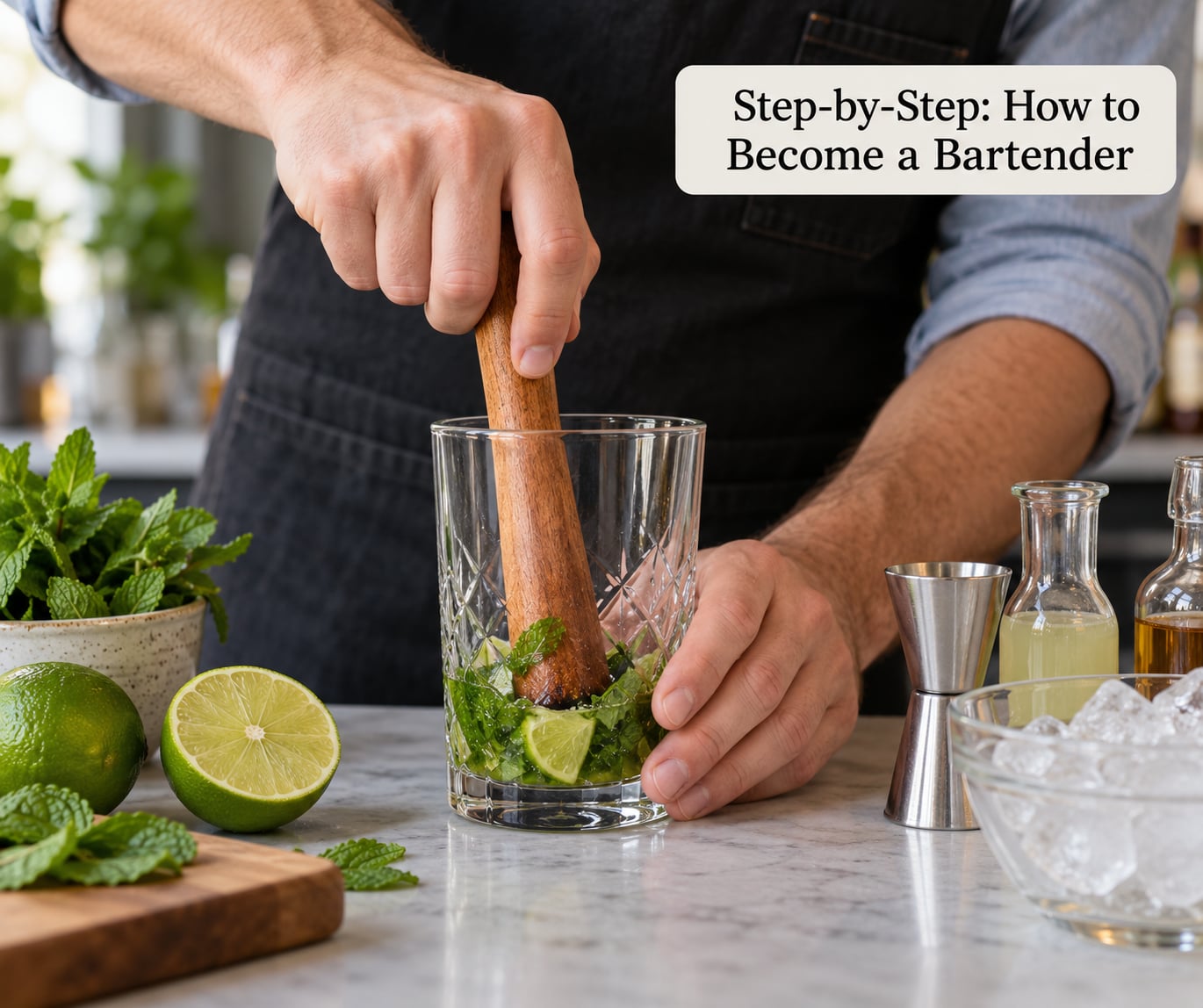
Learn the four base motions: shaking, stirring, muddling and building. Shaking blends and aerates a drink with egg white or juice, stirring keeps clear drinks clear and chills without dilution, muddling presses fruit and herbs, and building means layering without any technique at all.
Learn ice management, which is less glamorous and more important than most of the above. Melting ice waters down drinks, drains smell, and a bar that runs out of ice mid-rush cannot recover.
Learn garnish and presentation. A drink that looks like the menu photograph sells itself, and a lemon wheel nobody asked for is a small insult to the guest.
Learn the soft side at the same time: reading the room, remembering what a regular drinks, upselling without pushing, and cutting off a guest who has had enough in a tone that does not humiliate them.
Step 3: Practice With a Reliable Drink Menu
Beginners try to learn forty drinks and end up owning none of them. Start with a short list and make each one automatic.
A workable starting menu: an Old Fashioned, a Martini or a Manhattan, a Margarita, a Daiquiri, a Gin and Tonic, a Mojito and an espresso Martini. That covers stirred, shaken, muddled and built drinks plus the most-ordered cocktails in North American bars.
Practice to a method. Write the recipe on an index card, note ounces and the ice type, and make the drink ten times in a row until you no longer read the card. Consistency is the whole job: a guest who orders the same drink twice should not taste two different things.
Then film yourself making one drink from memory. It surfaces mistakes faster than anything else will.
Step 4: Get Hands-On Experience
Apply widely and apply early. Chain restaurants, hotel bars, banquet halls, country clubs and casual dining spots hire beginners far more often than cocktail bars do, because cocktail bars want people who already know what an Old Fashioned is.
While you wait for callbacks, do the unglamorous work: learn one POS system, practice a 30-second drink build, and learn how a jigger, Hawthorne strainer and mixing glass feel in your hands.
Volunteer for a wedding or a friend’s party and run the bar yourself. Nobody will judge your speed and you still learn the setup and teardown.
Once you are working a barback or support role, ask questions out loud. Veterans advise newcomers to be visibly interested in the boring parts too, since managers promote the person who knows how the whole bar runs.
One habit stands out: if the ice is low and your barback is not around, you go get ice. Self-starting behavior is what gets noticed.
Step 5: Complete Any Required Training or Certification
Requirements vary by country, state and province, and they change, so confirm the current rule for where you live with your state licensing agency or the venue’s manager.
TIPS, which stands for Training for Interventions and Safety Services, is the most widely recognized responsible alcohol service program in the United States. It is short, online and inexpensive, and plenty of employers ask for it even where the law does not.
What a standard course actually covers: state alcohol laws, how alcohol affects the body, recognizing the signs of intoxication, how to refuse service without confrontation, and handling a guest who has become a problem.
Some states mandate a state-specific course instead, and a few require a permit for bartenders in certain settings. Do not assume a national certificate covers a local rule.
If you are outside the United States, look for your national equivalent, which in the UK is the personal licence route and in Canada is usually a Smart Serve or similar provincial program.
Step 6: Create a Resume and Professional Profile
A no-experience bartender resume is a list of transferable evidence, not a list of wishes. Rewrite your previous jobs with bar-relevant specifics.
For a retail or warehouse job, say you handled a fast-paced queue, dealt with difficult customers and worked a shift schedule that changed weekly. For restaurant work, name the sections you covered, how many covers a shift ran and how you handled complaints.
Include a short skills block: bartending school and certification, POS systems, cash handling, food safety training, languages, and any bar-adjacent software.
Put availability in plain terms, including nights and weekends. Availability is what a manager scans for first.
List two or three references, and keep the profile photo situation simple: a clean headshot if you use job boards, no shirtless photos no matter what the posting shows.
If you have a professional profile online, scrub it the same way. Managers check.
Step 7: Apply for Bartending Jobs
Read the job description before you apply and mirror its language in your resume. Most bar postings list the same eight or nine requirements, so one well-tuned resume can cover dozens of applications.
Apply within the first day or two of a posting. Volume moves fast.
For the interview, expect questions about handling an intoxicated guest, refusing service, a customer sending a drink back, working a busy rush, and what you would drink on a Tuesday night. Prepare a real answer for each, using the STAR pattern: situation, task, action, result.
Dress like you are about to work, not like you are going out. Wear closed-toe, slip-resistant shoes, because you will be on your feet for the entire shift and bad shoes end interviews early.
Follow up once, briefly. A short message a few days later is fine; repeated messages are not.
Ask about the tip structure and any tip-out policy during the interview, since that changes your take-home more than the hourly rate does.
Step 8: Keep Improving After Your First Shift
Your first weeks are about consistency, not impressing anyone. Learn the house drinks, learn the POS, and get your station set up and torn down faster each shift.
Ask for feedback once, specifically. A good manager will tell you what to fix; if they will not, find one who will.
Track what you are still slow at. If four tickets land at once, what do you do first? The answer to that question is most of what separates a beginner from a lead bartender within a year.
Take care of your body. Invest in supportive, non-slip footwear early, keep your elbows close to your body when you shake, and lift ice bins with your legs. Tendinitis, carpal tunnel and lower back strain are the three injuries bartenders mention most, and all three are preventable with technique.
Watch the money. Tips are taxable income, so set aside roughly a quarter to a third of what you take in cash, and ask early whether your venue runs a tip pool or requires you to tip out to the barback and servers.
Then think about the ladder. Bartender to lead bartender to bar manager to beverage director is a real path, and if you want the management step, take a business or accounting class. Consulting, brand work and mobile bartending are the branches off the side.
Know when to stop taking work home with you. The job accumulates stress, and veterans who last years all describe compartmentalizing on purpose.
Common Mistakes
Free-pouring everything to look fast. A 1.5 ounce pour that lands at 2 ounces every time quietly costs the bar money and makes the drinks stronger than the guest expects. Measure while you are new; pour free once a manager says you have the muscle memory.
Giving away drinks to prove you are generous. The comp tab is tracked, and a new bartender handing out free pours is the fastest way to build a bad reputation. Ask a manager what the house policy is before you comp anything, ever.
Ignoring the ticket rail. Tickets accumulate in order of when the drinks were ordered, and the drink you skip is the one that comes out cold and over-poured. Look at the rail constantly.
Trying to prove you know drinks. Guests order a drink for a mood, not to test you. Knowledge helps behind the bar and rarely helps in the conversation.
Saying yes to every shift to earn more. Four busy nights in a row produces sloppy service, mistakes and injury. Pick the shifts that make money, and turn down the slow ones when you have the standing to do it.
Ignoring the money until payday. Tip-outs, a shared pool and taxes can turn a good night into a thin check. Ask about all three before your first shift.
Drinking on shift. It looks like part of the culture in some venues and it is still a termination offense nearly everywhere.
A few habits that pay off quickly: learn the bar’s top twenty drinks by sales volume rather than by reputation, keep your station stocked before the rush instead of during it, and treat the last person in the queue the same as the first.
Frequently Asked Questions
Do I need a degree to become a bartender?
No. Almost no bartending jobs require a formal degree. What matters is that you are legally old enough, complete any alcohol server training your state or province requires, and can prove you are reliable and fast enough to work a busy shift. A culinary or hospitality degree helps if you want bar management or beverage director roles later, but it is not a gate to your first pour.
What qualifications do I need to become a bartender?
The legal requirements are age and, in some places, a mandatory responsible alcohol service course or permit. Employers usually add their own expectations: a completed alcohol server certification such as TIPS, a clean availability for nights and weekends, cash handling experience, and a short food safety certificate in some markets. Most qualifications can be earned in a single afternoon and cost very little.
Can I become a bartender without experience?
Yes, and almost everyone starts that way. The usual route is an entry-level bar role such as barback, busser, host or cocktail server, where you learn the inventory, the setup and the menu while working close to the bar. Then you practice the house drinks until you can make them accurately, ask your manager when you are ready to pour, and take the certification your area requires. Hiring managers care far more about attitude and schedule than about a resume full of bar titles.
How long does it take to become a bartender?
Most people go from first application to pouring behind a bar in three to six months, depending on how quickly they land a support role and how much they practice at home. A short certification can be finished in an afternoon, and a longer bartending school runs anywhere from a weekend to several weeks. Promotions to lead bartender or bar manager usually come after a year or more on the floor.
How much does a beginner bartender make?
Beginner pay depends far more on venue type and tips than on the hourly rate. Banquet halls, country clubs and busy restaurant bars rely heavily on tips, while hotel bars often pay more per hour with smaller tips. Ask about the base rate, any tip pool, the tip-out to servers and barbacks, and whether the venue runs on a tip credit before you accept. New bartenders in high-volume rooms can clear a strong week; quiet weeks are where beginners get discouraged.
Is bartending a good career for beginners?
It is a good entry point into hospitality and it teaches skills that travel across venues, but it is not the easy money some posts suggest. Expect nights, weekends, standing for hours and physical strain. The pay is uneven until you land a busy spot, and the schedule works against a normal social life. People who genuinely like people and tolerate mess tend to do well; people who do not usually leave within the year.
Where to Start Tomorrow
Pick one bar within driving distance that you would actually want to work in, and apply for a barback, busser or host position tonight. Then set up a jigger, a shaker and a handful of cheap bottles at home and make the same Old Fashioned ten times in a row.
That is how to become a bartender in practice: one application, one repeatable drink, repeated until it is boring. Everything else, the certification, the resume, the interview and the promotion, follows from the hours you put in behind the bar.