
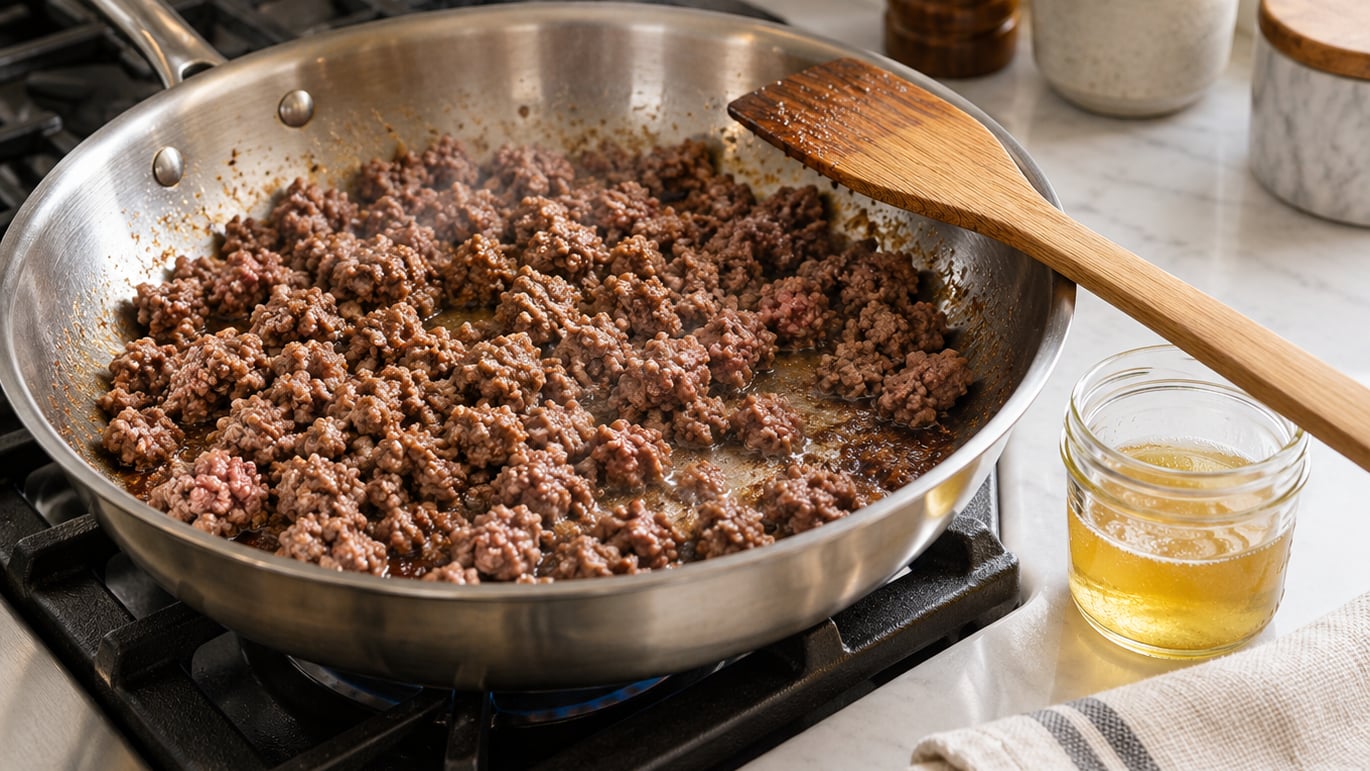
Yes, you can cook frozen ground beef straight from the freezer. Set the block in a cold skillet, add a splash of water, cover it, and let it steam for 4 to 5 minutes so the ice softens; then scrape, flip, and crumble it until the thickest part reads 160°F (71°C) on a food thermometer.
A pound of frozen beef takes roughly 15 to 20 minutes on the stovetop, about 50% longer than thawed beef, because the middle thaws at its own pace instead of starting at zero. Expect a different look too. Frozen meat greys out before it browns and rarely gets that crisp restaurant crust.
That grey color is where most people get stuck. They think something went wrong, either pull the pan off early or keep cooking until the meat is dry and rubbery. A thermometer ends the guessing: cook the full time, check 160°F in two or three spots, and previously frozen beef is completely safe and completely edible.
Here is the method I use, how it changes for burgers, and what to do when the meat sticks to the pan.
Table of Contents
What You Need
The whole method runs on four things, and you probably own all of them already.
- A wide skillet. A 12-inch stainless steel or cast iron pan. Crowding is the single biggest reason frozen beef cooks badly, so width matters more than anything else.
- A sturdy spatula or wooden spoon. You need enough leverage to split a frozen block before it hits the heat. A potato masher works too.
- A lid. Any lid that fits the skillet. This is how you steam the block before you brown it, and it is the step most people skip.
- An instant-read thermometer. A thin probe is best. You want to check the center of a chunk without the probe touching the pan bottom.
For fat, pick one: a tablespoon of neutral oil for a faster, more even browning, or 2 to 3 tablespoons of water if you want the gentlest steam start. Salt, pepper, and spices wait until the end, because seasoning will not dissolve on frozen meat and it burns before the center thaws.
Step-by-Step: How to Cook Frozen Ground Beef
This is the steam-and-sear method. The block sits in a covered cold pan until the outer ice turns to water, then you move heat onto it gradually and keep breaking it down. It is the approach I would teach anyone learning how to cook frozen ground beef, because it works the same for a 1-pound chub and a 5-pound bulk block.
Remove the Frozen Ground Beef from Its Packaging
Take the package straight from the freezer and open it at the counter. Check the use-by date while you are there, and check for a thick layer of freezer burn or ice crystals on the surface, which is normal on older chubs and does not affect safety.
Slide the block out and put it directly into a dry, cold skillet. Do not set it on the counter to soften, even for ten minutes, because the outside of the block warms into the 40°F to 140°F danger zone long before the center does. If the wrapper has a tray or absorbent pad underneath, leave that in the freezer and put the raw beef in the cold pan instead.
Break Up the Beef in a Cold Skillet
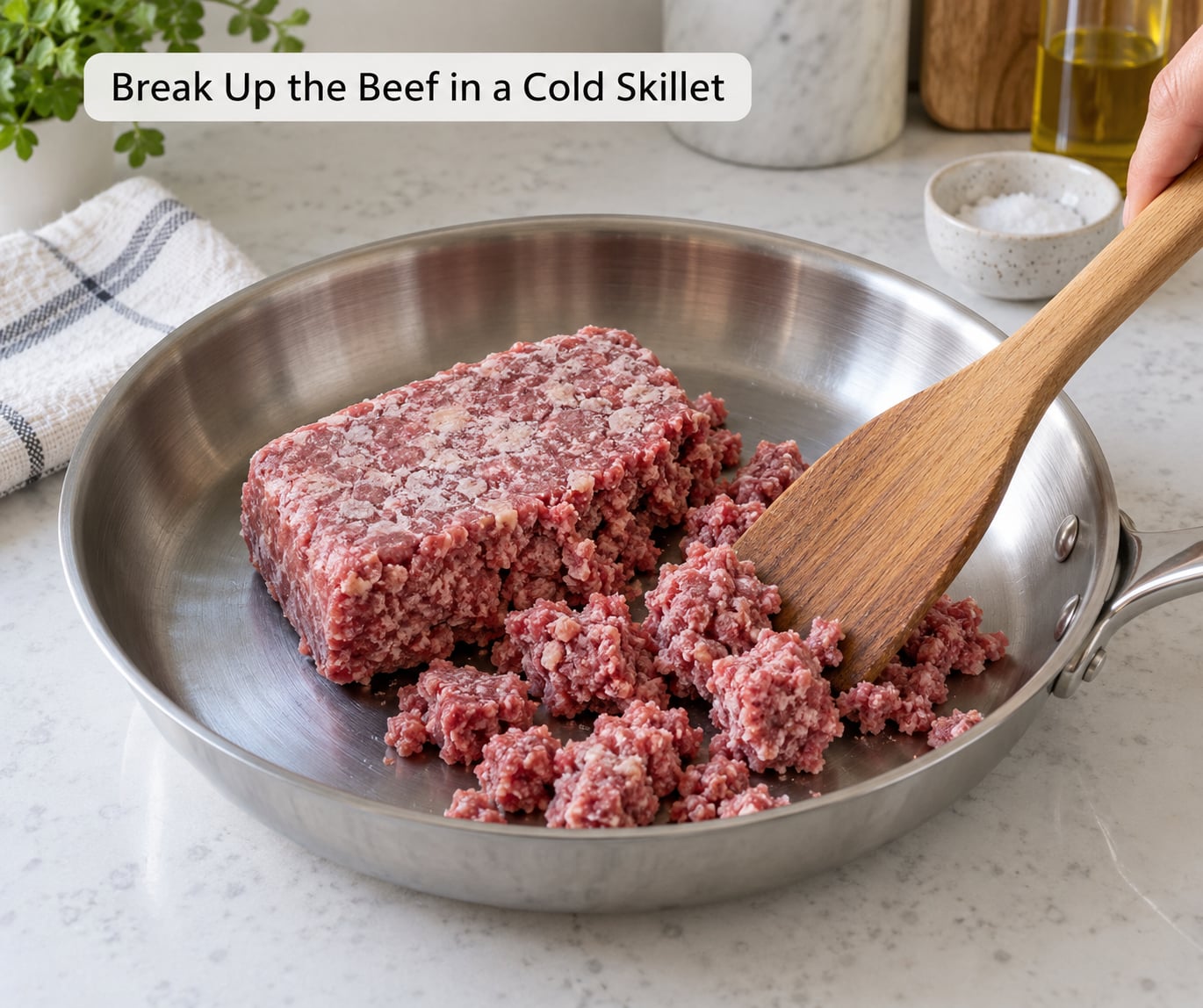
With the pan off the heat, press the block with the back of your spatula and split it into 4 to 6 chunks. Aim for pieces about the size of a golf ball. Smaller than that and the meat turns to paste before you get any browning; much larger and the outside cooks long before the middle is safe.
Once it is in pieces, add your oil or water, cover the skillet, and set it on medium. Then leave it alone for 4 to 5 minutes. This is the part that feels wrong, so let me be specific: the covered phase is not cooking the meat, it is melting ice. You want the chunks sitting in a shallow puddle of steaming water when you come back.
Cook and Brown the Ground Beef
Take the lid off, turn the heat up to medium-high, and scrape the bottom of the pan with the spatula. Every 4 to 5 minutes, flip the chunks and shave off the cooked layer underneath, breaking them smaller as they soften. The pile should go from solid chunks to small crumbles over about 15 minutes, and the liquid goes from cloudy water to rendered fat.
Two things go wrong here most often. The first is heat: too high scorches the outside and freezes the center solid, so medium-high, not high. The second is crowding. One pound per 12-inch skillet is the limit before the pan boils in its own liquid instead of searing, and a 3-pound block wants two or three rounds rather than one.
Season near the end. Salt added at the start hits cold, wet meat, beads up, and burns long before you get browning. Salt, pepper, and garlic go on once the crumbles have lost their grey color and there is visible fat in the pan.
Check the Temperature and Drain Excess Fat
Push the probe into the thickest crumble, touching no bone and no pan surface, and read the temperature. The USDA minimum for ground beef is 160°F (71°C). Check two or three separate spots, because a frozen block heats unevenly and one pink corner means it needs more time.
If it reads 160°F and still looks grey with no crust, that is the honest result of cooking from frozen. It is safe, it is tender, and it is not going to turn brown from more heat alone. Push past 160°F and you are just drying out the fat you worked to render.
Tilt the pan and spoon off the rendered fat into a jar or bowl. Do not pour water into a hot pan of grease to rinse it, which spatters badly, and do not pour hot grease straight down the drain, which solidifies in the pipe. Once it cools, poured grease keeps in a covered jar in the fridge for weeks and is worth keeping for the next batch of vegetables.
Cooked ground beef keeps 3 to 4 days in the refrigerator and 3 to 4 months in the freezer.
How to Cook Frozen Ground Beef for Burgers
Formed patties and loose blocks are two different problems. A block wants to be broken up; a patty wants to stay whole and cook through.
For pre-formed frozen patties, press each one down to about a quarter inch thick while it is still solid, which helps the frozen center thaw faster. Cook in a skillet or on the grill over medium-high heat with the lid on for 3 to 4 minutes, flip, then 3 to 4 minutes more. The lid is doing most of the work: it traps steam so the inside cooks before the outside burns. Expect 8 to 10 minutes per side for a thick frozen patty and check 160°F in the center. Our guide to how to cook frozen burger patties without thawing has the grill timing in more detail.
For burger toppings, sloppy joes, or taco meat, skip shaping entirely and use the stovetop method above as-is.
What does not work from frozen is anything you have to shape yourself. Meatballs, meatloaf, and hand-formed patties need the fat and binder to blend, and frozen beef will not hold together in your hands. Thaw those first. So do stuffed shells or anything where you need the meat spread into a thin even layer.
Can You Cook Frozen Ground Beef From Frozen?
You can, and it is not a compromise. Safety is determined by internal temperature and time at that temperature, not by whether the meat thawed first. Nothing about a frozen start creates a hazard if the beef reaches 160°F (71°C).
The real hazard is the slow cooker. A frozen block in a slow cooker sits for hours in the 40°F to 140°F danger zone while cooking itself slowly, which is the one combination the USDA specifically warns about. Browning the beef on the stovetop first and then transferring it to the slow cooker takes ten extra minutes and removes the risk entirely.
Microwave thawing is safe as a partial thaw only. Defrost in one-minute bursts on low power, check between each burst, and cook the beef straight away, because it is not uniformly cold afterward.
If you want to thaw rather than cook from frozen, the fastest safe methods are covered in how to thaw ground beef fast and safely: 4 proven methods.
How Long Does Frozen Ground Beef Take to Cook?
On the stovetop, budget 15 to 20 minutes per pound, and add 50% to whatever time the thawed version would take. A 1-pound block lands around 15 to 20 minutes, a 2-pound block around 25 to 30. Bigger blocks are not linear because you are still limited by how fast the center thaws.
Across methods, the range looks like this:
- Stovetop skillet: 15 to 20 minutes per pound, flipping and scraping every 4 to 5 minutes.
- Pressure cooker: 20 minutes per pound at high pressure on a trivet above 1 to 1.5 cups of water, then a 5-minute natural release before you saute to brown.
- Air fryer: 380°F for 25 to 30 minutes, shaking the basket every 10 minutes. Good for small batches, and almost no splatter.
- Grill, formed patties: 8 to 10 minutes per side over medium-high with the lid closed.
- Microwave: not recommended for cooking through. It heats the edges long before the middle and leaves the outside rubbery.
Use those numbers as a plan, not as a test. Time depends on how thick the chunks are, how cold the beef started, and how much liquid is in the pan. Color and time are unreliable here; the thermometer is not.
Common Mistakes and How to Fix Them
Almost every bad frozen beef dinner traces back to one of these.
- Cooking it as one solid mass. The outside burns while the center stays frozen. Break the block into golf-ball chunks before any heat goes on.
- Crowding the pan. Two pounds in one skillet steams instead of sears, and you get grey meat. Batch it, or use a second pan.
- High heat. Frozen beef scorches at high heat because there is no moisture left to buffer it. Stay at medium to medium-high and keep moving it.
- Seasoning too early. Salt on frozen meat beads, burns, and then the inside still needs more cooking. Season after browning, always.
- Trusting the color. Grey is normal and pink is a signal to keep going. Take the temperature instead of guessing from the surface.
- Leaving it too long on one side. That is what makes it stick and tear. Scrape and flip every 4 to 5 minutes, even when nothing appears to be happening.
- Keeping the lid on too long. The lid is for the first 4 to 5 minutes. After that, take it off so the liquid boils away and browning can start.
- Draining grease badly. Spoon it off, or pour the whole skillet through a colander set over a bowl. Never add water to a hot grease-filled pan.
Tips for Juicy, Flavorful Ground Beef
A few things turn decent frozen beef into good frozen beef, and none of them cost extra time.
- Deglaze the pan. Those brown bits stuck to the skillet after you drain are the best flavor in the pan. Add a splash of water, stock, or wine, scrape, and that liquid goes into your sauce.
- Cook vegetables in the rendered fat. Onions, peppers, and mushrooms dropped into the same skillet after the beef browns pick up every bit of it. If you drain the fat first, you throw away the flavor you just made.
- Season in layers. Salt after browning, then add paprika, cumin, chili powder, or garlic after the liquid has cooked off. Spice burns on a dry pan.
- Use loose crumbles for the right dishes. Chili, sloppy joes, taco filling, bolognese, and shepherd’s pie all start with crumbled beef, so the frozen block is an advantage rather than an inconvenience.
- Cook once, freeze many. A 3-pound block cooked from frozen yields 12 to 15 burger portions. Portion it into a flat container so individual scoops come off cleanly later.
- Rest before draining. Three minutes off the heat lets the juices settle instead of running straight into the colander.
If you want the sear to come from the oven instead, our guide to how to cook burgers in the oven covers high-heat roasting and the same temperature check.
Frequently Asked Questions
Can ground beef be cooked from frozen?
Yes. Frozen ground beef is safe to cook straight from the freezer as long as it reaches 160F (71C) internally, measured with a food thermometer. Cooking time increases by roughly 50 percent, so a one-pound block needs about 15 to 20 minutes on the stovetop. The color and crust will be less even than beef cooked from thawed.
Do I have to defrost ground beef before cooking?
No, defrosting is optional. Thawing first gives you more even browning and faster cooking, but cooking from frozen works fine for crumbles, chili, taco meat, and sloppy joes. Frozen beef does not shape into meatballs, meatloaf, or hand-formed patties, so thaw it first for those.
Is ground beef safe to eat at 160 degrees?
Yes. The USDA recommends a minimum internal temperature of 160F (71C) for ground beef, and that applies whether the meat started frozen or thawed. Check two or three separate spots, because a frozen block heats unevenly and a pink corner means it needs a few more minutes.
Why does frozen ground beef look grey and cook unevenly?
Previously frozen beef loses moisture in the freezer, so the surface dries and greys, and the center still thaws slower than the outside. USDA testing also found previously frozen burgers browned on the surface before the center was safe far more often than fresh burgers. Grey color is normal and not a sign of spoilage.
How long can frozen ground beef sit on the counter?
Raw ground beef should not sit above 40F (4C) for more than two hours, and one hour in a hot kitchen. A frozen block left on the counter thaws from the outside in, so the outer layer enters the 40F to 140F danger zone long before the center does. Thaw in the refrigerator, in cold water, or in the microwave instead.
How do I stop frozen ground beef from sticking to the skillet?
Break the block into small chunks before the pan gets hot, add a tablespoon of oil or a few tablespoons of water, and scrape and flip every 4 to 5 minutes. Sticking usually means the beef has sat on one spot too long, or that the pan is too crowded and liquid is pooling under the meat.
Start with a pound in a cold skillet, lid on, medium heat, four minutes. Check the temperature, not the color, and the answer to how to cook frozen ground beef is the same every time: steam it first, break it up early, and stop at 160°F.