
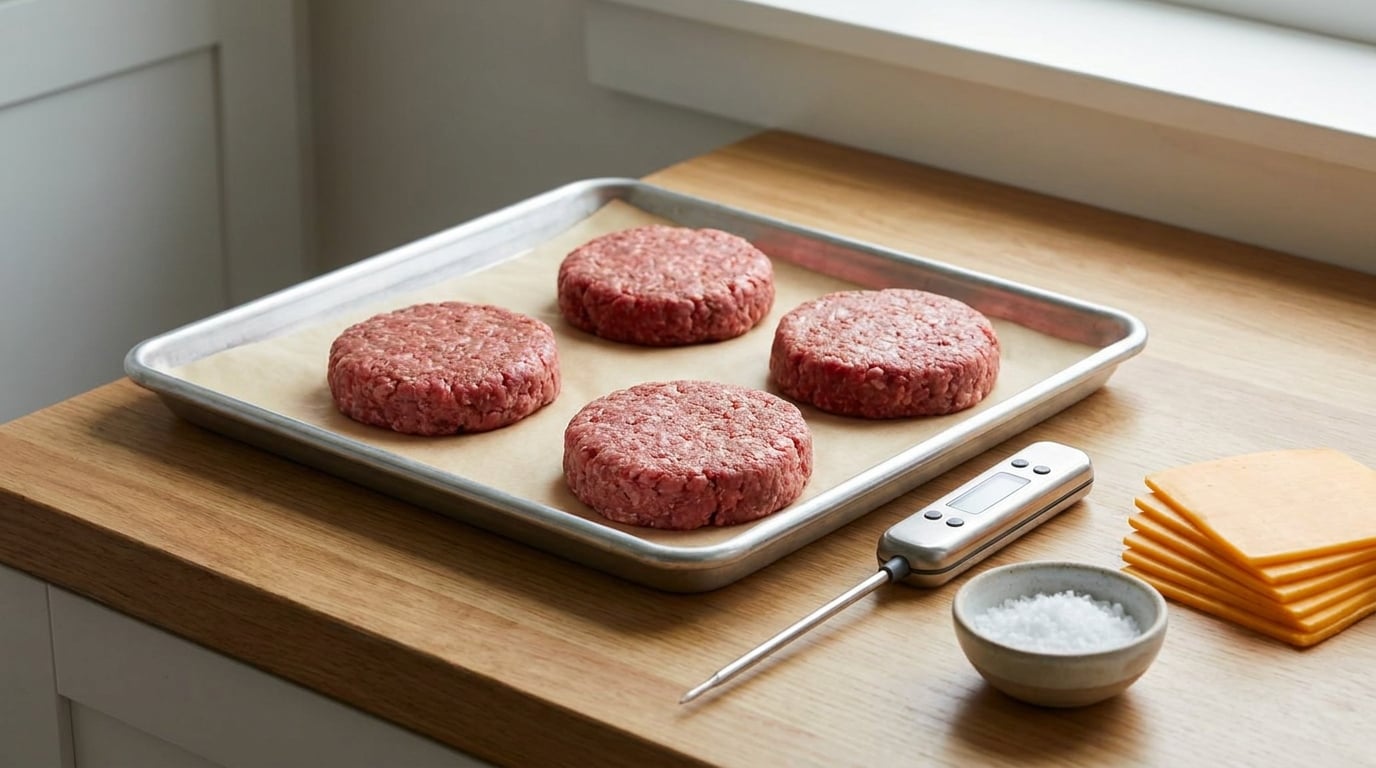
How to cook burgers in the oven is mostly a matter of three numbers: 400°F, a 1/2-inch-thick patty, and 15 to 20 minutes on a lined baking sheet. Pull the burger at 160°F internal, rest it for three minutes, and assemble. From start to plate you are looking at about 30 minutes, and the whole method is hands-off once the pan is in.
I cook burgers in the oven more than on the grill. The oven wins on a cold evening, with a group of six or eight, or on the weeknight when I do not want to babysit a flame. What it gives up is crust, and you can get that back with two minutes under the broiler.
Table of Contents
- What You Need
- Step-by-Step: How to Cook Burgers in the Oven
- Common Mistakes
- Frequently Asked Questions
- Do I need to preheat the oven when cooking burgers?
- Should I cover burger patties while they cook in the oven?
- How long does it take to cook frozen burger patties in the oven?
- What temperature is best for juicy oven-baked burgers?
- How do I keep oven-cooked burgers from becoming dry?
- Can I add cheese to burgers while they cook in the oven?
- Conclusion
What You Need
Nothing here is exotic, and almost everything you probably own already.
- 80/20 ground beef. That is 20 percent fat by weight, and it is the single biggest factor in whether a burger comes out juicy. 90/10 works, but it needs a shorter cook and a faster rest.
- A rimmed baking sheet. A flat rimless pan sends drippings onto your oven floor. The rim catches the fat and makes cleanup a scrape instead of a soak.
- Parchment paper or heavy-duty foil. Parchment is slick and cheap. Foil gives you a surface you can fold up around the burgers for a softer, steamier result.
- A digital meat thermometer. A cheap instant-read probe is the difference between a burger you are sure about and one you hope is done. Push the target to 160°F for ground beef, every time.
- Optional: a wire cooling rack. Set it over the sheet so fat drains off the bottom instead of steaming back into the meat.
- Optional: cheese, buns, and toppings. A slice of American or cheddar per patty, cut buns, and whatever you like on top.
Step-by-Step: How to Cook Burgers in the Oven
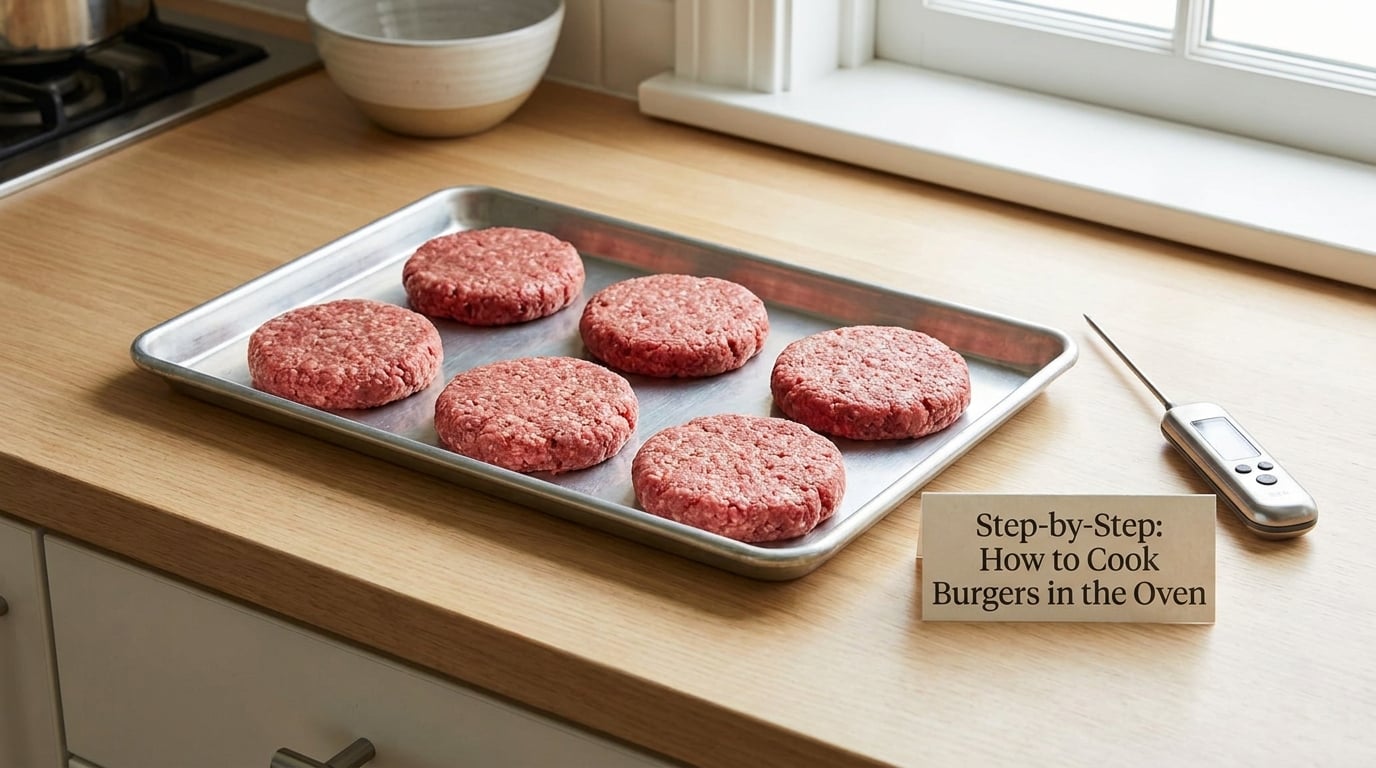
Step 1: Preheat the Oven and Prepare the Pan
Set the oven to 400°F and let it fully preheat, which takes 20 to 25 minutes. While you wait, put the empty baking sheet inside so it heats up with the oven. A hot sheet gives the patties an instant sear on contact, which is where most of the browning actually happens in a convection-free oven.
Take the sheet out, line it with parchment, or lay down heavy foil. If you are using foil, give it a very light coat of oil, since bare foil is not naturally nonstick. Do not use parchment for the broil finish, because the direct heat darkens paper.
Step 2: Shape the Burger Patties
Divide 1 pound of ground beef into four 4-ounce portions, or eight 2-ounce patties for sliders. Weighing them on a kitchen scale takes ten seconds and is the difference between patties that finish together and patties that finish whenever.
Pat each portion into a patty about 1/2 inch thick and 4 inches wide, wider than your bun. Press a shallow thumbprint into the center of each one. That divot is not cosmetic: without it the patty domes into a rounded puck, and a domed patty sits crooked on the bread.
Keep the edges loose and slightly ragged rather than smooth. Cooks on cooking forums keep repeating the same advice, and they are right. The surface of a beef patty is a tangled mass of myosin and fat; when you knead and compact it, those proteins line up into a dense grid, squeeze out the moisture, and give you the bouncy, rubbery texture that people mistake for undercooking. Loose, shaggy edges char and stay juicy.
Season both sides generously with coarse salt and black pepper right before the patties go in. Then arrange them in a single layer with a couple of inches between each one, so hot air can move around them. Crowding drops the pan temperature and steams the meat.
Step 3: Bake the Burgers in the Oven Without Burning Them
Put the sheet on the center rack and set a timer. A 1/2-inch patty at 400°F takes 12 to 15 minutes. Thin 1/4-inch patties need 8 to 10, and thick 3/4-inch patties need 18 to 22. The fuller matrix below matters, since patty thickness is the variable that actually changes your cook time.
| Patty thickness | 350°F | 375°F | 400°F | 450°F |
|---|---|---|---|---|
| 1/4 inch (smash style) | 10 to 12 min | 8 to 10 min | 7 to 9 min | 5 to 7 min |
| 1/2 inch (standard) | 18 to 20 min | 15 to 18 min | 12 to 15 min | 9 to 11 min |
| 3/4 inch (thick) | 24 to 28 min | 21 to 24 min | 18 to 22 min | 13 to 16 min |
Use 350°F when you want a gentle cook and the most forgiving result, 400°F for the best balance, and 450°F when you are in a hurry and willing to watch the clock. There is no need to flip patties this thin. Turning them tears the browned surface, and at half an inch thick they cook through on one side in a normal home oven.
If you want a grill-style crust, move the sheet to the top rack, switch the oven to broil, and watch it closely. Two to three minutes, no longer. Broiling goes from golden to black in a very short window, so stand there.
For cheese, lay a slice on each patty during the final minute of cooking, or immediately after you pull the sheet out. American cheese melts at a lower temperature than cheddar, which is why it drapes perfectly while a thick cheddar slice can sit on a hot patty looking untouched.
Step 4: Check the Internal Temperature and Rest
Push the thermometer into the thickest part of the patty, side to side, avoiding the fat that runs along the edge. The USDA safe minimum internal temperature for ground beef is 160°F. That number is firmer than for a steak because ground meat can carry bacteria distributed throughout the mixture, not just on the surface, so pink in the center of a burger is a different safety question from pink in the center of a roast.
The readings map like this, purely as a guide for texture:
- 145°F: rare, very red center
- 150 to 155°F: medium-rare to medium, with a pink band
- 160°F: medium, the safe minimum for ground beef
- 165°F: medium-well
- 170°F and up: well done, noticeably drier
A popular shorthand called the 5 6 7 rule assigns roughly 5 minutes of broiling for rare, 6 for medium-rare, and 7 for medium. It is a fine guide for a single thick patty under the broiler, and it is not a substitute for a thermometer, especially with a batch cooking at different rates.
Then rest the patties 3 to 5 minutes on the rack or the board. A patty pulled at 155°F will climb to roughly 160°F while it sits, because the hot outer layers keep driving heat toward the center. That carryover cooking is also the window in which the muscle fibers relax and reabsorb the juice they pushed out. Skipping the rest is why a burger can taste drier than its temperature suggests it should.
While you rest them, toast the cut faces of the buns in the still-hot oven for a minute or two. Build with a lettuce leaf under the patty if you want to keep the bottom bun from going soggy, and eat within a few minutes.
Common Mistakes
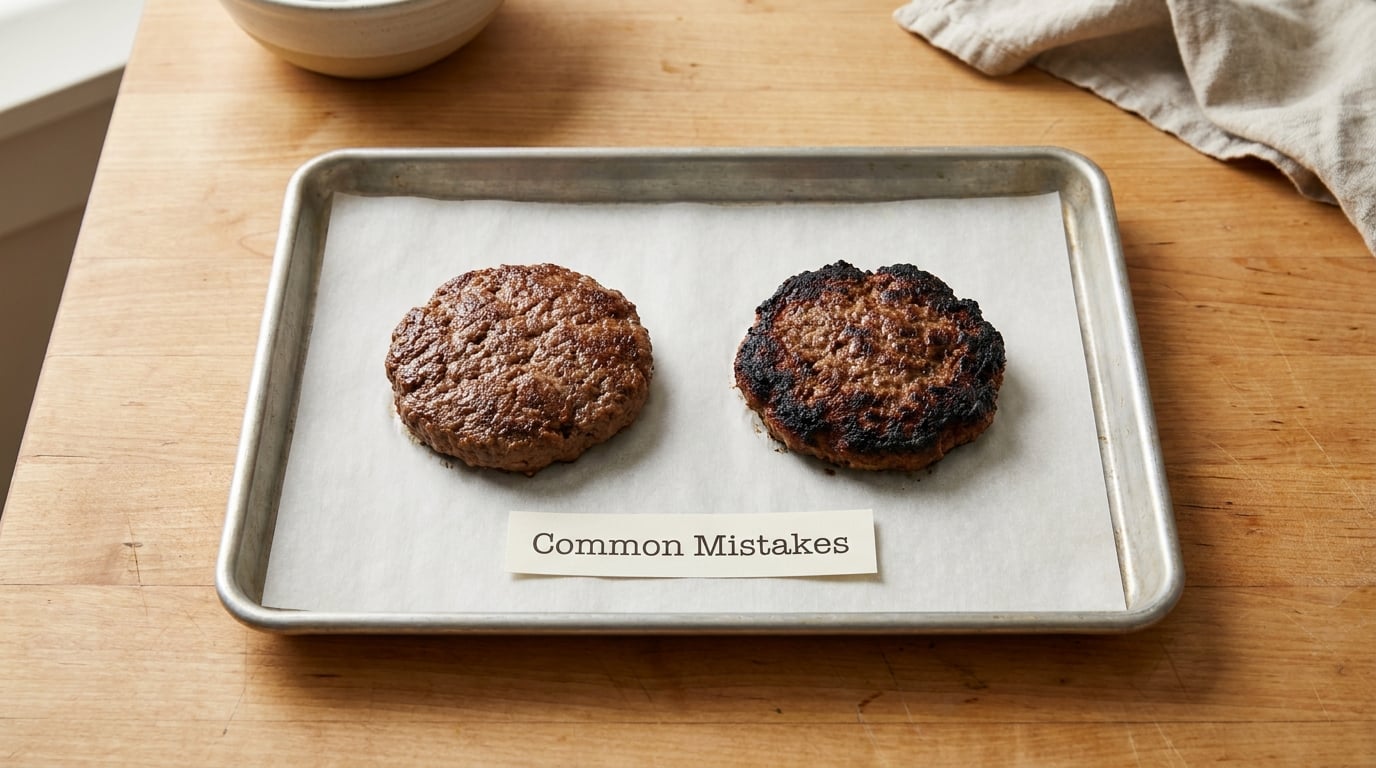
The patties shrank into small, sad discs. That is protein contracting and fat rendering out of the meat, and it is mostly driven by heat applied too long to a patty that was too lean. Use 80/20, keep the patties at 1/2 inch, and pull at 160°F rather than cooking until the juices run clear.
They puffed into domes. You skipped the thumbprint. Press the divot in raw, and the patty stays flat enough to stack.
The edges burned while the middle was still pink. The pan was too close to the heating element, or the oven was running hot. Move the sheet to the center rack, check your oven with an independent thermometer, and lower the temperature to 375°F if it runs more than about 25 degrees hot. The other culprit is sugar in the seasoning, which caramelizes long before the center catches up, so season with salt, pepper, and paprika rather than a barbecue-style rub with brown sugar.
The bottoms stuck and tore off. Parchment was not lying flat, there was no oil on the foil, or the patty was frozen and its surface was thawing into a tacky layer. Press the parchment down with your palm, oil bare foil lightly, and thaw frozen patties in the fridge before cooking them.
They came out dry, or springy and rubbery. Two different problems with one shared root. Dry usually means lean meat or too many minutes in the oven. Rubbery usually means the beef was kneaded, packed, or run through a grinder, which aligns the proteins and squeezes out moisture. Both get better with a gentler hand and a shorter cook.
The buns went soggy. The patties were sitting on the bread, dripping, while you finished everything else. Rest them on a rack, not on a plate, and assemble at the table.
A few habits cover most of this. Preheat the sheet, not just the oven. Keep patties the same size. Give them room on the pan. Season late, cook on 400°F, verify with a thermometer, and rest before you build.
Frequently Asked Questions
Do I need to preheat the oven when cooking burgers?
Yes, and give it the full 20 to 25 minutes. A cold oven plus a cold pan means the patty spends the first several minutes warming up rather than browning, so the outside stays pale and the cooking time stretches well past the chart. Putting the empty baking sheet in during preheat fixes the second half of that problem by giving the meat a hot surface to land on.
Should I cover burger patties while they cook in the oven?
For patties under 1/2 inch thick, leave them uncovered so the surface can dry out and brown. For thick or frozen patties, tenting with foil for the first 10 to 12 minutes traps steam and gets the center to temperature, then pull the foil off for the last few minutes to develop color. Fully wrapping burgers in foil works too, but the result is soft and pale rather than crusted.
How long does it take to cook frozen burger patties in the oven?
Add roughly 5 to 8 minutes to the charted time. A frozen 1/2-inch patty at 400°F runs about 18 to 23 minutes, checked with a thermometer and pulled at 160°F. Cooking from frozen sears the outside before the center thaws, so the crust can scorch, which is why dropping the oven to 375°F is worth it for frozen patties.
What temperature is best for juicy oven-baked burgers?
400°F is the best all-around answer. It browns the surface well without scorching, and a 1/2-inch patty finishes in 12 to 15 minutes, which is short enough to keep the fat from rendering out. Use 350°F if you want the most forgiving, gentle cook, and 450°F only when you are broiling a thin patty for a fast crust.
How do I keep oven-cooked burgers from becoming dry?
Buy 80/20 ground beef, handle it gently instead of kneading it, keep patties at 1/2 inch, and stop cooking at 160°F internal rather than waiting for the juices to run clear. Then rest the patties 3 to 5 minutes before serving so the muscle fibers relax and hold onto the juice. Cooking lean 90/10 patties calls for all of the same moves and a shorter time.
Can I add cheese to burgers while they cook in the oven?
Yes. Add a slice in the final 60 to 90 seconds so it melts without the patty overcooking, or set it on the patty the moment the pan comes out, since residual heat finishes the job. Broiling with the cheese on for 30 to 60 seconds is fastest. Use American or provolone for the best melt, and add it only after you have confirmed the patty has reached 160°F.
Conclusion
Start with the oven, not the meat: set it to 400°F, put the empty sheet in to heat with it, and line it once it is out. Form four even 4-ounce patties at 1/2 inch, press a thumbprint in each one, season both sides, and give them space. Bake 12 to 15 minutes, verify 160°F in the thickest part with a thermometer, rest three to five minutes, and only then toast the buns and build.