
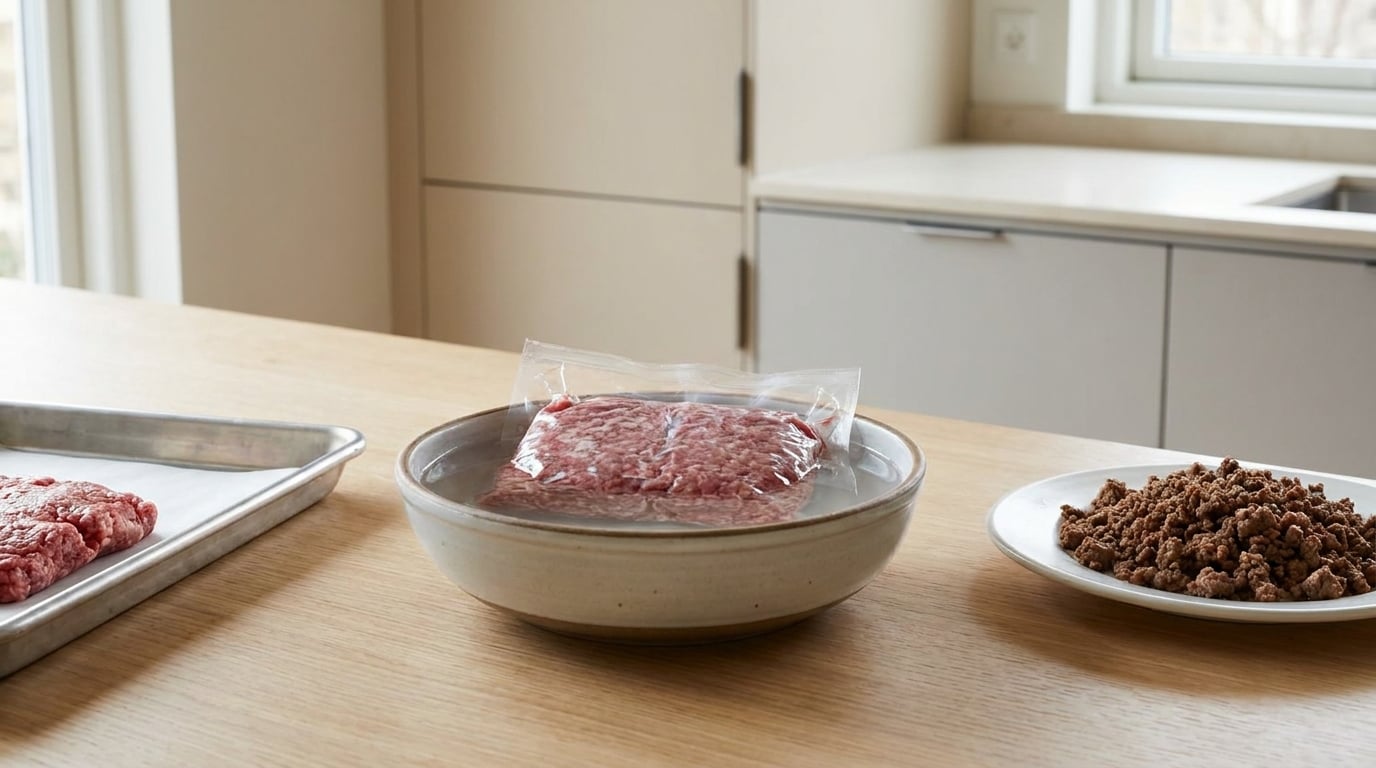
The fastest safe way to thaw ground beef is cold water, at roughly 1 hour per pound, with the water changed every 30 minutes and the beef cooked right away. The microwave is faster still, but only works if you cook the beef immediately afterward. No matter which route you take, the outside of the block warms into a bacterial sweet spot long before the center does, so thawing is where most kitchen food-safety mistakes happen.
Searching for how to thaw ground beef fast and safely usually returns the same four answers, and the differences between them come down to how much time you have and whether you can cook on the spot. I cook a lot of ground beef, mostly for taco nights and chili, and the honest truth is that most of the time you do not need a full thaw at all. But when you do need one, here are the four methods that actually work, ordered by how much time you have.
Table of Contents
- What You Need
- Step-by-Step: Four Ways to Thaw Ground Beef
- How to Tell When Ground Beef Is Fully Thawed
- Common Mistakes
- Food Safety and Storage Tips
- Frequently Asked Questions
- Is there a safe way to thaw ground beef fast?
- Which thawing method is safe for ground beef?
- Is it safe to let ground beef thaw at room temperature?
- Can I cook ground beef that is slightly frozen?
- Can you refreeze ground beef that was thawed in the microwave or cold water?
- Is it safe to eat frozen meat left out for 12 hours?
- Conclusion
What You Need
Each method needs very little, which is why the counter ends up looking so appealing in a hurry.
- For the refrigerator: a fridge at 40°F or 4°C or below, a tray, a plate or a shallow container to catch drips, and a way to tell when it is done.
- For cold water: a leakproof zip-top bag or a clean bowl, cold tap water deep enough to submerge the beef, and a kitchen timer.
- For the microwave: a microwave-safe plate or shallow dish, a fork or spatula, and a microwave with a defrost setting and adjustable power.
- For either water or microwave: an instant-read thermometer so you can check that the beef reaches 160°F or 71°C before it hits the plate.
- For portioning: a sheet pan, parchment or a silicone mat, and freezer bags or a rigid container.
Two things are worth having on hand that most kitchens skip: a thermometer and a shallow tray. The tray keeps a leaking tub from turning your counter into a cleanup job, which is honestly half of why people grab a paper towel and go to the counter anyway.
Step-by-Step: Four Ways to Thaw Ground Beef
Step 1: Thaw in the Refrigerator
The refrigerator is the safe default because the whole block warms slowly and evenly, staying below the danger zone the entire time. Put the beef on a tray or in a container, leave it in its original sealed packaging, and give it about 1 to 2 days depending on how thick the block is.
A flat 1-pound pack is usually fine after overnight in a well-cooled fridge. A dense 5-pound frozen block can take a full day and a half, which is why this method fails in a pinch. Cook it soon after you take it out, or move it into the cold water method once it has loosened a little.
Step 2: Thaw in Cold Water
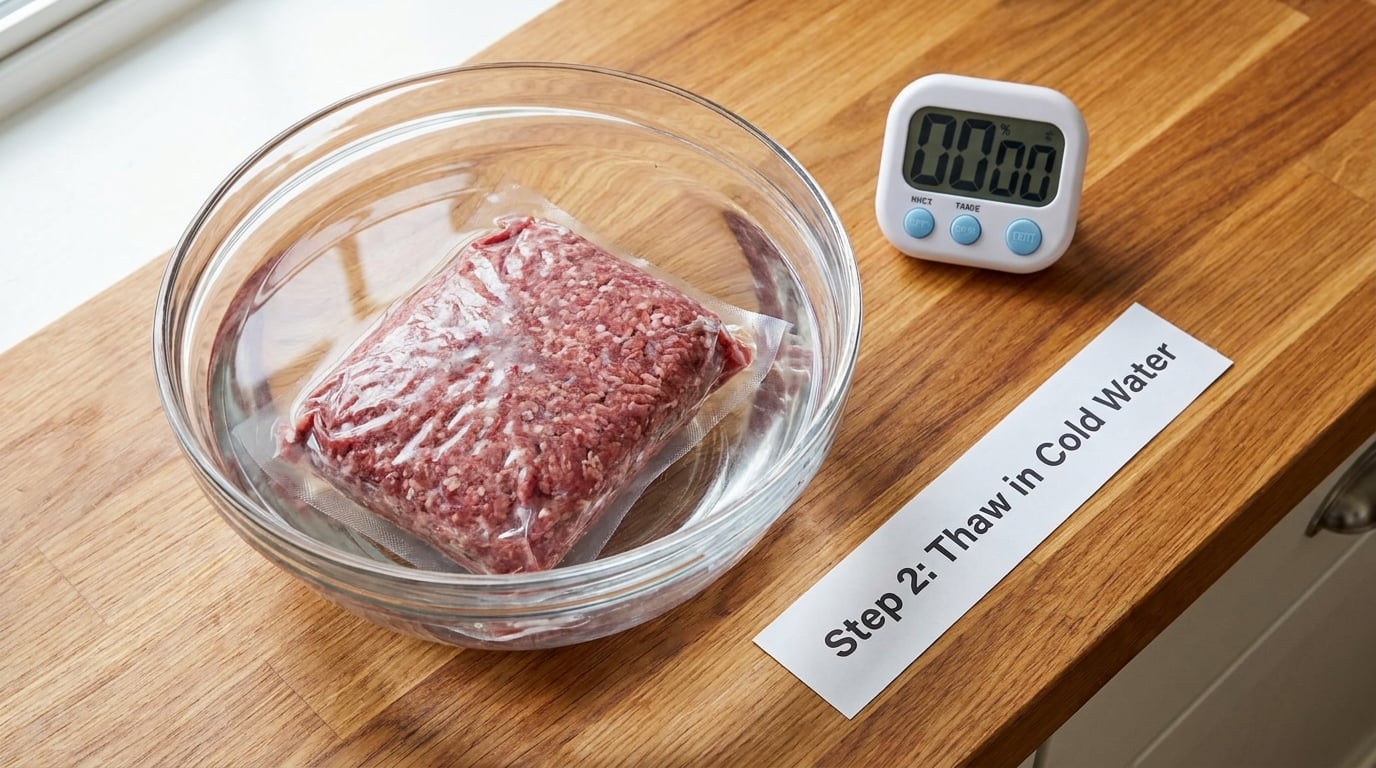
Cold water is the fastest method that does not put the meat at risk, and it works because moving water transfers heat far faster than still air. Seal the beef in a leakproof bag first, or place it in a sealed container if the package is punctured.
Submerge it completely in cold water, set a timer, and change the water every 30 minutes. Cookers repeat the same default advice, and one beginner thread added a good detail: swapping the water on a schedule thaws the beef evenly from all sides instead of softening one face and leaving the far end hard.
Budget about 1 hour per pound. Cook it immediately, and skip the fridge step afterward, because the beef has already spent time in a warm environment and belongs in the pan now. Never use warm or hot water; that is not a faster version of this method, it is a different and unsafe one.
Step 3: Use the Microwave
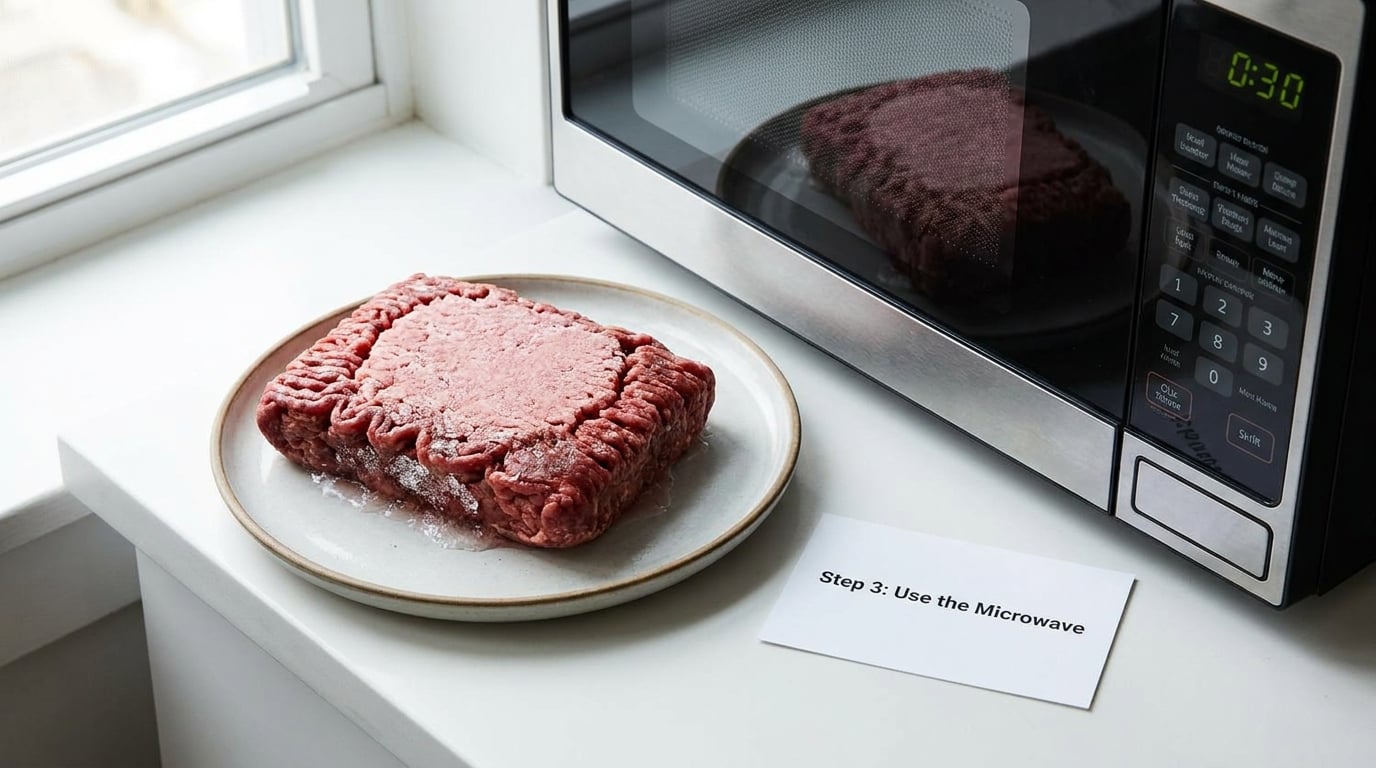
The microwave is the fastest option and the least forgiving one. Take the beef out of its cardboard tray and any plastic film, break the block into loose crumbles or individual portions, and spread them on a microwave-safe plate. They thaw much more evenly that way, and a solid frozen brick will always cook on the outside first.
Run it in short bursts at about 30 percent power, or use the defrost setting, and check every 45 seconds. Turn and stir between bursts so heat reaches all sides. Stop as soon as the beef is pliable, or when a small thawed patch appears in the center, and push it right into the skillet.
This is the source of the most common complaint about fast thawing. People describe edges that started to cook while the middle stayed frozen, which is exactly the uneven-heat problem that the pause-and-flip technique solves. Cook immediately to 160°F or 71°C.
Step 4: Cook From Frozen or Refreeze Portions
For crumbled beef, taco meat, chili or burrito filling, you can skip the thaw entirely. Put the frozen beef in a skillet, add a splash of water, cover it so the steam does some of the work, and cook on medium-high, breaking it apart with a spatula as it loosens.
Expect roughly 50 percent longer cooking time than thawed beef would need, and the texture will be a little less even, which does not matter in a heavily seasoned pot of chili. If the beef is only slightly frozen rather than solid, a hot skillet handles it fine without any adjustment.
The other half of this step happens weeks in advance. When you buy a bulk pack, press it flat on a sheet pan, freeze it until firm, then cut and bag it into 1-pound portions. A thin flat pack thaws in hours; a 5-pound brick is a two-day problem.
How to Tell When Ground Beef Is Fully Thawed
Once you know how to thaw ground beef fast and safely, the last part is knowing when to stop. Touch is usually enough for cold water or refrigerator thawing. A thawed pack bends easily, feels slack rather than rigid, and has no hard core in the middle. Press a finger into it and you should leave a dent that does not spring back.
Color is a poor test. Beef that is still slightly pink in the center of a thick block after a microwave defrost is often fine, because cooking temperature matters more than how it looks.
When a package is half-thawed with a frozen center, do not fight it. Move it to the refrigerator and let it finish slowly, or separate the thawed portions from the frozen block so you can cook the loose beef now and keep the solid part cold for later.
With the microwave, stop as soon as the beef is pliable. Waiting for a completely even thaw means the thin edges spend extra minutes sitting in the danger zone, which defeats the reason you used the microwave in the first place. Cook the thawed portion right away.
Common Mistakes
Thawing on the counter. A frozen block left on the counter thaws from the outside in, so the outer layer spends hours in the 40°F to 140°F range while the center is still solid. Move it to the fridge or the cold water method instead. The usual argument is that you are going to cook it anyway, and the answer is that cooking kills bacteria, not the hours of warm growth that happened before the pan was hot.
Using hot or warm water. Warm water speeds things up by moving meat into the danger zone from the start. It also cooks the outside while the inside thaws, which gives you a cooked outer shell and a raw middle. Cold water only, changed every 30 minutes.
Microwaving on full power and walking away. Full power heats the edges in seconds and leaves the center frozen. Short bursts at reduced power with a turn between each one is the fix.
Refreezing beef that is soft or was thawed by microwave or cold water. Meat thawed in the refrigerator can go back in the freezer. Beef thawed in water or in the microwave should be cooked first, then frozen, because those surfaces have already been warm.
Starting to cook before the center is thawed. A browned outside gives you no information about the middle. Cut the beef open and check, or use a thermometer.
Skipping the thermometer. The USDA safe minimum internal temperature for ground meat is 160°F or 71°C. Without one, you are guessing, and guessing is how people serve undercooked burgers to guests.
Food Safety and Storage Tips
Keep your refrigerator at 40°F or 4°C or below, and put the thawing beef on the bottom shelf or in a tray so nothing can drip onto other food. Ground beef is loose and leaky, and raw juices carry bacteria with them.
Perishable food should not sit at room temperature for more than 2 hours, or 1 hour if the room is above 90°F or 32°C. That two-hour window is a hard limit, not a guideline, and it is also the reason cold water thawing ends with immediate cooking rather than a trip back to the counter.
Thawed ground beef keeps 1 to 2 days in the refrigerator before it needs to be cooked or frozen again. If the package leaks, throw the outer packaging away, wash your hands and the surface, and treat the meat the same way, since the leak itself is not a safety problem but the mess slows you down and that is what leads to shortcuts.
For anything you are unsure about, check the temperature at the thickest part with an instant-read thermometer. If you have a warm kitchen and no thermometer, cold water with a timer is the method that gives you the most control.
Frequently Asked Questions
Is there a safe way to thaw ground beef fast?
Yes, cold water is the fastest safe method. Seal the beef in a leakproof bag, submerge it fully in cold tap water, and change the water every 30 minutes. Allow about 1 hour per pound, then cook it immediately rather than returning it to the refrigerator. Hot water is not a safe shortcut because it warms the outer layer into the danger zone before the center thaws.
Which thawing method is safe for ground beef?
Three methods are safe: refrigerator, cold water and microwave. The refrigerator is slowest at roughly 12 to 24 hours. Cold water takes about 1 hour per pound with the water changed every 30 minutes. The microwave runs 8 to 10 minutes per pound in short bursts. Beef thawed in water or the microwave must be cooked right away; beef thawed in the refrigerator can be refrozen.
Is it safe to let ground beef thaw at room temperature?
No. Thawing on the counter is the most common way home food poisoning happens with ground beef. The outside of the block enters the 40u0026deg;F to 140u0026deg;F range while the center is still frozen, giving bacteria hours to multiply before you cook it. If the beef has already been at room temperature for more than two hours, discard it rather than cooking it.
Can I cook ground beef that is slightly frozen?
Yes, especially for crumbled beef, taco meat or chili. Put it in a skillet with a splash of water, cover it so steam helps soften it, and cook on medium-high, breaking it apart as it loosens. Allow about 50 percent longer than thawed beef needs. A thick frozen block will brown outside before the center cooks, so cut it open and confirm 160u0026deg;F or 71u0026deg;C before serving.
Can you refreeze ground beef that was thawed in the microwave or cold water?
Cook it first, then refreeze it. USDA guidance is that food thawed in the refrigerator can be refrozen safely, but beef thawed in cold water or the microwave has already sat in a warm environment, so cooking it before freezing is the safe move. Cooking does not reverse bacterial growth, it just stops it, which is why the refrigerate-and-refreeze path stays the only one that is fully reversible.
Is it safe to eat frozen meat left out for 12 hours?
No. Perishable food should not be at room temperature for more than 2 hours, or 1 hour in a room above 90u0026deg;F or 32u0026deg;C. Meat that has been out for 12 hours has spent most of that window in the danger zone, and freezing or cooking it later does not make it safe again. Discard it, and next time use the cold water method, which takes about 1 hour per pound.
Conclusion
Match the method to the time you actually have. Planned a day or two ahead, the refrigerator on a tray is the safest route and the only one you can refreeze from. Need it today, cold water at about 1 hour per pound gets you there safely. Cooking within the hour, the microwave works, in short bursts with a turn in between. Then verify 160°F or 71°C before anyone eats it.
Last checked for 2026, and the rules have not moved much since the USDA wrote them down.