
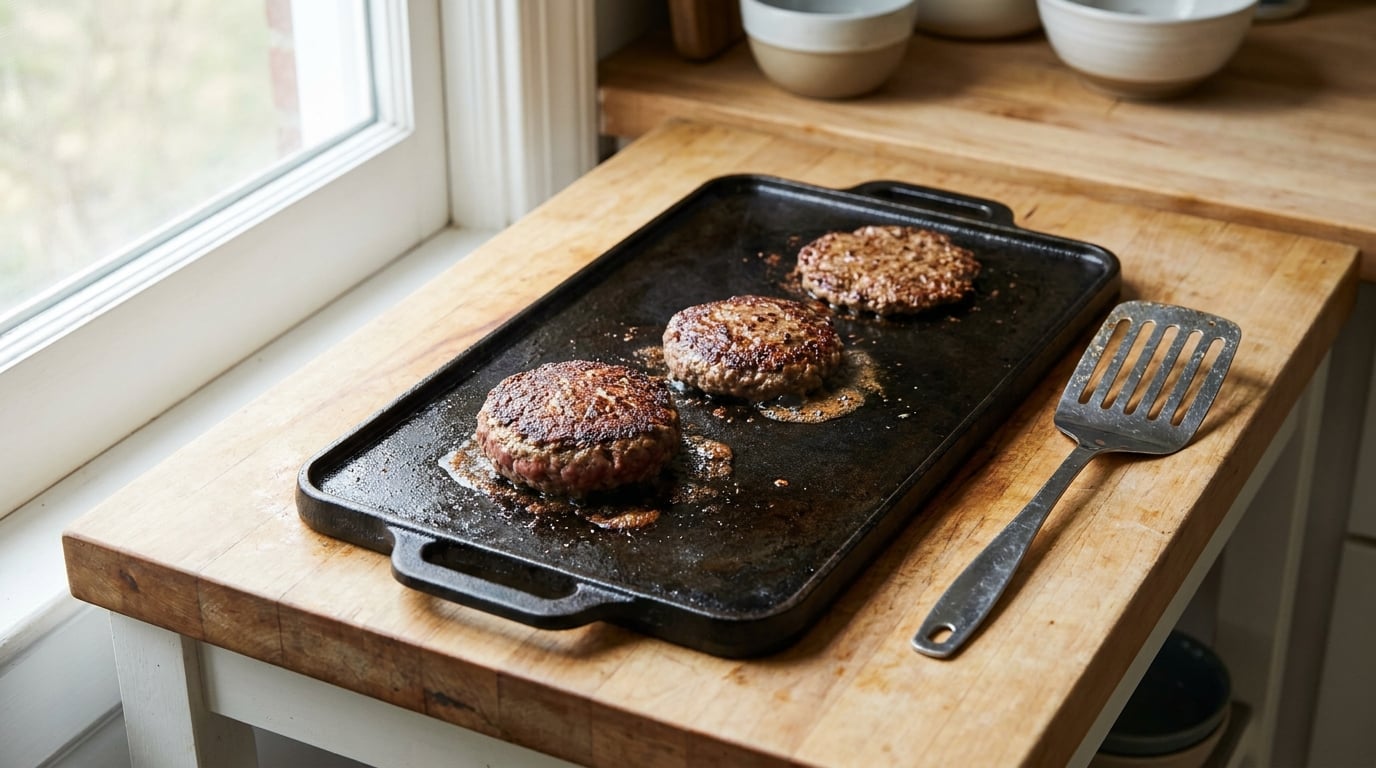
You can tell when a burger is done without a thermometer by reading the patty instead of probing it. Press the surface to judge firmness, watch the color and behavior of the juices that collect in the pan, and time the cook by patty thickness. Ground beef should reach 160°F (71°C) in the center, and no color or aroma can confirm that number on its own.
That last sentence matters more than it sounds. Ground beef carries one of the highest food-poisoning risks in home cooking because bacteria such as E. coli are mixed through the whole patty rather than sitting only on the surface, so a beautiful seared crust tells you nothing about the middle. This guide gives you a repeatable set of cues instead of a guess, and it is honest about the moment you should stop using them.
For most weeknight cooking the method is short: press, look, listen, rest. The detail below is for anyone who has been burned by a gray, raw, dry patty and wants to know why it happened.
Table of Contents
- What You Need
- Step-by-Step
- Food Safety When You Do Not Have a Thermometer
- Frequently Asked Questions
- Can I tell if a burger is cooked just by pressing it?
- Are clear juices a reliable sign that a burger is done?
- Why does my burger look done outside but remain pink inside?
- How long should I cook a thick burger without a thermometer?
- Is a pink burger always unsafe to eat?
- Can I use a microwave or oven to check burger doneness without a thermometer?
- Conclusion
What You Need
None of this needs a gadget. It needs a hot pan, a thin metal spatula wide enough to slide fully under a patty, coarse salt, and somewhere to rest the finished burgers that is not the cutting board.
Start with the pan. A cast iron skillet or a griddle holds steady heat and gives you a crust; a thin nonstick pan works but tends to cook the fat away and leaves you with less to judge by. A wire rack set over a plate is the single most useful piece of equipment for the resting stage, because juices drain off the patty instead of soaking into the bun and turning the bottom soggy.
About a thermometer: an instant-read thermometer is genuinely helpful, and for ground beef it is the only way to confirm 160°F. But it is not required for any of the visual, tactile or aromatic cues taught here. If you do not own one, you can still cook a safe burger — you just have to lean harder on cues that only measure doneness and texture, not safety.
Step-by-Step
Read the whole sequence once before you light the burner. The cues only work in combination, and a single sign like a brown crust or clear juices is not a verdict on its own.
Choose a Thickness You Can Judge Consistently
Patties between 1/4 and 1/3 inch thick are the easiest to read without tools. A very thin patty cooks in under three minutes a side, which is too fast to form a reliable feel; a thick half-pound patty heats so slowly that the outside and the center can be ninety seconds apart.
Composition matters as much as size. An 80/20 patty holds fat and moisture, so the texture changes gradually and the touch test stays honest. A lean 90/10 or 93/7 patty renders almost nothing, tightens fast, and can look finished and gray on the outside while the center is still cool and raw. That is the single most common failure in home burger cookery, and it is exactly the case where the touch test is least reliable.
When you buy pre-formed patties, cook ones from the same pack, at the same thickness, on the same heat. Familiarity is what makes a cue usable — the reason the touch test feels like guesswork the first few times is that you have no reference yet, not that your hands are bad at it.
If you have heard the 5-6-7 rule for burgers, it is a timing convention, not a doneness test. It roughly maps to about 5 minutes for a thin patty, 6 for a standard one and 7 for a thick one per side, at medium heat. Treat it as a rough schedule to check your cues against, and never as a substitute for them.
Create a Manageable Sear
Heat the pan to medium and give it a full minute before the patty goes near it. A cold or half-heated pan steams the meat instead of browning it, and a steaming patty gives you no crust to read and no fond to tell you when it is time to turn.
Oil the grate or the pan, not the meat. A lightly oiled surface browns; a wet surface fries in place and stalls the crust. Scrape any blackened bits off a griddle between batches, because burnt carbon under a patty is a bitter, acrid smell that will sit in the pan and fool your nose later.
Then leave it alone. Pressing a patty with the spatula every thirty seconds tears the crust, squeezes out the juices you are trying to read, and slows the cook. Wait until the edges look set and lose their wet translucence, and until the patty releases from the grate with almost no scraping — that release is the flip signal, and it is more reliable than any clock.
How to Tell When a Burger Is Done Without a Thermometer
Combine three channels: touch, sight and smell. Any one of them can be wrong; together they narrow it down fast.
Touch. Press the center of the patty with the pad of a fingertip, using roughly the pressure you would use to test dough. Note how it resists, then press again a second later and notice how fast it returns to shape. Raw ground beef feels soft and squishy with no spring at all. A well-done patty feels firm and springs back instantly. Everything in between gives a partial spring that you can feel and rank.
Sight. Watch the pan, not the patty. As the meat cooks, fat and water leave it and collect around the edges. Early on that liquid is cloudy and pink-tinted; as the patty firms up, the liquid thins, the film around the patty starts to look like clear oil rather than water, and the patty’s surface stops looking damp and matte. A brown crust forming around the edges is a browning cue, not a doneness cue.
Smell. A cooked beef patty moves from a raw, mineral, almost metallic note to a savory browned-beef aroma. When the smell of the pan shifts to something close to a hamburger stand, the cook is well advanced. If the pan smells burnt or acrid, that is the pan, not the patty.
Here is the ladder those three cues map onto. The temperatures are what you would read with a probe, included so you can calibrate yourself later.
| Doneness | What it feels like | Center color | Approximate internal temperature |
|---|---|---|---|
| Rare | Very soft, no resistance, stays dented | Deep red | 125-130°F (52-54°C) |
| Medium-rare | Soft with a light give, slow rebound | Red with a hint of pink | 130-135°F (54-57°C) |
| Medium | Light give, springs back slowly | Pink to pink-brown | 135-145°F (57-63°C) |
| Medium-well | Firmer, springs back quickly | Light pink fading to tan | 145-155°F (63-68°C) |
| Well done | Firm, no give, immediate rebound | Tan to gray-brown | 160°F (71°C) and above |
One practical addition: the bounce test. Press the patty gently, lift your finger, and see whether the dent fills in fast, slowly, or not at all. Fast rebound is well done, slow rebound is medium, and a dent that stays is still raw in the middle. It reads slightly better than the press itself because you are measuring recovery, not resistance.
There is also a discreet-tool version for anyone who prefers not to rely on their own hands. Press a clean cake tester or skewer into the thickest part of the patty, then press the spot where it entered against the soft inside of your wrist. It is an approximation, not a measurement, and it works best on a thick patty.
Compare Thick, Thin, and Smash Burgers
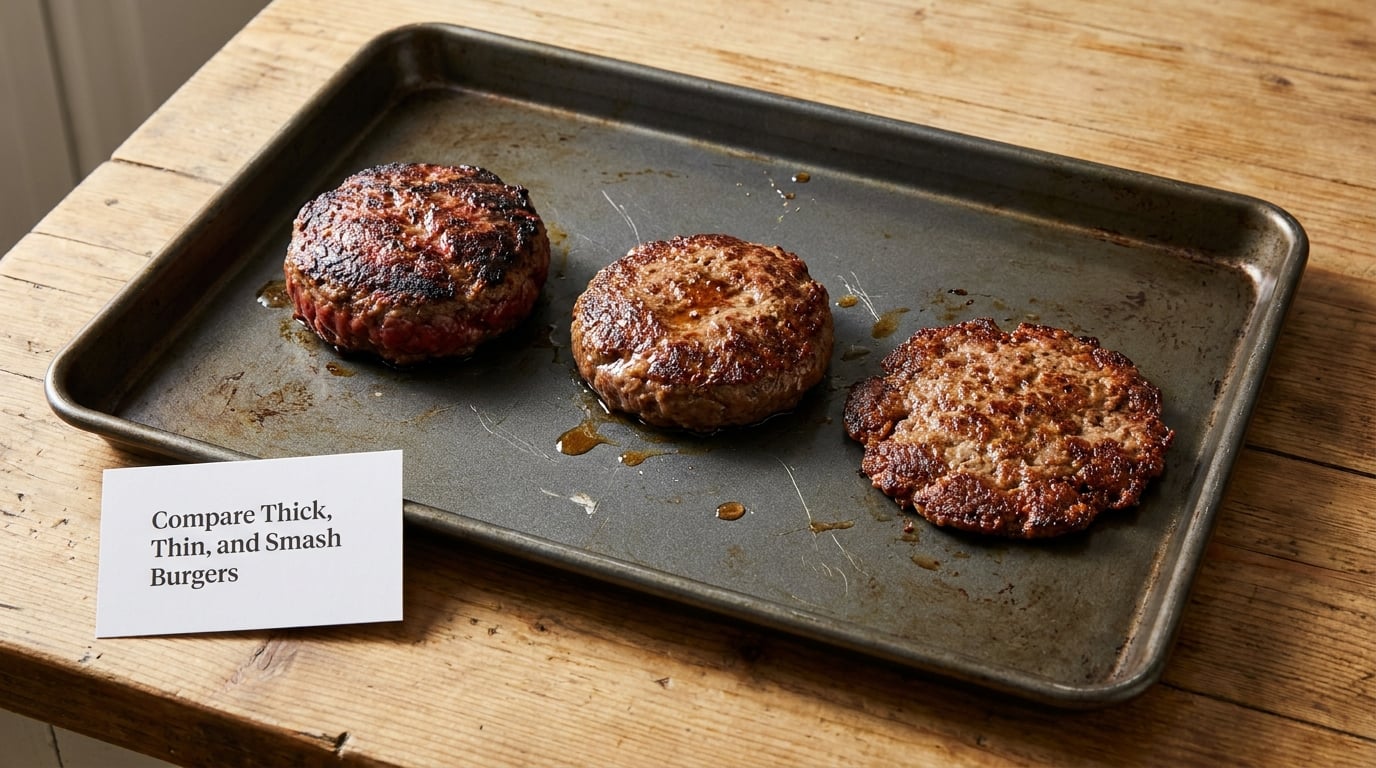
A thin smash burger cooks so fast that the entire patty reaches temperature in seconds, which leaves no window for a slow press test. Judge it by the crust alone: a fully browned, cheese-melted, glossy-beef surface on a griddle is a good practical proxy, because the meat cannot outrun the Maillard browning at that size. Turn it the moment the edges go dark and the bottom releases.
A thick patty behaves the opposite way. Its center lags the surface badly, so the touch test actually works better here, and so does a short rest before you judge it. If you want more signal, cook thick patties with a gentle lid on for part of the second side so the top finishes instead of only drying out.
Mixed-meat patties need more caution, not less. A beef and pork blend, or any patty seasoned with a lot of onion and pepper, can hold a pink or gray center long after it is safely cooked, and the texture of the blend firms at a different rate than pure beef. Treat a blended patty as done later than a pure beef one of the same thickness, and cut into the thickest part if you want to see what is happening.
Rest the Burger and Recheck the Center
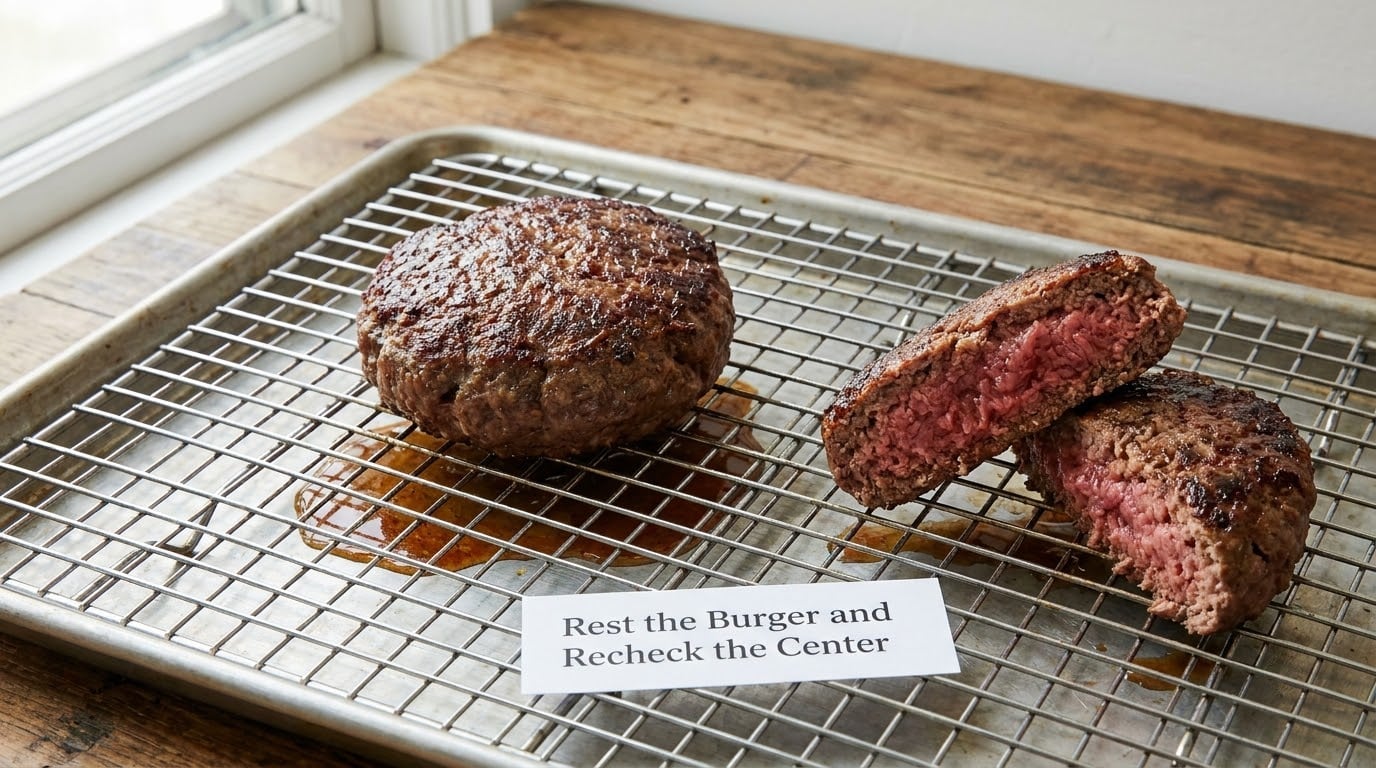
Resting is not optional, and the reason is physical. A patty keeps cooking after it leaves the heat, so its center temperature keeps rising while the juices redistribute and firm the texture. Rest a burger for three to five minutes on a wire rack and the same patty that felt ambiguous in the pan reads clearly on the plate.
After the rest, press the center once more, gently. If you want to see the interior, cut the patty across the thickest part with a clean knife on a clean board — one cut, taken in the kitchen, costs far less than a burger ruined on the plate. Look at the color of the juices that run out, not just the meat. Thin liquid rather than pooled water, with no wide pink stream, is a late-stage sign.
Be clear-eyed about what juice color proves. Clear juices mean the surface is browning and the water is leaving, which correlates with cooking progress. They do not mean the center reached 160°F, and they cannot. A patty can push clear liquid out of the sides while its middle is still undercooked, particularly a thick one with an uneven shape.
Common Mistakes
Judging by crust color. Browning is a Maillard reaction on the surface, and it says nothing about the inside. A well-browned patty can hide a raw center, especially a lean one. Fix: always confirm with touch or a cut through the thickest part.
Using one timer for every patty. Time is a function of thickness, fat content, starting temperature of the meat and how much heat your pan actually holds. Fix: treat time as a schedule to check against, and let the patty’s feel end the cook.
Pressing too hard. A hard press squeezes the juices out of the patty and leaves you reading a dry burger. Fix: use the same light pressure every time, the way you would press dough.
Reading rendered fat as rawness. Clear oil pooling around a patty is fat leaving the meat, which is a sign of cooking. Fix: separate the cues — cloudy pink liquid is early, thin clear oil is late.
Believing clear juices mean safe. They are a doneness cue, not a safety cue. Fix: if anyone at the table is pregnant, elderly, immunocompromised or very young, confirm 160°F with a thermometer instead of reasoning from the pan.
Flipping on schedule instead of on release. Forcing a flip before the patty lets go tears the crust and pulls the juices out early. Fix: wait for the edges to set and for the patty to come away cleanly.
Tips for More Consistent Results
Make every patty the same size. Divide the meat by weight with your hands, then flatten each one with the palm until it is the same thickness edge to edge, and press a shallow dimple in the center so it stays flat instead of doming.
Handle the meat gently and keep it cold. Work it as little as possible, and let patties sit in the refrigerator rather than on the counter while you preheat. Overworked meat compacts and dries out; meat that starts warm cooks unevenly from the outside in.
Control the heat and then leave it alone. Medium heat is the right default. High heat gives you crust fast but a raw middle on anything thicker than a quarter inch.
Calibrate once, properly. Cook three patties to 130°F, 145°F and 160°F, checking with a thermometer, and note the feel, the rebound and the pan juices at each. That memory is what turns a guess into a method, and it costs you one cook.
Use every cue together, and use a thermometer whenever one is available. Nothing above replaces it for ground beef. It just means that on the days you have no thermometer, you are reading the patty rather than guessing at it.
Food Safety When You Do Not Have a Thermometer
Say this plainly: touch, smell, color, juice clarity and crust browning cannot detect harmful bacteria. They measure doneness and texture. Bacteria in ground meat are not killed by browning, and a sealed, dark, evenly cooked center is not proof of anything on its own.
USDA guidance sets the minimum internal temperature for ground beef at 160°F (71°C), measured in the thickest part of the patty with an instant-read thermometer inserted at a shallow angle. For reference, the same guidance puts poultry at 165°F (74°C) and whole cuts of beef and fish at 145°F (63°C) with a three-minute rest. Poultry burgers and turkey patties are the worst case for a thermometer-free cook: leanness, pale color and a texture that firms unpredictably mean the cues below genuinely mislead.
Ground beef is the meat where guessing has the most consequence, because the bacteria are distributed throughout the muscle rather than only on the surface where searing reaches. It also is the meat most often cooked rare at home.
If you are cooking for anyone pregnant, over 65, immunocompromised or a young child, do not run the no-thermometer method. Use a thermometer, confirm 160°F, and keep raw beef and its juices away from anything that will be eaten raw. The cues in this guide are for a well, properly handled patty cooked for a healthy adult — useful for texture, and a reasonable sanity check, not a safety instrument.
Frequently Asked Questions
Can I tell if a burger is cooked just by pressing it?
You can judge texture by pressing, but not safety. A light press that leaves a dent that fills in slowly is roughly medium, while a firm patty that springs back instantly is well done. The technique works best on a thick, evenly shaped patty and least well on a thin, lean one. Always confirm 160°F for ground beef with an instant-read thermometer when safety is the concern.
Are clear juices a reliable sign that a burger is done?
Clear juices are a useful late-stage cue, not proof. As ground beef cooks, water and fat leave the patty, so the pooled liquid thins and shifts from cloudy pink toward clear oil. That correlates with progress, but a thick patty can push clear liquid from its sides while the center stays undercooked. Combine it with firmness and a check of the thickest part.
Why does my burger look done outside but remain pink inside?
Three reasons, and they are common. The patty was too thick or too lean for the heat, so the surface browned long before heat reached the center. The pan was too hot, which set the outside fast. Or the patty contains a lot of onion and pepper, where nitrates can leave a pink or gray center well past safe. Press the center, rest the patty, and check the thickest part.
How long should I cook a thick burger without a thermometer?
Budget roughly six to eight minutes per side for a patty thicker than a quarter inch, at medium heat, and treat that only as a schedule. Flip when the patty releases from the grate, then judge by pressing the center and watching the pan juices. Timing varies with fat content and starting temperature, so the feel of the patty should end the cook, not the clock.
Is a pink burger always unsafe to eat?
No, and this is where most burger advice misleads people. Myoglobin and oxymyoglobin give raw beef its color, so a patty can be safely cooked and still look pink, especially with onion and pepper mixes or curing salts. The reverse is more dangerous: gray, browned patties have been found to contain harmful bacteria. Pinkness proves neither safety nor danger, so verify the center hits 160°F.
Can I use a microwave or oven to check burger doneness without a thermometer?
Neither helps. A microwave heats unevenly and can leave cool spots, and finishing a burger in the oven dries the exterior and does not tell you anything you could not see by cutting it. If you want a non-visual check with a tool, use an instant-read thermometer, sliding it in from the side of the patty rather than straight down from the top.
Conclusion
Judging a burger without a thermometer comes down to reading the patty in three channels at once: how it resists a light press, how it springs back, and what the pan juices are doing. Brown crust, clear juices and aroma tell you the cook is advanced. None of them tells you the center hit 160°F.
So start simple: press your patties to an even thickness, get the pan properly hot, and stop poking them. Press the center once, watch the liquid, rest the burger three to five minutes, and judge again on the plate. And if anyone at the table needs it guaranteed, use a thermometer.