
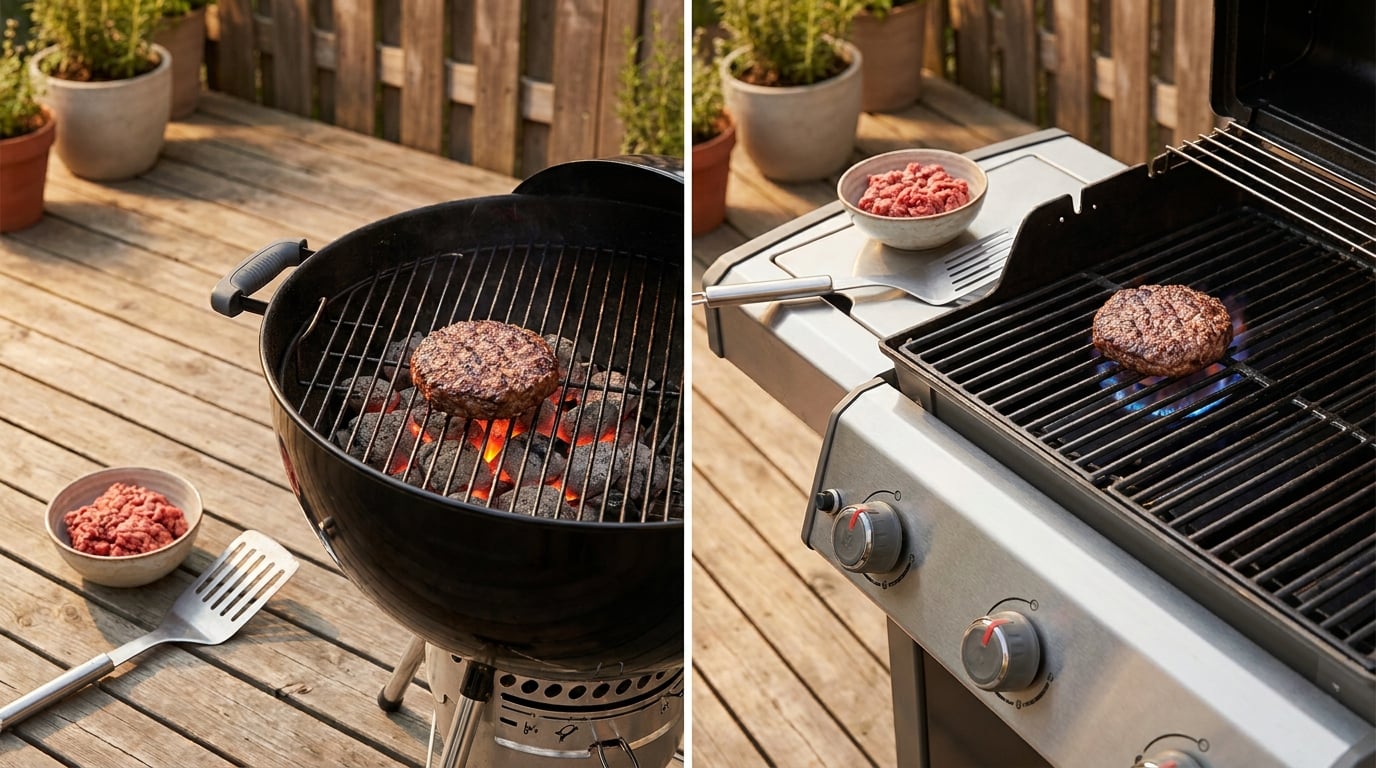
Charcoal wins on flavor, gas wins on convenience. For burgers specifically, a charcoal grill gives you more crust, more smoke character and a sear that gas struggles to match, and it asks you to manage a live fire while doing it. A gas (propane) grill heats in about ten minutes, holds temperature without supervision and wipes clean afterward. Most people end up wanting both, one after the other.
This guide breaks down the charcoal vs gas grill for burgers question on the criteria that actually change the burger: smoke, sear, heat control, startup time, cleanup and safety. No brand names, no rankings of specific models, just what happens to the meat on each type of grill.
One thing worth stating early: a gas grill will absolutely produce an excellent hamburger. It is not a compromise you have to accept. The difference is real but it is a difference of degree, and most of it comes from smoke plus how the heat behaves, not from some secret ingredient in the coals.
Table of Contents
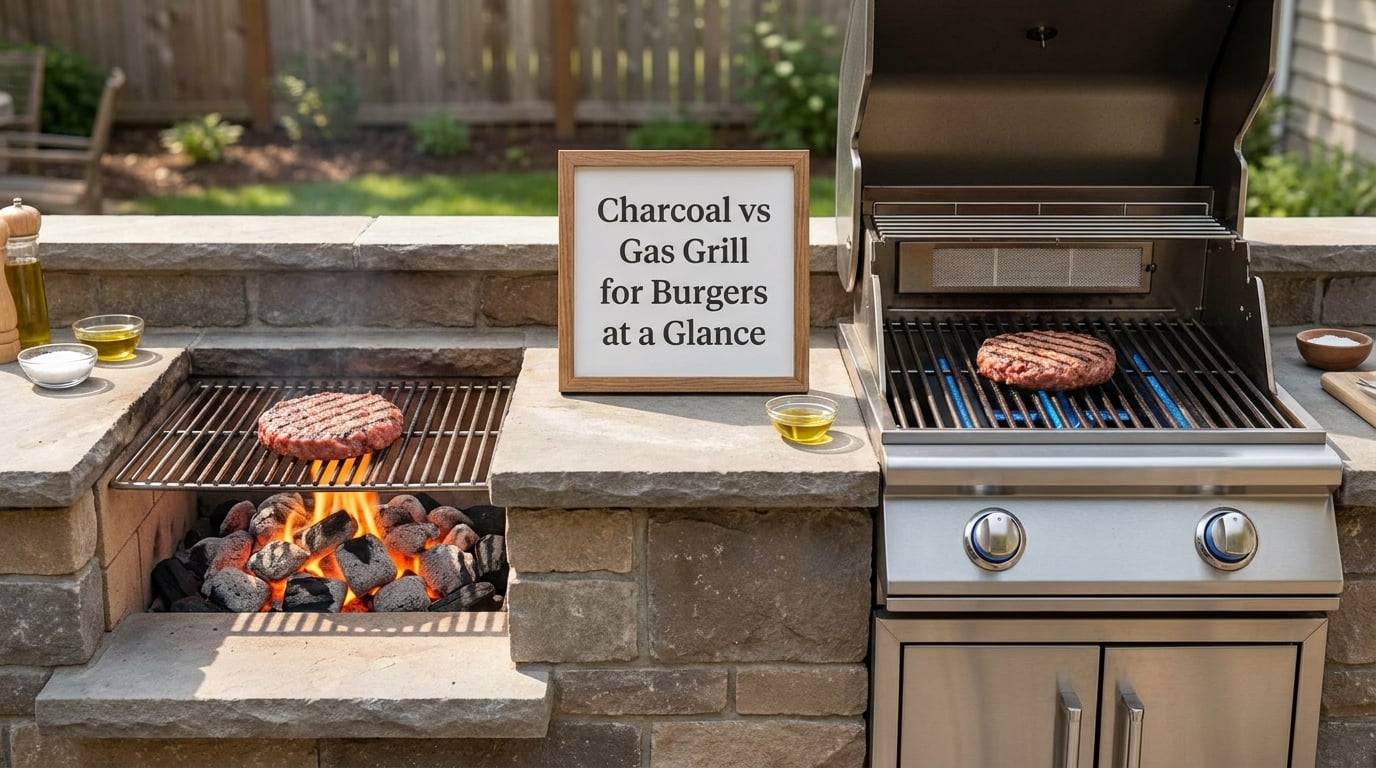
- Charcoal vs Gas Grill for Burgers at a Glance
- Flavor and Smoke
- Searing and Maillard Flavor
- How Heat and Temperature Control Compare
- Charcoal Grill for Burgers: Flavor-First Grilling
- Gas Grill for Burgers: Fast and Consistent Grilling
- Lighting, Cleanup, and Maintenance
- Safety, Weather, and Practicality
- How to Grill Burgers Safely and Consistently
- Which Should You Choose?
- Frequently Asked Questions
- Conclusion
Charcoal vs Gas Grill for Burgers at a Glance
| Criterion | Charcoal grill | Gas grill |
|---|---|---|
| Smoke flavor | Noticeable, adds depth | Minimal without help |
| Searing | Very high heat, strong char | Strong sear, even browning |
| Heat control | Vents and airflow, hands-on | Knob control per burner |
| Startup time | 15 to 25 minutes | 8 to 12 minutes |
| Recovery after opening lid | Slow, coals cool fast | Quick, burners respond |
| Cleanup | Ash disposal, ash can needed | Brush grate, wipe surfaces |
| Maintenance | Air vents, grate, ash catcher | Burners, grease tray, hoses |
| Portability | Small and standalone, kettle style | Bulky, except tabletop models |
| Best for | Weekend cookouts, flavor seekers | Weeknight burgers, beginners |
Two rows in that table decide most arguments. The startup row is why so many people buy gas, and the smoke row is why the same people later buy charcoal anyway.
Flavor and Smoke
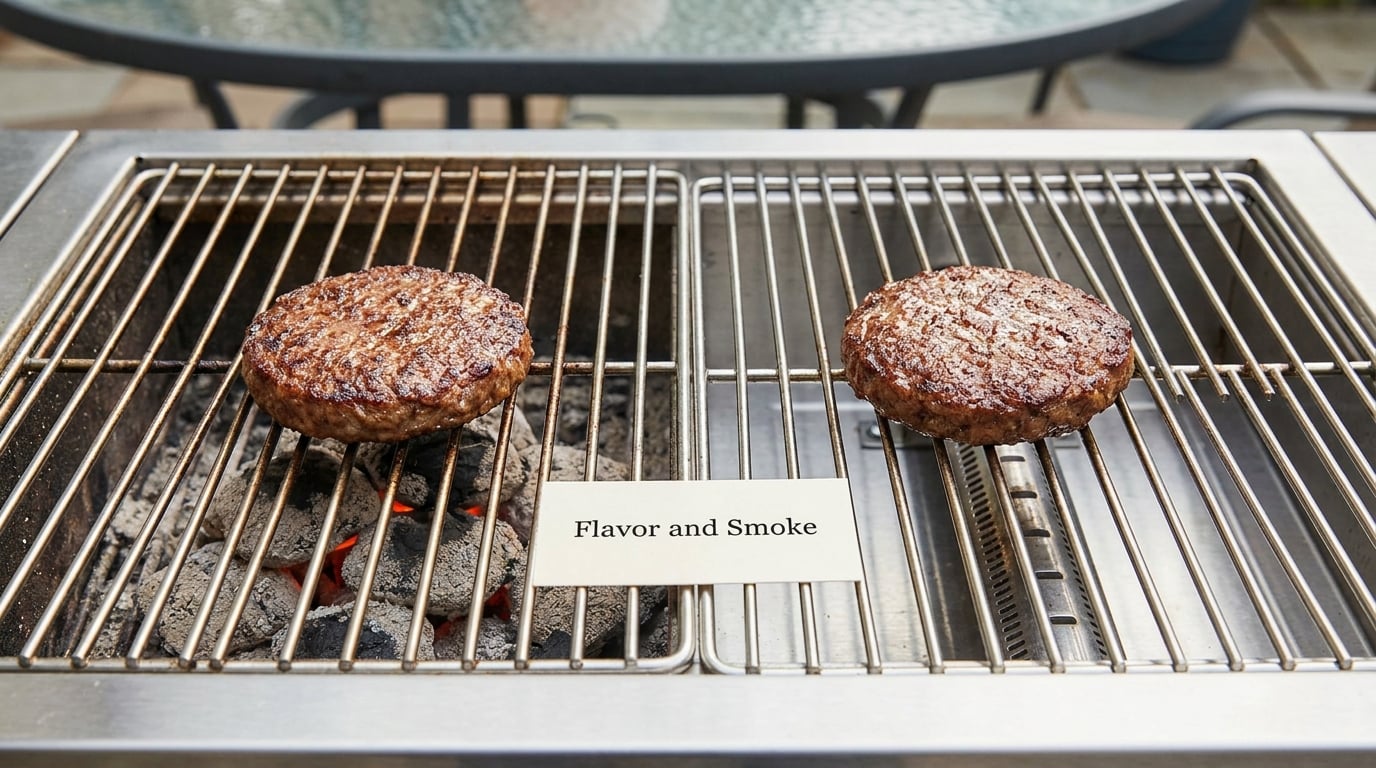
The honest answer to why charcoal burgers taste better comes down to four things happening at once, and only three of them happen on gas.
- Smoke adhesion. A charcoal fire gives off combustion gases that settle on the surface of the meat and on the grate. Burger patties are thin, so what sticks to them goes straight into the bite.
- Radiant heat. Coals throw infrared heat straight up, hitting the bottom of the patty harder than a gas burner’s mostly convective heat. That extra browning on the underside is where a lot of the flavor lives.
- Peak temperature. A kettle grill or a kettle-style charcoal grill with the lid closed will run hotter than most gas grills, and a very hot surface drives the browning reaction quickly.
- Wood options. You can build a fire out of oak, hickory or mesquite and put the coals over mesquite for the last few minutes before cooking.
The catch is that charcoal can taste bad. Lighter fluid leaves a chemical taste, and cheap briquettes have a uniform charcoal smell that some people describe as a chemistry class. Lump charcoal burns cleaner and smells like wood, which is why it is worth the price difference for burgers.
Does charcoal really taste better than propane?
Usually, yes, and the forum consensus is nearly unanimous about it. As one r/grilling post puts it, nothing beats meat and charcoal. But blind taste tests tell a more honest story: an unmanaged gas grill and a well-run charcoal grill land closer together than the internet suggests. The gap opens up when the charcoal cook leaves the vents open, the coals are properly lit and the grate is clean.
Which charcoal should you buy for burgers?
Briquettes are easier: they light quickly, hold an even temperature and cost less per bag. Lump charcoal lights slower, burns hotter and gives you the wood aroma people are actually chasing. For burgers, briquettes work fine and lump is the upgrade, mostly about the smell in your yard and on your clothes.
Searing and Maillard Flavor
Both grill types will give you a browned, crusted patty if you manage them. The Maillard reaction, which is the browning you actually taste, kicks in somewhere above 300 F and speeds up dramatically as the surface climbs. Gas reaches a useful searing temperature in a few minutes after preheating. Charcoal does too, once the ash on the coals turns gray and the surface stops looking like raw fuel.
The practical difference shows up in recovery. Open a gas grill lid and the burners put heat back within a minute or two. Open a charcoal lid in the middle of a sear and the coals drop noticeably, so the crust stops developing until the fire recovers. That is why a charcoal cook leaves the lid closed during the sear and the gas cook can leave it open and even finish a thin patty by air.
Grate material matters in both cases. Cast iron holds heat and gives a hard, fast sear that releases cleanly once the patty has crusted. Stainless steel sears a little more gently and sticks more readily to a raw patty. Pat LaFrieda, the butcher quoted by Thrillist, put the pro-gas case plainly: with lava stones heated up, the burners off, and the grate carrying the heat, a gas grill sears like charcoal without the flare-ups.
How Heat and Temperature Control Compare
Direct versus indirect heat is the whole ballgame for burgers, and both grills can do it. You want one side of the grate hot for searing and the other side cooler for finishing, so the fat renders and the inside cooks without the outside burning. On charcoal you build that by pushing coals to one side and adjusting the vents. On gas you light the burners on one side and use the other side of the grate as the indirect zone.
Two-zone cooking is what prevents the three classic failures: a raw center, a black crust outside a pale interior, and patties that cook unevenly from edge to edge.
Gas gives you finer control than people give it credit for. Burners are independent, so you can hold a steady medium heat for a batch of thin patties and still have a very hot zone for the sear. Gas does have hot spots, usually where a burner meets the grate bars or near a side wall, which is why a two-zone setup beats blasting the whole grate on full.
Charcoal gives you a wider range and a rougher dial. You can take a bed of coals from 250 F to above 700 F by opening vents and adding fuel. Managing that range means watching the fire rather than a knob, which is exactly what appeals to some cooks and exhausts others.
Charcoal Grill for Burgers: Flavor-First Grilling
Charcoal rewards attention. Light a chimney starter rather than fluid, dump the coals in about 15 minutes before you plan to cook, and build the fire to one side of the kettle while leaving the other side open for indirect cooking.
Hot spots are the main thing to learn. They sit over the freshest fuel, so move patties around once early on, when the crust has set enough to survive the move. Ash on the coals insulates rather than burns, so if the heat feels weak, rake the lighter gray ash off the top and let the red underneath breathe.
Flare-ups come from dripping fat. Charcoal is more forgiving here because there is usually more vertical distance between the coals and the food, but a heaped patty can still catch fire. Keep a squirt bottle of water within reach, never a full one over an open flame, and move the meat to the cool side if fat starts running.
The honest list of drawbacks: 15 to 25 minutes of startup, ash to dispose of, dirty hands and clothes, and a fire that needs checking. One r/grilling poster switched from charcoal to gas specifically because cooking on a kettle was causing sinus issues every time. That is a real reason, not a wrong one.
Gas Grill for Burgers: Fast and Consistent Grilling
Gas is the grill you can walk up to at 6pm with ground beef in your hand. Push the igniter, set two burners on high, wait for the grate to stop smoking, and you are searing patties in under fifteen minutes from opening the fridge.
The control is precise in a way charcoal never is. Knobs move the heat in small increments, so thin smash-style patties that need 45 to 60 seconds a side are easy to time. Recovery is fast, which means you can work a batch of burgers hard for the sear, then drop the burners back for a gentle finish without losing your setup.
Gas also handles a group. Cook onions and peppers on a side burner while the main grates sear, or run one side low for a batch of patties while the other side finishes thick burgers. That is a Tuesday-night operation, and it is why plenty of experienced cooks use gas during the week and charcoal on weekends.
To close part of the flavor gap, three things help. A smoker box with soaked wood chips gives you real smoke flavor on gas. A cast iron griddle plate or flat top gives you the hard radiant sear and even heat a grate cannot. And preheating longer than feels necessary, until the grate is hot enough that a water bead skitters and sizzles, produces a better crust.
Lighting, Cleanup, and Maintenance
Cleanup is where gas wins so decisively that it decides the argument for anyone cooking four nights a week. After a cook, a gas grill needs a grate brush, a wiped lid and, every few uses, an emptied grease tray. There is no ash pan and nothing to carry out to the bin.
Charcoal asks more. Embers must be fully dead before ash goes in a metal container, lids can rust if trapped moisture sits on them, and the grease catcher needs the same attention as a gas grill’s. The mess is not the cooking, it is the two minutes afterward.
Fuel handling differs too. Charcoal is a bag you carry from the trunk, and you can grill as much as you lit, which is a waste when you only want four burgers. A propane tank means paying for fuel by the tank and possibly a refill or an exchange. A natural gas grill needs a line run to the patio and the grill installed permanently.
For maintenance, charcoal grills mostly need air vents kept clear and grate care. Gas grills need more: burners inspected for blocked ports, hoses and fittings checked for leaks with soapy water, and the grease channel cleared. Follow the manual your grill shipped with; burner layouts differ between brands.
Safety, Weather, and Practicality
Both grill types should be used outdoors, on a stable surface away from overhangs and dry vegetation. Never move a hot grill into a garage or under a patio roof, and let a charcoal fire die down completely before you consider it out.
Charcoal carries a carbon monoxide risk that gas does not, because a smoldering charcoal fire produces carbon monoxide continuously and a kettle can sit in a yard for hours after dinner. If you feel a headache or irritation after cooking, that is a reason to open a window, not to ignore.
Gas burns cleanly with no carbon monoxide output outdoors, which is why many people with asthma or sinus sensitivity make the switch. The trade is propane handling: check for leaks with soapy water before a first light, close the cylinder valve when you are done, and store the tank upright outdoors.
Wind is the one condition where charcoal loses badly. A kettle with an open top and hot coals is easy to blow out or, worse, to send embers into dry grass. Gas burners shrug off a breeze. And before you buy either, check your building or HOA rules: some patios permit a gas grill and prohibit charcoal outright because of the fire and smoke rules.
Portability splits the same way. A kettle is small, light and independent, so a beach or campsite grill is almost always charcoal. Most gas grills are wide and heavy, though small tabletop gas models exist for the same trips.
How to Grill Burgers Safely and Consistently
These steps work on either grill type, with one temperature difference: charcoal usually wants a little more heat for the sear, gas gives you more control over the finish.
- Form the patty loosely. Handle the meat as little as possible and leave it slightly irregular. A thumbprint in the center stops it from doming as it cooks.
- Preheat fully. For charcoal, wait until the ash looks gray and the coals glow; for gas, wait until the grate is hot enough that a drop of water skitters across it. This step is where most missed sears happen.
- Set up two zones. Push coals to one side on charcoal, light burners on one side on gas. Sear on the hot side, finish on the cool side.
- Do not press. Pressing squeezes out juice and the Maillard flavor. Scrape once with a spatula instead.
- Tame flare-ups. Move the meat to the cool zone rather than flooding the fire, and keep the vent open on charcoal so it burns clean.
- Check the temperature. Ground meat must reach 160 F or 71 C internally. Use an instant-read thermometer in the thickest part of the patty, not against the bone or the grate.
- Rest before serving. A couple of minutes off the heat lets the juices settle instead of running out onto the plate.
The short version of the temperature debate: for thin patties, sear hot and fast; for thicker patties, start on the hot side for crust then move to indirect so the middle can catch up without charring the outside.
Which Should You Choose?
Choose charcoal if you cook outdoors on weekends, want the strongest smoke and char flavor, enjoy managing a fire, and do not mind ash, dirty hands and a 15 to 25 minute head start. Choose gas if you cook burgers on weeknights, want consistent results without thinking about airflow, have a family that needs dinner on the table fast, or want to finish grilling in the time it takes a kettle to light.
Gas is the better first grill for most beginners. It has the shortest learning curve and the fewest ways to go wrong on a Tuesday evening. Charcoal is the better grill if flavor is the reason you cook at all, and you are willing to earn it.
A few specific situations. For a burger cookoff with eight people, gas wins on throughput and predictability. For an apartment balcony or a patio under an HOA that bans open flames, gas is usually the only legal option. For camping or the beach, charcoal wins on portability. For someone with sinus sensitivity, gas wins on comfort.
Many cooks end up owning both, which is what r/askanything posters describe as the practical answer: gas for quick burgers, steaks and chicken, charcoal for everything else.
Frequently Asked Questions
Which is better for burgers, charcoal or gas?
Charcoal is better for burgers if flavor is your priority, because smoke adhesion and radiant heat from the coals produce a deeper crust and more char. Gas is better if you want speed, precise heat control and a five-minute cleanup, and it will still produce an excellent burger. Most cooks use gas midweek and charcoal on weekends.
Does a gas grill make burgers taste as good as charcoal?
A gas grill will produce a very good burger, but it will not taste identical. The difference comes from smoke and radiant heat, both of which are largely absent on gas. You can narrow the gap with wood chips in a smoker box, a cast iron plate, a longer preheat and a two-zone fire, but a well-run charcoal grill still has the edge.
Is charcoal safer to grill burgers than gas?
Neither is unsafe when used outdoors as intended. Charcoal adds a carbon monoxide risk, since a smoldering fire keeps producing it long after dinner and a kettle is easy to leave outside by mistake. Gas burns cleanly outdoors but adds propane handling and leak checks. Gas is usually the easier option for anyone with asthma or sinus irritation.
Which type of grill is easier to clean after cooking burgers?
Gas, without question. You brush the grate, wipe the lid and empty the grease tray every few cooks. A charcoal grill needs the same grate care plus ash disposal, and you must wait until every ember is dead before putting ash in a metal container. Over a year of twice-weekly cooking, that difference is substantial.
Can I make a gas grill taste more like a charcoal grill?
Yes, three changes do most of the work. Put soaked wood chips in a smoker box, sear on a cast iron plate instead of the bare grate, and preheat longer than feels necessary. Pat LaFrieda described heating lava stones, turning the burners off and grilling on the grate, which keeps the sear without flare-ups or lighter fluid taste.
Conclusion
Pick gas if you want burgers on the table on a weeknight with no fuss and no ash, and pick charcoal if you cook for the crust and the smoke and enjoy working a fire. Start by deciding how often you will actually grill: a few times a week makes gas the better buy, while weekends and cookouts make charcoal worth the extra effort.