
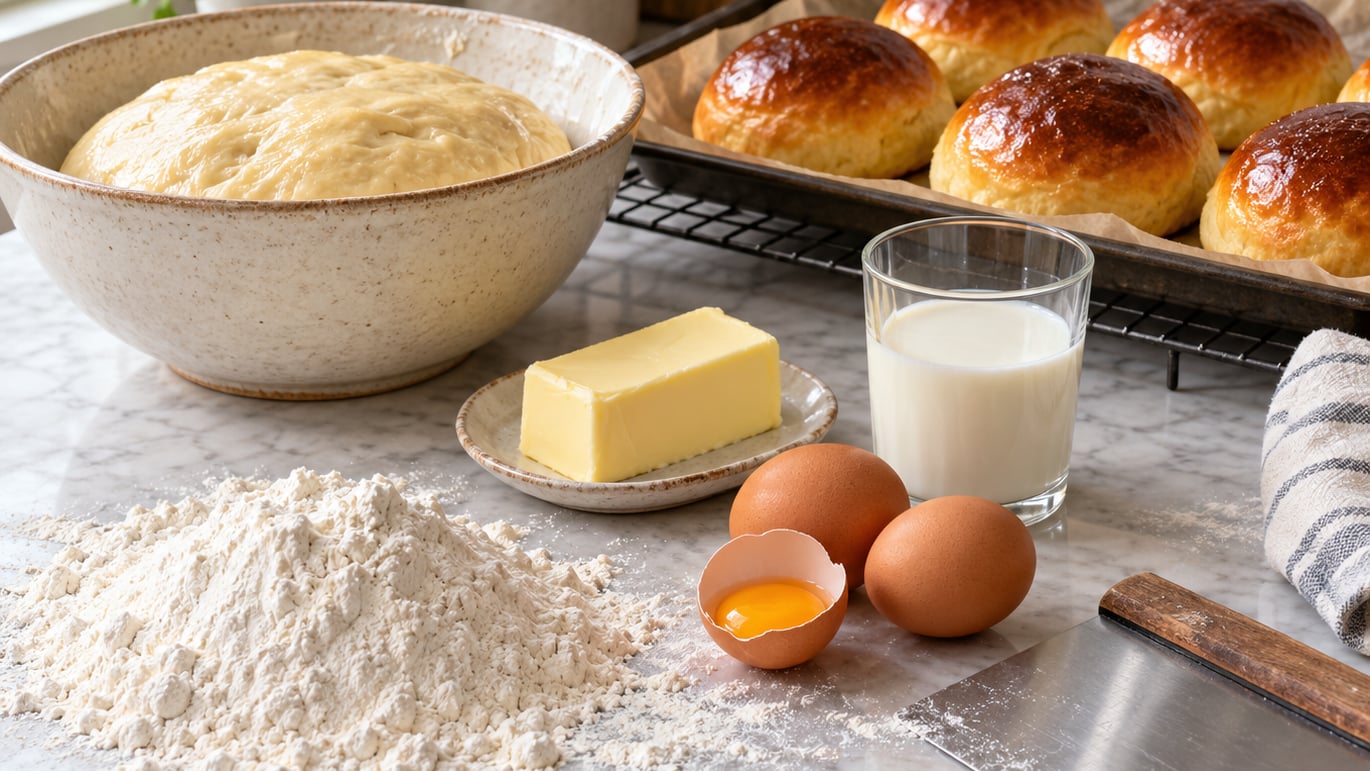
Brioche buns are small, tall rolls made from an enriched dough, which means eggs and butter go into the batter alongside flour, milk, sugar, and yeast. That fat-and-egg content is what makes them soft enough to almost squeeze flat, glossy from an egg wash, and sturdy enough to hold a thick smash burger patty without splitting. Learning how to make brioche buns at home takes about three hours start to finish, most of it waiting.
The dough looks sticky and messy for the first ten minutes, and that is where most beginners bail. Push through it. Enriched doughs are temperamental about temperature and careless with flour, but forgiving about time. If you learn to judge the two rises by sight instead of the clock, these come out reliably.
I’ve baked this dough enough times that I go by feel now. My rule: never add flour the recipe doesn’t ask for, and always let the buns cool completely before cutting them, even when you’re in a hurry for dinner.
What You Need
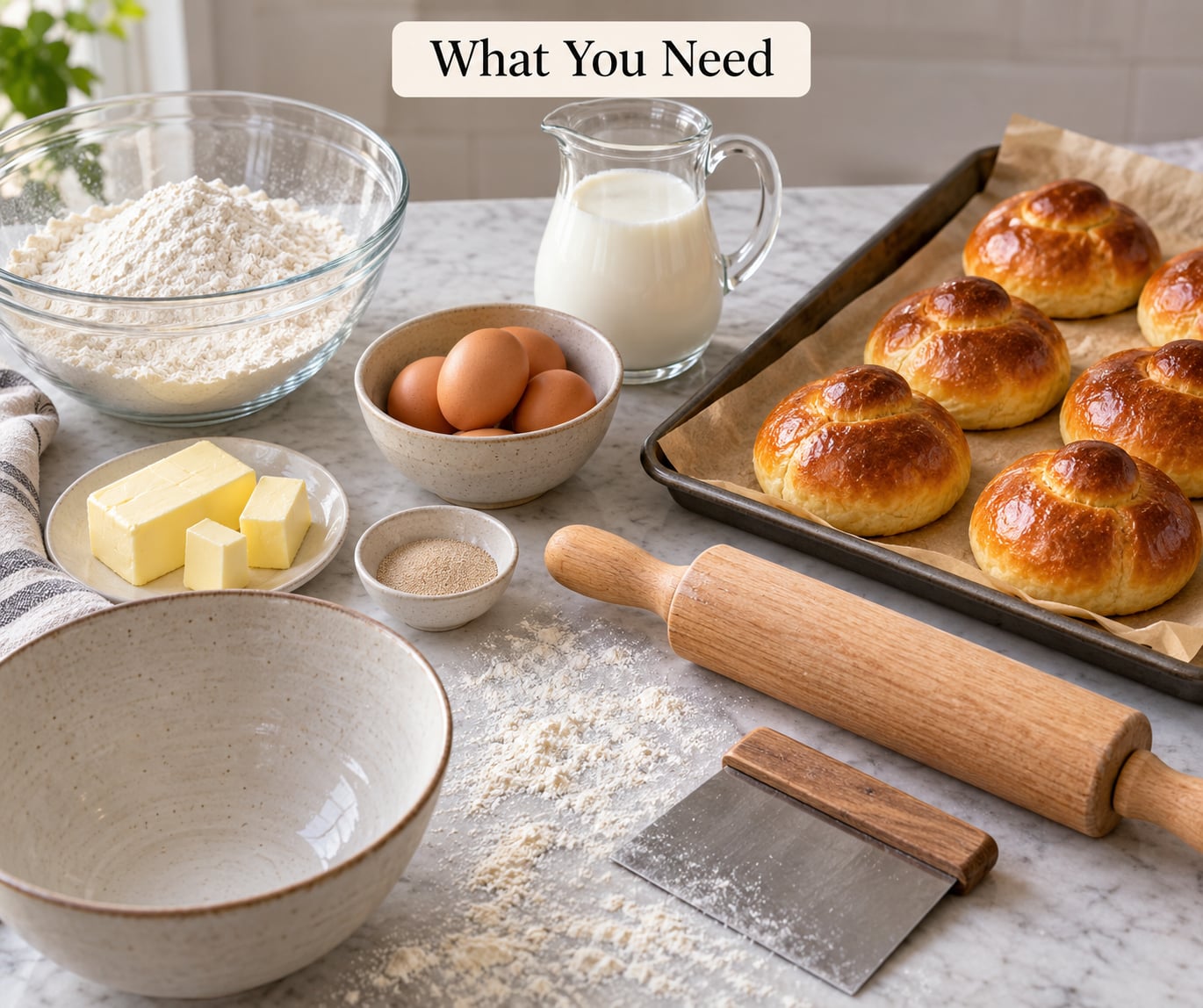
Six buns need about 700 grams of dough. Weighing ingredients is the single biggest upgrade you can make here, because cups and grams diverge fast in a flour-heavy recipe and enriched doughs punish small errors more than lean ones.
- Bread flour, 340 g (about 2 3/4 cups). All-purpose works, and gives a slightly denser, more tender crumb.
- Whole milk, 85 g (1/3 cup plus 1 tablespoon), warmed to 105–115°F. Too hot and the yeast dies on contact.
- Instant yeast, 7 g (2 1/4 teaspoons). Active dry yeast needs the same weight plus a longer activation.
- Granulated sugar, 50 g (1/4 cup), which feeds the yeast and gives the bun its faint sweetness.
- Large eggs, 2, at room temperature.
- Unsalted butter, 115 g (1/2 cup), softened to room temperature but still cool.
- Fine salt, 9 g (1 1/2 teaspoons).
- Vanilla extract, 1 teaspoon, optional but worth it.
- Egg wash: 1 beaten egg plus 1 tablespoon of milk, for brushing.
For equipment, a stand mixer with a dough hook saves about ten minutes of hand work, though plenty of people make this recipe by stirring in a bowl with a spatula. A kitchen scale, a bench scraper or dough whip, a rimmed baking sheet lined with parchment, and a wire cooling rack cover the rest.
On a baker’s percentage basis, this is roughly 25% milk, 34% butter, 15% sugar, and 11% egg against the flour weight, which puts it in American burger-bun territory. Classic French brioche leans far richer and more eggy. If you want that version for sandwiches, bump the eggs to three and the butter to 140 g, and expect a taller, less sweet loaf-like bun.
If you prefer a plainer route, our guide to how to make burger buns from scratch skips the eggs and butter entirely and bakes in under half an hour.
Step-by-Step: How to Make Brioche Buns
Step 1: Activate the Yeast and Prepare the Milk
Warm the milk in a saucepan for 30 seconds, or in the microwave in 15-second bursts, and stir in the sugar. Aim for 105–115°F on an instant-read thermometer; it should feel comfortably warm, not hot. Sprinkling in the yeast and waiting five minutes gives you a foam or a skin of bubbles on the surface. No foam means the milk was too hot or the yeast was old, so start over with cooler liquid.
Step 2: Mix the Dough
In your mixer bowl, combine the flour, salt, and half the activated milk mixture. Mix on low until a shaggy paste forms, then add the eggs, remaining milk, and vanilla. The dough will look rough and wet. Scrape down the bowl and mix two minutes longer before moving to butter.
Step 3: Knead Until Smooth and Elastic
Cube the softened butter and add it in three or four pieces, mixing on speed 2 until each piece disappears before adding the next. Total kneading takes 8–10 minutes on speed 2, or about 12–15 minutes by hand on a floured surface once the butter is worked in. The dough should clear the sides of the bowl and turn from sticky to smooth, soft, and slightly tacky.
To check gluten development, pull off a small piece and stretch it between two fingers. A thin, translucent membrane that holds without tearing means you’re done. Enriched doughs can take longer to develop than plain bread dough, and stopping early is the usual reason buns come out tough rather than tender.
Step 4: Let the Dough Rise
Round the dough, place it in a lightly greased bowl, cover with a damp towel or plastic wrap, and let it bulk ferment for 60–90 minutes at 75–78°F. Warmer kitchens ferment faster. The dough is ready when it has nearly doubled and looks puffy with bubbles at the edges.
Test with a floured finger: press gently into the dough. A dent that springs back slowly and leaves a slight depression means it’s ready. A dent that springs back instantly needs more time; a dent that stays with no springback at all means it’s over-proofed and will bake flat. Turn the dough out and press it down to deflate it.
Step 5: Divide and Shape the Brioche Buns
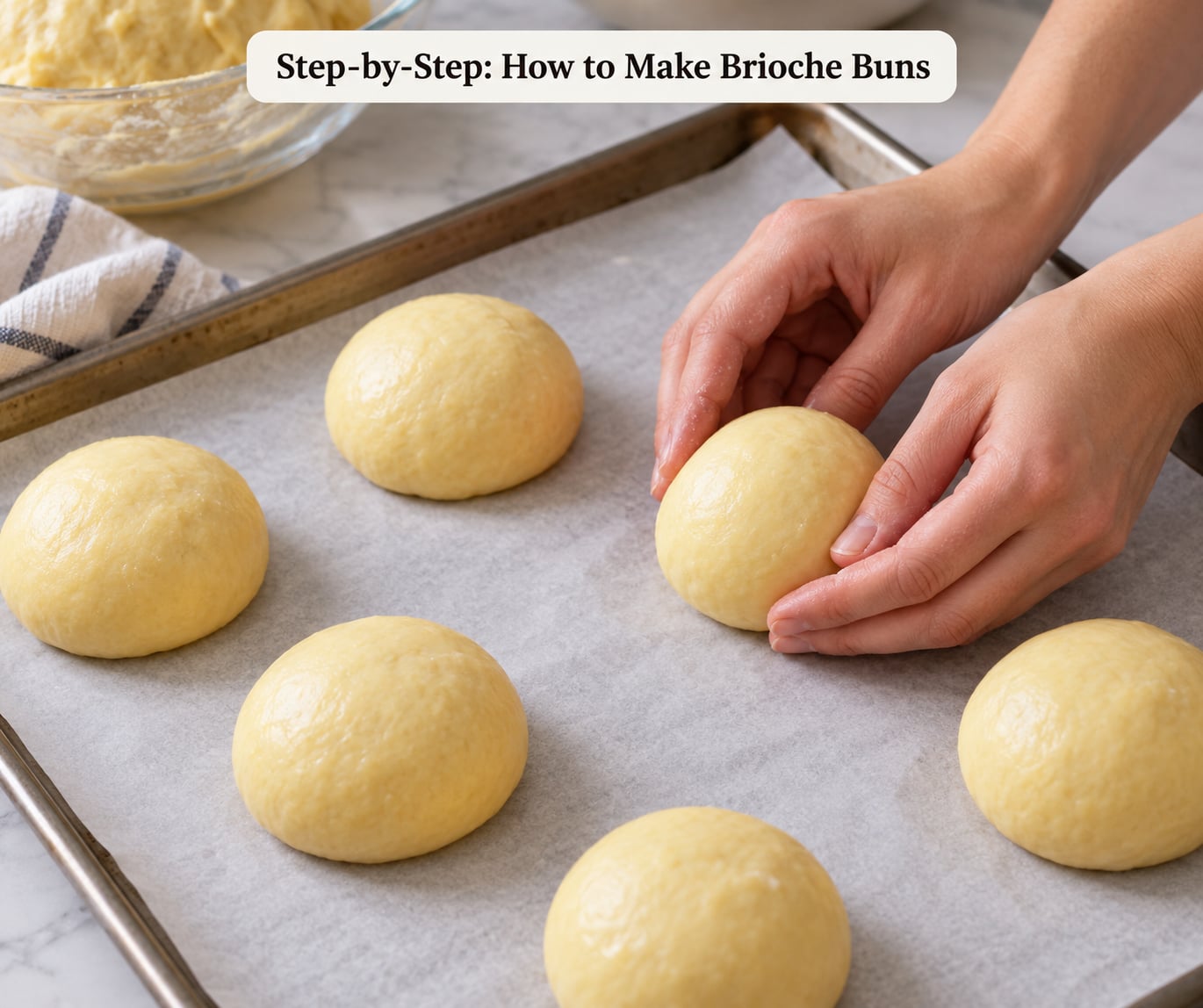
Divide the dough into six equal pieces, about 115 g each, using a scale for even buns. Cup each piece in your palm, pinch the edges into a ball, then drag it along the counter in a C shape with your hand cupped over it until you feel the surface tighten. That’s surface tension, and it’s what gives you a bun that rises tall instead of spreads flat.
Tuck the seam underneath and place each bun seam-side down on the parchment-lined sheet, leaving about 2 inches between them so the buns can expand without touching. If the dough softens and gets sticky while you shape, refrigerate the pieces for 10 minutes before continuing.
Step 6: Proof, Egg Wash, and Bake
Cover the shaped buns so nothing dries out and let them proof for 45–60 minutes, until puffy and roughly 1.5 times their size. Be careful here. Dough proofed past this point goes flat and spreads in the oven, which is the most common failure on a first batch.
Heat the oven to 375°F (190°C) and brush the buns gently with egg wash. They should look glossy but not dripping. You can scatter sesame seeds or Everything Bagel seasoning on now if you like.
Bake for 15–18 minutes at 375°F, or 12–15 minutes at 400°F if you want a darker, shinier crust on smash burgers. Smaller buns bake faster, so check the smaller ones first.
How to Tell When Brioche Buns Are Done
Color is your first cue: the tops should be deeply golden brown, not pale. The crust springs back when you press it lightly. Tapping the bottom gives a hollow sound, and an instant-read thermometer inserted into the center reads 190–195°F.
Most underbaked brioche failures come from pulling the buns too early, so if in doubt, give them two more minutes. A pale bun with a wet, gummy crumb is underbaked; a dark, dry, hard crumb is overbaked.
Cool the buns on a wire rack for at least 30 minutes, and ideally an hour. The crumb is still setting as it cools, so cutting early gives you a gummy, compressed interior. Cutting it early also makes the bun tear instead of slice. If a bun has gone stale, a 5-minute pass in a 350°F oven brings back the crust, and a light brushing with melted butter softens the crumb again.
Common Mistakes When Making Brioche Buns
Almost every problem with homemade brioche buns traces back to one of four things: dead yeast, cold or hot dough, over-added flour, or proofing that ran long. Anyone searching how to make brioche buns for the first time will hit at least one of them.
- Yeast and milk didn’t foam. The liquid was above 120°F, which kills the yeast instantly, or the packet was old. Recheck with cooler milk next time.
- Dough never doubled. Your kitchen was too cold, below about 70°F. Warm the bowl before it goes in, or place it near the oven while it preheats.
- Buns came out dense and heavy. Almost always extra flour. Enrichment plus too little structural flour gives you a tight crumb, and it can’t be fixed after the fact.
- Dough was too sticky to handle. That’s normal for this hydration. Rest it 10 minutes before dividing, and only flour your hands lightly rather than the dough.
- Buns spread flat and lost height. Over-proofed before baking, or handled roughly during shaping. Shorten the second rise and build more surface tension in Step 5.
- Centers collapsed or burst in the oven. The same over-proofing, sometimes compounded by a cool oven. Watch the rise, not the timer.
- Buns browned on the bottom but stayed gummy inside. Cutting too early. Cool them fully.
- Egg wash ran off and pooled. You brushed too heavily. A thin, even coat is all you want.
Tips for Better Brioche Burger Buns
Weigh everything, especially the flour and the butter. Volume measures on butter vary by more than a quarter cup across the block.
Softened butter should dent under your thumb but feel cool to the touch. If it melted, the dough will never develop properly, and the buns will be greasy rather than rich. When the room is warm, chill the dough pieces between shaping rather than adding flour.
Adjust proofing time to your kitchen, not the recipe. On a 78°F day the first rise can finish in 45 minutes. On a 68°F winter day, give it two hours and don’t panic.
For a moister crumb with a longer shelf life, cook a tangzhong: stir 20 g of flour into 60 g of the warmed milk, simmer until thick, and cool it before mixing it in. The cooked starch gelatinizes and holds water in the crumb.
To keep the tall bakery profile, rest the shaped buns 10 minutes in the fridge before the final proof, and handle them gently on the way to the oven.
The same dough easily becomes sliders, dinner rolls, or long hot dog buns and brats; just shape it differently and expect a few minutes’ adjustment on bake time. One dough, three shapes. A brioche loaf in a greased loaf pan works too, with the same rising time.
Once baked, cool completely, then store at room temperature in a bag or airtight container for two days. For longer storage, wrap each bun individually in plastic and freeze up to three months, then reheat straight from frozen in a 350°F oven for about 5 minutes.
For the burger side of the equation, a smear of garlic butter on the cut face and a stuffed patty turn a homemade bun into the reason people ask about it.
Frequently Asked Questions
Why are my brioche buns dense?
Dense brioche buns almost always come down to extra flour or a dough that never rose enough. Enriched dough is sticky by nature, and beginners often work in more flour than the recipe calls for, which tightens the crumb. Check that the first rise truly doubled before you deflate it, and make sure your kitchen was at least 70F so the yeast worked.
Can I make brioche buns without a stand mixer?
Yes. Combine the dry ingredients and wet ingredients in a bowl and stir with a sturdy spatula for about 10 minutes, then knead by hand for 10 to 15 minutes. Enriched dough is too wet to knead traditionally anyway, so a long stir does most of the work. Let the dough rest 10 minutes whenever it resists, and flour your hands rather than the dough.
Do I need a second rise when making brioche buns?
Skip it and the buns bake dense, short, and tight, no matter how long the first rise was. The second rise is what builds the tall, light bakery-style height, since the shaped gluten has to relax and re-inflate. Give it 45 to 60 minutes at room temperature, and watch the dough rather than the clock, because over-proofing flattens the buns in the oven.
Can I make brioche buns ahead of time?
Yes, and this is the easiest dough to plan around. Make it through shaping, cover tightly, and refrigerate for up to 16 hours. In the morning, let the buns sit at room temperature for 45 to 60 minutes until puffy, then egg wash and bake. You can also bake them a day ahead, cool fully, and freeze, then reheat from frozen at 350F for about 5 minutes.
What is the difference between a brioche bun and a hamburger bun?
A brioche bun is an enriched dough built with eggs, butter, milk, and sugar, which makes it sweet, tender, and glossy. A standard hamburger bun is leaner, uses less fat, and bakes up firmer and more neutral in flavor. Brioche is softer and taller; regular buns hold up better to very wet fillings and stay cheaper to buy by the dozen.
Can I freeze baked brioche buns?
Brioche buns freeze well for up to three months. Let them cool completely on a wire rack first, wrap each one individually so the crumb does not get freezer-burned, and store them in a freezer bag or airtight container. Thaw at room temperature in the bag, or reheat from frozen in a 350F oven for about 5 minutes until the crust is warm again.
Conclusion
The whole method comes down to four beats: activate your yeast in warm milk without scalding it, develop the dough until it clears the bowl and stretches thin, give it two full rises, and bake until deeply golden and hollow-sounding. Everything else, tangzhong, an overnight rest, French-style ratios, is an upgrade on a sound base.
Start with the numbered steps above, watch the dough instead of the clock, and let the buns cool before you cut into them. That is how to make brioche buns that taste like they came from a bakery case.