
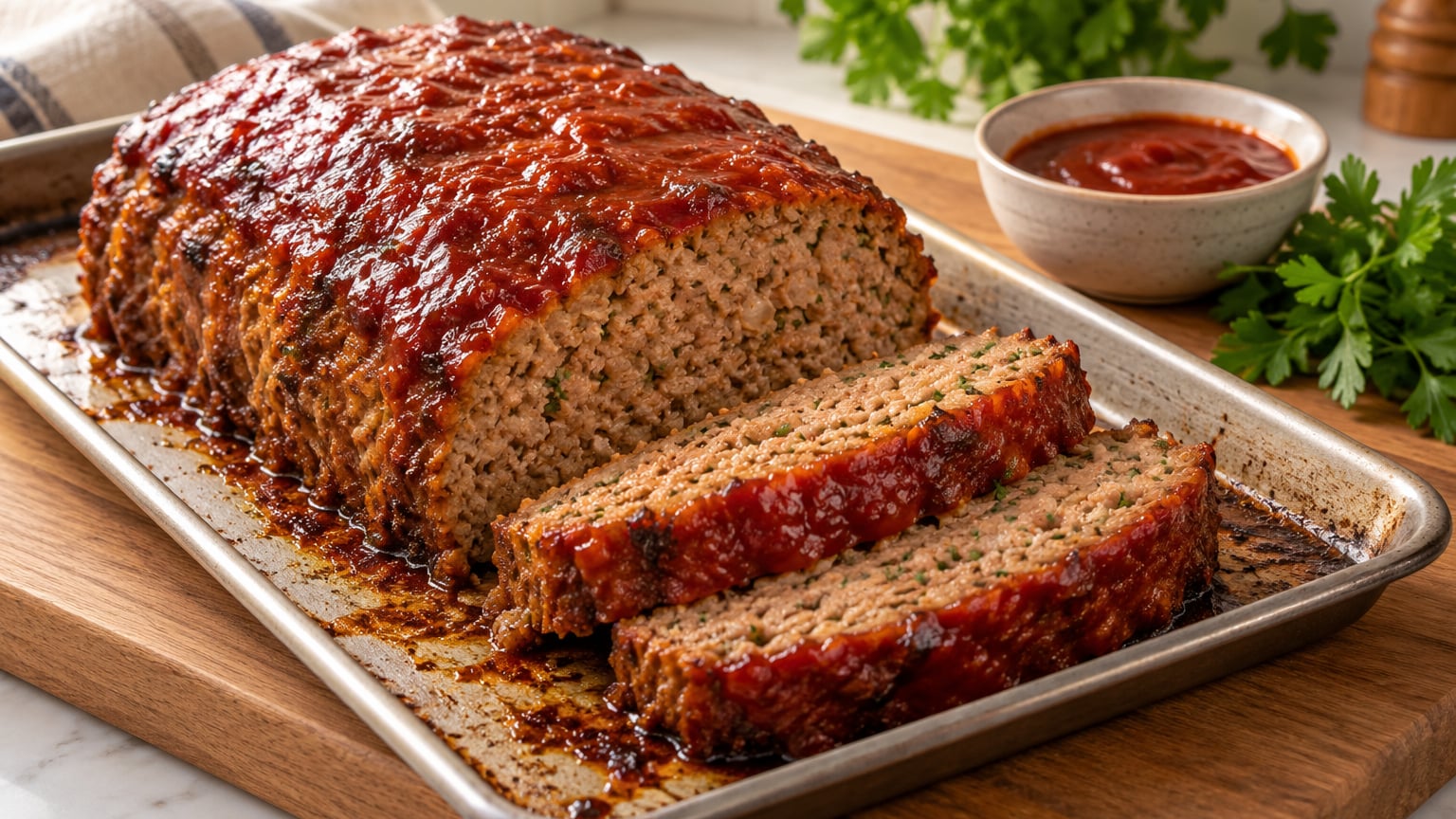
How to make meatloaf comes down to six things: 80/20 ground beef, breadcrumbs soaked in milk, an egg to bind it, onion and Worcestershire sauce for flavor, a loaf shaped on a lined sheet pan, and a ketchup glaze brushed on halfway through the bake. Bake at 350°F until the center hits 160°F, then rest it before slicing.
That last part is where most home cooks go wrong. Meatloaf that comes straight out of a screaming oven and gets sliced immediately looks like a burger and tastes like one. Ten minutes of rest turns it back into a loaf.
Budget: about 20 minutes of prep, 55 to 75 minutes in the oven, and it feeds six hungry people for very little money. If this is your first time, read the whole guide once before you start.
What You Need
Everything below builds the classic meatloaf recipe. Measurements are grouped by what each ingredient actually does in the mix, which makes substitutions easier later.
The meat
- 2 pounds (900 g) 80/20 ground chuck. This is the workhorse. Eighty percent lean gives you flavor and enough fat to stay juicy. Ninety-ten ground sirloin works if you want it leaner, but drizzle a tablespoon of olive oil into the mix to compensate.
- A classic tender alternative: 1 pound (450 g) beef, 1 pound (450 g) pork, and 1/2 pound (225 g) veal or turkey. Restaurants use blends like this for a reason.
Stay away from 93/7. Almost no fat renders out, and that is the single most common reason a lean-ground-beef meatloaf comes out dry and crumbly.
The binder and the moisture
- 1 cup (115 g) dry breadcrumbs. Panko works and gives a slightly crunchier crust. Seasoned Italian breadcrumbs let you skip half the salt.
- 1/2 cup (120 ml) milk. Soak the breadcrumbs in it for 5 to 10 minutes. This is the step most recipes skip and the one that keeps a lean loaf from drying out.
- 1 large egg. Sets the loaf so it holds together when sliced.
- 2 tablespoons Worcestershire sauce. Adds salt, tang, and umami in one pour.
The aromatics and seasoning
- 1 small onion, grated or finely diced. Grating it melts into the meat with no chunky bites. Pre-cooking is optional; see the notes below.
- 2 garlic cloves, minced.
- 1 teaspoon kosher salt and 1/2 teaspoon black pepper. Ground beef needs more salt than instinct suggests.
- 1 teaspoon Italian seasoning or 1 teaspoon dried thyme plus 1/2 teaspoon oregano.
The glaze
- 3/4 cup (200 g) ketchup
- 2 tablespoons light brown sugar
- 1 tablespoon Worcestershire sauce and 1 teaspoon yellow mustard
Equipment
A rimmed baking sheet is my pick. A loaf pan traps steam and juices, so the meat poaches instead of browning, and the bottom turns soggy. Line a rimmed sheet pan with parchment, leaving a small overhang so you can lift the loaf out. If you only own a 9×5-inch loaf pan, it will still work, just expect a softer crust and pull the loaf out at 160°F rather than waiting for deep browning.
You also want an instant-read thermometer. Baking time is a guess; 160°F is a fact. Skip the knife test, poke the center, and you are reading oven temperature, not meat temperature.
Simple swaps
| Instead of | Try | What changes |
|---|---|---|
| Dry breadcrumbs | Panko, crushed saltines, or 1/2 cup cooked white rice | Softer or crunchier interior; saltines mimic diner-style meatloaf |
| Milk | Buttermilk, or 1/2 cup tomato sauce | Buttermilk adds tang, tomato sauce adds sweetness and moisture |
| Ground beef | Ground turkey plus 2 tablespoons olive oil | About 30 percent less fat; add the oil or it dries out |
| Milk-soaked crumbs | Gluten-free breadcrumbs, plus a tablespoon of ground flaxseed | Works for gluten-free; flax gives the binding egg lacks |
| 1/2 cup milk | Grated potato, squeezed dry | The old-school trick for a soft, almost creamy crumb |
Step-by-Step: How to Make Meatloaf
The method below is the one I use for a 2-pound loaf. Follow it in order and the timings will line up.
1. Prepare the Pan and Sauce
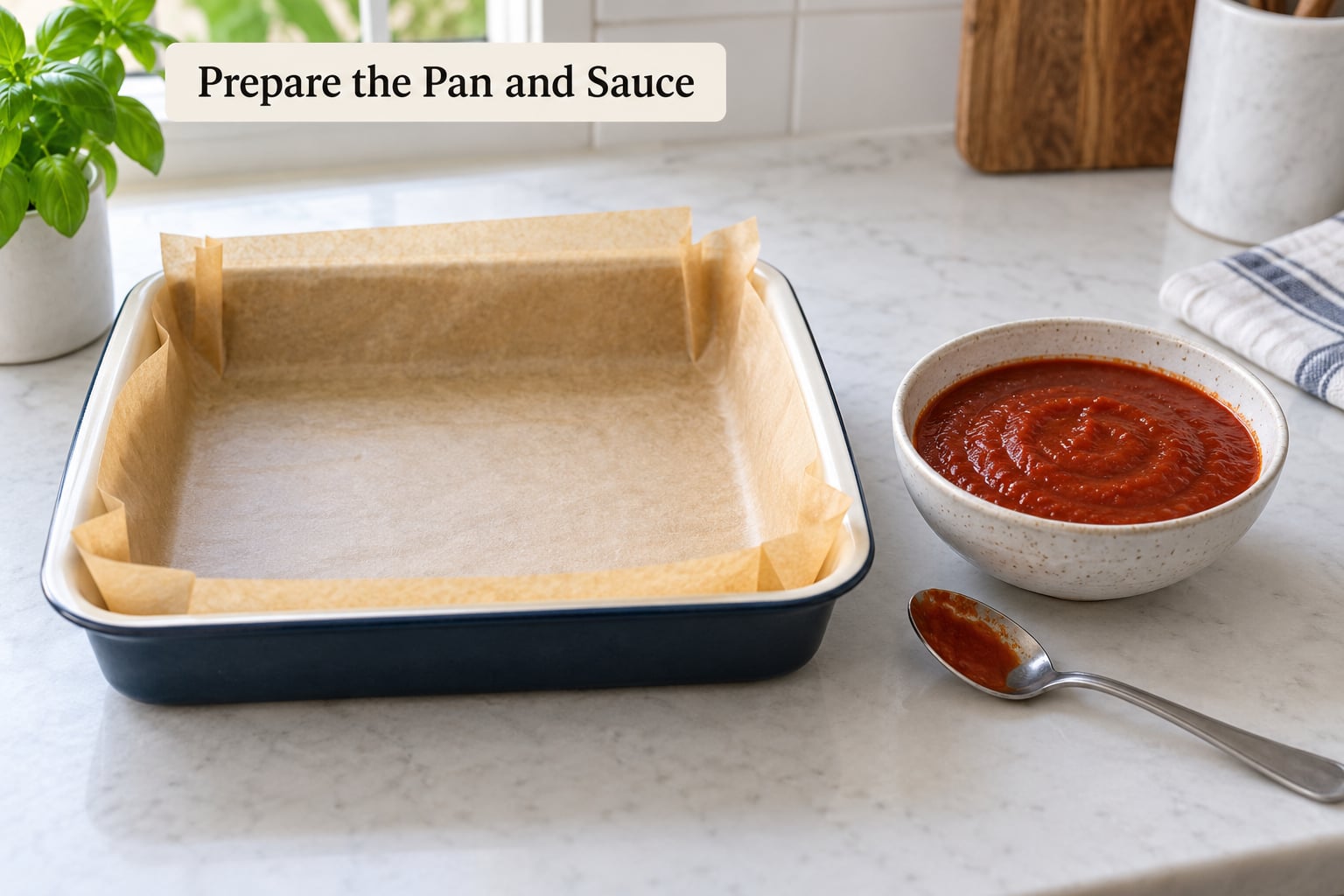
Heat the oven to 350°F. Line a rimmed baking sheet with parchment and set it inside the oven while it heats, so the pan is already hot when the loaf lands on it. A hot sheet gives the bottom a head start on browning.
Whisk the glaze together in a small bowl: 3/4 cup ketchup, 2 tablespoons brown sugar, 1 tablespoon Worcestershire, and 1 teaspoon mustard. Set it aside, covered, at room temperature. Mixing it now means you are not fumbling with a spoon in the middle of a hot bake.
2. Mix the Meatloaf Without Overworking It
Put the breadcrumbs in a bowl, pour the milk over them, and wait 5 to 10 minutes until the crumbs are fully damp and soft. Squeeze a handful: it should hold together without dripping.
While the crumbs soak, pre-cook the onion if you want a softer texture. Sweat 1 diced onion in 1 tablespoon olive oil over medium heat for 4 to 5 minutes until translucent, then let it cool to just warm. Mixing raw onion straight into cold beef is fine too, just expect more visible pieces and a sharper bite.
Now combine the ground beef, soaked breadcrumbs and milk, egg, Worcestershire, garlic, salt, pepper, and Italian seasoning in a large bowl. Add the cooled onion if you cooked it. Use a wooden spoon and mix with about 15 strokes, just until no streaks of dry crumbs remain.
Here is the part that decides your texture. Overmixing works a lot of gluten and myosin into the meat, which is what gives a bouncy meatball its spring. It turns a tender loaf into a rubbery one. Stop early, even when the mixture still looks slightly uneven. A slightly uneven meatloaf eats better than a dense one.
3. Shape and Top the Loaf
With damp hands, gather the mixture into the center of the lined sheet pan and press it into a compact loaf about 8 inches long, 4 inches wide, and 2 inches tall. Compact is the operative word. A loose mound bakes into a crumbly pile; a firmly packed loaf holds clean slices.
Run your fingers lengthwise down the top to make two or three shallow ridges. Those grooves catch the glaze so it caramelizes in stripes instead of sliding off.
Glaze goes on after about 30 minutes of baking, not now. Ketchup contains sugar and acid, and sugar at the start of a hot bake burns and turns acrid long before the center of the loaf reaches temperature. If you love a very caramelized top, brush a thin first coat at 30 minutes and a second at the last 10 minutes.
4. Bake Until the Center Reaches 160°F
Bake the uncovered loaf at 350°F. Start checking at 45 minutes. Insert the thermometer into the thickest part of the loaf, dead center, at a shallow angle so you are not hitting the pan. Ground meat is safe to eat at 160°F according to USDA guidance, and that is also the temperature where the starches set and the loaf stops shedding juice.
Cooking time scales with weight and oven temperature. Use this as your guide, then trust the thermometer over the clock.
| Loaf weight | 350°F (177°C) | 375°F (190°C) | 400°F (205°C) |
|---|---|---|---|
| 1 pound (450 g) | 35 to 45 min | 30 to 40 min | 25 to 35 min |
| 1.5 pounds (680 g) | 45 to 55 min | 40 to 50 min | 30 to 40 min |
| 2 pounds (900 g) | 55 to 65 min | 50 to 60 min | 40 to 50 min |
| 3 pounds (1.4 kg) | 75 to 90 min | 70 to 80 min | 55 to 65 min |
| Mini loaves (muffin tin) | 22 to 28 min | 20 to 25 min | 18 to 22 min |
Is 350°F or 375°F better? 350°F wins on flavor. It gives the fat time to render slowly and the crust time to brown without the outside scorching while the middle is still raw. Use 375°F when you are short on time, and 400°F only for small loaves, where the risk of a burnt glaze and a raw center is highest.
At the 30-minute mark, brush on half the glaze with a pastry brush or the back of a spoon. At roughly 10 minutes before the center hits 160°F, apply the rest. Watch it, though. Once the sauce darkens past brick red, pull the loaf out, because it will keep darkening on the counter.
5. Rest, Slice, and Serve
Move the loaf to a cutting board and wait 10 minutes. That rest lets the muscle fibers relax and the juices redistribute instead of running out onto the board with the first slice. Cut with a serrated knife using a gentle sawing motion, in thick 3/4-inch slices.
Check the interior as you cut. It should be uniform in color, moist but not wet, and slightly springy. If you see any pink, put it back in the oven for 10 minutes and recheck.
Serve with mashed potatoes, green beans, or a salad. It also does real work as a sandwich filling the next day, and the leftovers taste better in a sloppy joe made from scratch with the right amount of ketchup and a toasted bun.
Refrigerate cooked meatloaf in an airtight container for 3 to 4 days. For longer storage, wrap slices in foil, drop them in a freezer bag, and freeze up to 2 to 3 months. Reheat with a light sprinkle of water in a covered pan at 325°F for 20 minutes, or 60 to 90 seconds in the microwave at half power. Both methods keep the meat from turning to leather.
Common Mistakes and Fixes
Almost every disappointing meatloaf traces back to one of six problems. Find your symptom below, then fix the cause rather than adding more sauce to the plate.
| Symptom | What went wrong | The fix |
|---|---|---|
| Dry, like a sponge | 93/7 beef, too little liquid, or overbaking past 160°F | Use 80/20 or 90/10, soak the breadcrumbs, and pull at 160°F |
| Tough and rubbery | The mix was worked too hard or kneaded | Mix in about 15 strokes and stop; never knead like bread dough |
| Crumbly, falls apart when sliced | Too many breadcrumbs and not enough binder or fat | Hold breadcrumbs to 1 cup per 2 pounds of meat and keep the egg |
| Dense and heavy | Undermixed, or packed down in the pan too firmly while raw | Mix until no dry streaks remain and press firmly only after shaping |
| Greasy puddle in the pan | Excess fat dripped and hardened; the meat was not drained | Drain the cooked fat before slicing and skim it for gravy |
| Splits or cracks on top | Meat dried out fast, often a high-fat loaf baked too long | Check at 30 minutes instead of waiting out the full time |
| Glaze burned, meat underdone | Glaze went on at the start of the bake | Brush at 30 minutes; sugar burns long before the center cooks |
Too many breadcrumbs is the most common structural mistake. Extra crumbs absorb moisture that the meat needed, and the loaf crumbles when you try to lift a slice. Too few and you get a dense brick. One cup per 2 pounds of meat is the ratio that works across most recipes.
What keeps meatloaf from falling apart is the egg plus the right crumb quantity, handled gently. If you want extra insurance, add 2 tablespoons finely grated onion: the onion water acts as a binder that costs nothing.
A few other techniques worth stealing. Cook the aromatics first if you want restaurant-level texture, and let them cool to just warm before they meet the beef. Never preheat a meat mixture that will sit out while you shape; let the beef come to room temperature while still cold enough to handle. And glaze in two thin coats rather than one thick one, because a thick coat insulates the surface and slows browning underneath it.
For mini meatloaves, divide the mixture into a greased 12-cup muffin tin, filling each cup about three-quarters full. They bake 22 to 28 minutes at 350°F and freeze beautifully. For a make-ahead, shape the loaf, wrap it tightly, and refrigerate for up to 24 hours, then bake straight from cold and add 10 to 15 minutes to the cook time. Freezing unbaked works the same way for longer storage.
As for sides, keep them simple and let the loaf do the work. Mashed potatoes, crisp green beans, or a salad. If you are cooking outdoors, beer brats on the grill alongside it turns the meal into something people remember, and a tray of crispy onion rings made at home handles the crunch that most people secretly want at dinner.
Frequently Asked Questions
Why is my meatloaf dry?
Dryness usually comes from three places: ground beef that is too lean, breadcrumbs that were not soaked, or a loaf that baked well past 160°F. Switch to 80/20 chuck, let 1 cup of breadcrumbs sit in 1/2 cup of milk for 5 to 10 minutes, and pull the loaf the moment the center thermometer reads 160°F. Carryover cooking adds a few more degrees, so resting covers the gap.
Can I make meatloaf ahead of time?
Yes. Shape the raw loaf, wrap it tightly in plastic and foil, and refrigerate for up to 24 hours before baking. Bake it straight from the cold oven and add 10 to 15 minutes to the cook time, since the loaf starts below room temperature. For longer storage, freeze the shaped loaf unwrapped on a tray first, then bag it so it will not stick, and bake from frozen with the same added time.
What is the right internal temperature for meatloaf?
Ground meat should reach 160°F at the center, according to USDA guidance. Check with an instant-read thermometer inserted into the thickest part of the loaf, angled so you do not hit the pan. Read 160°F and take the loaf out; the carryover heat during resting brings the interior a few degrees higher on its own. Color alone is not a reliable doneness test.
Should I cover meatloaf while it bakes?
No. Bake it uncovered so the surface browns and the glaze reduces to a sticky, caramelized finish. Foil or a covered pan traps steam, softens the crust, and can make the underside soggy. If you are worried about the top browning too fast, tent it loosely with foil for the last few minutes only, then remove it so the glaze can set.
Can I make meatloaf in a slow cooker?
You can, though the result is a steamed meatloaf rather than a baked one. Brown the raw mixture in a skillet first, then set it on high for 3 to 4 hours in a slow cooker lined with foil, or on low for 5 to 6 hours. Check with a thermometer and aim for 160°F. There is no glaze step, so spoon the ketchup glaze over during the final 30 minutes.
How long does cooked meatloaf last?
In the refrigerator at 40°F or below, cooked meatloaf keeps in an airtight container for 3 to 4 days. Refrigerate it within two hours of cooking. For longer storage, wrap individual slices in foil or freezer paper and freeze for up to 2 to 3 months. Reheat in a covered pan at 325°F with a splash of water, or at half power in the microwave, so the meat stays moist.
If you make one change to how to make meatloaf tomorrow, soak the breadcrumbs. Everything else on this page has a workaround. That one step is what separates a loaf that stays juicy through the last slice from one that needs extra ketchup.
Beyond that, remember three numbers: 350°F for the oven, 160°F for the center, and 10 minutes of rest. Get those right and the recipe practically runs itself.