
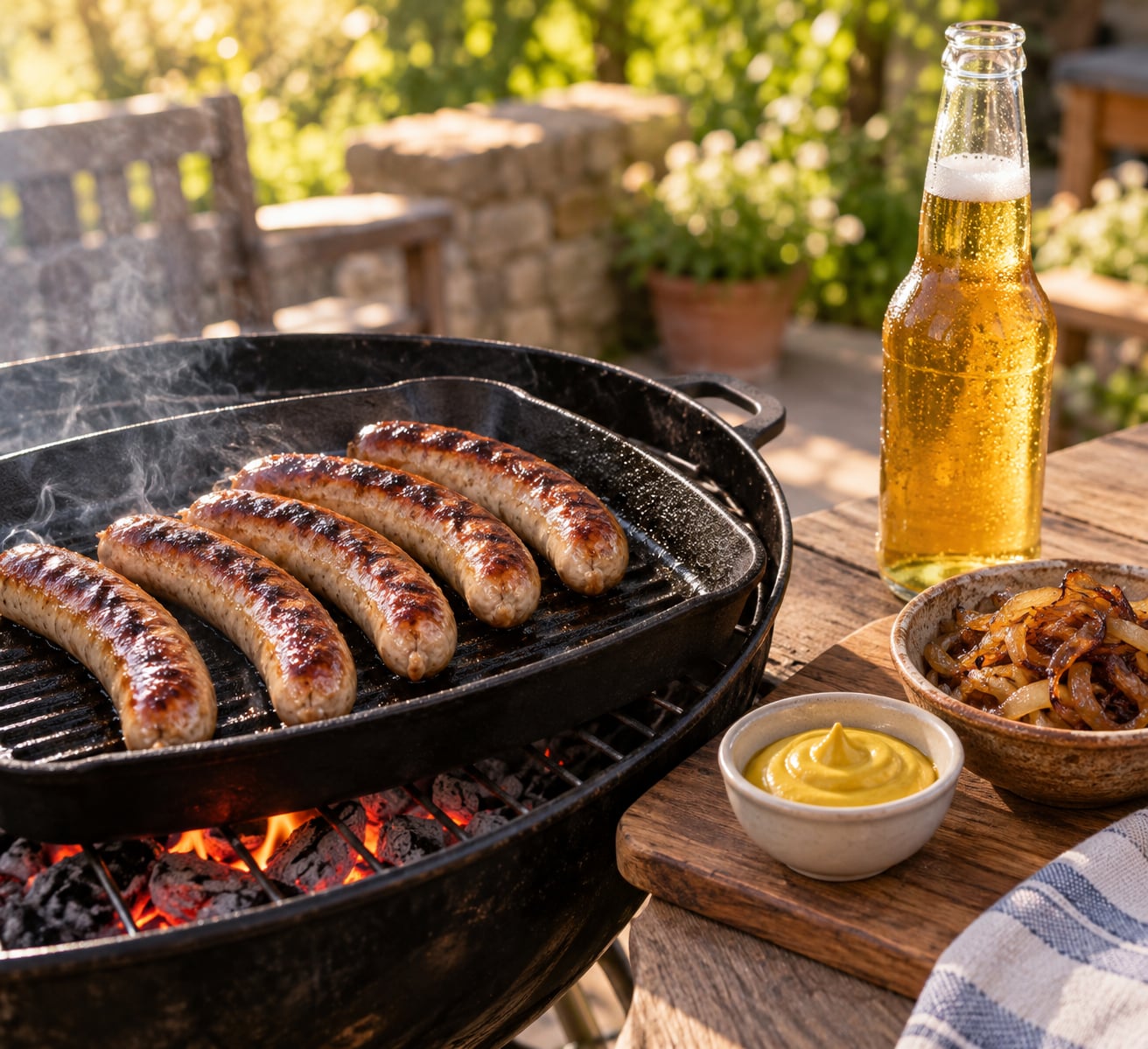
How to make beer brats: simmer raw bratwurst links in a shallow bath of light beer with sliced onions until the centers hit 160°F, then grill or sear them briefly for char and a crisp casing. From prep to plate takes about 40 minutes, and most of that is hands-off while the sausages simmer.
The reason this method works is the casing. A raw brat is mostly water and fat held together by a natural or collagen skin, so heat applied too hard, too fast, or through a puncture pushes the juice out and leaves you with a dry sausage. Gentle cooking first, then a short blast of heat at the end, is what keeps the middle juicy and the outside browned.
It is also the most forgiving recipe in my rotation. There is no searing window to nail, no marinade to balance, and almost nothing that can go wrong once the beer is in the pot. If you have a Dutch oven, a wide skillet or a foil pan, you can do the whole thing indoors and finish under a broiler.
What You Need
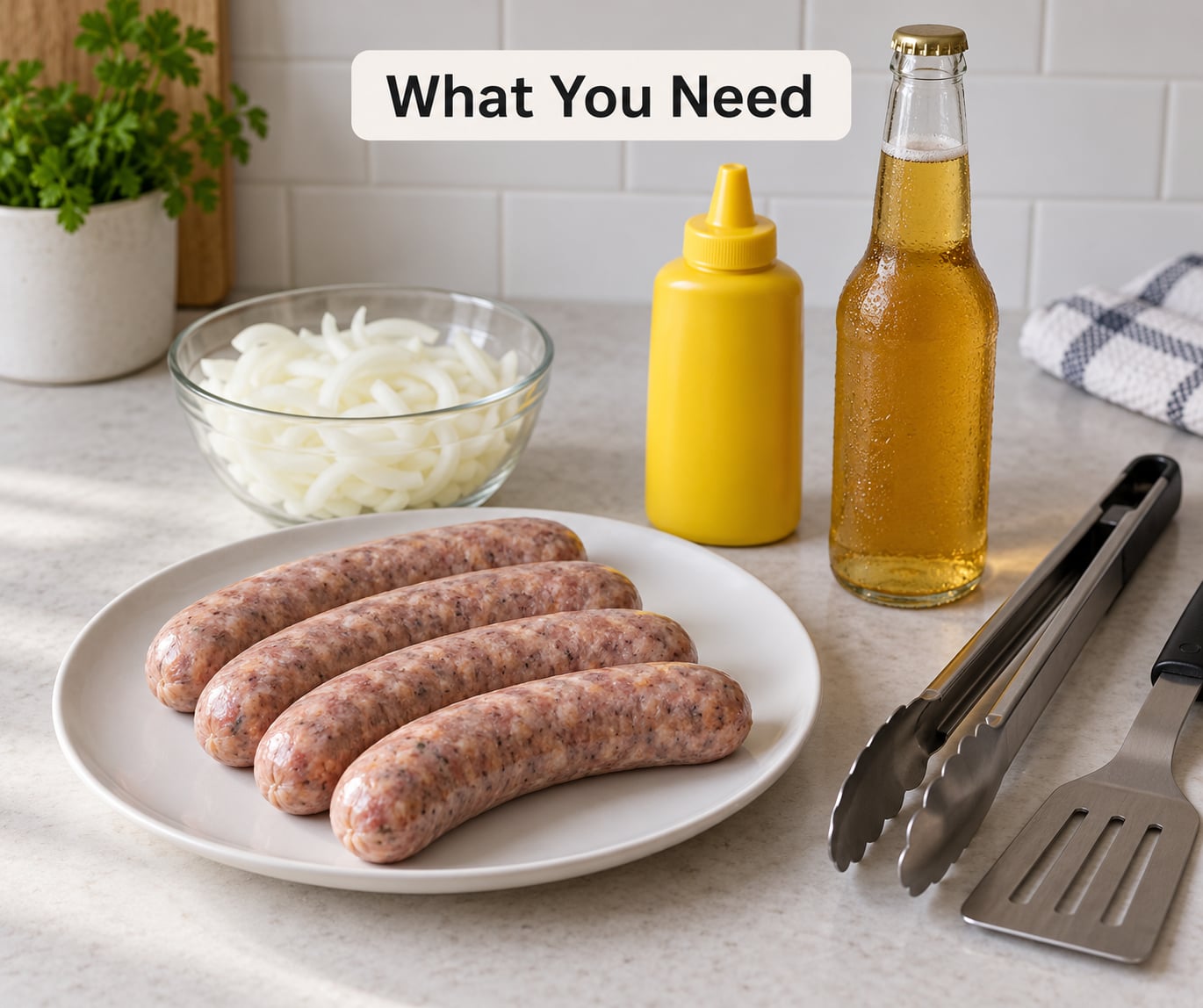
For six to eight people you want six to eight raw bratwurst links. Check the package: most store-brats are raw and need full cooking, while a few come pre-cooked and only need reheating. That label changes your timeline, not your method.
Ingredients
- 6 to 8 raw bratwurst links (about 3 to 4 pounds)
- 2 large onions, thinly sliced or chopped
- 2 tablespoons butter or neutral oil
- 2 x 12 oz bottles or cans of light lager, pilsner or amber ale
- 1/2 teaspoon salt
- 1/4 teaspoon black pepper
- 1 teaspoon spicy brown mustard or yellow mustard for the bath
To serve: brat buns or a split baguette, spicy brown mustard, yellow mustard, sauerkraut, and the beer-soaked onions straight out of the pot.
Equipment
- A large Dutch oven, heavy skillet with a lid, or a disposable foil pan
- An instant-read thermometer (this is the one tool that is genuinely non-negotiable)
- A gas or charcoal grill for the finishing step, or a broiler
- Tongs and a small brush if you plan to mop with the reduced beer
What to swap
Any light-bodied lager, pilsner, or amber ale works. Skip the IPA. As the liquid reduces over the simmer, hop bitterness concentrates, and the brat ends up tasting grassy rather than malty. More on that in the mistakes section.
For a non-alcoholic version, use chicken broth, apple cider, or non-alcoholic beer and compensate with an extra chopped onion and two cloves of garlic. The result is a different dish in a good way, and the cooking times do not change.
Step-by-Step: How to Make Beer Brats
How to Prepare the Beer and Bratwurst
Melt the butter in your pot over medium heat, add the onions, and cook them 5 to 7 minutes until soft and translucent. You are not trying to brown them here; the bath will take care of the rest. Scrape in the mustard, salt, and pepper, pour in the beer, and bring the liquid to a bare simmer.
Look for tiny bubbles at the edge of the pan and steam on the surface, not a rolling boil. A hard boil is the fastest way to split a casing, and split casings mean dry brats.
Do not poke holes in the brats. Not with a fork, not with a knife tip, not even to check them. If you need to know the temperature, push an instant-read probe into the meat through the side of the sausage, not through the skin. That is the only exception.
Once the beer is simmering, nestle the links into the liquid. They should sit mostly submerged. If the pot is wide and shallow, turn the links with tongs about halfway through so both sides get time in the bath. Do not stir them around aggressively.
How to Boil or Pan-Simmer Beer Brats
Cover the pot and hold the simmer for 12 to 15 minutes for raw brats. Thick pork-and-beef links can take closer to 20 minutes. Thin ones, or pre-cooked brats, usually need only 6 to 10 minutes in the bath, since they are being reheated rather than cooked from raw.
Check the temperature after the minimum time. Raw brats need to reach 160°F (71°C) in the center before they are safe to eat. If your thermometer reads 150°F, give it another 3 to 4 minutes rather than cutting into the link to peek.
Everything from the pot is edible, and nothing is wasted. The onions and the reduced beer are a topping on their own, and the liquid makes a mop for the grill. My preference is to lift the brats out, keep the pan going on low, and let the liquid reduce a few more minutes until it thickens slightly.
For a large batch, this step is the reason to make beer brats in the first place. The pot handles a dozen links without crowding, and cooking for a big cookout is exactly the situation where a hands-off simmer method pays for itself.
How to Grill Beer Brats Without Splitting the Casings
Heat the grill to 300 to 375°F. On a gas grill that is one burner on high and one on medium, or all burners on medium with a cooler corner. On charcoal, build a two-zone fire: coals piled on one half, empty grates on the other for indirect cooking.
Brush the grates with oil so the natural skin does not weld itself to the metal. That welded patch is a good chunk of the reason brats tear when you try to turn them.
Place the brats on the grates casing-side down first and leave them alone for 2 to 3 minutes. Rendering the fat against hot metal browns the skin and seasons the sausage without pushing juice out. Turn a quarter turn at a time, so each side gets seared but the casing never sits still enough to grab the grate.
Move the brats to indirect heat if a flare-up starts. Rendered fat dripping onto coals causes flame, and a brats casing over open flame chars in seconds before the middle is warm. You want browned in patches, not blackened.
Brush or mop them with a spoonful of the reduced beer and onion mixture for the last 30 seconds. That liquid is mostly malt and it sticks. If you skipped the grill entirely, use a skillet over medium-high heat, or put the brats on a rack under the broiler for 3 to 5 minutes, turning once.
How to Know Beer Brats Are Cooked Through
Use the thermometer. Raw bratwurst is ground meat, so the USDA minimum internal temperature is 160°F (71°C). Poultry bratwurst needs 165°F (74°C). If you buy a pre-cooked brat, follow the package reheating directions and still cook it through to a piping hot center.
Color is not a reliable guide. Bratwurst with a high fat ratio often looks pale pink or grey even when fully cooked, and a well-done link can still show pink near the center. Judge by temperature and by how the casing feels: firm, snappy, and lightly browned.
There is one useful trick for carryover. Pull the brats at 155°F (68°C) and let them rest 2 to 5 minutes off the heat; the temperature keeps climbing while they sit. Many cooks pull too late because they are aiming at 160 while the grill is still doing the work.
How to Serve Beer Brats
Toast the buns in the pan juices or on the grill for 30 seconds. A cold bun makes the whole thing taste flat, and it turns to mush faster than you think.
Build it: bun, brat, spoonful of beer onions, mustard, sauerkraut. Spicy brown mustard is the Wisconsin default and pairs with the malt in the beer bath; yellow mustard is sharper and cuts the fat better. Sauerkraut, either cold or warmed in the leftover liquid, adds the acid that the beer does not.
Side dishes: potato salad, coleslaw, baked beans, grilled corn, or just the onions from the pan. For what to pour alongside, the short version is that anything you already drink with burgers works, and my guide to pairing beer with burgers covers the reasoning. If you want the specific style question settled, IPA vs lager with burgers breaks down why a lager usually wins on a grill.
The same liquid that cooked the brats will cook vegetables. Add carrot chunks, halved small potatoes, or sliced peppers to the pot during the last 15 minutes of the simmer, or use it as a basting liquid for anything you are grilling alongside. My grilled vegetable method covers the timing if you want them crisp rather than tender.
For a party, hold the finished brats in the beer bath with the heat under the lowest setting, or in a warm oven in the foil pan. They will not dry out, which is the whole problem with letting a platter of brats sit on a picnic table.
Store cooked brats in a sealed container in the refrigerator for up to 3 to 4 days and reheat in a skillet over medium-low, with a splash of water or broth so they do not dry out.
Common Mistakes That Ruin Beer Brats
A rolling boil. Bubbling hard pushes the ends of the links open and squeezes the juices out. Hold a bare simmer, cover the pot, and check at the 12-minute mark. Ten minutes is enough for thin links; thirty is not better, it is drier.
Starting over direct heat. A sausage dropped onto screaming-hot grates burns on the outside while the center is still raw and grey. Brown first on medium heat, or start on the indirect side and move over only for the final few minutes.
Using an IPA. Bitterness concentrates as the beer reduces, and the reduction step is exactly where flavor lives. Use a lager, pilsner, or amber ale. If you only drink hoppy beer, use less of it and keep the pot covered so less liquid cooks off.
Poking holes. A fork mark is a pressure release valve. Cook brats whole and check them with a probe pushed in from the side.
Grilling brats from raw without the bath. The sear takes 2 to 3 minutes a side. That is a finishing step, not a cooking method, and a raw link left on the grill that long splits before it cooks through.
Overcooking on the grill after a correct simmer. Once the link has hit 160°F in the pot, it only needs char. Ten extra minutes on the grate is how a juicy brat becomes a firmer one.
Stacking or pinning the links. Do not skewer them flat to stop them rolling, and keep them in a single layer. Pressure from a pin is pressure from a fork. If they keep rolling, cook them on the grates over a curved pan or just turn them as they go.
Frequently Asked Questions
Do I need to soak brats in beer before grilling?
Simmering is not strictly required, and plenty of people grill brats straight from the package. It is still the better method. Raw brats need to reach 160°F inside, and a quick sear will brown the outside while the middle stays undercooked and grey. The beer bath cooks them gently and evenly and seasons them while it does. If you skip it, grill them over indirect heat at 300 to 375°F and check the temperature with a probe rather than by cutting one open.
What kind of beer is best for beer brats?
A light lager, pilsner, or amber ale is the right call. They bring malt and sweetness without the sharp edges that concentrate during the simmer. Skip IPAs, imperial stouts, and anything heavily hopped, because the flavor reduces along with the liquid and bitterness is what survives. Dark lagers and Oktoberfest-style Märzen work well too. If you want the non-alcoholic route, use chicken broth, apple cider, or non-alcoholic beer with an extra onion and two cloves of garlic.
How long should I grill beer brats?
About 2 to 3 minutes per side over medium to medium-high heat, roughly 8 to 10 minutes total, is enough to brown the casing once the brats are already cooked through from the simmer. Watch them closely at the end, because natural casings char faster than the meat does. You are looking for browned patches and a snap, not an even black crust. Broiling works too, at 3 to 5 minutes with one turn.
Can I boil bratwurst before grilling it?
Yes, and in a gentle form it is the whole point of this recipe. The correction is in the word boil. Raw brats want a bare simmer, covered, for 12 to 15 minutes, not a rolling boil, which splits the casings and dries the meat. Then grill or sear them for 2 to 3 minutes a side to add char. If you have already fully cooked your brats by boiling, you only need the grill step for browning.
How do I know when brats are fully cooked?
Use an instant-read thermometer. Raw bratwurst is ground meat, so it needs to reach 160°F (71°C) in the center; poultry bratwurst needs 165°F (74°C). Push the probe into the side of the sausage rather than through the casing. Color is not a reliable signal, since many brats look pale or slightly pink even when properly cooked. Casing texture is a good backup cue: firm and springy with browned patches means done.
Can I make beer brats in a skillet instead of a grill?
Absolutely, and for a first batch it is the easier path. Brown the brats in a skillet over medium-high heat after the simmer, turning every couple of minutes, and expect about 8 to 10 minutes total. An oven works as well: set a rack about 4 inches from the broiler, cook for 3 to 5 minutes, turn, and repeat. The char will be lighter than a grill gives you, so a final minute under the broiler helps.
Start with the pot, not the grill. Get your onions and beer to a bare simmer, cover the brats for 12 to 15 minutes, check for 160°F, and only then move on to the heat that gives them color. Everything after that is ten minutes of char work, and the thermometer is what keeps the middle juicy.