
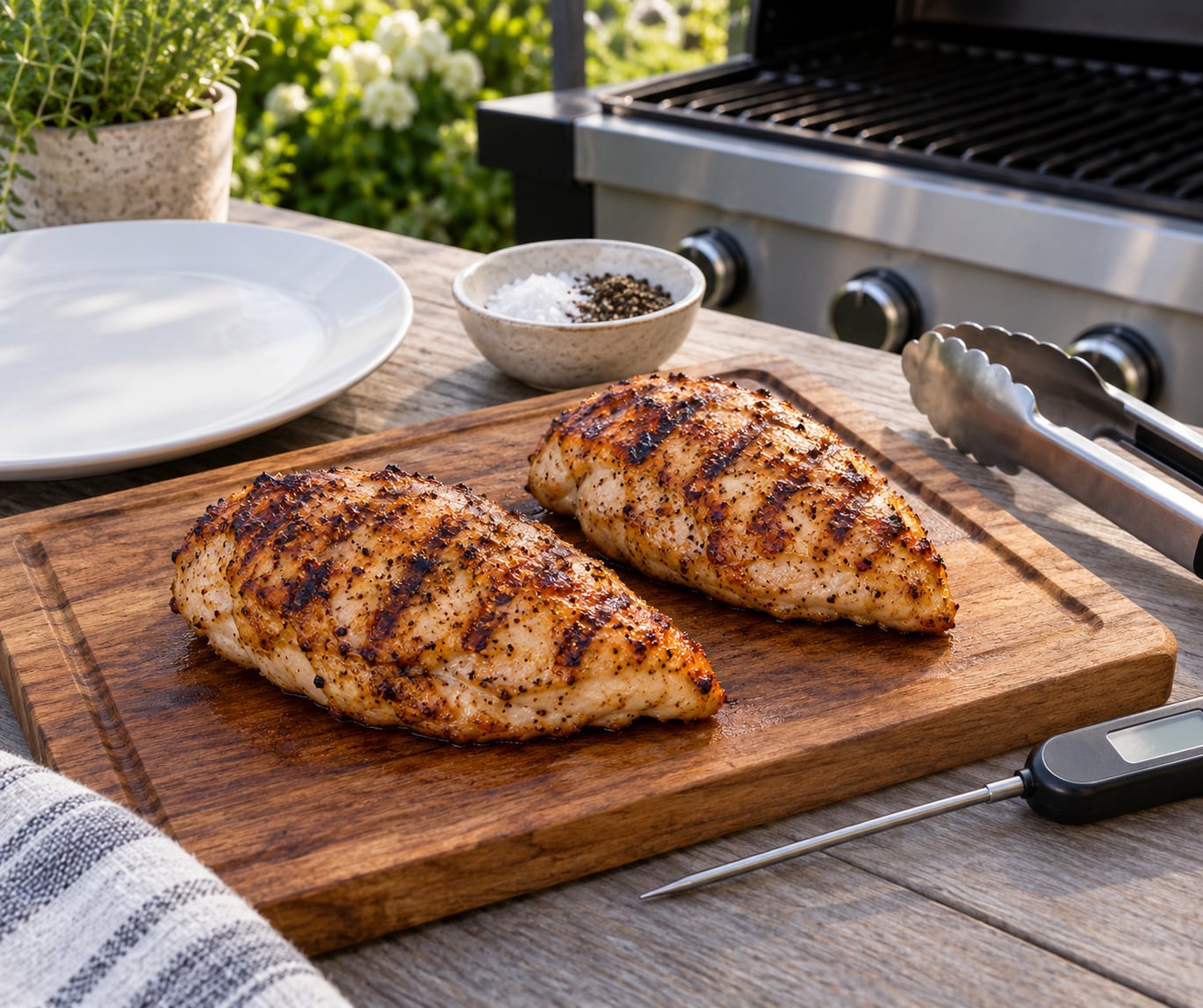
How to grill chicken breasts without drying them out comes down to three things: pound the chicken to an even thickness, use a moderate two-zone fire instead of screaming-hot direct heat, and take the chicken off the grill at 150 to 155F so carryover cooking finishes the job while it rests.
That whole process takes about 25 minutes of grill time and is honestly easier than most recipes suggest. The tricky part isn’t the technique, it’s that chicken breast is a lean, oddly shaped cut that punishes any guesswork. Once you measure instead of eyeballing, the results change.
The two-zone heat setup is the part most people skip, and it’s the part that saves the meat.
Table of Contents
- What You Need
- Step-by-Step: How to Grill Chicken Breasts Without Drying Them Out
- Common Mistakes
- Frequently Asked Questions
- What temperature should chicken breasts be grilled to?
- Should I grill chicken breasts over direct or indirect heat?
- How long should I grill a chicken breast on each side?
- Does marinating chicken breasts help prevent them from drying out?
- Can I grill frozen chicken breasts without thawing them first?
- Why are my grilled chicken breasts tough and dry?
- Conclusion
What You Need
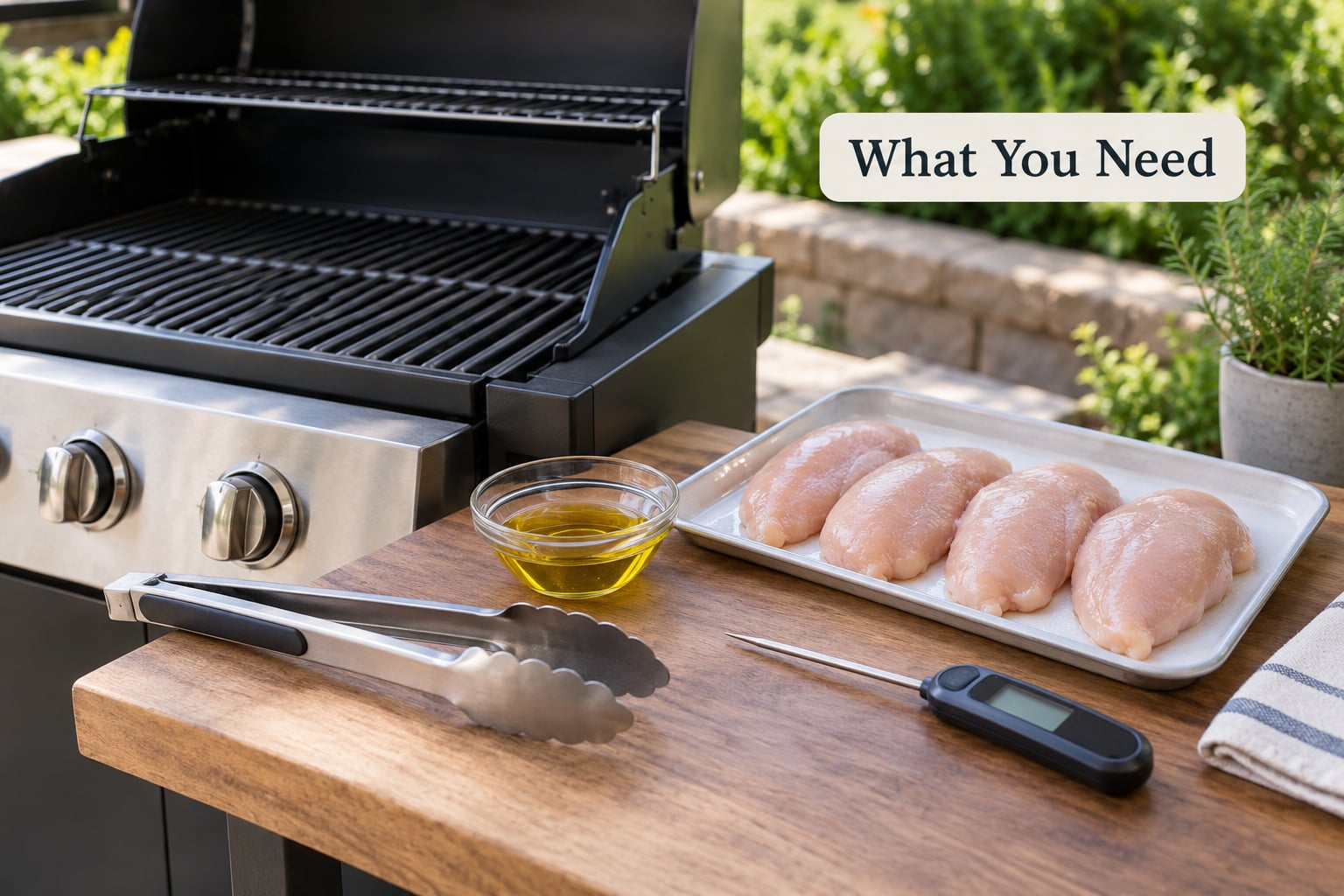
An instant-read thermometer is the one non-negotiable item. It’s the difference between cooking chicken and guessing at chicken, and a decent one costs about as much as a takeout order.
You’ll also want long tongs with a scalloped grip, a small bowl of high-heat oil for brushing the grates, and a meat mallet or rolling pin for evening out the thickness.
For seasoning, you need salt, coarse black pepper, and whatever dry rub you like. Optional extras: a shallow pan for brining, butcher paper or a board for resting, and foil if you want to tent.
On brining, mix 1/4 cup of kosher salt with 2 tablespoons of sugar in a container of cold water, then submerge the breasts for 30 to 60 minutes. Don’t go longer than a few hours or the surface turns tacky and oddly soft.
Step-by-Step: How to Grill Chicken Breasts Without Drying Them Out
Keep these numbers in view as you go. They’re the difference between a plan and a guess.
- Direct heat zone: medium-high, 400 to 450F.
- Pull temperature: 150 to 155F, off the heat.
- Temperature after carryover and rest: 160 to 165F.
- USDA safe minimum internal temperature: 165F / 74C.
- Rest time: 5 to 10 minutes, loosely tented.
- Target thickness after pounding: 3/4 inch.
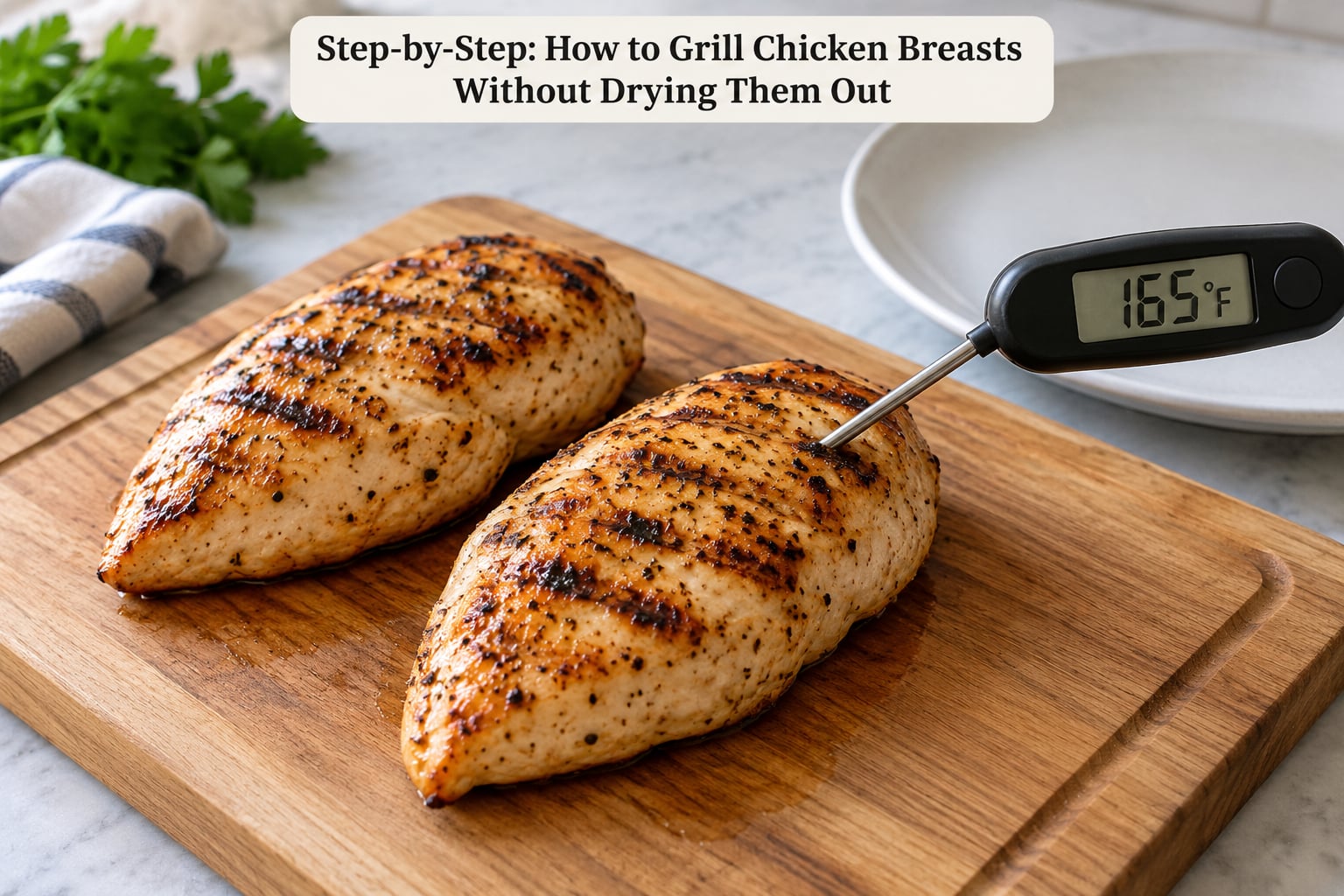
The USDA safe minimum internal temperature for poultry is 165F. That’s the safety floor, not the finish line, and pulling at 150 to 155F lets the residual heat carry the rest of the way without squeezing the moisture out.
1. Prepare the chicken breasts evenly
Buy breasts that are close in size, and if one has a thin tail end hanging off, trim it or fold it under before cooking. Uneven pieces are the number one reason one breast burns while the other is still raw in the middle.
Place each breast between two sheets of plastic wrap or on a thick cutting board and pound the thick side down to about 3/4 inch. Gentle taps, not sledgehammer swings. You want an even slab, not shredded meat, and a mallet with a textured face gives better grill marks than a smooth one.
Pat the chicken dry with paper towels. A wet surface steams instead of searing, and it sticks to the grate. Oil the breasts lightly, season with salt and pepper, and let them sit at room temperature for 15 to 20 minutes while the grill heats.
If you’re marinating instead of brining, keep the time window between 30 minutes and 3 hours. Acid from vinegar or citrus tenderizes the surface, and past about 3 hours the breast turns mushy and stringy. Wipe off excess marinade before it hits the grill so it caramelizes rather than burns.
2. Set up moderate, two-zone heat
Light one side of the grill and leave the other side off. That gives you a hot direct zone and a cooler indirect zone on the same grate, which is the whole point. Chicken breast should start over the cooler side and finish with a quick move over the hot side.
Preheat to medium-high, roughly 400 to 450F. Give it a full 10 to 15 minutes with the lid closed. If you put chicken on a grill that hasn’t come up yet, the first several minutes are spent recovering rather than cooking, and the exterior suffers for it.
Clean your grates with a wire brush, then wipe them with a paper towel held in long tongs and a little oil. The smoke that follows is the grill seasoning being removed, not a problem.
If you have a charcoal grill, let the coals burn until the ash is coated white, then push them to one side and put the grate back on. Same two zones, different hardware. Charcoal holds heat less precisely, so keep the lid on longer between checks.
3. Cook the first side patiently
Lay the breasts on the cooler zone with the thicker side down, then close the lid. A 3/4 inch breast takes about 4 to 5 minutes on that side. Let it do something rather than hovering over it.
Turn when the surface is deeply browned and the breast releases from the grate on its own. If you have to scrape it loose, it’s not ready. Every flip resets the browning process, and three or four flips is how you end up with a pale, rubbery exterior.
After the second side, move the chicken to the hot zone for 60 to 90 seconds per side to pick up stronger grill marks and a little char. If flare-ups start, move it back to the cool side or pull it off until they die down. Handling a flare-up mid-cook is covered in how to control flare-ups on a grill.
4. Check thickness and use the thermometer
Push the probe into the thickest part of the breast, side to side, and avoid touching bone or the pan. Bone reads high, and a probe slipped between two muscles can give you a reading that’s off by 10 degrees or more.
Take the chicken off the grill at 150 to 155F. The internal temperature keeps climbing after the heat stops, usually landing somewhere around 160 to 165F by the time you slice it, which is where you want it for both texture and safety.
If you’re brining, leave-in probes aren’t very useful because salt shifts how heat moves through the meat. An instant-read gives you a truer number for pre-brined and unbrined chicken alike.
5. Rest, slice, and serve
Move the chicken to a board or a loose foil tent and wait 5 to 10 minutes. Resting lets the muscle fibers relax and reabsorb the juice that pushed out during cooking. A breast sliced the second it leaves the grill will leak onto the plate.
Slice across the grain, not with it. Look for the faint lines running along the surface and cut perpendicular to them. Same chicken, noticeably more tender, and it costs about ten extra seconds.
If you’re grilling on a portable grill, the heat zones are smaller and it runs hotter for a given setting, so shorten the first-side cook. Our portable grill guide covers how the smaller grate changes the timing.
Common Mistakes
Cooking it straight to 165F on the grill. This is the big one and by far the most common. Chicken breast is lean muscle, so it gives up water fast as it goes past roughly 155 to 160F. Pull early and let the rest do the work.
Skipping the pounding. A breast that is 1.5 inches thick at one end and half an inch at the other can never cook evenly. The thin part hits 165F and dries out while the thick part is still pink.
Constant flipping. Every turn restarts the sear and exposes a raw surface to the heat. Two turns per breast is plenty, and the thermometer handles the rest.
Cutting too early. Slicing straight off the grill dumps the juices on the cutting board. Even five minutes of rest changes the amount of juice that stays in the meat.
High heat the whole way through. A screaming-hot grill scorches the outside, drives moisture out, and leaves the centre underdone. Use the indirect zone first, the direct zone only to finish.
Grilling straight from the fridge. Cold chicken cooks unevenly and sticks more often. Thirty minutes at room temperature makes a real difference.
Wiping off the brine. Pre-brined supermarket chicken already carries salt and sometimes added water. If you brine it again or salt it heavily on top, the meat gets noticeably salty and can turn spongy in the middle.
Leaving acid marinades on too long. More than 3 hours and the surface texture goes mushy rather than tender.
Frequently Asked Questions
What temperature should chicken breasts be grilled to?
The USDA safe minimum internal temperature for poultry is 165F (74C). For texture, take the chicken off the grill at 150 to 155F and let carryover cooking bring it the rest of the way during a 5 to 10 minute rest, where it usually lands between 160 and 165F. Cooking straight to 165F on the grill is what pushes lean breast past the point where it holds moisture.
Should I grill chicken breasts over direct or indirect heat?
Start over indirect heat and finish over direct heat. Chicken breast is thick enough that direct heat alone scorches the outside before the centre cooks through. A two-zone setup lets the breast cook gently on the cool side for most of the time, then pick up colour and grill marks in a final minute or two over the hot side.
How long should I grill a chicken breast on each side?
At 400 to 450F over indirect heat, expect about 4 to 5 minutes per side for a breast pounded to 3/4 inch. Thicker pieces at a full inch need closer to 6 to 7 minutes per side. Treat these as rough guides only. Watch the surface colour and probe the thickest part, because a thermometer beats any clock once the thickness varies.
Does marinating chicken breasts help prevent them from drying out?
Yes, mostly because the liquid adds moisture and, if it contains salt, pulls water into the muscle before cooking. Acid-based marinades also tenderize the surface. Keep the time between 30 minutes and 3 hours, since long marinades make the texture mushy and stringy, and wipe off excess marinade before grilling so it caramelizes instead of burning.
Can I grill frozen chicken breasts without thawing them first?
You can, but brining or seasoning frozen meat draws moisture out of it instead of in, and the outside will scorch long before the centre thaws. Thaw in the refrigerator overnight, or cook from frozen at a lower temperature with the lid closed, and add 10 to 15 minutes to the total time. Check the temperature in the thickest part before serving.
Why are my grilled chicken breasts tough and dry?
Lean breast muscle loses water quickly past about 155 to 160F internal, so the usual cause is cooking too long rather than too hot. Uneven thickness makes it worse, since the thin end dries out before the thick centre is done. Pound the breast to an even 3/4 inch, use a two-zone fire, pull at 150 to 155F, and rest for 5 to 10 minutes before slicing.
Conclusion
Start with the prep, not the grill. Pound your chicken breasts to an even 3/4 inch, give the grill a full preheat at medium-high, and set up two zones so you have a cool side to cook on and a hot side to finish on.
Then lean on the thermometer. Pull the chicken at 150 to 155F, tent it loosely, and wait 5 to 10 minutes. Carryover cooking takes it to a safe 165F while the juices stay where they belong, and slicing against the grain after the rest keeps them there.
Those three habits, even thickness, honest temperature, and a real rest, are the whole difference between chicken that stays juicy and chicken that needs a lot of sauce.