
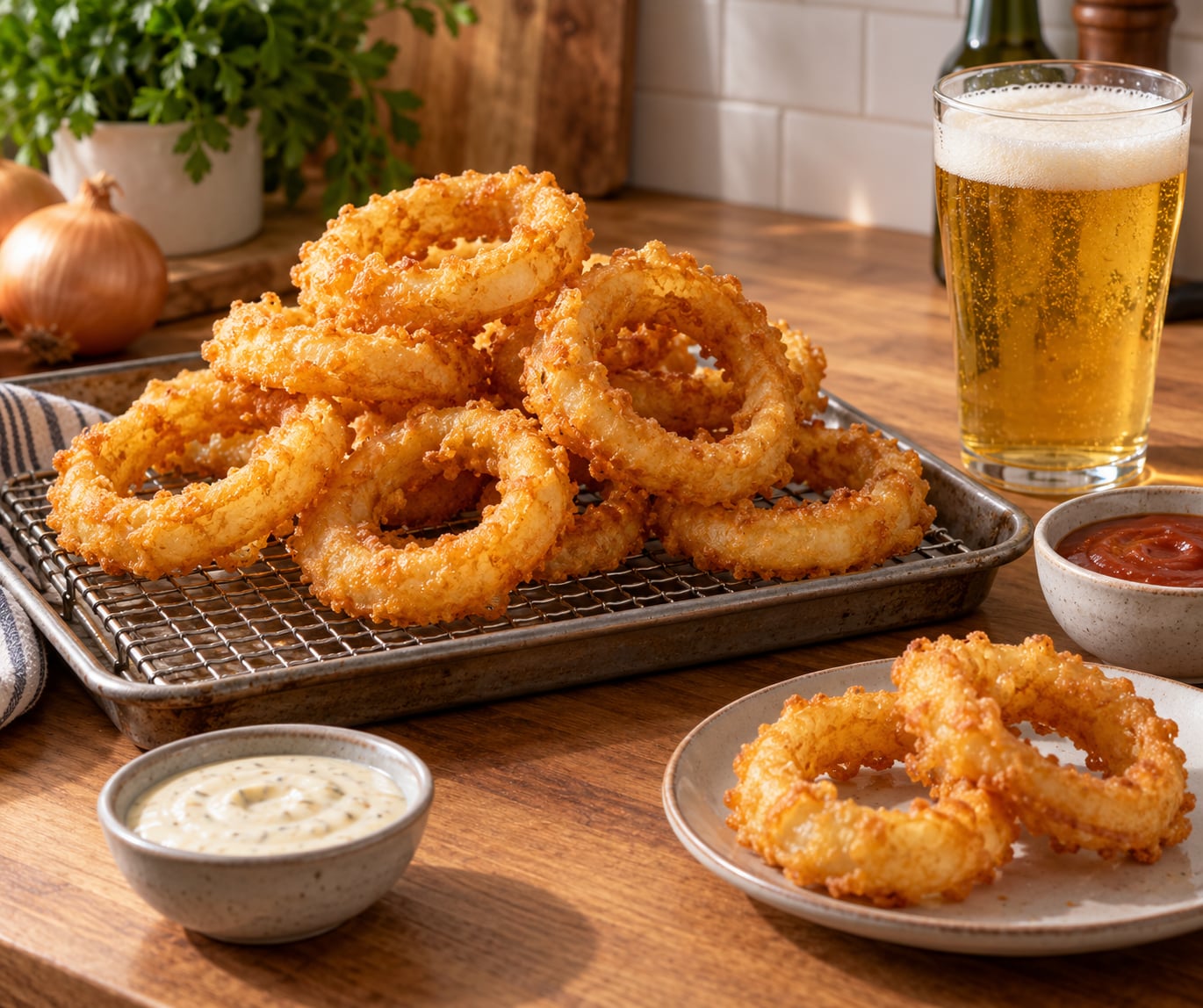
Beer battered onion rings are onion rings cut into even half-inch slices, dredged in seasoned flour, dipped in a thin batter made with ice-cold beer, and deep-fried at 350-375F until the shell turns golden and lacy. The carbonation in the beer, plus a little baking powder, is what makes that shell airy and brittle instead of bread-like and heavy. The whole thing takes about 35 minutes from slicing to serving, and the trick to restaurant-style crispness is keeping the onions bone dry before they ever touch the batter.
I have made this recipe enough times that I stopped chasing the flashier temp. Hold the oil steady around 365F, work in small batches, and drain on a wire rack rather than a paper towel. Those three habits fix nearly every disappointing batch I have had.
Beer is doing more than flavor here. If you want the drinks to match the plate, my simple rules for pairing beer with burgers apply just as well to a platter of onion rings.
What You Need
One 10-12 oz onion makes about 10 to 14 rings, which serves three or four people as an appetizer. That is the batch size I cook, because anything larger cools the oil down and the rings arrive greasy.
For the onion
- 1 large sweet onion, Vidalia or Walla Walla if you can find one, or a yellow onion
- 1 tablespoon salt, for a short soak that firms the layers
Skip red onion for frying. Its higher sugar content browns long before the center softens, so the rings go dark at the edges while the middle still bites.
For the batter
- 1 cup (125 g) all-purpose flour
- 1/4 cup (30 g) cornstarch, for extra crunch
- 1 teaspoon baking powder
- 1 teaspoon salt
- 1/2 teaspoon white pepper
- 1 teaspoon paprika, optional
- 1 cup (240 ml) ice-cold beer, straight from the fridge
Any light lager or pale ale works. A Boston Lager or a simple pilsner is the safe pick, and a Belgian tripel adds a little sweetness if you like it. Stay away from a chocolate coffee stout, which tastes burnt once it hits hot oil. Non-alcoholic beer or plain sparkling water both work as swaps, and the bubbles come from carbonation rather than alcohol either way.
For frying and serving
- 3 to 4 cups neutral oil with a high smoking point, such as peanut, canola, sunflower or vegetable oil
- A heavy pot or Dutch oven, filled about 1.5 inches deep with oil
- A deep-fry or candy thermometer, which is the difference between guessing and knowing
- A wire rack set over a sheet pan for draining
- Coarse salt for scattering while the rings are hot
A wire rack matters. Paper towels under hot rings trap steam, and steam is exactly what turns a crisp crust limp within a minute. If you also want a fried starter alongside these, jalapeno poppers for burger night use the same oil and temperature logic.
Step-by-Step: How to Make Beer Battered Onion Rings
1. Prep the Onion Rings and Seasoning
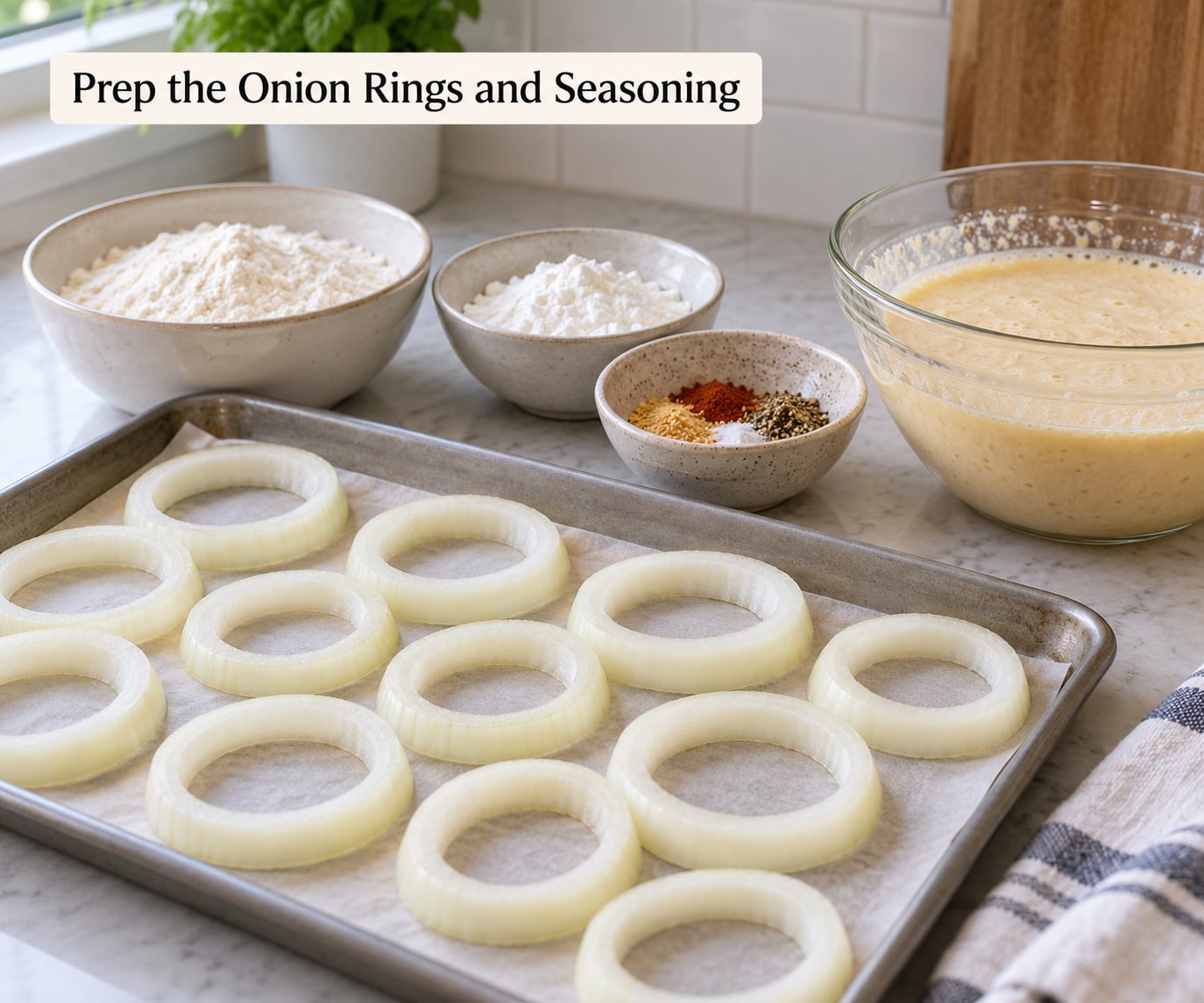
Peel the onion, cut off the root end, and halve it through the equator. Slice each half into half-inch rounds, then separate the rings with your fingers. A 3/8 inch slice cooks faster and stays tender inside a thicker shell, but too thin and the rings split apart in the oil.
Soak the rings in cold water salted with the tablespoon of salt for 20 to 30 minutes, then dry them thoroughly on a towel or a rack. The soak firms up the layers so the rings hold their shape, and the drying is the step people skip. Any surface water on the onion turns your batter into paste.
While they soak, combine the flour, cornstarch, baking powder, salt, white pepper, and paprika in a wide bowl. This dry mix does double duty: it seasons the rings and gives the wet batter something to grab.
2. Mix the Beer Batter
Pour the ice-cold beer into the dry mix and stir just until combined. Stop while lumps remain. A smooth batter fries heavy and greasy, while a lumpy one fries lacy and light, which is the whole point of beer batter.
If the batter is too thick to coat a spoon, add beer a tablespoon at a time. If it runs like milk and drips off in ribbons, add a tablespoon of flour. Aim for the thickness of pancake batter, and keep the bowl near the stove so it stays cold while you work.
Add a splash of vodka in place of some of the beer if you have it. Home cooks on cooking forums swear by it for a lighter, crunchier shell, and the effect is real, but it is an optional flourish, not a requirement.
3. Coat the Onion Rings
Dredge each dry ring in the seasoned flour, shaking off the excess. Then dip it into the beer batter and turn it once so the whole surface is covered. Let it hang over the bowl for a few seconds so the excess drips back in.
Hold the finished rings on a second rack or a clean tray, keeping them from touching. Rings that lie against each other fry into one solid disc, and stacked batter slowly collapses under its own weight before it ever reaches the oil.
Do not let battered rings sit for more than a few minutes. The flour hydrates the longer it sits, the coating goes pasty, and the fry comes out patchy and soft.
4. Heat the Oil Safely
Heat the oil in your pot over medium-high heat to 365F. Recipes disagree between 350F and 375F, and both are workable: 350F gives a lighter, less browned ring, while 375F browns faster and crisps harder. A temperature in between gives you color and a tender center at the same time.
Do not crowd the pot, and keep the rings submerged in a pot filled to the depth you chose. Never fill a pot more than halfway with oil, and turn the burner off before you lower anything into the hot fat. A wet ring hitting oil at 365F spits, so shake the rings dry one more time on the way in.
If you have no thermometer, drop a small pinch of batter into the oil. It should sizzle steadily and turn golden in a minute, not sink and sit there.
5. Fry Until Golden and Crisp
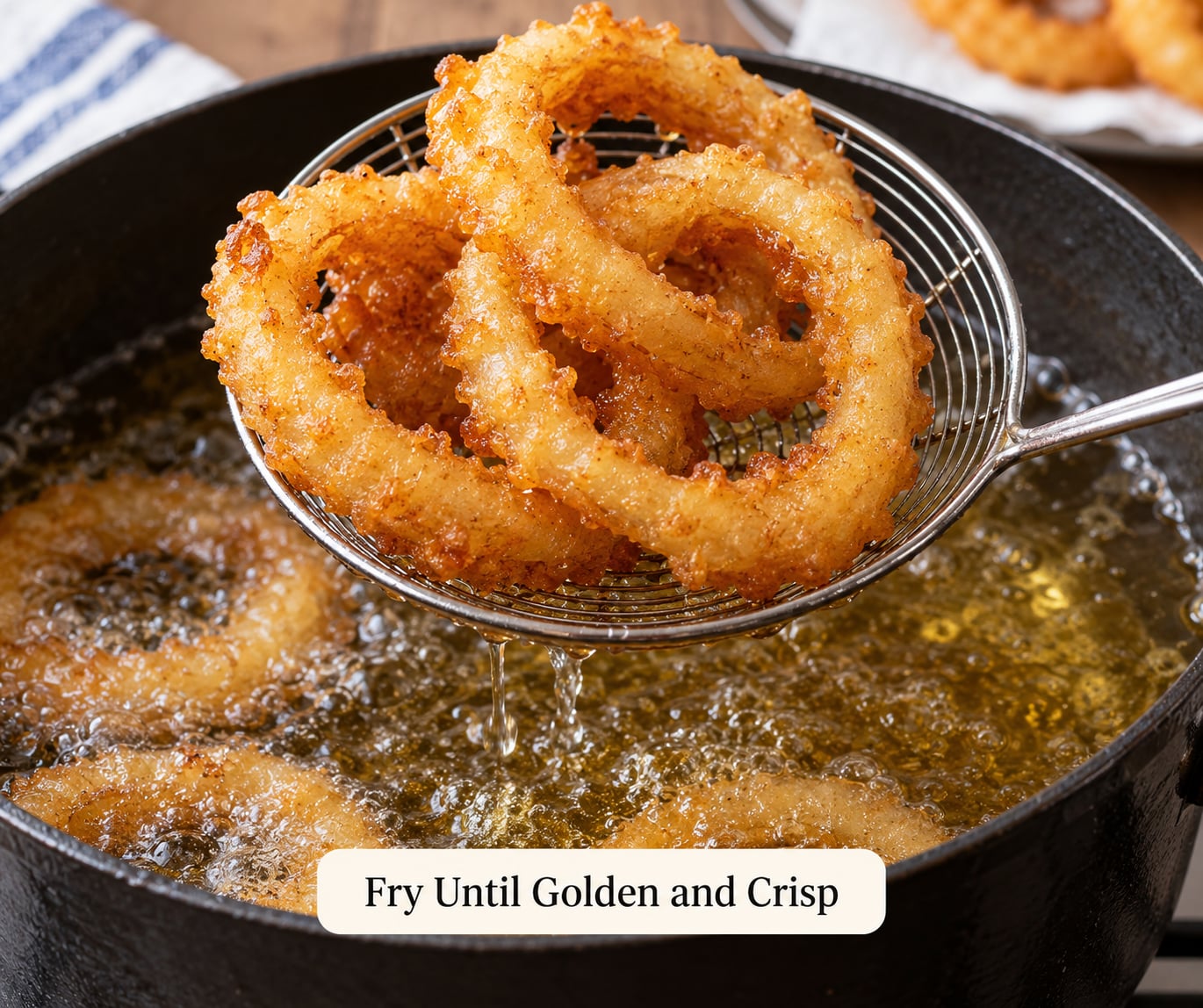
Fry four to six rings at a time, more if your pot is wide. Lower them away from you with a spider or tongs and watch the oil. When a batch goes in, the temperature will dip, so nudge the heat up a touch and hold for the rest of the batch.
Fry for 2 to 3 minutes per side, turning once with the spider. The rings are done when the coating is an even deep golden brown, the shells feel firm when you lift one, and the centers no longer look translucent when you cut into a test ring.
Overcrowding is the single most common reason rings turn out greasy, because dropping too much food in at once drops the oil far enough that the batter soaks it up instead of sealing. Fewer rings, hotter oil, better result.
6. Drain and Serve Immediately
Lift the rings out and let them drip for a few seconds over the pot, then move them to the wire rack set over a sheet pan. Keep them in a single layer and scatter coarse salt over them while they are still hot. Seasoning now works because the surface is dry and blistered; seasoning later just sits on top.
Serve straight away with a cool dip. A simple lime mayo, a Sriracha mayo, or a comeback sauce all work, and ranch has its place. To finish the table, a root beer float handles the kids while the grown-ups drink whatever was in the batter.
Common Mistakes and Fixes
- The batter slides right off. The onion was wet. Dry the rings properly, dredge them in the dry mix first, and shake off the excess flour before dipping. A dry layer is the anchor the wet batter grabs onto.
- The rings are soggy five minutes after draining. They sat on paper towels or in a pile. Drain on a wire rack, keep them in one layer, and serve right away. Any covering traps steam.
- The rings are greasy and heavy. Too many went in at once, or the oil fell below 325F. Keep the oil at 350-365F, cook in smaller batches, and let the pot recover between them.
- The crust is golden but the onion is still crunchy. The slices were too thick for the fry time, or the oil was too cool. Cut to half an inch, or 3/8 inch for larger onions, and check the oil temperature before every batch.
- The batter is dark but the onion is raw inside. The oil was too hot. Drop back to 350-360F and give each side the full 2 to 3 minutes.
- The coating peels off in patches. The batter was overmixed or sat too long. Keep the lumps, mix right before frying, and skip the beer you were saving for later unless you stir it in.
- The rings look flat and limp. The slices were thin or broke apart during handling. Cut thicker, separate the rings gently, and lift them with a spider rather than a slotted spoon.
- The oil smokes. It is past its smoking point. Turn off the heat, let it cool, and check the oil for food particles, which are usually what burned first.
Frequently Asked Questions
What kind of beer is best for beer-battered onion rings?
A light lager or pale ale is the safest choice. A Boston Lager or simple pilsner brings carbonation without heavy flavor, which is what makes the shell light. A Belgian tripel adds mild sweetness if you like it. Avoid chocolate coffee stouts, and non-alcoholic beer or sparkling water work just as well since the bubbles do the work.
Can I make beer-battered onion rings in an air fryer?
Yes, and it is a good option if you do not want a pot of hot oil. Lightly spray the battered rings so the coating does not blow off, keep them from touching, and air fry at 400F for 10 to 14 minutes, shaking the basket twice. The crust will be lighter and less shattering than deep-fried, and it is also the fastest way to reheat leftovers.
Why are my beer-battered onion rings soggy?
Three things cause soggy rings. The onions were wet when battered, so the coating never sealed. Too many rings went in at once and dropped the oil below frying temperature, making the crust drink oil instead of crisping. Or the finished rings were left stacked or on paper towels, which trap steam. Dry onions, small batches at 365F, and a wire rack will fix all three.
Can I prepare the onion rings ahead of time?
You can slice the onions, soak them in salted cold water, and refrigerate them in a sealed container for up to a day. Dry them well right before you batter. Do not batter them in advance, because the flour hydrates and the coating turns pasty while it waits, which is why the last handful of rings is often the worst batch of the night.
How should I store leftover beer-battered onion rings?
Let the rings cool completely, then store them in a single layer or loosely in an airtight container with a paper towel for up to two days. Reheat in an air fryer at 400F for 2 to 3 minutes, or in a 425F oven for 5 minutes. Microwaving is the one method to skip, since it softens the crust every time.
Can I use a regular beer batter for onion rings?
Yes, and a thinner batter is usually better here. A fryer batter made with egg and a fuller body tends to wrap onion rings in a heavy, bready shell. Keep this one close to pancake batter thickness, add the beer a little at a time, and add cornstarch for crunch. The same thin, lumpy approach is what gives you a shell that shatters instead of chews.
Conclusion
Start with the onions, because that is where most batches go wrong. Slice them at an even half inch, soak them briefly in salted cold water, and dry them until they are genuinely dry to the touch. Mix a thin, lumpy batter with ice-cold beer, dredge each ring in seasoned flour first, and fry four to six at a time at 365F for two to three minutes a side. Drain on a wire rack, salt while hot, and serve right away. That sequence is the difference between beer battered onion rings that stay crunchy and ones that go soft in your hand.