
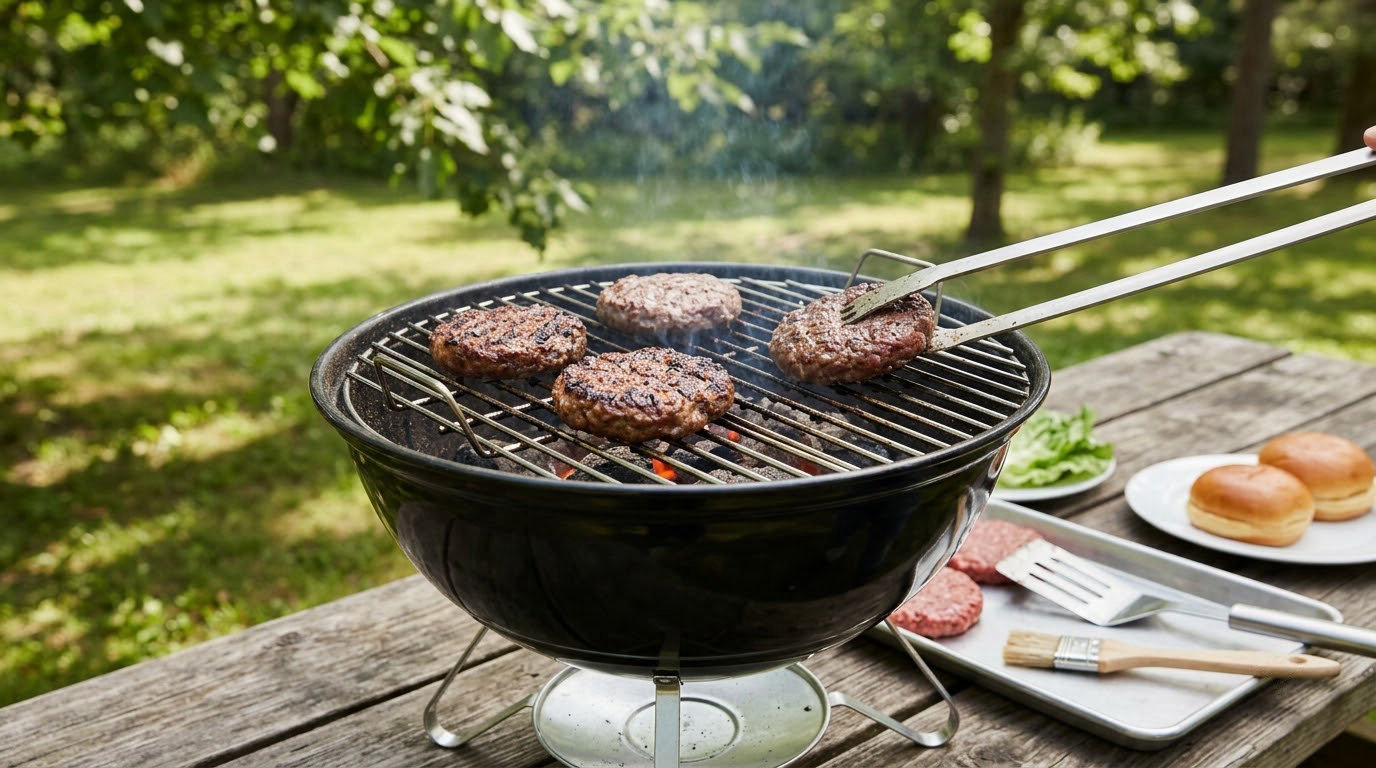
How to grill burgers on a portable grill comes down to the same method as a backyard grill, just compressed. Preheat to medium-high (400-450F / 200-230C), press patties 3/4 to 1 inch thick, cook 3 to 4 minutes a side, flip once, and pull them at 160F / 71C. A small cooking surface is the only real difference, and that is where the technique lives.
That last part matters more than it sounds. A tabletop grill has almost no thermal mass compared with a kettle or a gas cart, so it heats up fast and cools down just as fast. Standard full-size timings, borrowed from a grill twice the size, will hand you a black crust wrapped around a raw middle.
This guide covers the whole job: what to gather, how to build a two-zone fire on a single burner, when to flip, and what to do when a patty sticks or a fat flare-up sends everyone reaching for a water bottle. Allow about 20 minutes of active cooking plus preheat, and the whole thing is beginner-friendly.
Table of Contents
- What You Need Before You Light the Grill
- How to Grill Burgers on a Portable Grill: Step by Step
- Common Mistakes on a Portable Grill, and the Fix for Each
- Frequently Asked Questions
- What is the 5-6-7 rule for grilling burgers?
- Do you grill hamburgers with the lid open or closed?
- Do I need to oil my burgers before grilling?
- What temperature should I preheat a portable grill to for burgers?
- How long do you cook a burger on a portable grill?
- Why are my burgers sticking to the portable grill?
What You Need Before You Light the Grill
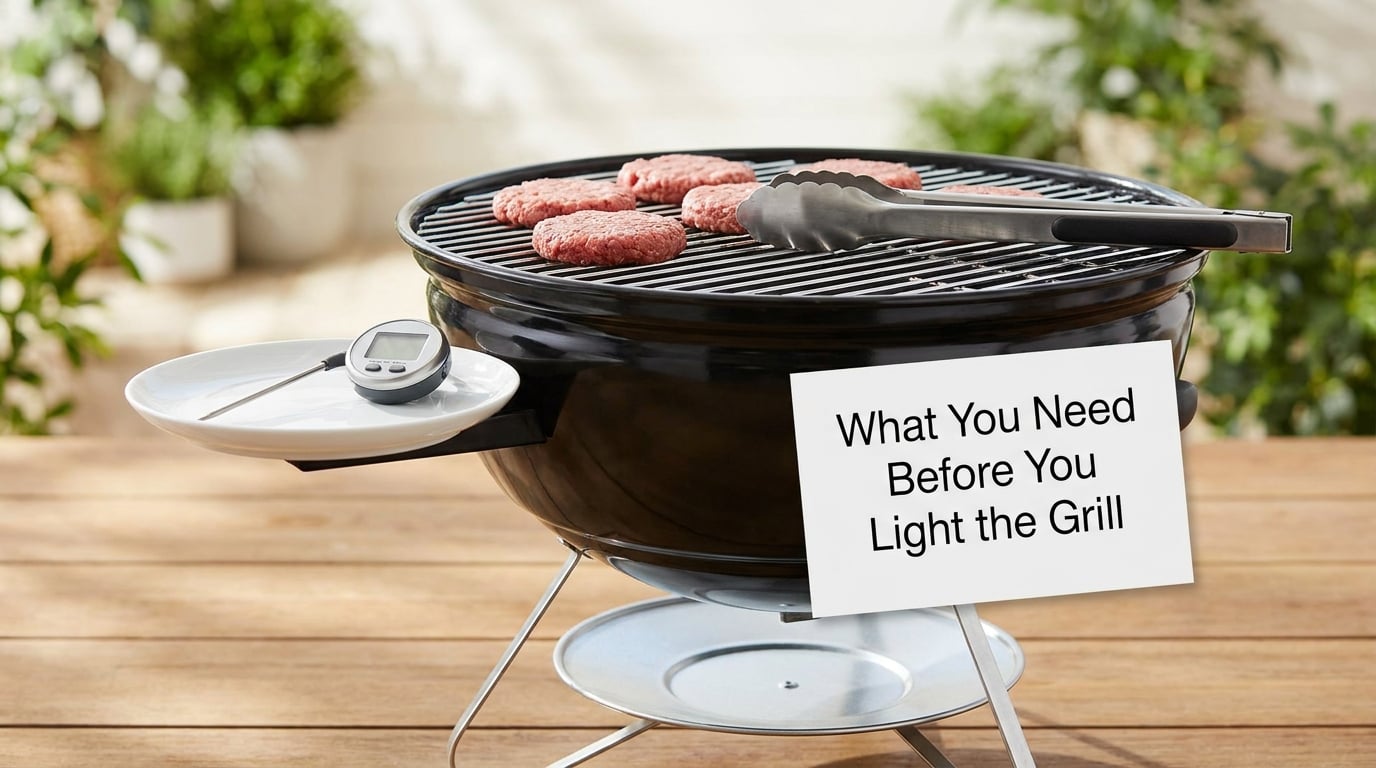
Three kinds of portable unit show up most often, and each one behaves differently at the moment you close the lid. A tabletop gas grill on a propane or butane canister heats fast and recovers quickly, so cook times run close to the figures below. A small charcoal kettle has the most flavour and the least forgiveness. A cast iron griddle plate on a portable burner gives you a flat surface, which is the setup for smash-style patties rather than classic grilled burgers.
Whatever the fuel, buy ground chuck with roughly 80 percent lean. Chuck carries about 18 percent fat against closer to 12 percent in round, and that extra fat is what keeps a patty from turning into a hockey puck on a grill that dries out faster than you expect. Leaner blends need a little fat worked in or a drizzle of oil on the patty before it hits the grate.
- Ground chuck, 80/20, kept in the fridge until the moment you shape it.
- An instant-read thermometer. The single most useful tool on this list, and the reason your burgers stop being a guess.
- A wide, thin spatula or a wire grate press tool with a handle that keeps your knuckles away from the heat.
- Tongs with a locking arm for turning patties and moving cheese.
- Kosher salt and coarse ground pepper. Seasoning goes on at the grill, not at the mixing bowl.
- A grill brush. A dirty grate is the number one reason a patty tears instead of releasing.
- Buns, cheese, and toppings you can assemble at a folding table: sliced tomato, lettuce, onion, pickles, mustard, ketchup.
Ice or a bowl of ice is worth having nearby too. A block of ice under your platter keeps patties cold while the first batch cooks, which matters when you are making burgers in waves.
How to Grill Burgers on a Portable Grill: Step by Step
1. Preheat the Portable Grill Until the Grate Smokes
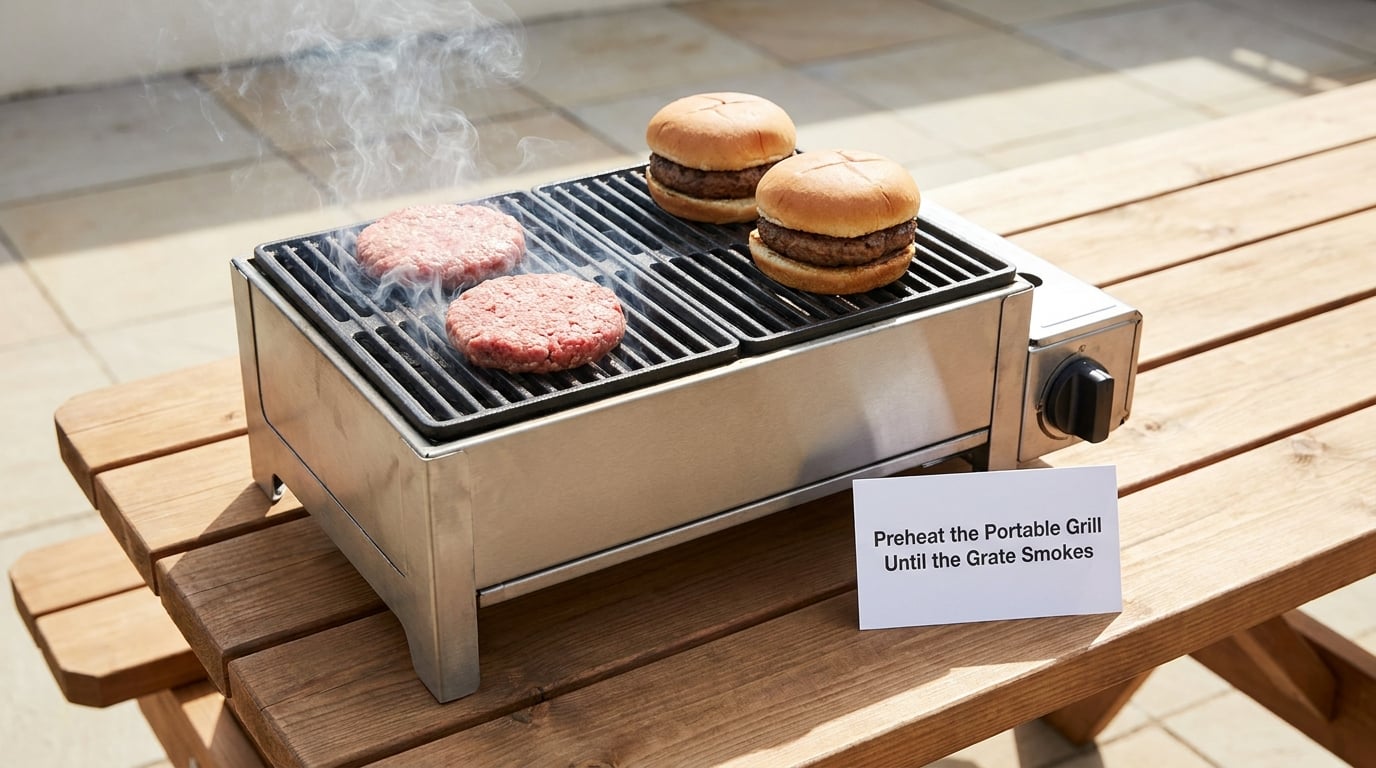
Preheat until the grate is hot enough to make a drop of water spit and hiss, which on most portable units is 10 to 15 minutes. Hold a hand a few inches above the grate and you should feel real radiant heat, not a warm breeze. You are aiming for 400-450F / 200-230C at the cooking surface.
On charcoal, set the lit coals to one half of the grill and leave the other half bare. That is your two-zone fire, and it is the best tool you have on a small grill. On gas, push the burner to the one side and set the control valve to start, turning it up only once you see how quickly the metal responds. Electric tabletop grills need a full 10 minutes on high with the lid closed, and they hold heat steadier than anything else in this group.
Preheating with the lid down is the right call on a portable grill, opposite to a full-size kettle. The hood traps the heat loss that a small unit cannot afford. Keep it down through the preheat, and decide about the lid again when you flip.
2. Prepare Burger Patties That Fit the Small Grate
Shape patties 3/4 to 1 inch thick and slightly wider than the bun. Thick is better on a small grill, because surface area per burger is what limits how many you can cook, and a thin patty dries out before its centre catches up. Do not go much past 1 inch on a fast-heating portable burner. The outside will char long before heat reaches the middle.
Press a shallow thumbprint into the centre of each patty. That indentation stops the burger from doming into a meatball and gives you an even thickness to cook through. Handle the meat with cold hands, work quickly, and overmixing is the mistake that turns a good blend into a dense, bouncy puck. If the meat gets sticky and stringy as you form it, chill it for ten minutes rather than adding flour or bread crumbs to fix it.
Shape every patty before the grill is ready. Once the smoke starts, you want patties going on, not being rolled.
3. Oil the Grate, Not the Burgers, and Space Them Out
Brush a thin layer of high-smoke-point oil on the preheated grate just before the patties go down, using a wad of paper towel held in tongs. An old trick worth keeping: wipe the grate with a dry paper towel first to scrape off carbon, then oil it. Oiling the burgers instead just gives you a slick, unevenly seasoned exterior and no change to the sticking problem.
Leave a finger’s width of space between patties. They need air moving around them, and touching patties cook their touching edges slowly while the exposed edges char. On most tabletop grills that means two to four burgers per batch, which is why batching matters more here than on a full-size grill.
If your patties are thinner than three-quarters of an inch and you have wide grate spacing, they can sag and tear. Watch the first placement closely and be ready to rescue one with the spatula.
4. Flip Once and Finish on the Cooler Side
Give it 3 to 4 minutes on the first side. Do not flip early, and do not flip a second time. Test readiness by sliding the spatula under one edge and lifting gently. If it resists, give it another minute; when the patty releases cleanly, it is time to turn.
Put cheese on immediately after the flip, then close the lid for the last stretch so the melt comes fast. Leave the patty on the hot side for a full side-one sear, then move it to the cooler zone to finish. That two-zone move is what saves a small grill from overcooking, because carry-over heat does the last ten percent of the work while the crust keeps its colour.
One flip, one move. That is the whole technique.
5. Check Doneness With a Thermometer, Then Rest
Push the probe into the thickest part of the patty, away from the metal edge, and read it fast. For ground beef, 160F / 71C is the safe minimum. Check more than one patty, because the corners of a small grate run hotter than the centre.
Here is how the temperatures and the clock line up for a 3/4 inch patty at medium-high heat:
- Rare, 125F / 53C — roughly 4 to 5 minutes total. Below the safe minimum for ground beef.
- Medium rare, 130F / 54C — roughly 5 to 6 minutes total. Still below the safe minimum for ground beef.
- Medium, 160F / 71C — roughly 6 to 8 minutes total. The safe minimum for ground beef, and where most people stop.
- Medium well, 170F / 77C — roughly 8 to 10 minutes total. Noticeably drier, especially on a small grill.
- Well done, 180F / 82C — roughly 10 to 12 minutes total. Dry on a portable unit, and rarely worth the extra two minutes.
Rest each burger 2 to 3 minutes on a plate before serving. The juices redistribute instead of running out onto the plate, and a short rest on a small grill makes the difference between a burger you eat and a burger you chew.
6. Serve With Buns and Sides That Hold Up
Toast the cut faces of the buns in the last minute, cut side down, with a slick of butter or a little garlic butter. Toast them on the same zone you used for resting, not over a flame, so you get a golden face without burning the crumb.
Build in this order so the burger stays hot: sauce on the bottom bun, lettuce, then the patty with cheese, then tomato and onion on top. Tomato first traps steam and makes the bun soggy by the second bite. Add pickles last.
For sides, keep it to things that survive a folding table: chips, coleslaw, a bagged salad, grilled corn, or a tray of onion rings warmed in the same zone. If you have a cast iron plate, a sliced tomato and a halved onion on it while the patties cook makes a good side you assemble at the end.
Common Mistakes on a Portable Grill, and the Fix for Each
The patties stick and tear. The grate was dirty, cold, or not oiled. Brush off the carbon, preheat fully, and oil right before the patties go down. Scraping stuck beef off a cold grate with a spatula is what turns a good burger into shreds.
You get a flare-up. Fat drips hit flame, and on a small grate there is little room for the fire to spread out. Close the lid and wait, or move the patties to the cool side until the flare dies down. Lifting the lid feeds oxygen to the flame and makes it worse. A drip tray with water underneath is the fix that prevents it.
The burgers come out dry. Small grills lose heat the moment you open the lid, and cold patties shrink the window further. Keep the lid on, flip once, and pull at 160F / 71C rather than cooking until they feel firm. An 80/20 blend is the other half of the answer.
The bottom burns before the middle cooks. That is too much direct heat, usually from a full-blast gas setting or a fire built under the whole grate. Push the coals to one side, or turn the gas valve down to medium.
Only two patties fit and you are feeding four people. Batch it. Cook the first wave to 160F, hold finished burgers in a single layer on a platter over a block of ice, and start the second wave immediately. The cooking surface is small, but the grill is not the bottleneck; your patty prep is.
You pressed down with the spatula. Every press squeezes juice out of the patty. Use the spatula to lift, never to press. If you want a smashed burger, do it deliberately on a griddle with a press tool before it hits the heat, then leave it alone.
You served them straight off the heat. A two-minute rest costs nothing and keeps the juice in the meat.
If you are still stuck on how to grill burgers on a portable grill, work down that list one item at a time. Almost every disappointing burger on a small grate traces back to a cold grate, a crowded cooking surface, or a patty pulled a minute late.
Frequently Asked Questions
What is the 5-6-7 rule for grilling burgers?
The 5-6-7 rule is a social media convention rather than a cooking standard: five minutes on the first side, six on the second, seven minutes of total cook time. Useful as a rough shape, dangerous as a rule. Portable grills heat and cool faster than full-size ones, so a 3/4 inch patty can be well past medium in seven minutes. Use a thermometer and pull ground beef at 160F / 71C.
Do you grill hamburgers with the lid open or closed?
Closed, for most of the cook. A portable grill has very little metal to hold heat, so the lid traps the loss that a small unit cannot replace. Keep it down through the preheat and through the cheese melt. Open the lid only when you need to look, and always on the first flip. If you are using the cool side for resting, the lid stays open for that final minute so the patty does not steam.
Do I need to oil my burgers before grilling?
No. Oil the grate, not the patty. A thin film of high-smoke-point oil on a preheated grate is what stops sticking, and a little oil on the meat gives you a slick, unevenly seared exterior without solving the problem underneath. If your blend is leaner than 80/20 and you want extra moisture, mixing a tablespoon of mayo into the raw meat before shaping is more effective than brushing the patty.
What temperature should I preheat a portable grill to for burgers?
Medium-high, which is 400-450F / 200-230C at the cooking surface. Most portable grills have no built-in thermometer, so read the surface instead: hold a hand a few inches above the grate and you should feel real radiant heat, and a drop of water should spit and hiss. Preheat fully, 10 to 15 minutes. Going in early is the single biggest cause of sticking on a small grate.
How long do you cook a burger on a portable grill?
Three to four minutes on the first side, the same again on the second, so six to eight minutes total for a 3/4 inch patty at medium-high. Thinner patties finish in four or five minutes and dry out past that. Rather than trusting the clock, slide a spatula under an edge and lift: when it releases cleanly, flip. Confirm with a thermometer at 160F / 71C for ground beef.
Why are my burgers sticking to the portable grill?
Three causes cover almost every case: the grate was not fully preheated, the grate was dirty with carbon from a previous cook, or it was never oiled. Brush the grate clean, preheat until a water drop spits, and wipe on a thin layer of high-smoke-point oil just before the patties go down. Sticking in the first ten seconds means the grate was too cold. Sticking all cook means it was dirty.
Start here: preheat the whole grill with the lid down for a full 10 to 15 minutes, scrub the grate, oil it, and put on the first two patties before you do anything else. If you remember only one habit from this guide, make it the thermometer reading at 160F / 71C. It removes the guesswork that a small cooking surface makes very easy to fall into.