
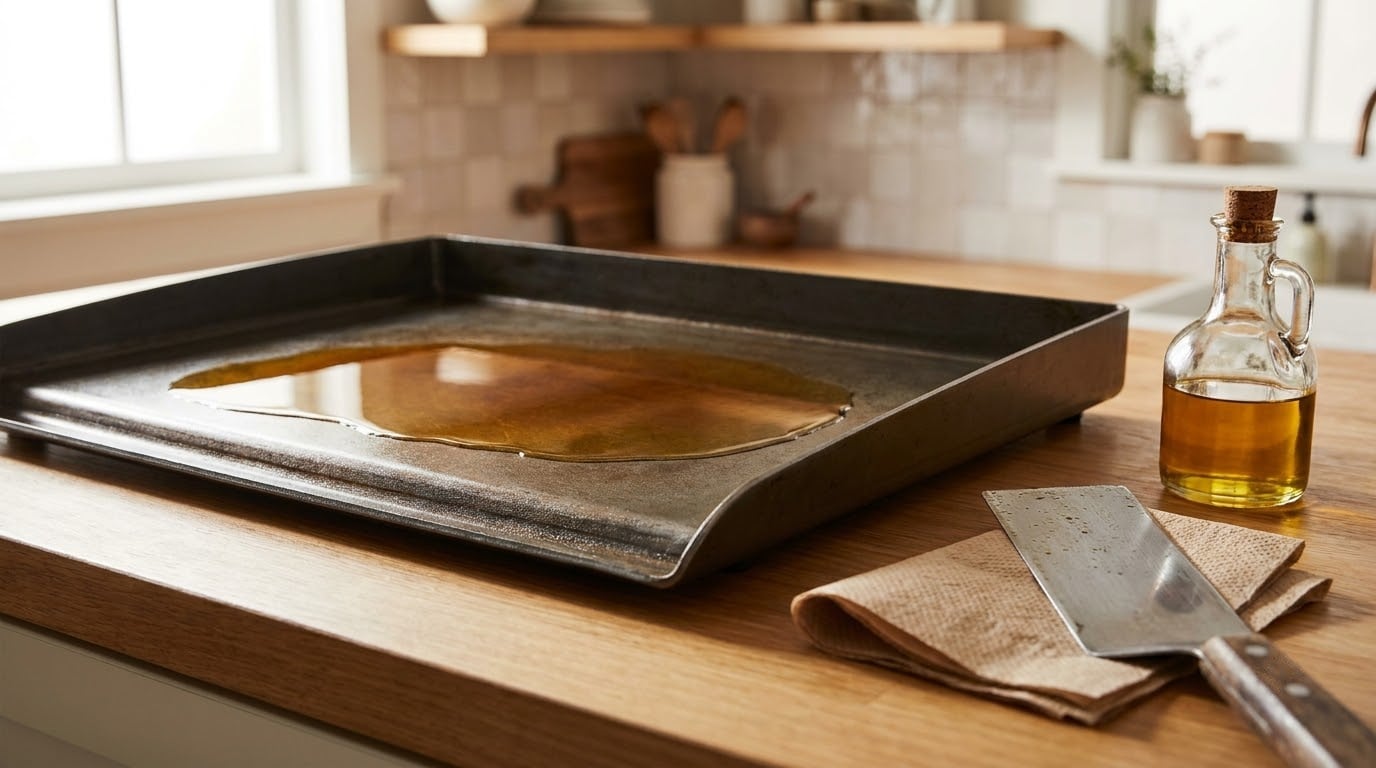
Seasoning a flat top griddle takes about 45 to 60 minutes and means baking four to five paper-thin coats of high-smoke-point oil onto bare steel until the oil polymerizes into a slick, rust-resistant film. Clean the plate, heat it empty until it discolors, wipe on a thin layer of oil, let it smoke off completely, and repeat. You can cook on it straight after the last coat.
That film is the whole reason a restaurant griddle releases a smash burger in ninety seconds without butter or spray. Raw cold-rolled steel does two things you do not want: it rusts when it meets moisture, and food welds itself to it. Seasoning fixes both at once, and it keeps getting better. A properly seasoned griddle outlives any factory nonstick coating you can buy.
None of it is difficult, and almost nothing about it is permanent. A gummy first coat, a skipped edge or a rainy week left uncovered can all be corrected in place. Start with the care instructions that came with your griddle, since manufacturers occasionally specify their own oil or coating, and use the sequence below for everything else.
What You Need
The tool list is short, and most of it you probably already own. Budget an hour the first time and half an hour for every seasonal touch-up after that.
- The griddle itself, on level ground with the burners or propane hookup ready to go.
- A high-smoke-point oil your manufacturer approves. Canola, grapeseed, avocado and vegetable oil all work. Flaxseed oil is the hardest layer but is fussier than the rest.
- A griddle scraper or bench scraper with a straight edge, plus a stiff nylon or heat-safe brush for stubborn carbon.
- Paper towels or cotton rags, the lint-free kind, folded into a flat pad.
- Water, warm not cold, and a mug or spray bottle to steam off stuck bits. Distilled water helps in hard-water areas.
- A fitted cover for wherever the griddle lives between cooks.
- About 45 to 60 minutes of uninterrupted time for the first seasoning.
Skip the steel wool and the harsh grill cleaner. Both strip metal off the plate, and you will be starting over from bare steel again the next afternoon.
Which oil to pick, in one table
Smoke point is the number that matters. Oil that smokes before it bonds leaves a film that never hardens properly, which is exactly how you end up with a sticky griddle.
| Oil | Smoke point | Verdict |
|---|---|---|
| Avocado | about 520°F (270°C) | Best all-round choice. Mild flavor, high tolerance, easy cleanup. |
| Grapeseed | about 465°F (240°C) | Excellent. Neutral and widely available. |
| Flaxseed | about 466°F (240°C) | Hardest layer, dries fastest, needs the thinnest coat. Can chip if laid on thick. |
| Canola or vegetable oil | about 460°F (238°C) | Perfectly good and cheap. Buy a dedicated bottle so you do not cross-contaminate it. |
| Olive oil | 375 to 410°F (190 to 210°C) | Skip it. Smokes early and goes bitter and sticky on the surface. |
| Corn oil | about 450°F (232°C) | Not recommended. Its high sugar content burns into a gummy residue that has to be scrubbed off. |
| Butter | low, dairy solids burn | Cooking fat, not seasoning fat. It browns before it polymerizes. |
On the brand-name griddle pastes: r/blackstonegriddle owners reach the same consensus repeatedly. Plain avocado or grapeseed oil performs as well as a packaged conditioner, at a fraction of the cost, and a paste is mostly refined oil with a bit of wax in it anyway.
Step-by-Step
Work through these in order and do not skip ahead. The order is what makes each coat bond to the last one instead of sitting on top of it.
1. Clean the Cooking Surface
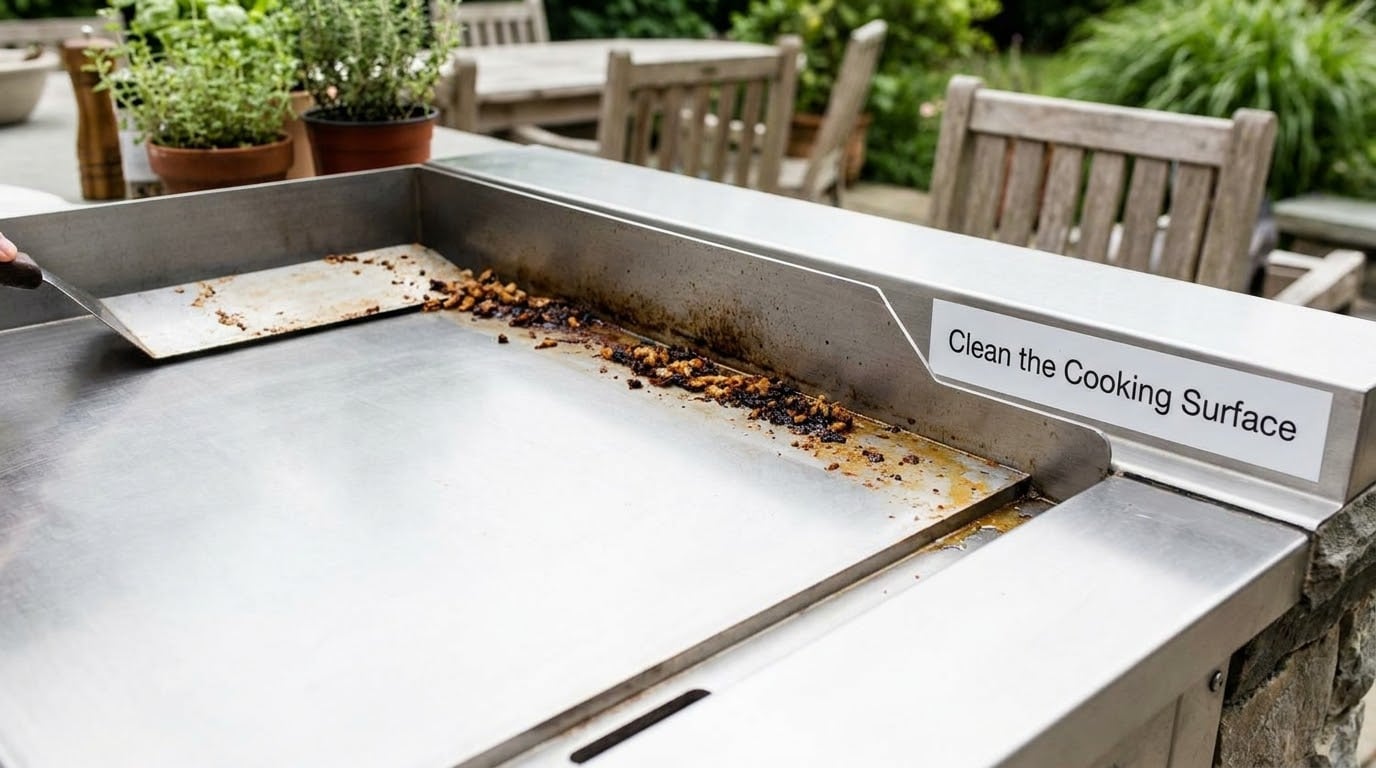
Scrape off crumbs and cooked-on carbon with a griddle scraper held at a shallow angle, almost flat, so the edge skims rather than gouges. For anything welded on, squirt a little water on the hot plate and let it steam for thirty seconds; the steam loosens the bit and a wipe clears it.
Wash with warm water and a drop of dish soap only on a brand-new griddle or when you are stripping rust. Soap is fine there and wrong everywhere else, because it strips the thin oil film that makes the surface slick.
Skip the wire brush, the abrasive pad and the oven cleaner. A little soap, a scraper and a rinse is enough, and a soft nylon brush handles the rest.
2. Dry the Griddle Thoroughly
Dry the plate completely with paper towels while it is still warm, then let it sit a few minutes. Trapped moisture is the fastest route to a failed coat, because water and oil will not mix and the oil beads instead of spreading.
Now heat the empty griddle on high for 10 to 15 minutes. This burns off the factory coating, oils and moisture still hanging on, and the plate will shift through tan and bronze toward a dull gray-brown. The smell is normal for this one pass and stops long before the surface does.
If the surface looks spotty or soapy after that burn-off, wipe it once more with a damp towel and let it dry. A brand-new griddle with a factory coating may not need the full pass; follow the manual on whether that coating is meant to be burned off or kept.
3. Apply a Thin Layer of Seasoning Oil
Pour a little oil into a folded paper towel pad until the pad is damp but not dripping, roughly one tablespoon for a 36-inch plate. Less is the number that matters here. A puddle takes twenty minutes to polymerize into a gummy tar you will spend an hour scraping off.
Wipe it on in long, overlapping strokes until the steel has a faint sheen and the towel leaves no visible trail. A correctly oiled surface looks almost dry. You are aiming for a film you could almost buff off with a dry finger.
Pay attention to the edges and the strip between burners, where the plate runs cooler. Those zones barely smoke and they are the first place the seasoning turns out blotchy later. A second light pass over them costs nothing.
4. Heat the Surface and Wipe Away Excess Oil
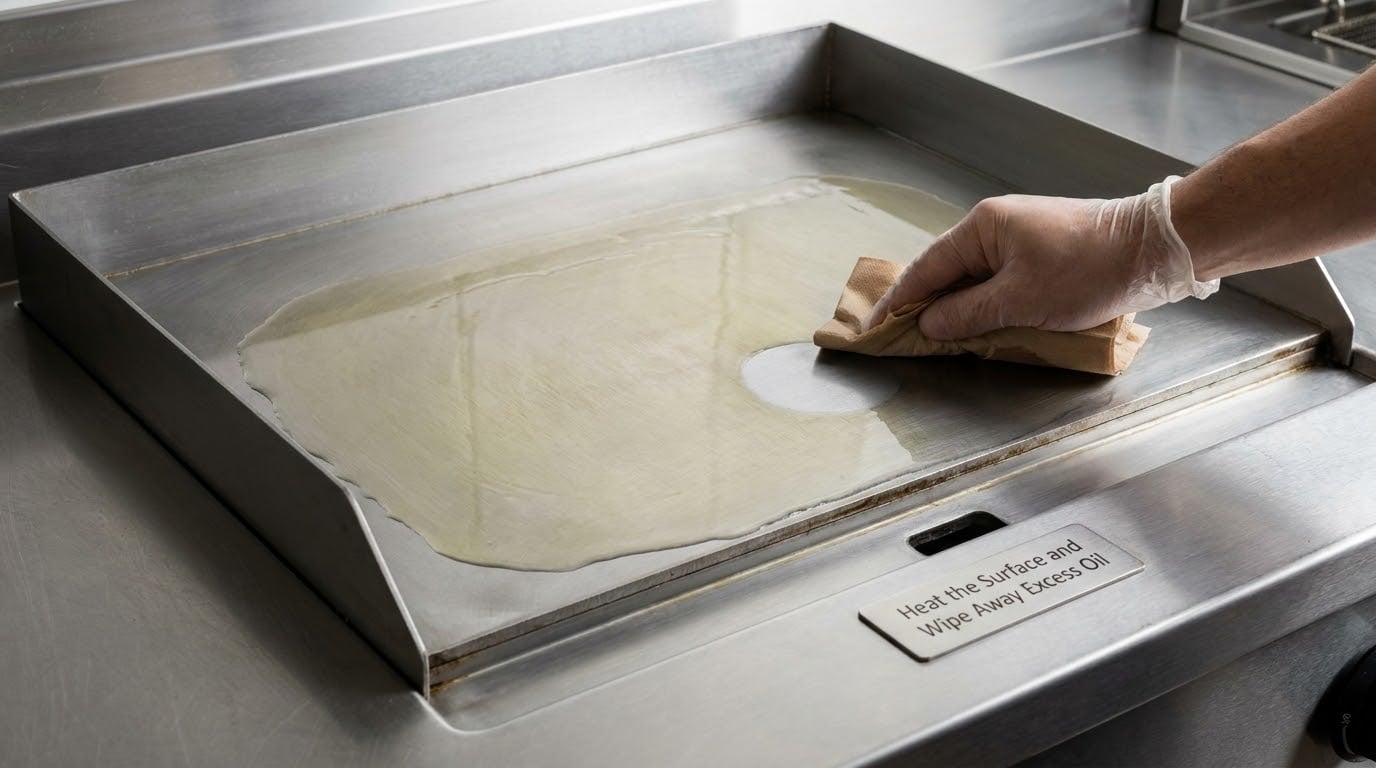
Turn the burners to high and heat the surface for 8 to 12 minutes, until the oil stops smoking and the faint haze clears. Watch the color rather than the clock: the plate moves from silver toward a warm tan, then a dark bronze.
The moment the smoke dies down, wipe the surface with a clean dry paper towel. Fold the towel flat, press it down, and drag it once across the whole plate. That single pass removes the unpolymerized oil and leaves the bonded layer behind.
Put a drop of water on the plate. If it skitters and beads into a round bead, the coat took. If it spreads into a film and hisses, wipe hard and heat another five minutes.
5. Repeat Coats for an Even Finish
Four to five coats is the target for a new griddle, with the fourth coat reserved for the edges and cool zones. Each coat takes 8 to 12 minutes, so a full seasoning runs 45 to 60 minutes including clean-up.
Between coats, let the plate cool for five minutes or so, then start again with a fresh clean towel and fresh oil. Never re-oil a hot, still-smoking surface; the oil goes straight past the polymerizing stage and pools.
Stop early if the plate reaches a uniform dark bronze-black and a paper towel drags across it without catching. Extra coats on an already good surface are what produce the thick, flaky layer that peels up in sheets, and a dried-out flaxseed layer can get hard enough to chip off in pieces. r/CastIronRestoration makes that exact point about flaxseed, and it applies to any fast-drying oil.
6. Test and Maintain the Seasoned Surface
Run the paper-towel drag test first. A folded dry towel should slide across the cooled plate with no resistance and no tackiness. Then try the egg test: wipe a little oil on, heat to medium, and crack an egg on. It should release without a spatula. The egg test also depends on temperature, so a stuck egg at a cold plate says as much about the heat as about the seasoning.
After every cook, scrape while the plate is still warm, wipe it clean, and put on a paper-thin closing coat of oil. A steam clean with a squirt of water handles whatever the scraper left. Regulars on the bbq-brethren forum run exactly that routine: burners high, water on, scrape, wipe, oil.
Let the griddle cool uncovered for a few minutes, then cover it. Standing moisture is what causes surface rust, and a fitted cover in winter is the cheapest rust prevention there is. Keep it dry between uses even in a garage, and check the grease trap and drip channel while you are at it.
Your first real cook should be bacon or smash burgers. Both give the surface fatty food at high heat, which is what builds seasoning fastest. Hold off on eggs and fish, which are the two things most likely to disappoint you on coat two. Cook ground beef to 160°F (71°C) and poultry to 165°F (74°C) as usual.
If a rust spot shows up, scrub just that patch with coarse salt and oil or a brass brush, wipe it dry, and re-season the patch with two light coats. Deep pitting that you can feel with a fingernail is a different problem, and the griddle is worth replacing at that point rather than fighting.
Common Mistakes
Almost every disappointing griddle I have seen traces back to one of these seven. Each has a straightforward fix.
- Leaving a puddle of oil. Thick oil never fully polymerizes and turns into a gummy, sticky surface. Fix: a tablespoon per 36-inch plate, applied with a folded towel until the steel looks almost dry.
- Seasoning over grease or moisture. The coat forms in patches and peels later. Fix: scrape, steam, dry completely with towels, then a short empty burn-off.
- Heating on medium. The oil never reaches the temperature it needs to bond. Fix: burners on high for 8 to 12 minutes per coat, judged by the color change rather than the clock.
- Skipping the final wipe. The unpolymerized oil stays behind and is the single most common cause of a sticky griddle. Fix: one firm pass with a clean dry folded towel the second the smoke stops.
- Over-seasoning. Twelve thin coats produce a thick layer that flakes. Fix: stop at four or five, and stop sooner if the plate already looks uniformly dark and slick.
- Using wire tools or steel wool. You remove metal, not seasoning, and the scratch pattern makes food catch later. Fix: a straight-edge scraper, a soft nylon brush, and water for steam.
- Storing it wet or uncovered. Even a good seasoning will spot with rust over one season of damp weather. Fix: dry, thin oil coat, cool uncovered briefly, then the fitted cover.
Two more worth naming. Do not use the griddle as a prep surface for raw meat, tomatoes or citrus; the acid and the salt get into the film and there is no way to scrub them out. And do not leave a splash of cooking oil sitting in the grease trap for weeks in summer.
Frequently Asked Questions
How often should I season a flat top griddle?
A full four-to-five-coat seasoning is a first-time job, not a yearly one. After that, a paper-thin coat of oil every time you finish cooking is enough to keep the film fed and the rust out. If the plate looks dull or gray between cooks, add an extra coat. Do a fuller touch-up of two or three coats in spring if the griddle sat outside all winter.
Can I use olive oil to season a flat top griddle?
No. Olive oil smokes at 375 to 410°F, well below the temperature a griddle plate reaches during seasoning, so it burns before it bonds. What is left is a bitter, sticky film that grabs food and has to be scrubbed off. If olive oil is the only oil in the house, canola or plain vegetable oil works in a pinch and costs less.
Why does my seasoned griddle still look patchy?
Patchiness almost always means the oil was uneven to begin with, or the plate was damp. Apply the coat with a folded towel in long overlapping strokes until the steel looks almost dry, and pay extra attention to the edges and the strip between burners where the surface runs cooler. Two extra coats focused on the pale areas usually evens it out without a full strip.
What is the best oil for seasoning a cast iron or steel griddle?
Avocado oil at about 520°F is the easiest all-round choice, with grapeseed and canola close behind and both widely available. Flaxseed builds the hardest layer but needs the thinnest coat and can chip if applied heavily. Skip olive oil, butter and corn oil. Follow the manufacturer’s care instructions first, since a few brands specify their own oil.
How do I remove rust from a flat top griddle without ruining the seasoning?
Work on the spot, not the whole plate. Scrub light surface rust with coarse salt and a little oil, or a brass brush, then wipe it dry and put on two light coats of high-smoke-point oil. Warm water and a drop of soap are fine for this one job since you are removing rust rather than preserving film. Pitting you can feel with a fingernail means the metal is gone, and the griddle should be replaced.
Yes, you can cook immediately after the last coat. Once the surface is cool enough to touch and a dry paper towel drags across it without catching, the film is bonded. Wipe on a light coat of oil, preheat, and start with bacon or smash burgers.
Conclusion
Seasoning a flat top griddle is one sequence repeated with patience: clean the plate, dry it completely, apply a very thin layer of high-smoke-point oil, heat until the smoke stops, wipe the surface once, and test the result. Four to five coats over 45 to 60 minutes is the whole job.
Then keep it fed with a paper-thin coat of oil after every cook, dry it before you cover it, and do not let a puddle, a wire brush or a season of rain undo the work. Begin with the care instructions that shipped with your griddle, since a few brands specify their own oil or factory coating, and the rest is straightforward from there.