
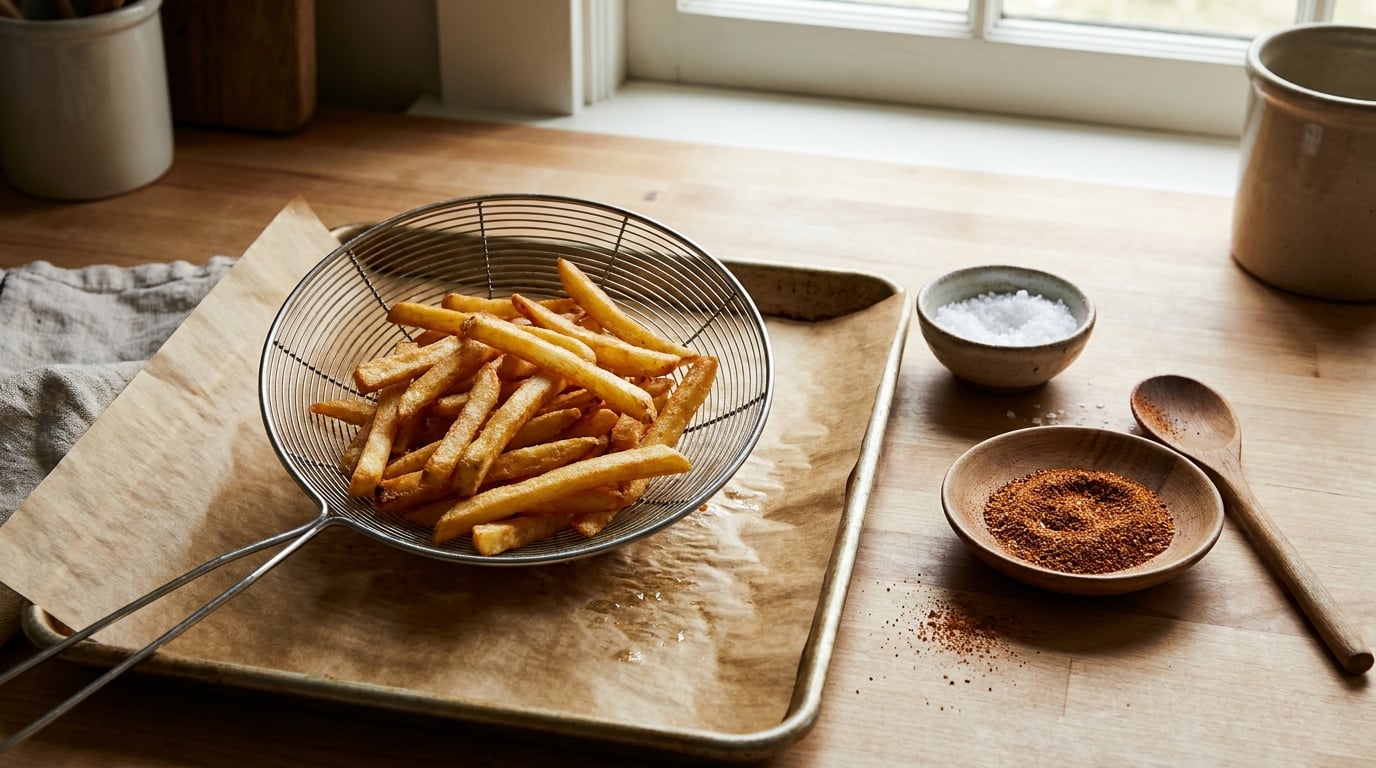
Restaurant fries taste different because of the last thirty seconds, not because of the fryer. To season fries like a restaurant, you toss them while they are still hot, with a salt-forward spice blend, then finish with coarse flaky salt so it sticks and adds a little crunch. Four levers do the work: a kosher or seasoned salt base, a garlic-onion-paprika blend, a flaky salt finish, and fries hot enough for the seasoning to bond.
Most home fries come out bland for a boring reason. The seasoning went on after the fries had cooled, so it slid to the bottom of the bowl. Fix the timing and the same blend tastes twice as strong. Budget about 40 minutes from cutting to serving, plus a 30-minute rest between the two fries.
Table of Contents
- What You Need
- Step-by-Step: How to Season Fries Like a Restaurant
- Common Mistakes
- Frequently Asked Questions
- What seasoning do restaurants use on fries?
- Should I season fries before or after frying?
- How do I keep seasoned fries crisp after frying?
- Can I use frozen fries to make restaurant-style seasoned fries?
- What is the best oil for crispy restaurant-style fries?
- How much salt should I use for one pound of fries?
- Conclusion
What You Need
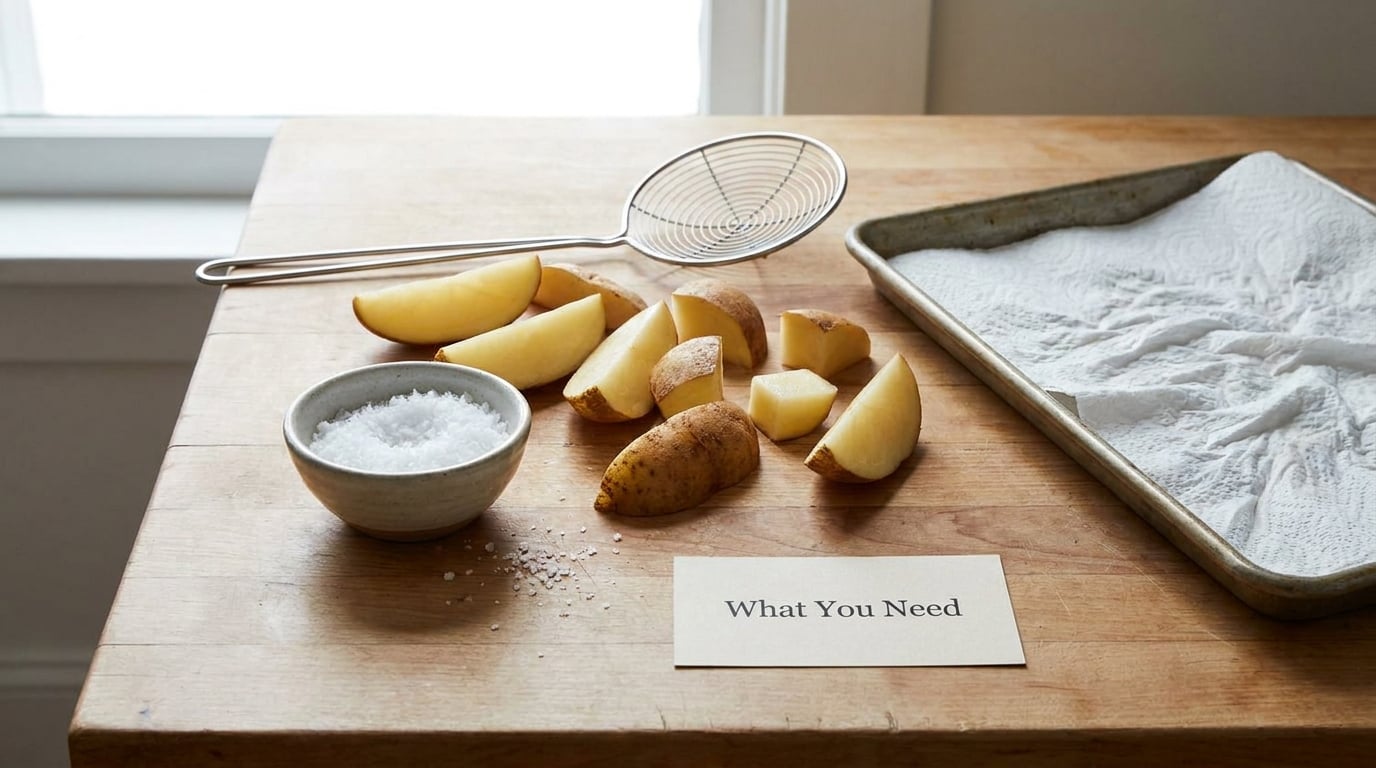
The ingredient list is short. The tools matter just as much, because the two that people skip are the wire rack and a wide, shallow bowl.
- Potatoes: 2 pounds russet for the classic craggy, crinkly fry, or Yukon Gold for a creamier, thicker-cut fry that holds its shape well.
- Oil: about 3 pounds of a neutral high smoke point oil such as canola, peanut or sunflower. Avocado works and tastes mild. Beef tallow or a tallow blend is what a lot of steakhouse fryers use, and it gives fries a deeper, beefier note.
- Salt: kosher salt for the base, plus flaky or coarse sea salt for the finish.
- Spices: garlic powder, onion powder, smoked paprika, black pepper and cayenne as a starting set. Dried thyme, oregano and parsley are worth adding later.
- Tools: a mandoline or sturdy knife, a heavy pot or Dutch oven 4 inches deep, a clip-on or infrared thermometer, a wire skimmer, a wire rack set over a sheet pan, a wide shallow bowl, and a slotted spoon.
Here is the base blend I keep on hand. The amounts are sized for 2 pounds of raw potatoes, which is roughly a family-size serving.
| Ingredient | Amount for 2 lb potatoes | What it does |
|---|---|---|
| Kosher salt | 1.5 tsp | The backbone of the seasoning |
| Onion powder | 1.5 tsp | Sweet, savory depth that survives the fry |
| Garlic powder | 1 tsp | Garlic aroma without the burn of fresh garlic |
| Smoked paprika | 1 tsp | Warm color and a faint smokiness |
| Dried thyme | 0.75 tsp | Herbal note that reads as restaurant rather than home |
| Cayenne pepper | 0.5 tsp | Heat; reduce it to 0.25 tsp or leave it out |
| Black pepper | 0.5 tsp | Peppery bite to balance the salt |
| Flaky sea salt | 1 to 2 tsp, added at the end | Crunch and a visible salty hit on top |
One warning before you start. Most bottled fry seasoning blends already contain salt, including Lawry’s-style seasoned salt and Old Bay. If you use one of those, treat it as your entire base and skip the kosher salt in the table, or the fries go salty after two bites.
Step-by-Step: How to Season Fries Like a Restaurant
1. Choose and Cut the Right Potatoes
Russet potatoes give the crinkly, craggy crust that fries with the most surface area to hold seasoning. Yukon Gold fries taste sweeter and hold their shape better, so they suit a thicker 3/8-inch cut. Whichever you pick, cut every piece the same thickness. Uneven cuts cook unevenly, and seasoning cannot fix a fry that is pale on one end and dark on the other.
Rinse the cut potatoes under cold water until the water runs clear, then soak them in ice water for at least 30 minutes, or up to a few hours if you have time. You are pulling excess surface starch out of the cut, which is the glue that would otherwise turn into a gummy coating. The soak finishes when the pieces feel firm and squeaky at the edges instead of slippery.
2. Dry the Potatoes Thoroughly
Spill the soak water, spread the fries on a towel, and blot the surfaces dry. Then spread them in a single layer and let them air out for 10 to 15 minutes. Surface water turns to steam the second the fries hit the oil, and steam softens the crust it just formed.
If you skipped the soak, give them extra drying time. Wet potatoes also lower the oil temperature, so the first fry never crisps properly and the seasoning ends up on a greasy surface that grips nothing.
3. Fry at the Right Temperature
Heat about 3 inches of oil in your pot to 325°F (165°C). Drop in a single test fry and give it about 15 seconds. If it bubbles steadily all the way to the edges of the pot, the oil is ready. If it sits still, give the heat more time.
Fry in batches of no more than a third of the oil volume. Crowding the pot drops the temperature, the fries soak instead of sear, and a cold, greasy surface is exactly where seasoning ends up sliding off. You are looking for 4 to 5 minutes in the first fry, until the interior is cooked and the outside is pale yellow with no color. Pull them out well before they brown.
4. Drain Without Steaming the Fries
Lift the fries out and spread them across a wire rack set over a sheet pan, in a single layer with no overlapping pieces. A pile of fries traps steam, and steam is the one thing that undoes all the work of the first fry. A folded paper towel is worse, because it holds moisture against the crust.
Rest the fries for 20 to 30 minutes. This is the step most home cooks skip, and it is the step that makes restaurant fries crunchy. The surface finishes drying and setting while the interior keeps cooking from residual heat. If you are cooking for a group, you can hold the rested fries loosely in a warm oven set no higher than 200°F, spread on that same rack.
Now raise the oil to 350°F (175°C) and fry the rested fries for 60 to 90 seconds, until they turn deep golden and the crust sounds hollow when you tap it. Drain and drain again, single layer, no exceptions.
5. Season in Layers
Season the fries within about a minute of leaving the oil, while they are hot but not yet screaming. This is the whole trick to how to season fries like a restaurant. The surface of a hot fry carries a thin film of oil and moisture, which dissolves the salt and spice particles and welds them to the crust. Season fries that have cooled even slightly and you get a bowl with seasoning at the bottom of it.
Put the fries in a wide, shallow bowl so they sit in one loose layer rather than a deep pile. Add about a teaspoon of neutral oil or melted butter per pound of fries and toss first. The fat gives the dry blend something to cling to instead of bouncing off a bare surface. Then add your base blend, roughly 1 to 2 tablespoons per pound, and toss again with a slotted spoon or by shaking the bowl.
Taste one before you serve. If it needs more, add a pinch of kosher salt, toss, and taste again. Small adjustments beat one big guess.
Delicate herbs and powdered flavors go last, after the first toss, so they do not grind into the crust. Flaky salt goes last of all. That is the finish a restaurant pass does at the last second: a pinch of coarse flaky salt over the top, where you can both see and hear it. Fine table salt dissolves into the crust and disappears; coarse flakes sit on the surface and add a faint crunch between your teeth.
If you are working with a bottled seasoned salt, use it as the base in place of the kosher salt and the spice blend, then finish the same way with flaky salt.
6. Toss and Serve Immediately
One more toss after the flaky salt, then serve within minutes. Fries lose their crunch fast as the salt keeps drawing moisture out of the potato, which is why a basket sitting on a counter for half an hour is nothing like the same fries straight from the kitchen.
Serve them in a paper-lined basket or a wire basket so air can still circulate underneath. If you are plating them, drain on the rack for the last 30 seconds rather than sitting them on a plate, where the bottom fries steam themselves soft.
Common Mistakes
Soggy fries
Usually undried potatoes, an overcrowded pot, or fries drained in a pile. Fix all three: dry the cuts properly, fry in thirds, and use a wire rack.
Seasoning that tastes flat
It went on too late, in a deep bowl, or on a greasy surface with no binder. Toss hot fries in a wide bowl with a small amount of oil or melted butter first, then add the blend.
Fries that go salty after two bites
You combined a bottled blend that already contains salt with a salted base. Pick one or the other, then taste before serving.
Uneven color
The cuts were not the same thickness, or the oil was not back to temperature between batches. Cut uniform pieces and check the thermometer each time instead of trusting the dial.
No crunch, or a greasy finish
The 30-minute rest between the two fries got skipped, so there was no dry surface to crisp. Give them the rest, and use an oil with a high smoke point so nothing breaks down during the second fry.
Fries go limp in the bag
They were seasoned too far ahead. Season within a minute of draining and serve right away. If you must hold them, keep them in a single layer in a warm oven, never in a sealed container.
Frequently Asked Questions
What seasoning do restaurants use on fries?
Most kitchens use a salt-forward base rather than plain salt alone: kosher salt or a seasoned salt, layered with garlic powder, onion powder and paprika, then finished with coarse flaky salt at the pass. Many also add a small amount of MSG, butter powder or mushroom powder, which is part of why restaurant fries taste rounder and more savory than plain salted ones. Home cooks get most of that effect with the base blend above and a tight seasoning window.
Should I season fries before or after frying?
After. Salting raw potatoes before frying draws water out of the cut and can make the surface spongy and greasy. Season the fries within about a minute of leaving the oil, while they are still hot, because that heat and surface moisture are what make the particles fuse to the crust. Toss in a wide bowl with a small amount of oil or melted butter so the blend has something to hold on to.
How do I keep seasoned fries crisp after frying?
Drain them in a single layer on a wire rack so no steam gets trapped, and never pile them in a paper towel or a closed container. Season late rather than early, and serve within about ten minutes. If you need to hold them for a group, keep them spread out in a warm oven at 200°F or below. Reheating is where crispness usually dies, so reheat in a hot oven or air fryer, never a microwave.
Can I use frozen fries to make restaurant-style seasoned fries?
Yes, and the seasoning step works exactly the same. Bake or air fry the frozen fries first so you can see how done they already are, then give them two to three minutes in hot oil, drain, and season while hot. Frozen fries already carry a thin coating to keep them from sticking together, so they hold up well for this method. Skip the rinse and the double fry, since both are only needed for raw potatoes.
What is the best oil for crispy restaurant-style fries?
A neutral oil with a high smoke point and little flavor of its own works best: canola, peanut, sunflower or avocado. For a steakhouse style, beef tallow or a tallow blend adds a deeper, beefier note that plain vegetable oil does not. Whatever you use, keep the temperature steady, do not crowd the pot, and change the oil when it darkens or starts to smoke, because old oil is the main cause of greasy fries.
How much salt should I use for one pound of fries?
For a plain salted fry, about 1 teaspoon of kosher salt per pound of finished fries is the usual starting point, adjusted to your taste. For a seasoned blend, most of the salt comes from the blend itself, so use 1 to 2 tablespoons of blend per pound and skip extra salt until you have tasted. If the blend you bought already contains salt, use it as the complete base and add only flaky salt at the end.
Conclusion
Cut the potatoes to one even thickness, dry them properly, fry at 325°F then 350°F with a 20 to 30 minute rest in between, and drain in a single layer on a wire rack. Season while the fries are still hot, in a wide bowl, with the base blend plus a pinch of flaky salt on top, then serve within minutes. That is the whole method, and it costs about the same as a bag of frozen fries.
Start with the blend table above for your next batch. Once that lands, swap the base for lemon pepper, Old Bay, curry powder or smoked paprika and you have a different restaurant style without changing the technique.