

To write a resume for a kitchen job, put your contact details at the top, follow with a two-line summary naming the stations you work, then list every restaurant role in reverse-chronological order with four to six bullets that pair a station duty with a number. One page, plain formatting, no photo. That is the whole formula.
A kitchen manager sorting forty applications for a line cook opening reads each one for about fifteen seconds. What earns a second look is not a list of soft skills everyone writes, but proof that you can hold a hot station: a volume you prepped, a ticket time you hit, a certification with a date on it.
Most guides on this topic are written for executive chefs with catering careers. This one is aimed at the person actually searching kitchen job: line cooks, prep cooks, expeditors, kitchen helpers, dishwashers, and people applying to their first kitchen job with nothing on paper yet.
It takes about 90 minutes the first time, and about 30 minutes for each application after that once you keep a master copy.
Table of Contents
- What You Need
- Step-by-Step
- How to Write a Resume for a Kitchen Job: Choose the Right Format
- Add a Focused Professional Summary
- Build a Reverse-Chronological Work History
- Translate Kitchen Duties Into Strong Resume Bullets
- Create a Relevant Skills and Certifications Section
- Tailor the Resume to Each Posting
- Proofread and Review for Hiring Managers
- Common Mistakes
- Frequently Asked Questions
- How to Write a Resume for a Kitchen Job: What to Do First
What You Need

Gather everything before you open a blank page. Scrambling for dates mid-draft is the reason most kitchen resumes end up vague.
- Contact details. Full name, phone, email, and city with state. A professional-looking email matters here more than in most industries, because your resume is often read on a phone in a back office.
- The target job. One specific vacancy. A line cook application should not read like a dish washer application.
- Employment dates for every role. Month and year, start and end. Gaps read worse than short stints, so be accurate.
- Station list per job. Grill, sauté, fry, prep, garde manger, expo, dish, pantry, bakery. Note which ones you ran yourself and which you covered.
- Ingredients and equipment. The proteins you handled, the equipment you operated, the cuisines you cooked.
- Volume numbers. Covers per shift, plates per hour, headcount on the line, pounds of produce prepped, parties catered. Estimates are fine if you flag them honestly.
- Certifications. ServSafe Food Handler, a state food handler card, HACCP, TIPS. Note the issuing body and the year.
- Two references. A chef or kitchen manager, and one other who can vouch for showing up. Have their contact details separate; many kitchens ask verbally rather than reading a reference section.
Which details matter most depends on the role. Fast food and high-volume spots scan for availability, lifting ability, and weekend close experience. Catering and hotels look for banquet volume, plating, and food cost discipline. Fine dining reads station names, cuisine, and technique.
Have your equipment vocabulary ready, too. Cooks who come out of a home kitchen often undersell themselves because they do not know the words. If you have seared proteins on a cast iron pan at home, that is a sauté station skill in plain language.
Step-by-Step
How to Write a Resume for a Kitchen Job: Choose the Right Format
Use a single-column layout with one font, 10 or 11 point, and generous margins. Applicant tracking systems mangle anything with text boxes, columns, tables, or decorative graphics, and many chain restaurants and hotel groups run resumes through one before a human sees them.
Leave out the passport photo, the color blocks, the skill rating bars, the objective written in the third person, and any graphic that looks like a restaurant menu. A one-page document, saved as a PDF, gets read; a designed one gets skipped.
A clean header looks like this:
Maria Delgado | Chicago, IL | (312) 555-0148 | [email protected]
Under it, write the job title you are applying for as a plain line. Kitchen managers are filtering by title, so make it easy to match against the posting.
Add a Focused Professional Summary
A summary is two or three sentences that tell a manager what you can run today. Name your level, the kind of kitchen, your strongest stations, any certification, and what you are looking for.
Example for an experienced line cook:
Line cook with four years on high-volume lines in casual dining, running sauté and grill during dinner service of up to 250 covers. ServSafe Food Handler certified, comfortable with ticket times, portion control, and training new kitchen helpers. Looking for a full-time station on a tight, well-run team.
If you are entry level, drop the experience claim and lead with what you have actually done:
Kitchen helper with one year in a busy bakery and a food handler card, experienced with dishwashing, sanitation, dry storage, and keeping a station stocked through service. Reliable, fast on feet, and eager to learn prep. Ready to start at the bottom and move up.
That version works because it is honest and still specific. Cooks on kitchen forums say the same thing over and over: hiring managers would rather read a true beginner who is willing to work than a padded one they have to vet.
Build a Reverse-Chronological Work History
List your most recent kitchen job first. Each entry gets four lines: job title, restaurant name, city and state, and dates on the same line, right-aligned.
Follow with four to six bullets per role. Six is the ceiling; four is plenty for early jobs. Lead each bullet with what you were responsible for, then add the ingredient, equipment, team size, volume, speed, quality, or safety practice that made it real.
Structure for one role looks like this:
Line Cook | Mariscos Del Sur | Chicago, IL | March 2024 to present
- Run the sauté and grill stations for a 90-seat restaurant averaging 180 covers on Friday and Saturday nights.
- Cook proteins to order on a flat top and charbroiler while holding ticket times under 12 minutes during peak.
- Break down and rotate proteins daily, log cooler and hot-hold temperatures, and complete closing sanitation on the line.
- Train two kitchen helpers on mise en place and portion standards for the lunch menu.
Keep the order of sections consistent across every role so a reader can scan quickly. Dates matter: most kitchen hiring managers want to see roughly two years of recent history, with older roles compressed to fewer bullets.
Translate Kitchen Duties Into Strong Resume Bullets
The core problem with most kitchen resumes is generic duties. “Cooked food,” “helped the team,” and “maintained a clean kitchen” describe every applicant ever submitted. Replace them with action plus result.
- Weak: Prepped food for the line. Stronger: Prepped 40 pounds of vegetables and portioned proteins for two services daily from a written prep list.
- Weak: Worked the grill. Stronger: Operated the charbroiler and flat top for a 250-cover service, managing proteins for four line cooks.
- Weak: Kept the kitchen clean. Stronger: Handled dishwashing, floor sanitation, and closing duties solo for a 60-seat casual dining restaurant.
- Weak: Helped with orders. Stronger: Took orders at the window during lunch rush and called out 30 tickets per hour.
- Weak: Kept food costs down. Stronger: Trimmed overproduction on proteins by tracking daily waste sheets, cutting waste roughly a quarter over two months.
When the duties are repetitive, do not write twelve similar bullets. Group them. One bullet on the grill and one on sanitation say more than six lines that all start with “cooked.”
Food-safety language is worth using because it is specific and verifiable. Name the practices you actually follow: temperature logs, cool and hold, cross-contamination control, FIFO date labeling, allergen separation. If you touched food, USDA safe minimum internal temperatures are poultry 165F, ground meat 160F, and whole cuts and fish 145F; mention the logging habit rather than lecturing about temperatures in a resume bullet.
Create a Relevant Skills and Certifications Section
Group skills so a manager can find them. Four short labeled buckets beat one long undifferentiated list.
Food preparation: sauté, grill, fry, sauté saucier, garde manger, prep, mise en place, butchery, portion control, knife skills, baking
Equipment: flat top, charbroiler, deep fryer, combi oven, slicer, mixer, stock pot, steamer, salamander
Service and operations: expo, ticket management, table turns, banquet plating, ordering, inventory counts, food cost, waste tracking
Food safety: ServSafe Food Handler, HACCP, temperature logging, FIFO rotation, allergen protocols, sanitation
Keep a short soft skills line as well: works under pressure, communicates with FOH, trains new hires, reliable close availability.
For certifications, list the exact name of the credential, the issuing body, and the year you earned it. Put them under Education and Certifications at the bottom of the page, or as their own short section if you hold more than two. Do not write “certified” for a class you attended but never passed, and do not imply a certification you do not hold.
This section is the cheapest lift available. Kitchen workers report again and again that a food handler certificate costs very little, takes a short online course, and immediately separates one application from a stack. Many kitchens want at least one certified person on every shift.
Tailor the Resume to Each Posting
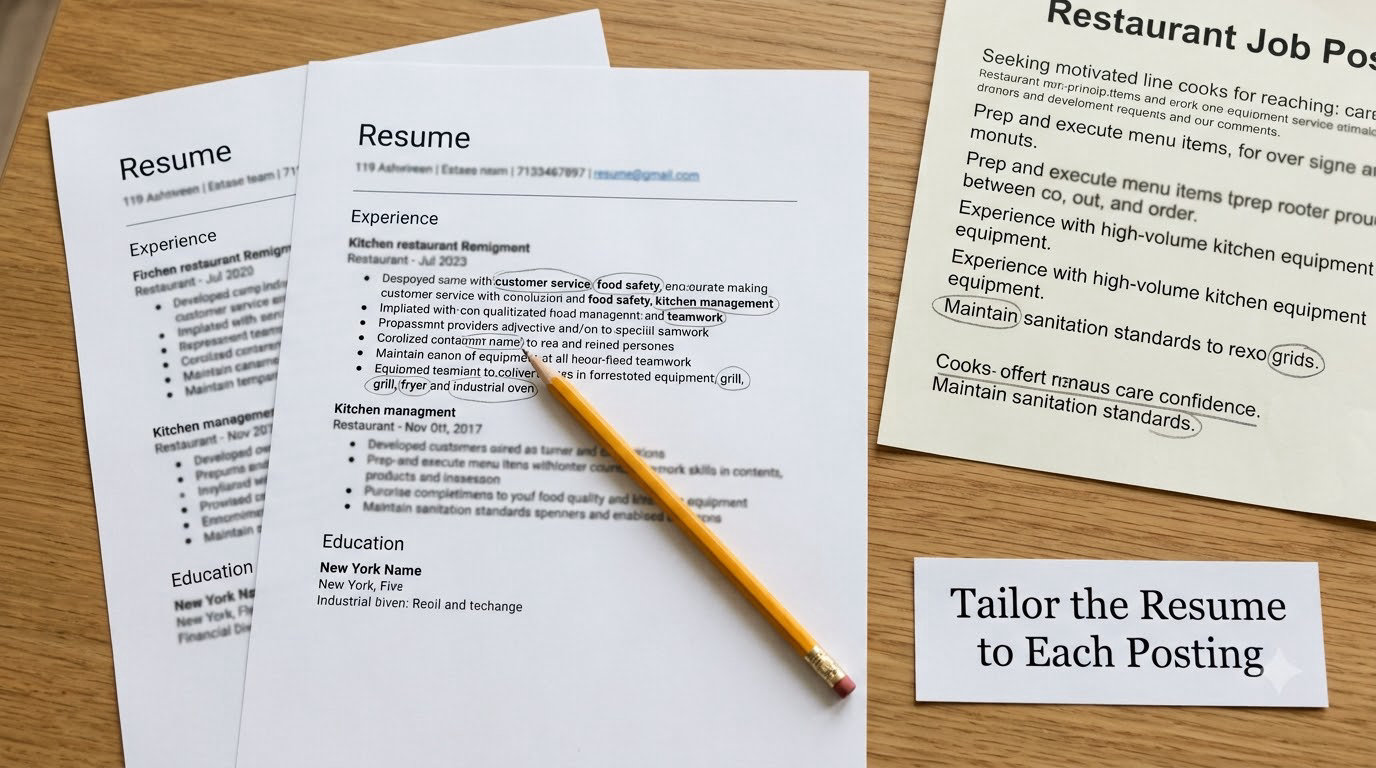
Every posting repeats the same requirements, and those requirements are your keyword list. Read it and pull out three to five phrases that matter most: “high-volume line,” “full-service brunch,” “banquet plating,” “HACCP,” “fast food,” “closing duties.”
Then mirror your genuine experience using those same words. If the posting says “sauté station in a full-service restaurant” and you have done exactly that, use that phrase. If you have never done brunch service, leave it out rather than stretching.
What you move depends on the posting. For a grill role, put grill bullets first and lead the summary with grill. For a dish role, lead with sanitation speed, equipment, and volume. For a banquet job, move plating, portion control, and up-to-200-guest experience to the top of the bullet list.
Never exaggerate. Every word on this page should survive a question in the interview, because chefs interview by asking how you did something. A claim you cannot explain in detail is worse than a shorter honest resume.
Proofread and Review for Hiring Managers
Run a final pass the way a manager would: six seconds of scanning.
- Are dates in a consistent format, in order, with no unexplained gaps?
- Does every job title match what the posting is asking for?
- Does at least one bullet in each role carry a number?
- Are acronyms spelled out once, for example HACCP, rather than assumed?
- Are spelling and restaurant names correct, and is the email address professional?
- Is anything on the page something you cannot back up in an interview?
Save it as a PDF with a text-friendly filename like Maria_Delgado_LineCook_Resume.pdf rather than a file called final_FINAL2.docx. Then ask someone who has actually worked a line to read it. That person spots inflated language instantly and will tell you which bullet sounds made up.
Common Mistakes
Copying a generic duties list. If your resume could belong to any restaurant, it belongs to no one. Fix: replace every third bullet with a specific station, ingredient, or number.
Naming equipment with no context. Listing slicer, fryer, and combi oven as bare words tells a manager nothing. Fix: attach an outcome, such as operating the slicer to portion 30 pounds of roast beef per shift.
Claiming duties you did not perform. This is the fastest way to lose a kitchen interview. Fix: cut it, or describe the version you actually did.
Using an unreadable design. Two-column templates, skill percentage bars, and clip art break text extraction and slow people down. Fix: single column, one font, one page.
Omitting dates. Kitchen hiring depends heavily on recent experience and availability. Fix: month and year for every role, in a consistent format.
Leaving out high-volume work. A cook who has never written a number looks interchangeable. Fix: add covers per service, pounds prepped, plates per hour, team size, or parties catered. If you are unsure, a careful estimate is better than silence.
Sending the identical resume everywhere. A posted grill application should not read like a dish application. Fix: keep a master copy, then reorder the summary and top bullets per vacancy.
Writing in paragraphs. Nobody scans a wall of text during a rush. Fix: bullets, six lines or fewer per role.
Listing references on the page. Fix: keep names and numbers on a separate sheet, or use the phrase “references available on request.” Many kitchens ask in person anyway.
Two habits make the rest easier. Keep a master document with every role, every number, and every date, then trim it for each application instead of rewriting from scratch. And print a few copies, because plenty of small kitchens still hire by walk-in, and a printed resume handed to a chef opens a conversation that an email never does.
Frequently Asked Questions
How long should a resume be for a kitchen job?
One page is the standard for line cook, prep cook, kitchen helper, and dish roles. Add a second page only when you have eight or more years of kitchen experience, multiple kitchen careers, or catering and banquet history that would not fit. Keep every role to four to six bullets so the page stays scannable. Two pages of thin bullets reads worse than one dense, specific page.
What should I put on a resume with little restaurant experience?
Lead with transferable work and home cooking described in kitchen language. A warehouse job becomes inventory rotation and order picking; a home health aide becomes time management and sanitation discipline; home cooking becomes knife skills, seasoning, and cooking proteins on a cast iron pan. Add a food handler card, name your strongest two stations, and state plainly that you want to learn.
Should I list every piece of kitchen equipment I have used?
List the equipment you can run confidently, and give each one a result. Ten names with no context read like padding. Five equipment items paired with what you produced on them, such as volume prepped or covers supported, tell a manager you have actually stood at those stations. If you touched something once during a rush, leave it off.
Who should I use as a reference for a kitchen job?
Use a chef, kitchen manager, or line cook you worked under, plus one person who can confirm you show up and work weekends and closes. A former supervisor is worth more than a family friend. Ask before you list anyone, give them a copy of your resume, and remind them which job you applied for so their call to the restaurant is useful.
Should I include a food-safety certificate on my kitchen resume?
Yes, if you hold one. List the exact credential name, the issuing body, and the year, under Education and Certifications. A ServSafe Food Handler card or state food handler card is one of the fastest ways to stand out, because many kitchens want at least one certified person on every shift. Never list a class you attended as a certification, and never describe yourself as HACCP certified unless you are.
How to Write a Resume for a Kitchen Job: What to Do First
Start by writing out your three most recent kitchen roles with dates, then list the measurable part of each one: volume, station, team size, or ticket time. Pick one specific vacancy and put the station it asks for at the top of your resume. Draft it plain, one column, one page, in reverse-chronological order, and save it as a PDF.
Three priorities decide whether it works: it has to be accurate enough that any line survives a question in the interview, scannable enough that a busy manager gets the picture in fifteen seconds, and relevant enough that the top bullets match the words in the posting.
Everything else is detail. Get those three right and the rest follows.