
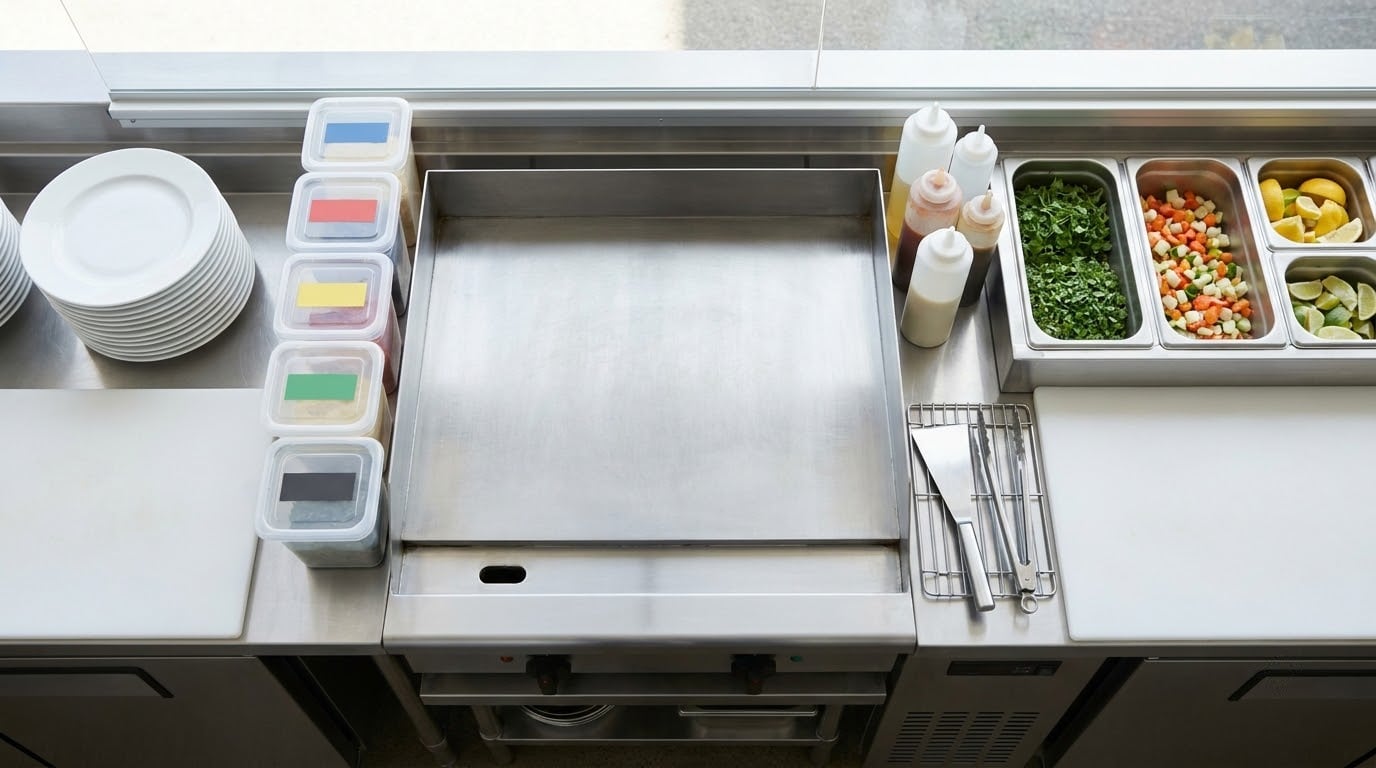
A line cook works one station on the kitchen line and owns it from start to finish: prepping the station before service, cooking its menu items to order during the rush, then breaking it down and sanitizing it at close.
Most shifts run about 8 to 11 paid hours, with five or six of those spent standing at the line while tickets stack up. Below is what that looks like hour by hour, including the parts job postings leave out.
Table of Contents
- What Does a Line Cook Do During a Shift?
- What Is the Line Cook’s Station Setup?
- What Does a Line Cook Do Before and During Service?
- How Does a Line Cook Handle Orders and Food Quality?
- How Does a Line Cook Practice Food Safety?
- What Happens When a Line Cook’s Station Gets Busy?
- What Does a Line Cook Do During the End of a Shift?
- How Is a Line Cook’s Shift Different From a Chef’s?
- Frequently Asked Questions
What Does a Line Cook Do During a Shift?
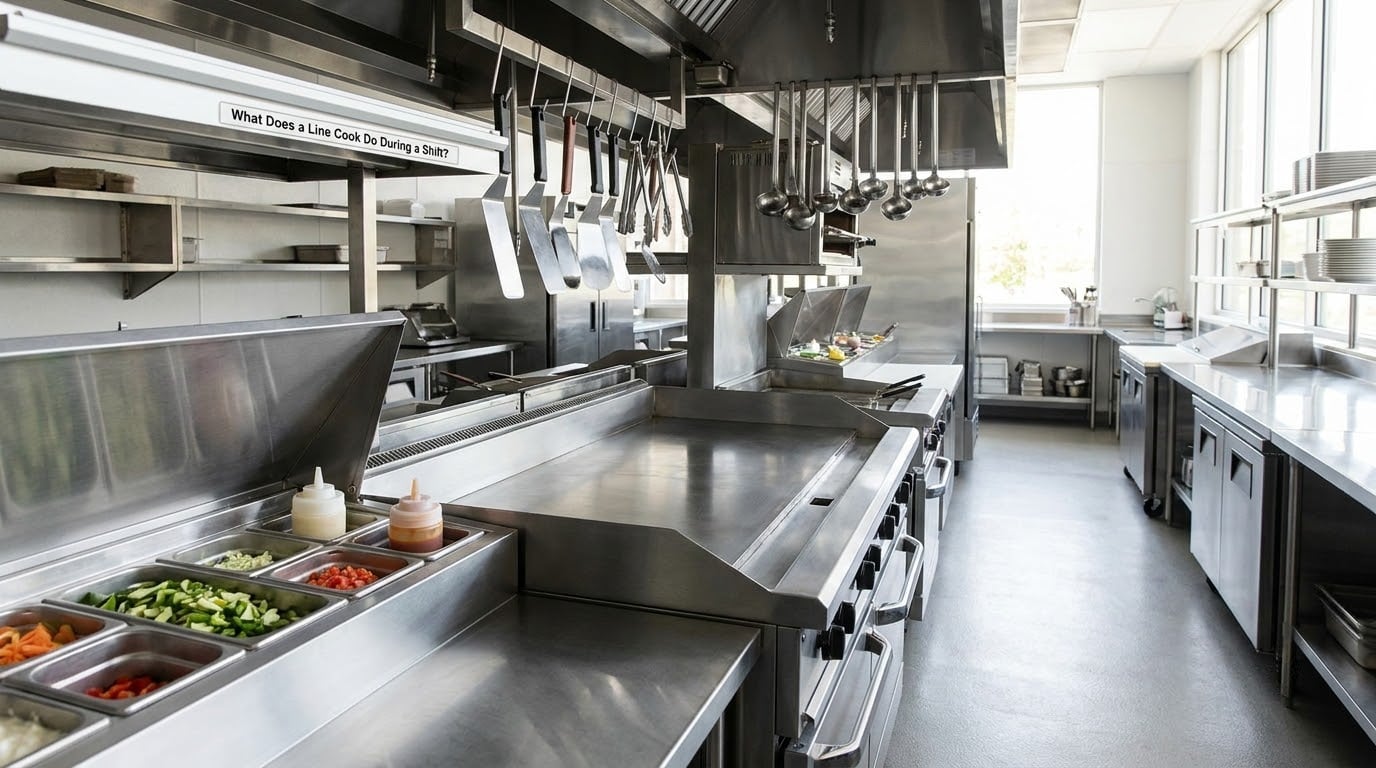
A line cook keeps one station running: they prep it, cook the dishes assigned to it, manage timing so every plate leaves the pass together, keep the station clean and safe through service, and close it down at the end.
In practice that breaks into six recurring jobs:
- Prepping food ahead of service, usually from a prep list left by the closing cook or the sous chef
- Setting up the station, which is mise en place: ingredients portioned, tools within reach, pans staged, nothing hunting for during a rush
- Cooking a fixed list of menu items to order, usually within a window of a few minutes
- Timing multiple orders at once so a table’s food hits the pass together rather than one dish at a time
- Staying clean and safe while cooking, which means wiping as you go, changing gloves, labeling, and watching temperatures
- Closing the station: breakdown, cleaning, sanitation, restocking, and reporting what ran low or broke
What the job posting does not mention is the side work. Cooks butter bread, run pans to the dish pit, haul trash, refill ice bins, portion sauces, and restock the line mid-rush while tickets are still printing.
What Is the Line Cook’s Station Setup?
Station setup is the block of time before doors open, and it decides how the rush goes. A station that is set up badly costs minutes all night.
A cook arrives, reads the prep list, checks what pars are low, then looks over the equipment they own: the grill is scraped and seasoned, the fryer oil is filtered, the banister pans are cold, the holding lamps are working, the probe thermometer is in its sanitizer, the ticket rail is clear.
After that, ingredients go into mise en place. Nothing is chopped during service if it can be avoided. Proteins are portioned and seasoned, sauces are mixed and put in squeeze bottles or hotel pans, garnishes are cut and covered, and backups of anything that runs out during a rush get built rather than left for later.
What Mise en Place Actually Means Before Service
Mise en place means everything in its place before the work starts. For a line cook that has a practical shape most kitchens follow:
- Read the prep list and pull the raw product you need
- Break down the product and trim it to the specs on the recipe card
- Portion and season proteins, and build backup pans to par levels
- Mix and stage sauces, then put them in labeled containers within arm’s reach
- Set the station: clean equipment, tools in order, pans staged, and a final look at the board
Organization matters more than it sounds. A station configured left to right in the order items are cooked saves the cook from crossing their own arms with a hot pan in one hand. Veterans on r/KitchenConfidential describe it simply: everything in the same place every service makes the work automatic.
Tools are worth naming too, because the list is short and everybody uses the same one: a chef’s knife you sharpen yourself, a paring knife, a speed peeler, a bench scraper, a set of spatulas and tongs dedicated to that station, a couple of hotel pans, a towel, and a probe thermometer. A separate set of utensils per station is what keeps raw chicken off the garnish pass.
How much room you have depends on the station. A grill cook works over a hot surface with a rail overhead, while a sauté cook needs clear burner space and a landing area for finished plates. Knowing the physical layout before service saves the fumbling that new cooks describe in their first weeks.
Which Station You Are On Changes the Shift
Same kitchen, same rush, very different job depending on where you stand. These are the ranges most restaurant kitchens work within, and they are a starting point rather than a rule.
| Station | Classic name | What it owns | Typical ticket time | Common failure |
|---|---|---|---|---|
| Grill | Grillardin | Steaks, burgers, chops, grilled proteins and vegetables | 6 to 14 minutes | Grill not scraped between batches, so old bits flavor the new ones |
| Sauté | Saucier | Sauces, pasta, pan-seared proteins, composed plates | 5 to 12 minutes | Sauce running out mid-rush with no backup pan built |
| Fry | Friturier | Fries, fried chicken, fried sides, tempura | 3 to 8 minutes | Oil quality dropping because the filter has not been run |
| Cold | Garde manger | Salads, cold plates, desserts, garnish and cold prep | 2 to 5 minutes | Dressing or garnish running out and no backup prepped |
| Expo | Aboyeur | Calling the line, timing the pass, running finished plates | Whole pass | Not flagging a problem early, so it reaches the server |
Read the ticket time column as the window a dish should leave the station, not a promise to the table. The point of the number is sequencing: a fry cook working in three minutes can batch through a whole rail, while a grill cook on a fourteen-minute chop has to start much earlier or the table waits.
Two more roles sit nearby and get confused with line cook. Prep cooks produce mise en place earlier in the day, and kitchen helpers run dishes, trash, and stocking. If you have wondered what the difference is between a prep cook and a line cook, it is the deadline: one deadline at the end of prep, the other every few minutes all evening.
What Does a Line Cook Do Before and During Service?
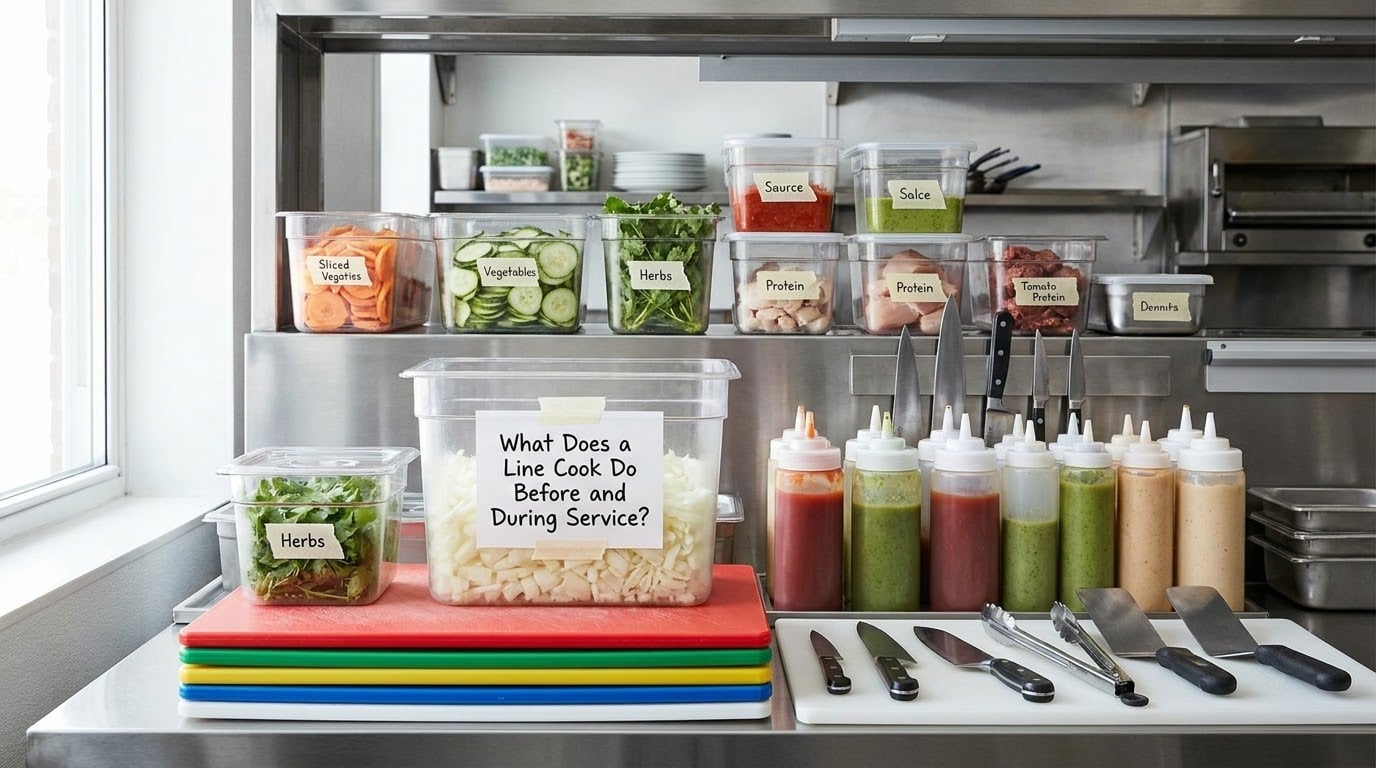
What a Line Cook Actually Does During Service, Hour by Hour
Clocks differ by venue, so treat these as a shape rather than a schedule. A dinner-service restaurant shift usually looks like this.
Two to four in the afternoon: arrive and prep
This window belongs to prep. Cooks pull product, break it down, and build pars, and the person closing the night before usually left a list of what ran low. New line cooks often discover here that the prep they thought was done was not, which is exactly why a KitchenConfidential poster described feeling “behind” in week one rather than during the rush.
Four to six in the afternoon: station setup
Prep slows and setup takes over. Equipment is cleaned and checked, sauces are portioned, the rail is wiped down, and the cook walks the station with whoever is calling the line, confirming what fires at what time. Some kitchens run a short team huddle here; others just point at the board.
Six to eight thirty in the evening: service and the rush
Dinner service starts slower for a while, and that is when the cook re-sauces, restocks, and catches up. Then the rush hits and tickets dictate everything. A line cook may be working three pans at once, timing proteins so they rest correctly, calling “fire” on a ticket so expo knows it is coming, and calling for hands when the tickets outpace the station.
Eight thirty to eleven: side work and close
Once the last ticket clears, the shift is not over. Breakdown starts, the station gets cleaned and sanitized, product is labeled and put away, waste is thrown out, and the cook tells the next shift what needs reordering. Depending on the venue, that close runs 45 minutes to an hour and a half of unpaid work after the last ticket.
Split shifts complicate the picture. Some restaurants run lunch and dinner with a gap in the afternoon, which means the same cook clocks in twice and often treats the gap as personal time. Brunch spots and hotels have their own patterns, and food trucks compress everything into a short, violent window.
How Does a Line Cook Handle Orders and Food Quality?
Speed comes from planning the sequence before the food hits the pan, not from cooking fast. Experienced cooks read ahead two or three tickets, group what shares an oven or burner, and build a cook order: fires, seasons, drops, then plates.
That is the habit cooks on r/KitchenConfidential keep pointing to. New cooks start each ticket the moment it prints and end up with six pans and no priorities. Reading ahead turns the rail into a plan instead of a queue.
Quality control sits in the details. The cook checks doneness with a probe rather than by appearance, plates to the same standard every time, and knows that a ticket sitting under a heat lamp is aging. Cooks who say they prioritize quality first generally mean speed follows from prep and station organization, not the other way round.
Special requests get confirmed out loud. Allergies, substitutions, and no-cook calls go back to expo immediately, and if the answer is unclear the cook asks rather than guesses. A wrong guess on an allergy is the one error on the line that cannot be cleaned up afterward.
When something goes wrong, the good cooks report it early. A dropped plate or a late protein gets mentioned to the chef while service is running, not discovered by the server at table twelve.
How Does a Line Cook Practice Food Safety?
Food safety is part of the station, not paperwork done at the end. Line cooks are usually the ones actually enforcing it during service.
- Handwashing happens on a schedule, not only when hands look dirty: after handling raw protein, after the trash, after touching a phone or a face
- Cross-contamination is controlled with separate boards, knives, and utensils per station, plus separate tongs for every banister pan
- Every container of prepbed food gets labeled with the product, the date, and the initials of whoever cut it
- Prepared food moves to the cooler on ice, covered and dated, and nothing sits out past the window the kitchen’s own plan sets
- Probe temperatures get checked and written down, not eyeballed
- Sanitizer buckets get made fresh at the right concentration and changed on a timer, and wiping as you go is treated as part of cooking, not an optional extra
The internal temperatures that matter most are the standard safe minimums: 165°F for poultry, 160°F for ground meat, and 145°F for whole cuts of meat and fish. Reheating cooked food for hot holding needs to reach 165°F again. Whether the kitchen runs HACCP-style logs or a simpler checklist, the cook at the line is usually the one filling in the numbers.
What Happens When a Line Cook’s Station Gets Busy?
A busy station is normal, not a crisis. The skills that make it manageable are prioritization, communication, and knowing when to hand work off.
Co-workers on r/KitchenConfidential describe the pattern consistently: the moment you are three tickets deep on something you cannot finish, say so out loud. Calling for hands early costs nothing. Quietly drowning costs the whole pass.
Prioritization in practice means protecting ticket time and food quality first, then the order items servers are standing at the pass for, then the backup pans. Ticket organization matters too, because tickets get grouped by type rather than fired in print order, and finished plates get run to expo as a group.
Cooking in batches only works for items that hold well. Proteins that need to hit the pass at a specific minute do not get batched, and neither does anything an order is waiting on. When a station does fall behind, the recovery is usually boring and effective: finish what’s on the fire, reset the board, rebuild what ran out, and ask the line for a hand with the ticket pile.
Regulars also describe the reset between rushes. Wiping down, restocking, and reorganizing during the quiet window is what keeps the second half of service as fast as the first.
What Does a Line Cook Do During the End of a Shift?
The close is a real block of work, and it is the part most new cooks underestimate. In a typical restaurant it runs in this order:
- Confirm the last ticket is out and decide what stays for the next service
- Break down the station: unused product covered, labeled, and refrigerated with correct dates
- Scrape, wash, rinse, and sanitize equipment in that order, then air-dry
- Clean and sanitize cutting boards, counters, the rail, handles, and any shared surfaces
- Change the sanitizer solution and record it if the kitchen keeps a log
- Take out waste and check the floors for anything dropped during service
- Restock and note what is running low or broken for the next shift and the ordering list
- Write or update the prep list so the opening cook knows exactly what to make
Number eight matters more than people expect. A line cook who writes an honest prep list makes the next shift dramatically easier, and one who skips it leaves someone else guessing. Chefs who came up through the ranks tend to appreciate that habit more than almost anything else.
How Is a Line Cook’s Shift Different From a Chef’s?
A chef runs the kitchen: menus, costs, hiring, training, ordering, and the schedule. A line cook runs a station inside that structure and cooks a fixed list of items to a standard set by someone else.
In practice the line cook owns the station completely at small restaurants and follows more rules in bigger ones. Either way, the recipe and the plating standard come from above, the food safety standard comes from the health department, and the prep list comes from whoever wrote it last night.
Prep cook is the boundary most people ask about. A prep cook works in the back, producing mise en place for the line, usually earlier in the day and with less direct service pressure. A line cook is on the line during service and owns a ticket load. Kitchen helpers handle dishes, trash, and stocking, and expo calls the tickets and runs the pass. A sous chef sits between the line and the chef, running the shift and the staff rather than the menu.
Cross-training is normal in all of it. Most cooks move prep to cold to fry to sauté to grill over a few years, and a strong cook can cover two stations in a pinch, which is also what happens the night someone calls out.
The unglamorous parts deserve a mention too. A shift means hours standing, heat from equipment, loud noise, fast pace, and split or closing schedules that take a real toll. Cooks on r/NoStupidQuestions describe it as demanding, long, and always on your feet, and a KitchenConfidential thread about working 12 days in a row solo on the line captures the burnout side of it honestly.
Frequently Asked Questions
How long is a line cook shift?
Most restaurant line cook shifts run about 8 to 11 paid hours, with five or six of those spent on the line during service. The extra hours are prep before doors open and cleaning after the last ticket, and closers often do that cleanup without pay. Split shifts are common in restaurants that serve lunch and dinner, where the same cook clocks in twice in one day. Venues differ a lot: a food truck compresses the same work into a shorter window, and hotel and brunch kitchens follow their own service windows.
Is being a line cook a stressful job?
Yes, and it is physical as much as mental. Cooks stand for most of a service, work near hot equipment in a loud room, and manage several orders at once when tickets stack up. The stress is highest when the kitchen is understaffed or when one person covers two stations. Good prep, a well-set station, and speaking up early when you are behind reduce it more than almost anything else. Long runs of consecutive shifts and closing duties are the other common pressure point.
What skills do line cooks need?
The core skills are knife handling, food safety habits, reading a ticket fast, sequencing several orders, and staying organized under pressure. Timing is the one that separates new cooks from experienced ones: knowing what to fire first and what can wait. Communication matters just as much, since a line cook works through expo and has to call fires, call for hands, and flag problems out loud. Strong mise en place discipline is the skill that makes the rest possible.
Do line cooks and prep cooks make more money?
It depends more on the restaurant and the region than on the title. Larger hotels, catering companies, and higher-volume operations often pay better, and experienced cooks can move up into a sous chef or kitchen manager role over time. Some kitchens share a tip pool or add a small service charge, others do not. Rather than guessing, ask about the full pay picture in writing before you accept, including overtime rules, whether closing work is paid, and how many hours a week the role really runs.
What is the difference between a prep cook and a line cook?
A prep cook works earlier in the day producing mise en place: breaking down product, cutting, portioning, labeling, and stocking the walk-in and the line. A line cook works on the line during service and cooks menu items to order on one station, usually grill, saute, fry, cold, or pastry. Prep cooks deal with a deadline at the end of prep; line cooks deal with a deadline every few minutes. In small kitchens the roles overlap, and many cooks start in prep before moving to the line.
How should a new line cook prepare for their first shift?
Ask which station you own and what menu items are on it before you start. Arrive early enough to be set up before the rush rather than during it, and ask for the recipe cards and the plating standard for your items. Wear closed-toe non-slip shoes, keep a spare set of utensils and towels in your station, and learn the kitchen’s call system for fires and for calling for hands. Write down where things live in the walk-in so you stop walking blind on night one.
If you are trying to picture the job rather than read a job posting, start at the middle: a busy station with three pans going, tickets in sequence, and one voice calling from the pass. Everything else in the shift exists to make that moment work, and that is what a line cook actually does during a shift in 2026, whether the kitchen serves 40 covers or 400.