
To read a restaurant menu for value, work in this order: decide what you can spend before you pick up the menu, look at where an item sits on the page and what its description says about how it is cooked, estimate the portion, then price the whole bill including drink, tax and tip. The listed figure is the least interesting number on the menu.
Menus are laid out on purpose. The dish in the top-left corner, the one in a box, the one printed first in its section, and the most expensive item on the page are all placed to steer you. Once you know that, the menu stops being a list of food and starts being a document you can read against the restaurant’s interests.
This is not about finding a bargain bin. It is about getting a genuinely good amount of food for what you pay, which mostly comes down to three things: knowing which words mean skill and which mean coating, judging portion before it arrives, and knowing what the price does not include.
Table of Contents
- What You Need
- Step-by-Step: How to Read a Restaurant Menu for Value
- 1. Start with your meal budget
- 2. Scan the entire menu before deciding
- 3. Compare the complete entree price
- 4. Look for portion and ingredient signals when you read a restaurant menu for value
- 5. Separate signature items from flexible value picks
- 6. Calculate the realistic total
- 7. Choose the best fit for your appetite
- Common Mistakes
- Frequently Asked Questions
- How can I tell if a restaurant menu item is good value?
- What should I look for first when reading a restaurant menu?
- Are combo meals usually cheaper than ordering separately?
- How do I compare portion sizes without seeing the food?
- Should I choose the cheapest entree or the best deal?
- How can I account for tax and tip when judging menu prices?
- Conclusion
What You Need
You need very little, and none of it is specialised. Here is the full kit.
- The menu itself. A paper or printed menu is easier to mark up than a phone screen, and one commenter in a restaurant forum made exactly this point: people on Reddit in r/AskReddit prefer paper menus partly because they can keep the menu beside them when the bill arrives and check the charge against it.
- Posted prices for everything. The entree price is only useful next to the price of the side, the drink, and any required accompaniment. A menu that buries those in a footnote is doing the same thing as a restaurant that quotes a net figure and adds fees later.
- A number you are actually willing to spend. Per person, for this meal, including drink. Not a vague intention. If you do not set it, the menu sets it for you, and the menu is more persuasive.
- Your dietary and allergy constraints, written down in your head before you sit down. You need to know whether you are avoiding gluten, dairy, shellfish or nuts before you start reading descriptions, because those constraints change which sections are worth your attention.
- A rough sense of your own portion needs. Regulars already track this without thinking about it. One commenter observed that the same dish is priced very differently depending on the neighbourhood, which is a good reminder that a menu alone does not tell you whether a portion is generous. It only tells you what this kitchen believes a portion is worth.
Optional but useful: the menu online before you leave the house. Checking it in advance turns a social problem into an information problem, and it means you arrive already knowing what you want to order.
Step-by-Step: How to Read a Restaurant Menu for Value
1. Start with your meal budget
Before the menu arrives, pick a per-person ceiling and split it into two pots. One pot is food. The other is everything the menu price does not cover: the drink, a service charge where one is applied, tax, and the tip you intend to leave.
Splitting the two pots matters because they behave differently. Food is something you choose and can moderate. The second pot mostly happens to you, and it is frequently larger than people expect. A regular on Waiter Rant put it plainly: they assume everything on a menu costs about a quarter more than the printed figure, and they are comfortable with that because servers do need to get paid.
A workable split on a mid-range weeknight dinner is roughly two-thirds food, one-third everything else. On a date night, or any meal where the drink is a real drink, the drink is usually most of that second third on its own.
Write your number down, or at least hold it firmly. Without a ceiling, the anchoring on the page will do the work for you.
2. Scan the entire menu before deciding
The single most common mistake happens in the first eight seconds. Something on page one is appetising or familiar, and that becomes the order. The rest of the menu never gets read properly, which is where most of the actual work in how to read a restaurant menu for value gets lost.
Read the whole thing top to bottom, in two passes. First pass: appetizers, entrees, sides, desserts, then the drinks list, in that order. Second pass: prices only, ignoring descriptions entirely. The price pass is what lets you compare a burger against a plate of appetizers instead of comparing a burger against another burger.
You are also reading for the shape of the menu during this scan, not just the dishes. The industry pages that explain menu design make this obvious once you see it. Menu engineering means placing high-margin items in the visual prime positions: the top-left of a section, the first line of a list, inside a box or a shaded panel. A Detroit-focused video that circulated on this exact topic used three proxy signals for judging a restaurant before you even sit down, and one of them was simply whether there is a line. Whether there is a line and where the best-selling dish sits are related questions.
So the items that grab your eye first are not random. They were put there. That does not make them bad. It makes them the ones worth pricing up carefully.
3. Compare the complete entree price
The number next to the dish is a starting figure, not a total. Most menus add to it in ways that vary by how honest the kitchen copy is.
Three things usually attach to an entree price. The first is a required or strongly implied side, which is where a burger menu is a clean example: the patty price reads as a sandwich price, and the fries or salad that completes it may be a separate line. The second is customization. Adding cheese, bacon, an avocado, a fried egg or a second sauce is usually a line item each, and on some menus those single additions add up to more than a whole appetizer. The third is the substitution: swapping one side for another is occasionally free and frequently a charge.
Do the arithmetic in your head once per candidate, not per line. A burger listed in the middle of the sandwich section, a side on the next line, and two paid toppings is a materially different order from the burger number alone suggests. The comparison that matters is not burger versus burger. It is complete burger versus complete salad plate, or complete burger versus two appetizers and a side.
One of the most common forum questions on this topic is whether ordering several appetizers is cheaper than two entrees. Sometimes it is, and the answer depends entirely on how the kitchen prices its small plates, so you cannot know until you have done the addition.
4. Look for portion and ingredient signals when you read a restaurant menu for value
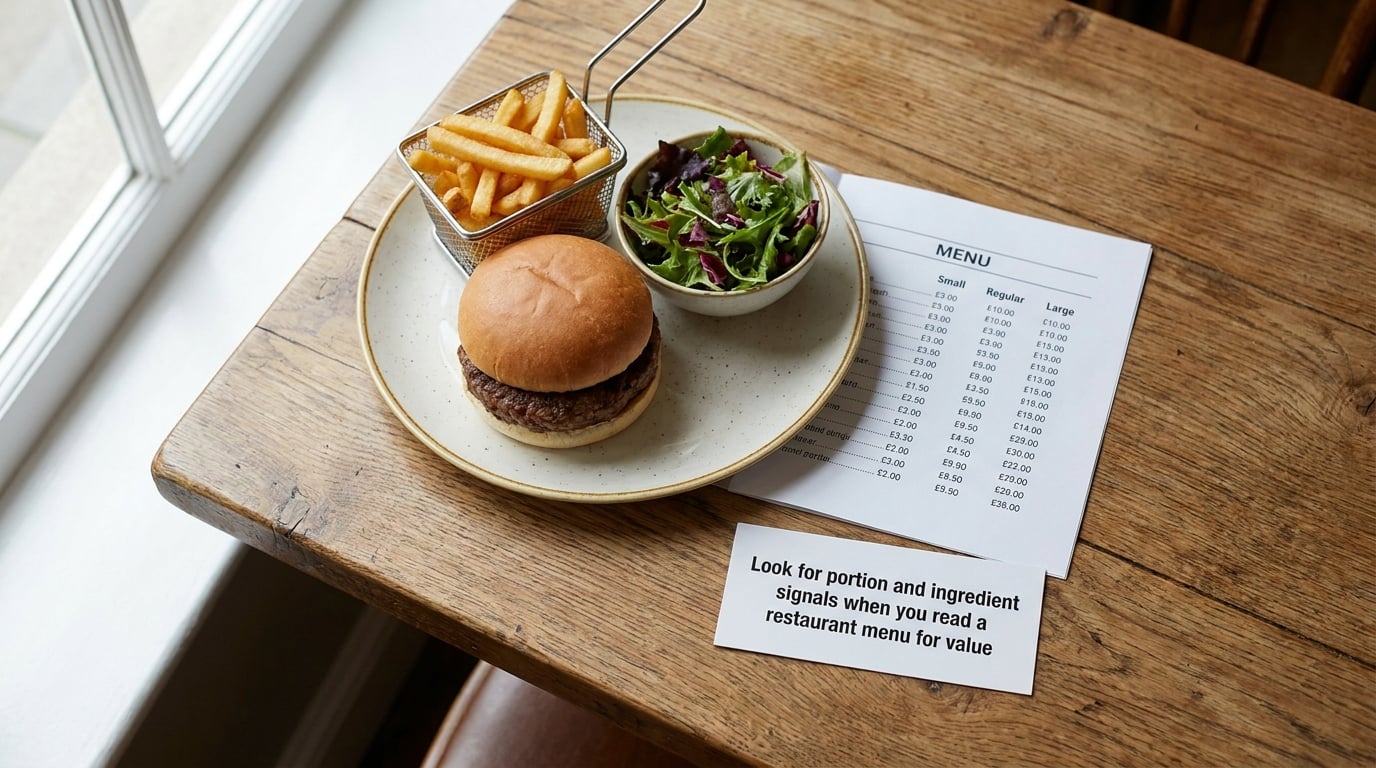
Description language is a portion report. Nobody writes a dish description without trying to make you imagine eating it, and what they leave out is as telling as what they add.
These are the signals worth reading:
| Menu signal | What it usually means | Value verdict |
|---|---|---|
| Shareable, for the table, to start | The kitchen expects two to three people to finish it | Good per person, and a lever for a group |
| Combo, with a drink, or served with | The components are already priced as a bundle | Usually cheaper than the parts; read what is included |
| Named after a region, cut, or producer | A specific ingredient, harder to fake and often cheaper to cook well | Favourable, though it does not guarantee portion |
| Real this, real that, repeated | Ingredient anxiety, covering a cheap base component | Unfavourable; the words are doing the work the food is not |
| Seasoned, house-made, chef’s | Nothing at all. A commenter noted that seasoned often means salted | No signal either way; ignore it |
| Glazed, crispy, crusted, battered, loaded | Sugar, deep frying, or a heavy sauce hiding what is underneath | Check whether the extra cost is skill or coating |
| Roasted, grilled, braised, stone-fired | Real cooking technique and modest markup | The most reliable words on most menus |
| Long component list | A lot of separate items, often a lot of plate area | Mixed; count the components, not the adjectives |
The single most useful habit here is counting components rather than adjectives. A dish described with six ingredients listed separately is usually built from six prepared parts, which usually means a wide plate and a real amount of food. A dish described in flowing prose is often one composed item in a large pool of sauce, and a big pool of sauce is where portion value quietly disappears.
Dish category also predicts size. Boards, flatbreads, and sharing plates are physically wide. A plate of pasta or a bowl of grains is dense and easy to over-order. If you are two people, an item listed under small plates is a third of the order at most, so plan three of them rather than one entree plus a starter.
One more signal worth trusting: menu language that leans hard on authenticity is often a warning, not a promise. The cheapest places on the list are the ones most likely to advertise real whipped cream, real mashed potatoes and real bacon, because they have the most to prove about the base ingredients.
5. Separate signature items from flexible value picks
Every menu has a small group of dishes that exist to define the restaurant, and a much larger group that exists to feed people. The first group is where the money is.
Signature dishes, tasting-menu courses, and anything marked as a house specialty carry the highest markup, because the kitchen can charge for the story as well as the food. That is not a reason to skip them. It is a reason to know that you are buying the version of the meal this restaurant wants to sell, and that the flexible items are where the same cooking skill shows up at a lower price.
Flexible value picks share a shape: simple burgers, sandwiches, salads, dishes built around one ingredient, and combinations that include a drink or a side. A sandwich described with three or four named components usually carries more food for less money than a signature plate with the same number of components and a paragraph of copy.
There is a second reason to look here. Experienced diners order the first item that comes out of the room, not the item they like most, because the first table to order reveals what the kitchen is confident in. Those dishes are rarely the ones with the longest descriptions.
6. Calculate the realistic total
This is the step almost nobody does, and it is where the money actually lives. Build the bill in layers, in this order:
- The entree as listed.
- Any required or chosen side.
- Paid add-ons and substitutions.
- The drink. Usually the single largest line you did not plan for.
- Any service charge the menu states, if it states one.
- Tax, on the taxable portion.
- The tip you intend to leave, on the pre-tax food and drink.
Tax rates, service charge rules and tipping norms differ by country, state and city, and they change, so check what applies where you are rather than assuming a figure from somewhere else.
Here is the shape of three typical orders, worked through as ratios rather than currency. The point is the gap between the listed entree price and what leaves your account.
| Order | Listed entree | Likely additions | Realistic total vs listed price | Portion verdict |
|---|---|---|---|---|
| Signature entree with a full wine pairing | Mid-range entree price | Side, one glass, service charge, tax, tip | Roughly double to nearly triple | Generous, but the drink is the real cost |
| Burger with a side, two paid toppings, and a soft drink | Low-range entree price | Toppings, side, drink, tax, tip | About a third to a half higher | Solid, though the paid toppings buy little food |
| Three small plates plus a side, water only | No entree price at all | Tax and tip on a smaller base | Comparable to one mid entree, often less | Depends entirely on how the small plates are portioned |
Two structural discounts are worth checking for before you order. A prix fixe or prix du jour menu gives you a fixed number of courses for a fixed price, which removes the decision entirely and is usually the best value in the house on price, though not always on portion. Happy hour pricing applies a discount to a bar list during a stated window, and a bar snack ordered in the early evening can do the job of an appetizer at a fraction of the kitchen version.
Then read the drinks list properly. It is the highest-margin section of any menu, which makes it the most likely place for a bill to be quietly padded, and it is the section most diners glance at once. The middle third of a drinks list is usually where the value sits, because the bottom is entry-level and the top is where the margin is heaviest.
7. Choose the best fit for your appetite
Now choose, and the criterion is fit rather than price. Value is the best combination of satisfaction and cost, which is not the same as the cheapest thing on the page. Anyone learning how to read a restaurant menu for value has to finish here, because stopping at the comparison stage leaves you with a good number and a meal that does not suit the evening.
Ask four things. How hungry am I actually, which decides between a sandwich and a plated entree. Does anything here need to be shared to make sense, which is the strongest single argument for a small-plate order for two people. Is the dish I want going to need three paid extras to be worth ordering, which usually means ordering a different dish instead. And can I skip dessert and spend that money on something better, which is often the highest-return swap available.
For a group, the arithmetic changes completely. Two people ordering two entrees and an appetizer to share is almost always worse value than two entrees chosen for splitting, or an entree plus two small plates. The cheapest dish on the menu is rarely the one that makes the table happiest at the same spend, and the table’s happiness is the part you actually came for.
Common Mistakes
Judging by the lowest price on the page. The cheapest entree is often the one with the smallest protein portion and the fewest components. Compare complete orders, not single lines.
Ignoring the required side. A sandwich price that reads as a meal total is a sandwich price. Some menus list the side separately precisely because it is not included, and skim-readers assume otherwise.
Treating the listed price as the final price. Drink, service charge, tax, substitutions and tip are all variable layers on top, and together they are commonly a substantial fraction of the bill. Build the total before you order, not after.
Reading a loaded dish as a generous one. Loaded, glazed, crispy and crusted are value-erosion words. They add cost through sugar, oil, coating or sauce, not through more food on the plate.
Ordering extras before the main is decided. An appetizer ordered out of habit changes the arithmetic of everything after it, including how much entree you actually need. Decide the entree first, then decide whether the starter still makes sense.
Treating the first attractive item as the answer. It was probably placed where your eye lands first for a reason. Second-pass reading the prices, with no descriptions at all, catches this in about thirty seconds.
A few closing tips. Ask the server what sells best here and why, and what they would order for value; experienced regulars say this question gets a better answer than anything printed. Ask whether a portion is enough for one person. Ask whether a dish is fried or grilled, since that is the question that reveals the preparation method the description is hiding. And read the bill line by line when it arrives, because a wrong charge is easier to fix at the table than after you have left.
Frequently Asked Questions
How can I tell if a restaurant menu item is good value?
Look at three things in order. Placement tells you what the kitchen wants you to order, since the top-left item, boxed items and the first line of a section are the high-margin picks. Description words tell you how it was made, with roasted, grilled and braised usually meaning real technique and glazed, crispy, loaded and battered usually meaning sugar, oil or sauce. Finally, compare the complete order rather than the entree line, because the side, drink, add-ons, tax and tip are all part of what you pay.
What should I look for first when reading a restaurant menu?
Read the whole menu in two passes before choosing anything. The first pass covers every section including appetizers, sides, desserts and drinks. The second pass reads prices only, with no descriptions, so you can compare a full entree order against small plates instead of comparing similar dishes to each other. Setting a per-person ceiling before the menu arrives matters as much as the reading itself, because the layout is designed to make expensive items feel reasonable.
Are combo meals usually cheaper than ordering separately?
Usually yes, and the discount is the reason combos exist, since the kitchen knows which items pair well and prices the bundle below the sum of its parts. The part to check is what the combo actually includes, because a drink substitution can erase the saving. A combo built on a signature item inherits that item’s markup too, so a plain burger combo often represents a better deal than a combo built around a plated special.
How do I compare portion sizes without seeing the food?
Use the description and the category. Words like shareable, for the table or to start tell you the kitchen expects two or three people to finish it. Count the listed components, because a dish built from six prepared parts is usually wider and more filling than a single composed item in a large pool of sauce. Dish category predicts size too, with boards, flatbreads and sharing plates physically wide, and bowls of pasta or grains dense and easy to over-order.
Should I choose the cheapest entree or the best deal?
Neither extreme. The cheapest entree is often the smallest in protein and components, and the most expensive is often marked up for its story rather than its food. Look for the best combination of satisfaction and cost instead, which usually means a simple burger, sandwich, salad or combo from the flexible section of the menu, ordered with a side and a drink you planned for. Check the whole order before committing, because extras change the answer quickly.
How can I account for tax and tip when judging menu prices?
Add them in layers rather than at the end. The entree price is the base, then the side, paid add-ons and drink, then any service charge the menu states, then tax on the taxable portion, then your intended tip on the pre-tax food and drink. Tax rates, service charge rules and tipping norms differ by country, state and city and change over time, so check what applies where you are rather than applying a figure you read somewhere else.
Conclusion
How to read a restaurant menu for value is a repeatable skill, and it costs nothing to use. Set your per-person number before the menu arrives, read the layout and the preparation words, estimate the portion from the components, and build the real total including drink, tax and tip. Do that once and you will have done it at every restaurant on the page, and you will never need a coupon to make a good call.