
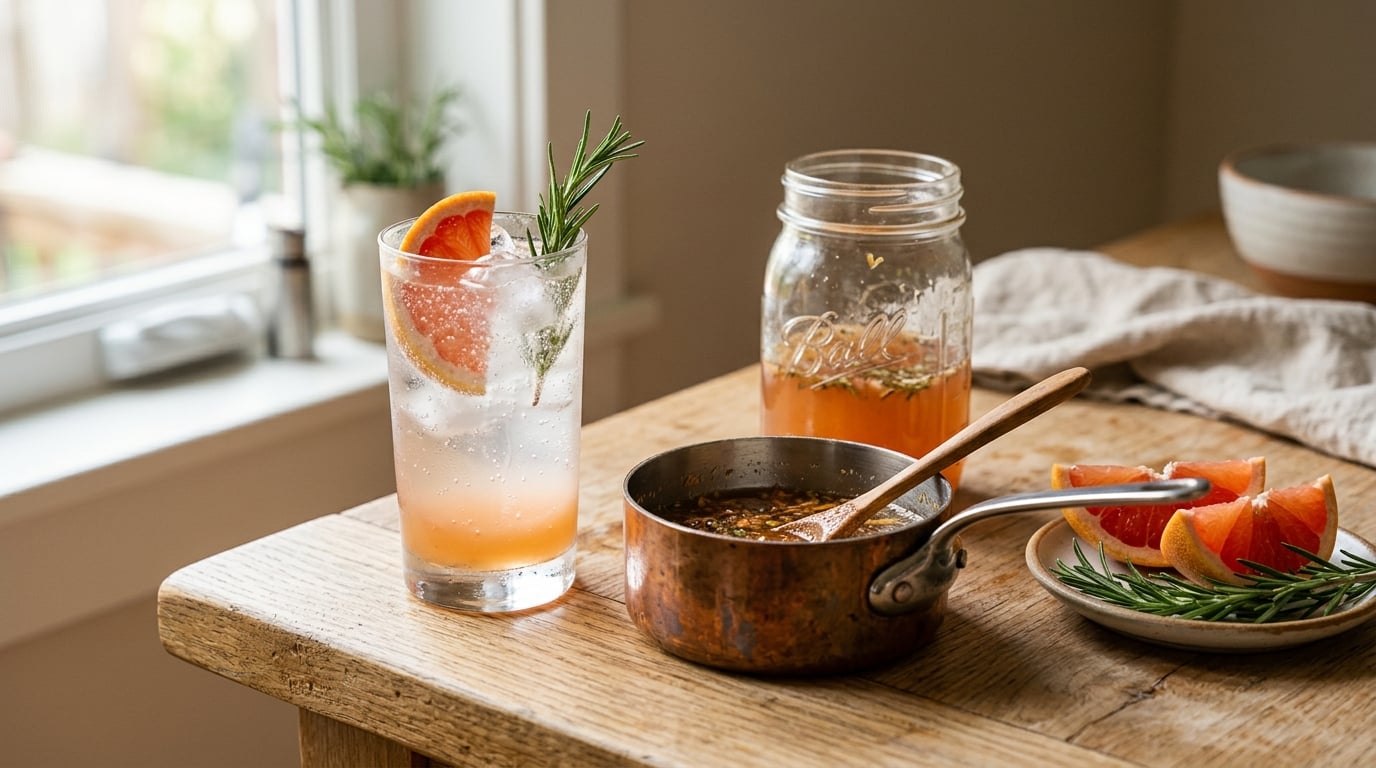
Homemade soda syrup is equal parts sugar and water by volume, simmered until the sugar dissolves, then flavored with fruit, herbs, spices or brewed tea. You pour a couple of tablespoons into a glass of cold seltzer and you have a soda that tastes like it came from a fountain, not a bottle. The whole batch takes about ten minutes on the stove and costs almost nothing.
I keep a jar of plain 1:1 syrup in the fridge permanently. Cold seltzer, two tablespoons, a squeeze of lemon. That is the base for about half the drinks that come out of my kitchen, and it is the same syrup a bartender calls a simple syrup.
Soda syrup is not the same thing as a finished soda. The syrup is the concentrate you keep in the fridge, and the seltzer is what you dilute it with at serve time. Getting that distinction straight is most of the reason home soda stops tasting flat or fizzless.
Table of Contents
- What You Need
- Step-by-Step: How to Make Soda Syrup
- Common Mistakes
- Frequently Asked Questions
- Can I make homemade soda syrup without a stove?
- How much soda syrup should I add to one drink?
- How long does homemade soda syrup keep in the refrigerator?
- Can I use honey or another sweetener instead of white sugar?
- What flavors work best in a homemade soda syrup?
- Can I use the syrup to make soda fountain-style drinks at home?
- Conclusion
What You Need
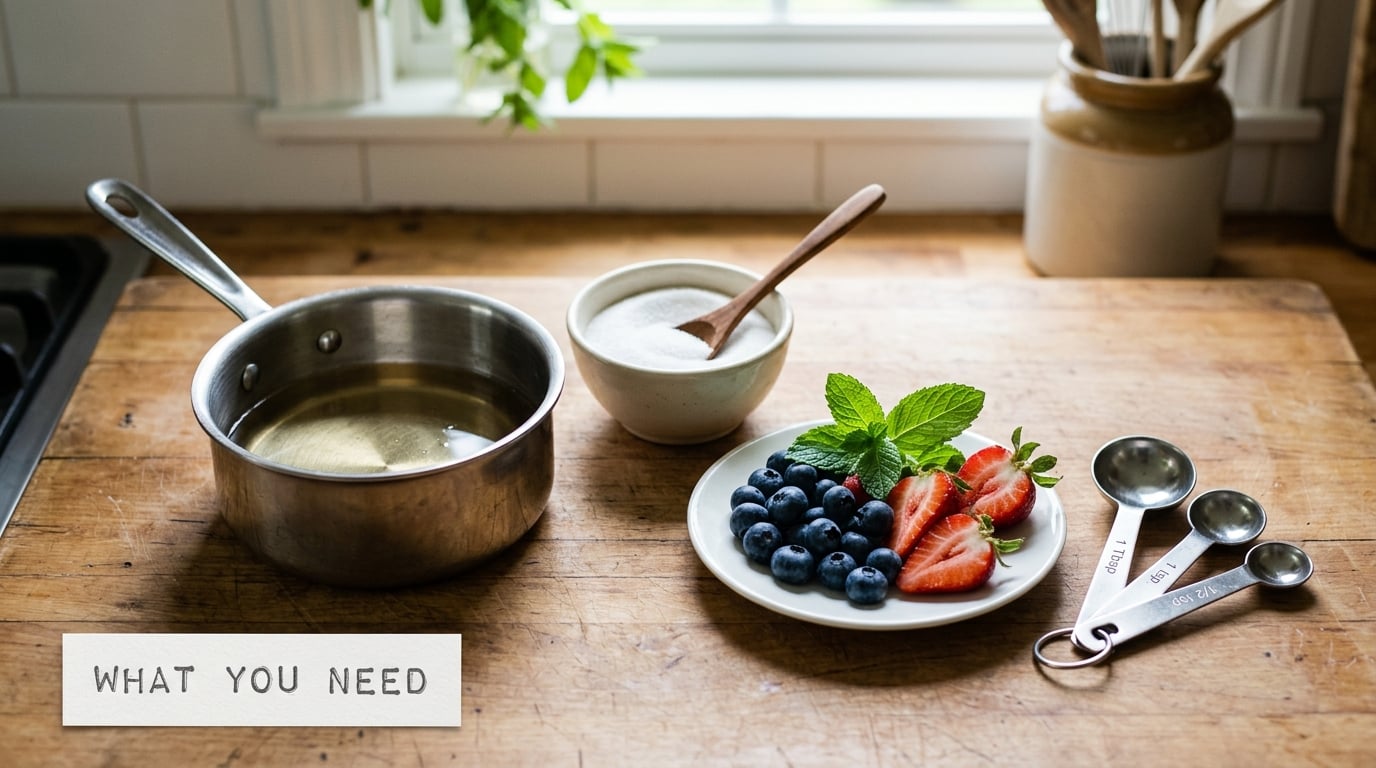
You need remarkably little equipment. If you have a saucepan and a jar, you have everything.
- Granulated sugar — 1 cup (about 200 g). Regular white sugar dissolves fastest; demerara or coconut sugar work but carry more flavor and leave a little sediment.
- Water — 1 cup (240 ml). Cold or room temperature, it makes no difference.
- A small saucepan — 2 to 3 cup capacity with a heavy bottom. Thin pans scorch syrup faster.
- A wooden spoon or silicone spatula — for stirring and for the coating test.
- A fine mesh sieve or a piece of cheesecloth — only if you are adding fruit, herbs or spices.
- A heatproof glass jar or bottle with a lid — a mason jar works. Wash it in hot soapy water and dry it fully.
- A label and a pen — write the flavor and the date before you forget which jar is which.
Flavorings are entirely optional. Fruit and citrus juice, whole spices like cinnamon sticks or star anise, woody herbs like rosemary and thyme, or brewed tea all work. Some people add a tablespoon of vodka, which does not make the syrup taste boozy at serving rates but does slow spoilage slightly.
One batch of 1 cup sugar to 1 cup water yields roughly 1.5 cups of finished syrup after a short simmer, which is about 8 to 10 drinks depending on how sweet you like them.
Step-by-Step: How to Make Soda Syrup
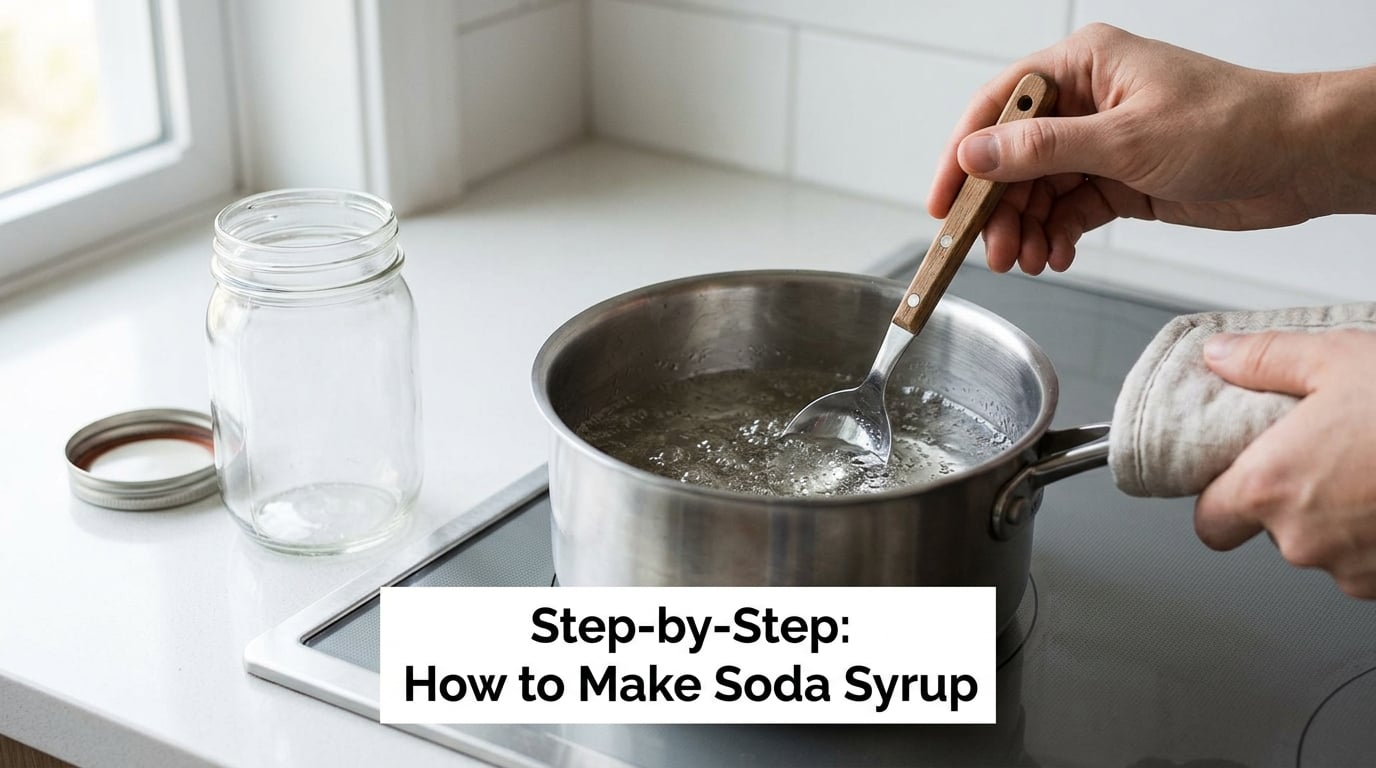
Follow these steps and you will have a clean, smooth syrup every time.
- Measure by weight if you can. Put 200 g of sugar in your saucepan, then add 200 g of water. Volume works too, but a cup of sugar and a cup of water are not equal weights, and weight gives you a repeatable result batch after batch.
- Heat over medium heat, stirring. Stir until the sugar dissolves and the liquid turns clear, usually 2 to 3 minutes. Do not leave it unattended; sugar scorches fast once the water drops.
- Hold it at a bare simmer for 5 minutes. You want tiny bubbles around the edge, not a rolling boil. A kitchen thermometer helps: aim for about 140°F (60°C), which is hot enough to dissolve everything and thicken the syrup without driving off so much water that it goes sticky.
- Turn off the heat and let it cool. A full batch cools to room temperature in roughly 30 minutes. Skim any foam or impurities off the surface with a spoon while it cools.
- Strain if you added anything solid. Pour through a fine sieve lined with cheesecloth while still warm. Press on the solids to get the flavor out, then discard them.
- Bottle and label. Pour into a clean dry jar, cap it, and write the flavor and the date on masking tape. Refrigerate promptly.
How do you know the sugar has dissolved? Run a finger along the back of the spoon and rub the two together. If you feel grit, keep cooking for another minute. When the syrup leaves a clear, thin film on the spoon and feels slick rather than sticky, it is done. Lift the spoon and let a thread fall: a thin, continuous ribbon means the concentration is right.
How to Make the Sugar-Water Base
The 1:1 sugar-to-water ratio by volume is the standard for soda syrup, and it gives you a thin concentrate that dilutes cleanly in cold water. A 2:1 ratio, often called a rich simple syrup, uses twice the sugar to the same water. It is thicker, slower to dissolve in a cold drink, and used more for cocktails than for soda.
Heat matters more than most recipes admit. Sugar dissolves fastest around 140°F, and simmering past that only cooks off water and thickens the result. A hard boil, on the other hand, is how you get scorched syrup that tastes bitter at the back of the throat. Gentle heat, a wooden spoon, and patience.
A pinch of salt, about half a teaspoon per batch, is a genuine bartender trick. It does not make the drink salty; it sharpens the fruit and makes the whole thing taste more like the fruit you started with.
How to Add Fruit, Herb, or Spice Flavors
Flavoring without weakening the syrup comes down to timing and to how much liquid the flavoring brings with it. Fruit releases water as it cooks, so a 1:1:1 pattern — one cup sugar, one cup water, one cup fruit — is the format most home soda makers land on. That is also the ratio behind the honey-orange syrup that sits high in the search results, and the fruit-forward pattern that works well for strawberry and pineapple.
- Fresh fruit and juice — add berries, diced pineapple, or 1 to 2 cups of citrus juice with the sugar and water and simmer 10 to 15 minutes. Mashed berries and fruit purées work the same way. Berries and pineapple are high in pectin, so a set can be normal rather than a mistake.
- Whole citrus — slice lemons or limes into the pan for the last 5 minutes so the oils infuse without the peel turning bitter.
- Spices — cinnamon sticks, star anise, cardamom pods, cloves, and black peppercorns go in at the start of the simmer and get 20 to 30 minutes at low heat. A cola-style syrup comes from a mix of cinnamon, cloves, nutmeg, and a little black pepper.
- Woody herbs — rosemary, thyme, sage, and lemongrass can simmer 15 to 20 minutes.
- Delicate herbs — mint, basil, and tarragon go in for the last 5 minutes or steep in the cooled syrup for 15 minutes. Long cooking turns them grey and grassy.
- Tea — swap the water for brewed tea. Home soda makers on r/Soda use strong brewed Earl Grey or black tea in place of water at the same 1:1 ratio, four cups of sugar to four cups of tea, usually with citrus zest added at the end.
- Extracts — vanilla, rose water, and almond go in off the heat so the volatile flavor does not cook away.
Taste as you go. Dip a clean spoon, let it cool a few seconds, and check the balance. Under-sweetened syrup is easy to fix later; over-sweetened syrup is not, and a dash of hot water or a squeeze of lemon usually rescues it.
How to Use and Store the Finished Syrup
Serve syrup first, ice second, cold seltzer last. Warm syrup and warm glasses melt carbonation, and pouring slowly onto foam strips the CO2 out faster than it can stay dissolved. If you use a soda machine, add the syrup to the carbonating bottle, fill with very cold water, and carbonate that — never carbonate plain water and try to sweeten it afterwards.
Here is the cheat sheet nobody else in this search gives you: how much syrup to pour.
| Glass size | Light | Medium | Sweet |
|---|---|---|---|
| 4 oz (half glass) | 2 tsp | 1 tbsp | 1.5 tbsp |
| 8 oz | 2 tbsp | 3 tbsp | 4 tbsp |
| 12 oz | 3 tbsp | 4 tbsp | 5 to 6 tbsp |
That 2 to 4 tablespoon range per 8 to 12 oz glass is the figure most soda syrups sold for carbonating machines are calibrated to. Start lighter than you think. Syrup tastes stronger straight than it does diluted in a full glass, and you can always add more at the table.
Beyond soda, the same syrup does a lot of work: the base for a mojito, paloma, or margarita, a drizzle over vanilla ice cream, a float poured over a scoop, or a sweetener for iced tea and coffee. If you want tartness, make a shrub instead: the same sugar and fruit with 1 to 2 tablespoons of vinegar added at the end.
Storage depends almost entirely on sugar concentration and how much fresh material is in the jar.
| Syrup type | Refrigerated shelf life | Notes |
|---|---|---|
| Plain 1:1 simple syrup | 1 to 2 weeks | The standard. Seal it, label it, replace it monthly. |
| Rich 2:1 syrup | 2 to 4 weeks | More sugar means less water activity and a longer life. |
| Fresh fruit syrup | 5 to 7 days | Pulp and juice carry microbes. Use this one first. |
| Extract-based syrup | 2 to 4 weeks | No fresh material, so nothing to spoil quickly. |
| Canned or sterilized | Several months | See the note on preservation below. |
| Non-sucrose sweetener | About 1 week | Honey, agave, and stevia are not preservatives. |
Store it in glass rather than plastic, always capped and always refrigerated, and use a clean dry spoon every time you dip. Warm syrup poured into a jar is the most common way people spoil a good batch — heat it through, then refrigerate. Freezing works well: pour into ice cube trays, freeze solid, and move the cubes to a bag. They are useful for iced tea and cold brew, and I keep a bag ready for drinks that take a while to drink.
A note on shelf-stability, because a lot of recipes here are wrong: the oven method you see recommended in a few places, heating jars at 250°F, is not current practice and thin modern glass can crack. Use a boiling water bath with tested canning jars if you want pantry-stable syrup, or add a preservative such as sodium benzoate with a little citric acid as homebrewers do. Anything with fresh fruit in it is a refrigerator product, no matter what you do to the jar.
One more question that keeps coming up: yes, you can boil down a store-bought soda into a syrup, and it is a fun experiment. Reduce it slowly over low heat, watch for scorching, and expect a much smaller yield. But you have removed water from a drink that was already diluted, so the result is thin, less intensely flavored, and no more shelf-stable than a from-scratch syrup. Sugars in commercial soda are often high-fructose corn syrup, and artificial-sweetener versions collapse within days. From scratch is less fuss and a better drink.
Common Mistakes
Almost every bad batch of soda syrup comes down to one of six things.
Too much water. If your soda tastes thin no matter how much syrup you add, the ratio slipped. Weigh the water, or measure it before the sugar goes in rather than pouring until the pan looks right. Weighing is faster and more accurate.
Boiling too hard. A rolling boil drives off water and scorches sugar at the bottom of the pan. Bare simmer, constant stir, and a spoon that sits in the pan the whole time.
Delicate herbs left in too long. Mint, basil, and tarragon cooked for 20 minutes taste like green hay. Add them at the end, or steep them in the finished syrup.
Storing warm syrup. Bacteria grows faster in a warm jar than a cold one, and condensation under the lid makes it worse. Cool to room temperature, cap, refrigerate within the hour.
Over-concentrated drinks. Pouring a heavy dose into a small glass of seltzer and expecting to dilute it later is how you get a syrup that eats the carbonation. Start with 2 tablespoons per 8 oz and add more if you want.
Confusing simple syrup with soda syrup. Simple syrup is the plain sugar-and-water base and it is what soda syrup is made from. Flavored soda syrup is that base with fruit, herbs, spices, or tea. Neither one is a finished drink.
And the four failures people search about most:
- Crystallized syrup — a drop of water evaporated and the sugar started seeding. Add a tablespoon of hot water, stir, and heat gently until smooth.
- Cloudy syrup — usually fruit pectin or a cold-process infusion, both harmless. Strain it, or leave it and accept a hazy drink. Cloudiness that appears weeks later, with a smell or film, is spoilage instead.
- Too thin syrup — simmer it another 3 to 5 minutes, uncovered, and it will thicken. Test with the spoon-coating trick before you stop.
- Drink goes flat fast — the syrup was too warm, the glass was warm, or you poured too gently down the side. Cold everything, and pour the seltzer last.
Frequently Asked Questions
Can I make homemade soda syrup without a stove?
You can, but heat is the shortcut rather than the requirement. Dissolve 1 cup sugar in 1 cup warm water in a jar, set it in a bowl of hot water, and stir for several minutes. A microwave works too, in short bursts, with a pause to stir between them. A cold-process infusion in the fridge takes 6 to 8 hours and gives a lighter syrup with softer flavor.
How much soda syrup should I add to one drink?
For an 8 oz glass, 2 tablespoons is light, 3 tablespoons is medium, and 4 tablespoons is sweet. In a 12 oz glass, go 3 to 4 tablespoons for most people. Start light, because cold water dilutes flavor more than you expect and you can always pour more at the table. For soda machines, the same 2 to 4 tablespoon range per bottle is what commercial syrups are calibrated to.
How long does homemade soda syrup keep in the refrigerator?
A plain 1:1 simple syrup keeps 1 to 2 weeks sealed and cold, which is the number most home makers use. A rich 2:1 syrup lasts 2 to 4 weeks, and extract-based syrups behave similarly. Anything made with fresh fruit or juice keeps only 5 to 7 days, and syrups made with honey, agave, or stevia last about a week because those sweeteners are not preservatives.
Can I use honey or another sweetener instead of white sugar?
Yes, and the syrup works, with two caveats. Honey gives a floral note of its own, coconut sugar adds caramel depth, and agave makes a thinner syrup. None of them preserve the way sucrose does, so plan on about a week in the refrigerator rather than two. Keep cooking times similar and cool the syrup fully before bottling, since honey sets into a solid mass if it goes in warm.
What flavors work best in a homemade soda syrup?
Citrus, berries, and pineapple are the easiest starting points, since fruit acidity balances sugar naturally. Pineapple, star anise, rosemary, and sage give a more grown-up soda, and brewed tea such as Earl Grey works well as a straight swap for the water. Mint, basil, and tarragon are worth trying but need short cooking times or a cold steep, or they turn grassy.
Can I use the syrup to make soda fountain-style drinks at home?
Yes, and that is exactly what it is for. Pour syrup into the glass first, add ice, then top with very cold seltzer or sparkling water and stir once gently. With a soda machine, add the syrup to the carbonating bottle, fill with cold water, and carbonate the mixture rather than the water alone. Warm syrup or warm glasses are the most common reason a home soda loses its fizz.
Conclusion
Start tonight with the plain base: 1 cup sugar, 1 cup water, medium heat, five minutes at a bare simmer, then a clean jar in the fridge. Once you can make that without thinking, start swapping water for brewed tea or adding ginger, star anise, and a strip of citrus peel, and your soda will taste like something you bought. Pour 2 to 3 tablespoons into a glass of very cold seltzer and adjust from there. That jar pays for itself in the first week.