
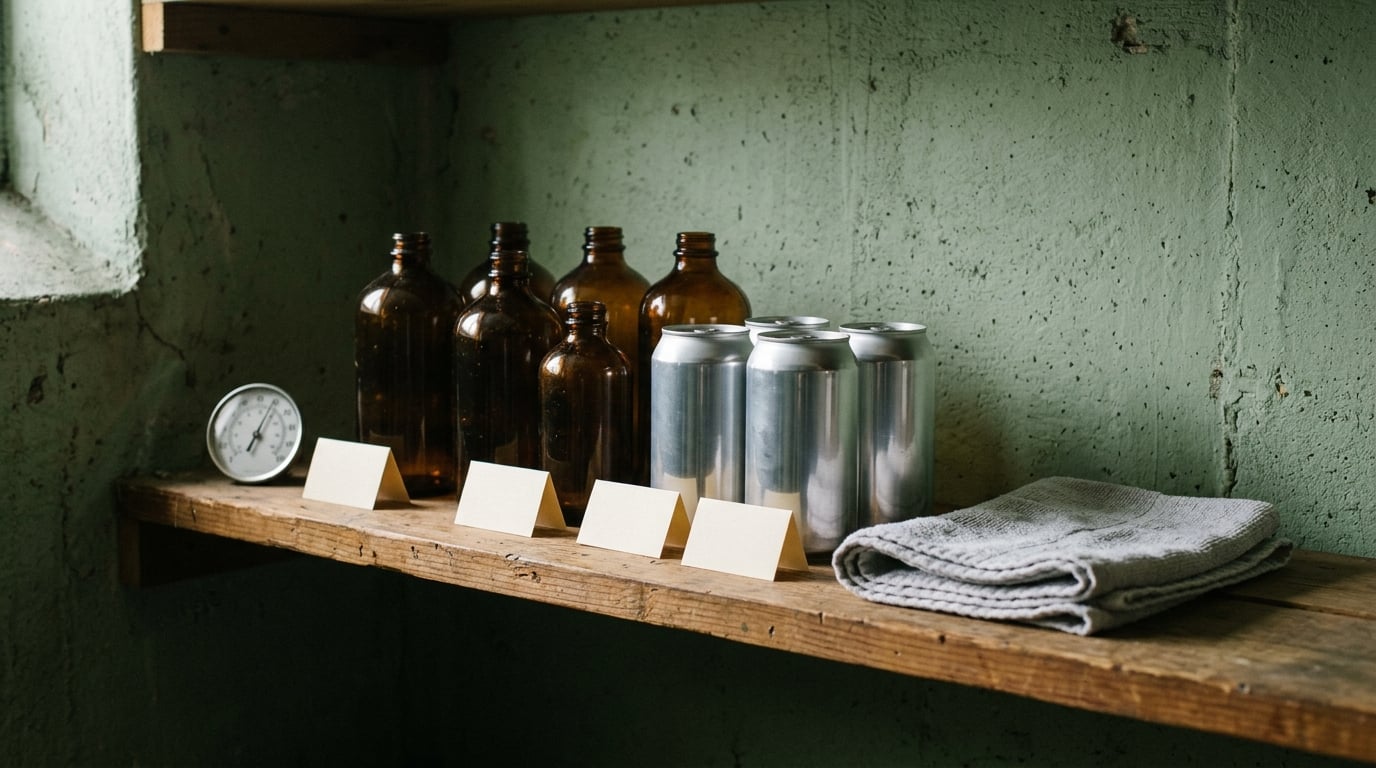
Store beer cold, dark, upright, and at a steady temperature, ideally 45-55F (7-13C) for anything you plan to keep more than a few days. That is the short version of how to store beer at home properly, and the rest of this guide unpacks each part of it. A kitchen fridge runs colder, around 35-40F (2-4C), which suits short-term drinking beer but is not what you want for cellaring. Keep it out of sunlight, keep it away from heat, and never let it freeze.
Most home beer storage problems are not about temperature alone. They come from light hitting a clear bottle on a shelf, a case shoved into a hot garage, bottles lying on their sides in a crate, or a fridge so packed that air cannot circulate. Each one is easy to fix once you know what it does to the beer.
This guide covers where to put your beer, how to inspect what you buy, how to arrange it so nothing breaks or goes flat, and how long different styles actually keep. Updated October 2026.
What You Need
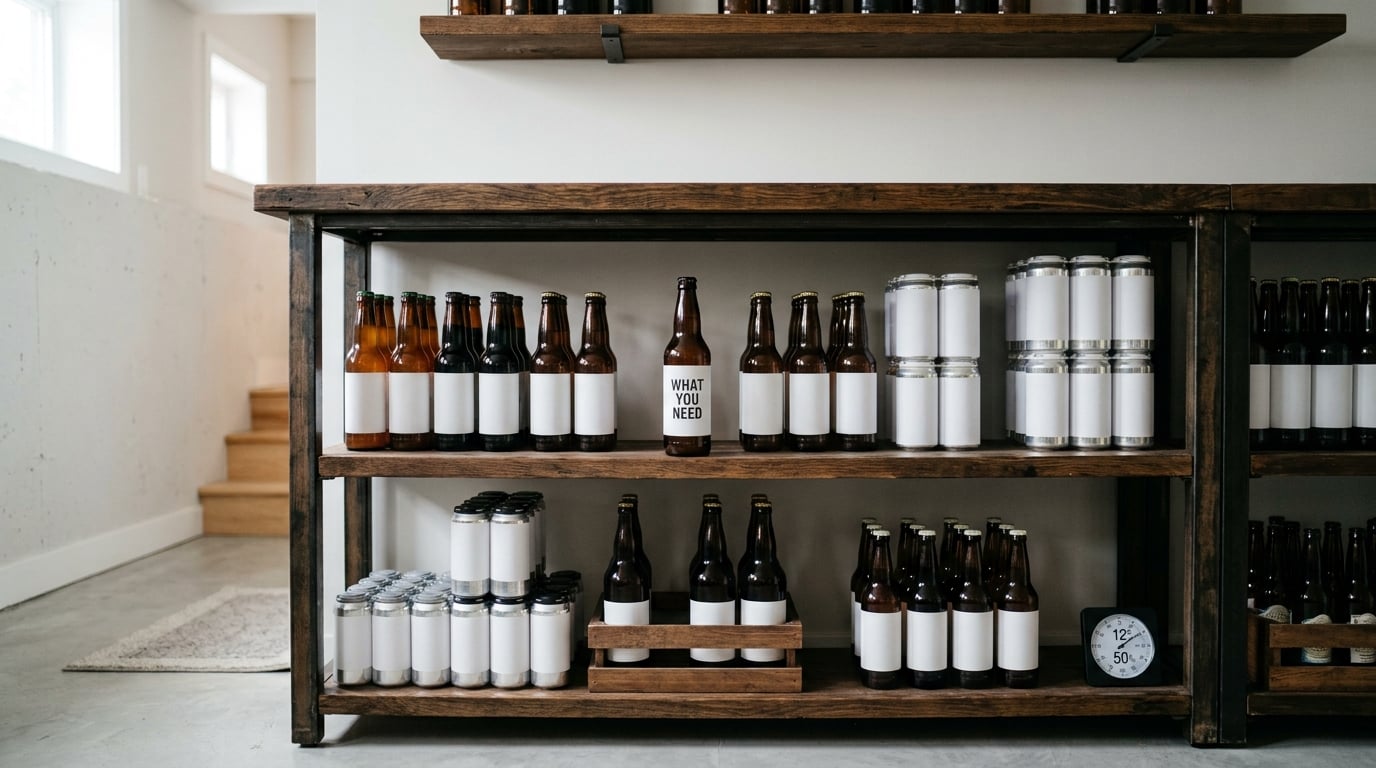
You need very little equipment, but you need a few specific things rather than a dedicated appliance. Most people who ruin beer at home are missing a thermometer, not a beer fridge.
- A thermometer for the space itself. The dial on a fridge tells you about the air at the back, not the shelf you loaded with cans. A cheap fridge thermometer or a single sensor left between the bottles shows you what the beer is actually sitting in.
- Shelving that holds the weight. A case of 12-ounce bottles weighs roughly 35 to 40 pounds. Standard closet shelving and some hollow-core shelves bow under that, and a bowed shelf eventually drops a case onto the floor.
- Something that keeps bottles upright. Wire racks, bottle crates, shelf liners, or individual slots in a wine rack all stop bottles from rolling and make pulling one from the back easy.
- Labels and a pen. Write the style, brewery, purchase date, and any date printed on the packaging. Six months from now, “that dark bottle with the blue label” means nothing.
- A light-blocking option if your only cool space is a lit shelf or an open rack: a cardboard box with the front cut down, an opaque tote, or a folded towel over the top.
- Empty space. A fridge crammed to the ceiling runs warmer and works harder. Leaving gaps keeps air moving and keeps the temperature where the thermometer says it is.
Step-by-Step
Step 1: Choose the Right Temperature and Location
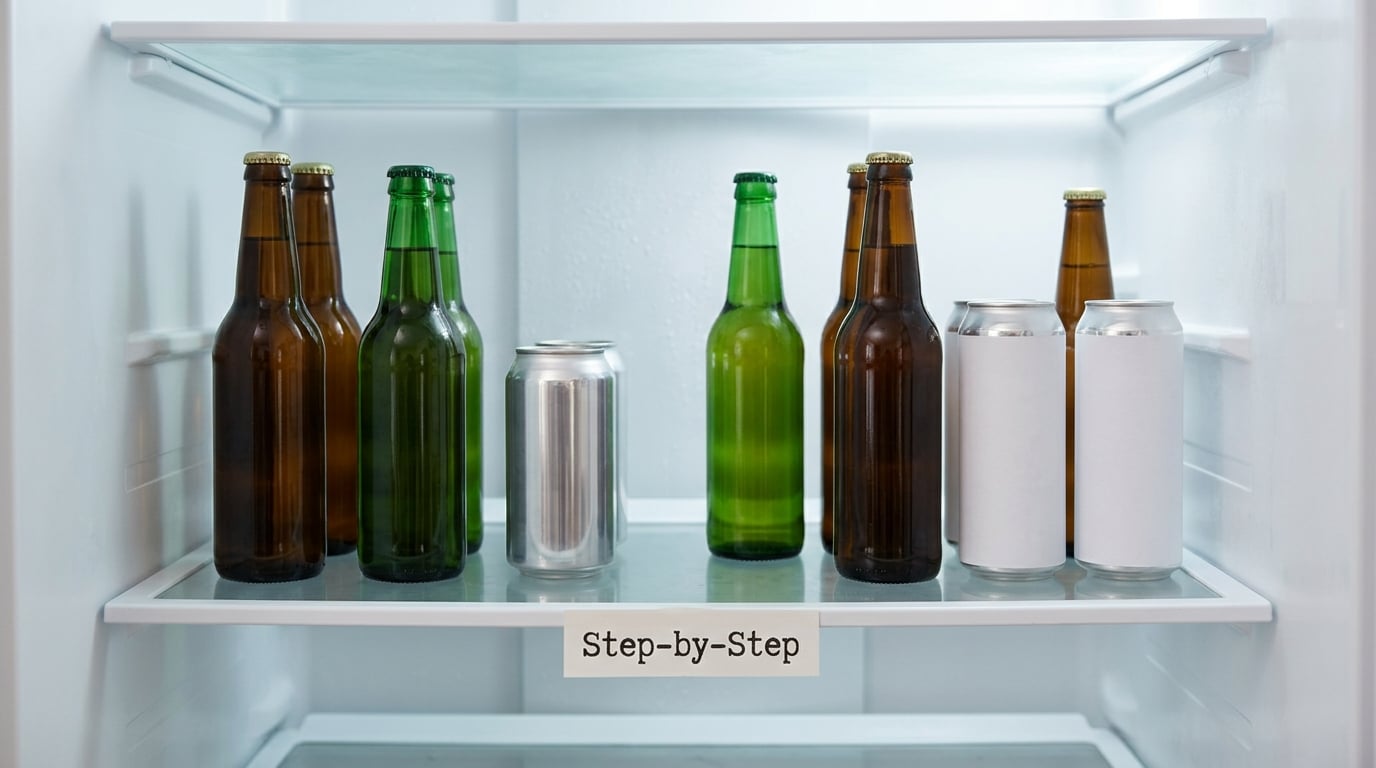
There are two different storage jobs, and they have two different target temperatures. Short-term fridge storage is about keeping beer cold and stable until you drink it in the next few weeks, and a normal fridge at 35-40F (2-4C) is perfect for that. Long-term storage is about slowing the chemical reactions that make beer taste stale, and for that you want 45-55F (7-13C), cool but not cold.
Why the distinction? Cold is great at making beer drinkable now, and it is not where beer ages best. Chilling suppresses oxidation and keeps carbonation dissolved, but a cellar that sits at 45-55F lets the beer evolve slowly without the condensation, pressure loss, and cold-cloud issues that come from long fridge storage. Homebrewers on HomebrewTalk run wine fridges set around 60F as a single-appliance compromise that works for both aging and serving, which is a reasonable approach for mixed styles.
What you should avoid is not simply warm beer, it is beer that changes temperature. Liquid expands as it warms and contracts as it cools, and each cycle pushes a little carbon dioxide out of the headspace and pulls a little oxygen in at the cap. A beer held steadily at 65F (18C) is fine. The same beer cycling between 40F and 75F over a summer is much worse off than either.
| Location | Typical temperature | Best use | What to watch |
|---|---|---|---|
| Kitchen fridge shelf | 35-40F (2-4C) | Short-term drinking beer, one to two weeks | Door opening, light on the shelf, crowding, smells from food |
| Dedicated beer fridge | 45-55F (7-13C) | Longer storage and a growing collection | Shelf weight, whether the compressor runs often enough |
| Wine fridge | 55-60F (13-16C) | Barrel-aged, imperial stout, barleywine, vintages | Too warm for hoppy beer, so keep IPAs elsewhere |
| Basement or cellar | 50-60F (10-16C) | Bulk cases, long aging, FIFO rotation | Humidity, mustiness, pests, flooding |
| Interior closet | Room temperature, seasonal | Short-term only, in an unheated part of the house | Summer heat spikes and winter cold snaps |
| Garage or shed | Ambient, often above 90F (32C) | Nothing, ideally | Heat, freeze-thaw cycles, condensation, label damage |
Measure before you commit. Put a thermometer in the garage in January and again in July, because the same shelf can swing by 40 degrees across the year. If a space swings that much, it is a short-term holding area for a case you will drink soon, not a cellar. A secondhand beater fridge with a basic temperature controller is the most common upgrade people make, and it solves stability better than any amount of rearranging a garage.
Step 2: Check Bottles, Cans, and Seals
Inspect what you are putting on the shelf, because packaging damage is the one home storage failure that cannot be fixed later. Beer itself is remarkably stable, but the seal is the entire defense. This is the step people skip in any guide to how to store beer at home properly, and it is the one that bites hardest six months later.
What to look for, in order of importance:
- Bulging or dented cans. A swollen end means gas is building inside, which means the seal has failed. Do not open it; set it aside and take it back or discard it.
- Leaking or weeping seams. Any moisture on a can or around a bottle cap means the seal is gone.
- Rust, deep dents, and crushed corners on cans. Surface scuffs are cosmetic. A dent on the seam or a sharp crease can split the can later, and rust weakens the metal.
- Bottle caps. Look for lifting, corrosion, or a cap that spins freely. A bottle with a loose cap has been sitting open to oxygen.
- Cloudiness or sediment. A small amount of yeast at the bottom is normal in unfiltered and bottle-conditioned beer. Cloudiness throughout the bottle is a sign of an unpasteurized beer that has not settled and is best chilled and poured carefully, or not kept at all.
While you have the bottle in your hand, read the date. Two conventions exist and they mean opposite things. A best-by date is the brewery’s estimate of peak quality, driven by distribution shelf life; it is not an expiration date and is often only three to nine months out for a pale lager. A born-on date marks when the beer was packaged, and everything after that is aging, not spoiling. A six-digit code stamped on the neck or can is typically a plant code followed by a day-of-year, so 15234 usually reads as day 152 of the year the beer was made, plant 4.
Record what you read it as. A bottle that was four months past a best-by date on the day you bought it deserves to be at the front of the queue, not the back.
Step 3: Arrange Bottles and Cans Safely
Stand bottles upright. This is the rule beer drinkers argue about most, and beer is not wine. The argument for laying bottles on their side keeps the cap wet, and on a wine bottle that surface area of liquid touching cork is a benefit. A beer bottle has a narrow neck, which means far less liquid is in contact with the cap, and beer has the opposite problem: an upright bottle lets yeast sediment and other particles fall to the base and stay out of the glass. Lay it down and that same sediment smears along the side of the bottle as you pour.
For unfiltered and bottle-conditioned beer, upright storage is not a style preference. Sediment that gets re-suspended tastes yeasty and cloudy, and in a sour with live yeast in the bottle, redistributing that sediment changes the beer in the glass.
Beyond orientation, weight and spacing decide whether your collection survives the year. A 35-pound case resting on a particle-board shelf in a garage is a future floor stain, so put the heaviest cases on the bottom shelf near the wall, where the shelf is strongest. Leave a finger’s width between rows so you can pull a bottle from the back without dragging three forward, and never stack loose bottles where they can roll off the edge. Skip the top of a fridge entirely, where vibration is constant and a falling bottle would land on the machine.
Then sort it. Group by style and brewery so you can find the IPA without pulling out twelve bottles, and within each group keep the oldest purchase at the front. A rough capacity rule helps here: a standard fridge shelf holds about one 12-pack of 12-ounce bottles lying flat, or two rows of cans standing, and a 24-bottle case of 12-ounce glass usually claims a shelf and a half. A mid-size dedicated fridge holds three to four cases comfortably. Once you know the shelf count, stop buying on the strength of the freezer.
Step 4: Protect Beer from Light and Odors
Keep beer in the dark, and the reason is chemistry rather than superstition. UV light, even light through a window, activates the hop compounds called isohumulones, which break down into volatile compounds that smell like skunk spray or wet cardboard. The effect is permanent once it happens, it is faster in beer with a lot of hops, and it is why clear glass bottles exist mainly for pale lagers with no hops at all.
Package choice changes how much light protection you get. Brown and green glass block most UV. An aluminum can blocks light completely, which is why hoppy beer in a can can sit in a lit fridge for weeks and still taste right. Clear glass gives you none. A keg in a dark cellar is the most protected of all.
Watch the fridge door. Every time it opens, the light comes in and hits whatever is on the shelves, and the door is the warmest spot in the appliance. Beer in the door is fine for a few days, wrong for a few months. If your only cool space is an open basement shelf, put the collection in a cardboard box with a flap over the top.
Odors are the other half of the same rule. Beer is a weak-flavored, high-water liquid, and a fridge that smells of garlic, raw onion, curry, or cleaning product will put those smells into the glass. It is one reason a dedicated fridge is worth the money if you are keeping anything expensive. If you must use the kitchen fridge, put beer on a shelf away from the strong items, keep it in the door or in a covered bin, and never store it next to raw fish or cut onions.
Step 5: Rotate and Maintain Your Collection
Run a simple first-in, first-out system, because the whole failure mode of beer storage is that good bottles migrate to the back and get forgotten. When you bring a case home, put it at the front, push the older stock forward, and put the new case behind it. On a monthly walkthrough, pull the three or four oldest bottles to the front regardless of what the label says. A sticky note on the shelf with the oldest purchase date on it is enough; elaborate inventory software is not.
You will also need to fix the space itself, not just the stock. Wipe shelves down and watch for condensation rings, which attract mold and rust. Keep the coils and vents clear so the fridge can hold its setpoint instead of warming up on a hot afternoon. Check the door gasket by closing the door on a sheet of paper and pulling; if the paper slides out with no resistance, the seal is letting warm air in all day.
Check shelves on a schedule, roughly every three months. Look for bulging cans, corrosion at the caps, labels that have started to peel, and sediment that has turned the whole bottle cloudy. Throw out anything swollen or leaking immediately, well before the annual check, and never taste-test a package that looks wrong.
| Style | How to store it | Realistic life from packaging when stored cool |
|---|---|---|
| IPA and hazy IPA | Refrigerate, drink fresh | 3-6 months; fresh-hop versions 1-3 months |
| Pale ale | Refrigerate | 6-9 months |
| Wheat beer | Refrigerate, upright | 3-6 months |
| Pilsner and pale lager | Cool cellar or fridge | 9-18 months, often fine well past that |
| Porter and stout | Cool cellar | 9-18 months; imperial stout 2-5 years |
| Barleywine | Cool cellar, dark, stable | 2-5 years and often longer |
| Belgian strong and quadrupel | Cool cellar, upright | 2-5 years |
| Bottle-conditioned sour | Upright, cool, dark | 1-3 years, sediment settling over time |
| Barrel-aged and vintages | Cellar or wine fridge at 55-60F | 3-10 years depending on style |
Two situations deserve their own rules. Moving beer in summer heat is where a collection is most often damaged: an unopened bottle in a car interior can reach temperatures that cook the beer in an afternoon, and a trunk full of warm beer that is then chilled condenses water on every surface. Move cases in the evening, keep them in the shade, and take them straight into a cool room rather than a warm one. And beer does not belong in a freezer at all, which is covered below.
Common Mistakes
Almost every ruined home beer collection is one of these nine things. Each has a straightforward fix.
- Storing beer near heat. A shelf above the radiator, a top-of-fridge spot, or a garage in summer accelerates oxidation and drives carbonation out of solution. Fix: measure the space with a thermometer across a full season before you commit bottles to it.
- Leaving beer in sunlight. A sunny windowsill or a glass-front display case will make hoppy beer taste skunky within weeks, and the damage does not reverse. Fix: opaque box, brown glass, cans, or a closed cabinet.
- Lying bottles down. Horizontal storage exists for wine. In beer it puts sediment on the side of the glass and increases the liquid surface area touching the cap. Fix: upright, always.
- Freezing beer. Beer freezes at a few degrees below zero Fahrenheit, and a home freezer is well below that. The expanding liquid pushes the cap off bottles, splits the seams on cans, and shatters glass. Fix: the coldest safe setting for a beer fridge is around 45F, never below freezing.
- Ignoring damaged packaging. A dented can seam, a lifted cap, or a bulging end is a failed seal. Fix: check every case as you put it away, not six months later.
- Mixing beer with strong kitchen odors. Beer picks up garlic, onion, spice, and cleaner smells faster than most people expect. Fix: a dedicated fridge, or a covered bin away from the strong items.
- Overcrowding. A packed fridge holds warm air and drinks more power, and stacked bottles fall. Fix: leave gaps, keep cases on the lowest shelf, and stop at your measured capacity rather than your budget.
- Storing in an unstable or unlevel place. A shelf above a washing machine, a garage rack on a slope, or a floor that floods will eventually cost you a case. Fix: level shelving, off the floor, and off anything that vibrates.
- Treating the best-by date as an expiration date. Most beer is safely drinkable well past its printed date if it was stored cool and dark, while a beer stored warm for a week is already past its best. Fix: judge the date against the conditions the beer actually lived in.
One more worth calling out: bulk-buy freezer storage. People load the freezer with cases to save space and discover the problem when the cans split. Freezer space is fine for beer you intend to thaw and drink within a day, but the safe answer is a second fridge.
Frequently Asked Questions
What is the 3-30-300 rule for beer storage?
The 3-30-300 rule is not a beer rule. It comes from waste reduction: refuse or reuse three single-use items, reduce thirty plastic items a month, and recycle the rest for three hundred days. It circulates next to beer questions because both get attached to household and prepping advice. The beer rules that actually matter are temperature (45-55F for anything kept beyond a few weeks), darkness, upright storage, and first-in first-out rotation.
Can you take beer out of the fridge and put it back?
Yes. A bottle or can does not care how many times it has been refrigerated, only how much it has been heated and how often it has cycled. A few cycles over a month of hosting and parties is not a problem. Repeated daily cycling between 40F and room temperature is, because each cycle expands the liquid, pushes carbon dioxide out, and pulls oxygen in at the cap. Take beer out, serve it, and return it within a day or two.
Does unopened beer go bad in the fridge?
Properly stored beer does not spoil. Alcohol and acidity make it inhospitable to the bacteria and mold that ruin food, and an unopened package is sealed against oxygen. What degrades it is heat, light, and time: oxidation flattens the aroma, warmth strips carbonation, and UV light makes hoppy beer skunky. Refrigerated and dark, most beer is comfortably drinkable six to nine months past its best-by date, and light lagers for considerably longer.
Is beer still good after 3 years in the fridge?
Usually yes, if the seal is intact and the beer was cold and dark the whole time. After three years, expect a light lager to taste flat and papery and a pale ale to have lost its hop aroma, but you should not expect illness. Stronger styles such as barleywine, imperial stout, Belgian strongs, and barrel-aged beer can be excellent at that age. Discard anything swollen, leaking, cloudy throughout, or sour-smelling before opening it.
Is 4 year old beer ok to drink?
Often, yes, and the deciding factor is how it was stored rather than the number on the calendar. Four years in a dark fridge at a steady temperature leaves most lagers, stouts, and strong ales drinkable though dull, while the same four years in a hot garage ruins them. Open it, smell it first, then taste a small pour. If it smells of vinegar, nail polish remover, or mustiness, or the package was swollen, throw it out without tasting.
Should beer be stored upright or on its side?
Upright, always. Wine is stored horizontally so the liquid keeps the cork wet, and a wine bottle has a wide neck that makes a large surface area. A beer bottle has a narrow neck, so there is far less liquid touching the cap, and upright positioning lets yeast sediment and particles fall to the base where they stay out of the glass. Lying beer down smears that sediment along the side of the bottle and, in unfiltered or bottle-conditioned beer, redistributes live yeast into the pour.
Conclusion
Start with the space, not the beer. Measure the temperature where the bottles will actually sit, and if it is not 45-55F (7-13C) and stable, fix that before you buy a single case.
Then inspect each package as it comes in, reject anything swollen or leaking, read and record the date, and stand everything upright on shelving that can hold the weight. Keep it dark and away from kitchen odors, run oldest to the front so nothing gets forgotten, and revisit the shelf every few months. Getting those four things right is the whole of storing beer at home properly.