
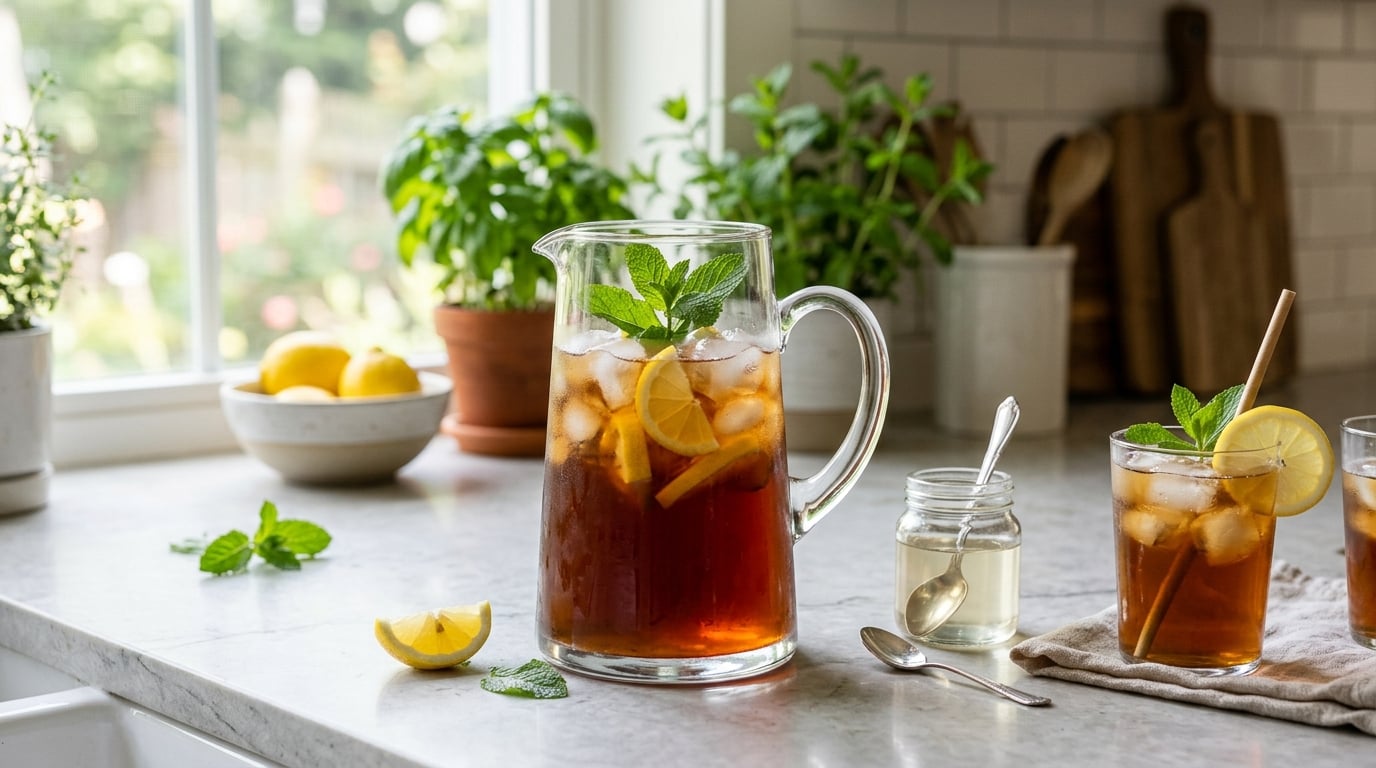
To make sweet tea properly, brew a strong hot concentrate, stir all the sugar into it while it is still hot, add a small pinch of baking soda, then dilute with cold water and chill. A gallon takes about 15 minutes of active work plus two hours in the fridge, and the payoff is a pitcher that tastes smooth instead of harsh, with no sugar grit at the bottom.
That is how to make sweet tea the way a Southern cook does it, and the order of those steps is the whole trick. Add sugar to cold liquid and it settles as grit. Leave the bags in too long and the tea turns bitter and astringent. Skip the concentrate and you end up with something thin and watery no matter how much sugar you stir in.
Updated for October 2026
What You Need
Here is the exact list for one gallon, the batch size most people actually need. Everything else on this page scales from it, so you are never guessing.
- 4 family-size black tea bags, or 12 regular-size bags (Luzianne and Lipton are the two that turn up in most restaurant-style recipes, but any plain black tea works)
- 8 cups boiling water for the concentrate
- 8 cups cold water for dilution, plus extra if you like it thinner
- 1 to 1.5 cups granulated white sugar for a traditional batch, or 3/4 cup for a lighter one
- 1/4 teaspoon baking soda, no more
- A glass pitcher that holds at least a gallon and a half, a long spoon, a kettle or pot, and a timer
Family-size bags hold roughly three times what a regular bag does, so the conversion is 4 family-size to 12 regular. If you only have a small box, count bags by weight instead: about 2.5 grams of tea per cup of concentrate water is a reliable starting point.
Here is the same recipe scaled four ways, which is the table most recipes leave out and the reason so many home batches come out wrong.
| Batch size | Family-size bags | Regular bags | Sugar | Boiling water | Cold water | Baking soda |
|---|---|---|---|---|---|---|
| 1 quart | 1 | 3 | 1/4 to 1/2 cup | 2 cups | 2 cups | Pinch, about 1/16 tsp |
| 1/2 gallon | 2 | 6 | 1/2 to 3/4 cup | 4 cups | 4 cups | 1/8 tsp |
| 1 gallon | 4 | 12 | 1 to 1.5 cups | 8 cups | 8 cups | 1/4 tsp |
| 2 gallons | 8 | 24 | 2 to 3 cups | 16 cups | 16 cups | 1/2 tsp |
Sweetness is a dial, not a rule, and households rarely agree. These three levels cover almost everyone, measured per gallon.
| Level | Sugar per gallon | What it tastes like |
|---|---|---|
| Light | 1/2 cup | You taste the tea clearly, and the black tea is the loudest flavor in the glass. |
| Traditional Southern | 1 to 1.5 cups | Sugar reads as a background sweetness and the tea is still unmistakably present. |
| Extra sweet | 2 cups | Borderline drinkable for most adults and the standard for a large summer gathering. |
If you want the ritual with less of the load, dissolve half the sugar and add a spoonful of simple syrup made from an equal part sugar and water at the end. Stevia and monk fruit sweeteners work too, though they do not dissolve or blend the same way, so stir them into the concentrate while it is still warm rather than into the cold pitcher.
Step-by-Step: The Concentrate Method
Six steps, in this order. The sequence is the method.
- Prep the pitcher. Put 1/4 teaspoon baking soda in the bottom of an empty pitcher, large enough to hold the full gallon. You are measuring the soda into the pitcher now so it dissolves in the hot concentrate later instead of speckling the finished drink.
- Boil the steeping water. Bring 8 cups of water to a full rolling boil and take it off the heat. If you can boil more than 8 cups, boil more. Water at a full boil for the first minute of steeping gives you the deepest color.
- Steep the black tea. Add 4 family-size bags and steep 3 to 5 minutes. Set a timer. The color should go deep amber-brown; if it is pale gold after five minutes, your bags are small, so add two more and keep steeping.
- Dissolve the sugar. While the bags are still in the concentrate, add 1 to 1.5 cups of sugar and stir until the liquid is completely smooth. It should be clear and syrupy, with no grainy feel on the spoon.
- Dilute with cold water. Lift the bags out, add 8 cups of cold water, and stir again for a full 30 seconds. The color will lighten to a bright amber as the concentrate cools, and the sugar stays suspended in the liquid rather than falling to the bottom.
- Chill and serve. Set the pitcher in an ice bath for 10 minutes, then refrigerate for at least two hours. Serve over ice with lemon, or on its own.
How to Brew the Tea Without Bitter Flavor
Bitterness in black tea comes from tannins, and more of them taste harsh the longer the leaves sit in hot water. How to make sweet tea properly means pulling the bags at the right moment, not guessing. Three to five minutes at near-boiling temperature is the window; past six, the concentrate turns noticeably astringent and no amount of sugar covers it.
Water temperature matters more than people expect. Just off a boil gives you the deepest color and body, which matters because the concentrate gets diluted by half later. Using water straight from a kettle that’s been sitting a while will give you a weaker batch that reads as watery even when the ratio is technically right.
The ratio matters just as much. 4 family-size bags to 8 cups of concentrate water is the sweet spot for a gallon. Go lighter and the finished pitcher tastes thin; go heavier and the concentrate can turn bitter before the dilution has a chance to soften it.
Baking soda is the piece most recipes get wrong by being vague, so here are the numbers. Use 1/4 teaspoon per gallon. The alkalinity softens the astringent edge of black tea and can rescue a batch that steeps a minute too long, which is why people on cooking forums swear by it. More than about 1/2 teaspoon per gallon and you cross into soapy, chalky flavor that is worse than the bitterness you were trying to fix. Start at 1/4 teaspoon, taste, and add another pinch only if it needs it.
One more thing about the soda, because it comes up constantly and the honest answer is that it is contested. Many recipes say baking soda keeps sweet tea clear. Southern Kitchen published a piece directly challenging that claim, and home brewers on tea forums have posted recipes using it while reporting no taste difference at all, only an appearance change. Treat the bitterness claim as real and the clarity claim as unsettled.
How to Dissolve the Sugar Completely
Granulated sugar dissolves slowly in cold liquid and barely at all in cold liquid that is already cold and crowded with tea. That is why sweet tea made by dumping sugar into a finished pitcher has a gritty layer in the bottom: the sugar never finished dissolving, so it settled.
Warm liquid does the work for you. Hot water moves faster around sugar crystals, and a concentrate that has just boiled is hot enough to take a cup of sugar without complaint. The test is simple: run your finger along the spoon. If you feel grain, keep stirring.
If your sugar has already hit cold liquid, you have two ways out. The first is to make a quick syrup: combine 1 cup sugar with 1 cup water, heat until clear, and stir that concentrate back into the pitcher. The second is to warm a cup of the finished tea, dissolve the sugar in that hot cup, and pour it back in. Both work in about three minutes, and both beat trying to force cold sugar to dissolve.
Sweet tea is also the one drink where simple syrup belongs on the counter permanently. A jar of 1:1 syrup next to the fridge takes a ten-second job off your hands every morning, and it makes sweetening by taste possible without a second pitcher.
How to Chill and Flavor Sweet Tea
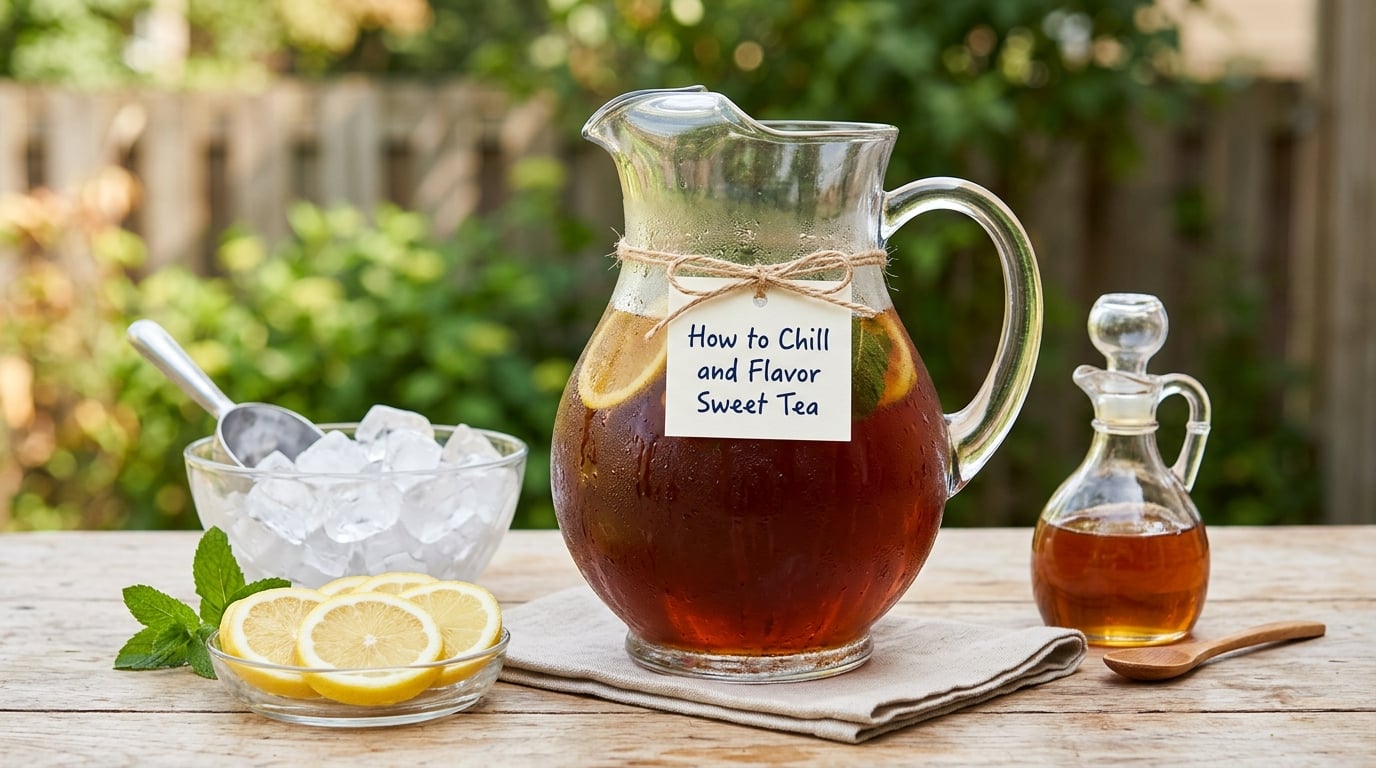
Cooling slowly is what makes a big batch taste thin. Set the pitcher in a bowl or sink filled with ice and water, stir for ten minutes, then refrigerate. The ice bath drops the temperature fast enough that the pitcher never sits in the lukewarm middle zone where the flavor goes flat.
Ice dilutes as it melts, so fill glasses with ice first and pour the tea over the top rather than the other way around. If you are serving a full afternoon, make the batch one step stronger than you want it and let the ice do the adjusting. That is the whole reason the concentrate method is worth the extra pot.
Keep the base clean and add fruit or herbs at the end. Lemon slices and mint sprigs are the classic pairings. Peach slices or a few crushed strawberries work if you cut the sugar back slightly, because fruit brings its own sweetness. Very cold tea also tastes sweeter than room-temperature tea, which is worth remembering before you add more sugar to a pitcher straight out of the fridge.
For a make-ahead version, brew a double concentrate with half a pitcher of water, refrigerate it covered, and dilute to taste when you pour. The concentrate keeps three to four days; the finished sweet tea keeps about that long too, though it tastes best in the first two days. If you leave a pitcher sitting out for more than two hours, toss it, especially in warm weather.
You can also cold-brew in the fridge overnight: put 6 to 8 bags in a gallon of cold water, let it sit 8 to 12 hours, and strain. It is smooth and lower in tannins, but it never has the deep color of a hot concentrate and it does not carry as much body. Skip sun tea, by the way, because the hours of warm-water sitting are exactly the conditions bacteria like.
Common Mistakes
Nearly every bad batch traces to one of five things. Here is what went wrong and what to do about it.
The tea tastes bitter and astringent. Almost always over-steeping, not too much tea. Set an actual timer for 3 to 5 minutes instead of eyeballing it, and if it is already bitter, stir in a small pinch of baking soda, let it sit five minutes, and taste again. Diluting with extra cold water softens it too, though that also softens the flavor.
Sugar sits in a gritty layer at the bottom of the pitcher. The sugar was added after the tea was cold. Next time, dissolve it into the concentrate while it is hot. For this batch, warm a cup of tea, dissolve the settled sugar in it, and pour it back in.
The tea is weak or watery. The concentrate was too light, or too much cold water went in. Fix the batch with more concentrate: brew 2 extra family-size bags in 1 cup of hot water for five minutes, dissolve in a spoonful of sugar, and stir it in. Going forward, use 4 family-size bags per gallon and hold the cold water to 8 cups.
It is cloudy or has a milky cast. Two causes show up most: over-steeping, which pulls solids out of the leaves, and hard tap water, which is a known variable that recipe pages mostly ignore. Over-steeping is the more common one. For hard water, let the concentrate sit for a few minutes after steeping and pour it off carefully, or use filtered water for the concentrate and tap for the dilution.
It tastes soapy or chalky. Too much baking soda. There is no dilution fix, because the whole pitcher is affected. Add cold water and sugar until the soapy edge drops below what you can taste, and use 1/4 teaspoon per gallon next time, no more.
It is far too sweet to drink. Different problem, easy fix. Add cold water a cup at a time and taste after each. Remember that a pitcher straight from the fridge tastes sweeter than the same pitcher after an hour on the table, so calibrate cold.
Frequently Asked Questions
Can I make sweet tea without granulated sugar?
Yes, and the method barely changes. Make a simple syrup with 1 cup sugar and 1 cup water, heat until clear, and use that to sweeten the concentrate, or use a monk fruit or stevia sweetener stirred into the warm concentrate before you add cold water. Cold liquid will not dissolve granulated sugar well, so anything powdered or granulated needs heat. Expect a cleaner, less rounded flavor than sugar, and keep the syrup in the fridge for up to two weeks.
Why is my sweet tea bitter?
Over-steeping is the cause nearly every time. Black tea releases bitter tannins the longer the leaves sit in hot water, and because the concentrate is later diluted by half, a harsh concentrate makes a harsh pitcher. Steep 3 to 5 minutes just off a boil and pull the bags on a timer. If a batch is already bitter, stir in a small pinch of baking soda, wait five minutes, and taste. More than 1/2 teaspoon per gallon turns soapy.
Should sweet tea be made with hot or cold water?
Hot for the concentrate, cold for the dilution. Boiling water extracts the color and body you need from the black tea, and the heat is what dissolves sugar completely. Cold water then brings the volume up without cooking the tea further, which keeps the flavor from turning harsh. Cold-brewing the tea straight in the fridge overnight also works, but it produces a thinner, paler drink with less body than a hot concentrate diluted with cold water.
How long should sweet tea steep?
Three to five minutes in water just off a rolling boil. That window gives you a deep amber concentrate with no astringent edge. Past six minutes the tannins start to dominate and the finished pitcher tastes harsh no matter how much sugar you add. A home brewer formula that works well is three black tea bags per quart of water, steeped four to five minutes. Always use a timer, since the difference between four minutes and seven is obvious in the glass and impossible to judge by looking.
How do I keep sweet tea from tasting watery?
Brew the concentrate stronger than you think you need, then fill the pitcher with ice before pouring the tea in, so the melt does the thinning gradually. For a gallon, use 4 family-size bags in 8 cups of boiling water and dilute with 8 cups of cold. If a finished batch already tastes thin, brew 2 extra bags in 1 cup of hot water for five minutes, dissolve in a spoonful of sugar, and stir that concentrate back into the pitcher. A cold concentrate is always better here than a hot one.
How long does homemade sweet tea stay fresh?
Kept covered in the refrigerator, sweet tea stays good for three to four days and tastes best within the first two. Keep a pitcher out no longer than two hours, and toss it in warm weather. For longer storage, brew a double-strength concentrate, refrigerate it covered, and dilute with water when you pour. Once you have diluted a batch, expect it to be thinner and less bright than tea made fresh, so save the concentrate for refills rather than pouring it all at once.
Conclusion
Everything above comes down to one habit: treat the concentrate as the real recipe and the pitcher as finishing work. Brew 4 family-size bags in 8 cups of near-boiling water for 3 to 5 minutes, dissolve 1 to 1.5 cups of sugar in that hot liquid until the spoon is smooth, add 1/4 teaspoon of baking soda, and only then top it with 8 cups of cold water.
Start there. Brew the tea a shade stronger than feels right, dissolve the sugar in warm liquid rather than cold, chill the finished pitcher fast in an ice bath, and adjust the sweetness after it is cold, when you can actually taste it.