
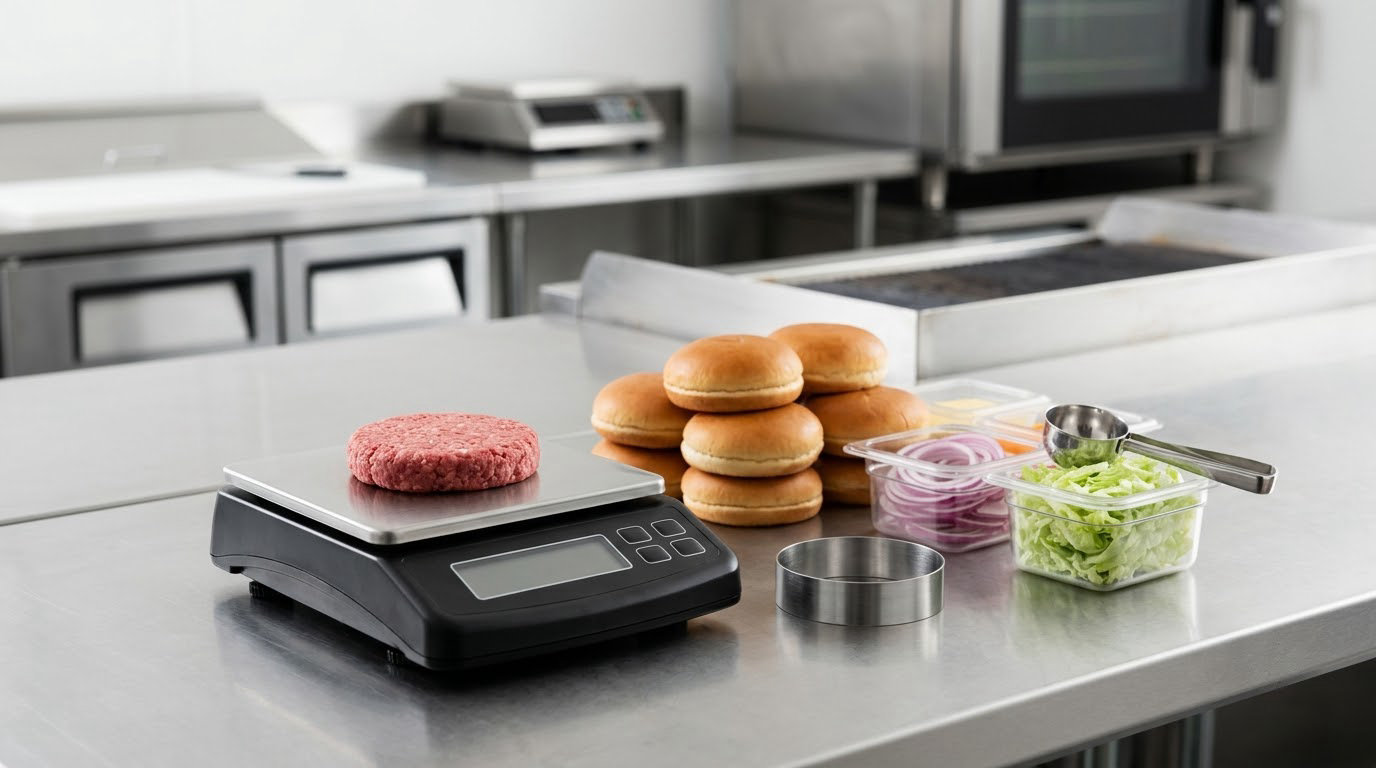
Restaurants keep burgers consistent every time by treating the burger like a manufactured product with a written spec: a fixed raw patty weight and thickness, a fixed beef blend and grind, a controlled flat-top temperature, a timed press, a fixed cook time per side, and a probe check before the burger leaves the pass. Change any one of those variables and the burger changes with it.
That is the honest answer to the question, and it is less mysterious than most people expect. Nothing on the line is done by feel alone. The number is written down, the equipment is set to it, and someone checks the result before the order leaves the window.
Table of Contents
- What Consistency Means in a Restaurant Burger
- How Restaurants Keep Burgers Consistent Every Time
- The Restaurant Burger Workflow From Prep to Service
- How Do Restaurants Measure Burger Portions and Ingredients?
- How Do Restaurants Control Burger Cooking?
- Why Do Restaurant Burgers Taste Better After Resting?
- How Do Restaurants Keep Burgers Warm Without Ruining Them?
- What Makes Burger Assembly Repeatable?
- How Can Home Cooks Copy a Restaurant System?
- Frequently Asked Questions
- How do restaurants make every burger taste the same?
- Should restaurant-style burger patties be pressed before cooking?
- How long can a cooked burger patty be held before serving?
- Why do homemade burgers shrink while cooking?
- What is the safest internal temperature for a ground-beef burger?
- Can I prepare burger patties ahead of time?
- Conclusion
What Consistency Means in a Restaurant Burger
Consistent does not mean identical patties. It means a customer who loved the burger on Tuesday gets something close enough on Saturday that they order it again without hesitation.
Five things have to land in the same place each time:
- Portion size — the same raw weight, so the same cooked yield.
- Temperature — a hot surface when the patty hits it, and a verified internal temperature when it comes off.
- Texture — same thickness, same press, same rest, so the crust and the center behave alike.
- Seasoning and sauce — measured, not eyeballed.
- Build quality — the same order of assembly, the same bun orientation, the same look leaving the pass.
A kitchen chasing only one of those can still hand you a bad burger. That is why operators talk about the whole system rather than the grill.
How Restaurants Keep Burgers Consistent Every Time
They do it with seven levers, all of them documented, and all of them pulled in the same order. Here is the direct version:
- A written spec sheet. Raw weight, thickness, blend, surface temperature, press seconds, cook seconds per side, pull temperature, rest time. If it is not written down, it is not a spec.
- A fixed beef specification. A named fat-to-lean ratio and grind, ordered from a supplier who holds to it, so week to week the raw material behaves the same.
- Weighed portions, not hand-sized ones. Every patty hits the scale before it hits the heat.
- A controlled surface temperature. The flat top is preheated and checked, and its heat recovery during a rush is planned for.
- A timed press. One press, a fixed number of seconds, then the patty is left alone.
- A fixed cook time per side, confirmed with an instant-read thermometer rather than color alone.
- A build order and a pass check. The burger is assembled the same way every time and looked at before it goes out.
Standardize the input and the output stops depending on the cook’s mood, the rush, or the weather. That is the whole trick, and it is why chain burgers land so similarly across hundreds of locations.
In r/cookingforbeginners, the most-repeated answer to “how do I stop my patties coming out different sizes” was almost boringly practical: get a press, get a scale, pre-portion the meat ahead of time. Not skill, not intuition — a physical portioning system.
The Restaurant Burger Workflow From Prep to Service
Consistency is created long before the beef hits the grill, and lost in predictable places. Here is the order of operations in most kitchens that actually manage it.
Receiving and storage
Beef arrives at a specified fat ratio and grind, at a set temperature, and goes straight into a walk-in at 34–37°F. Logs get checked, and a delivery that misses spec gets used for something else rather than quietly going into the build.
Mise en place
Patties are formed cold, before the rush, on a scale or in a press, and laid on parchment-lined sheets in the cooler. Toppings are portioned into labeled containers. Buns are staged. Nothing gets measured with a handful during service.
Cooking
The flat top is preheated, the surface temperature is confirmed, patties go down in a staggered batch rather than all at once, and the cook works a timer instead of eyeballing color.
Holding and assembly
Cooked patties move to the pass within a short holding window, and the person at the window builds to the written order. That last step is the one most home cooks skip and the one customers notice most.
Expo
The expo checks the build against the standard: bun face, sauce coverage, topping order, and whether the patty looks right for the spec. A burger that fails the check gets remade while it is still hot.
Where mistakes multiply
Almost every inconsistency traces back to one of four places: hand-portioning, a griddle that never fully recovered between rushes, patties formed too warm, or an unfixed build order at the window.
How Do Restaurants Measure Burger Portions and Ingredients?
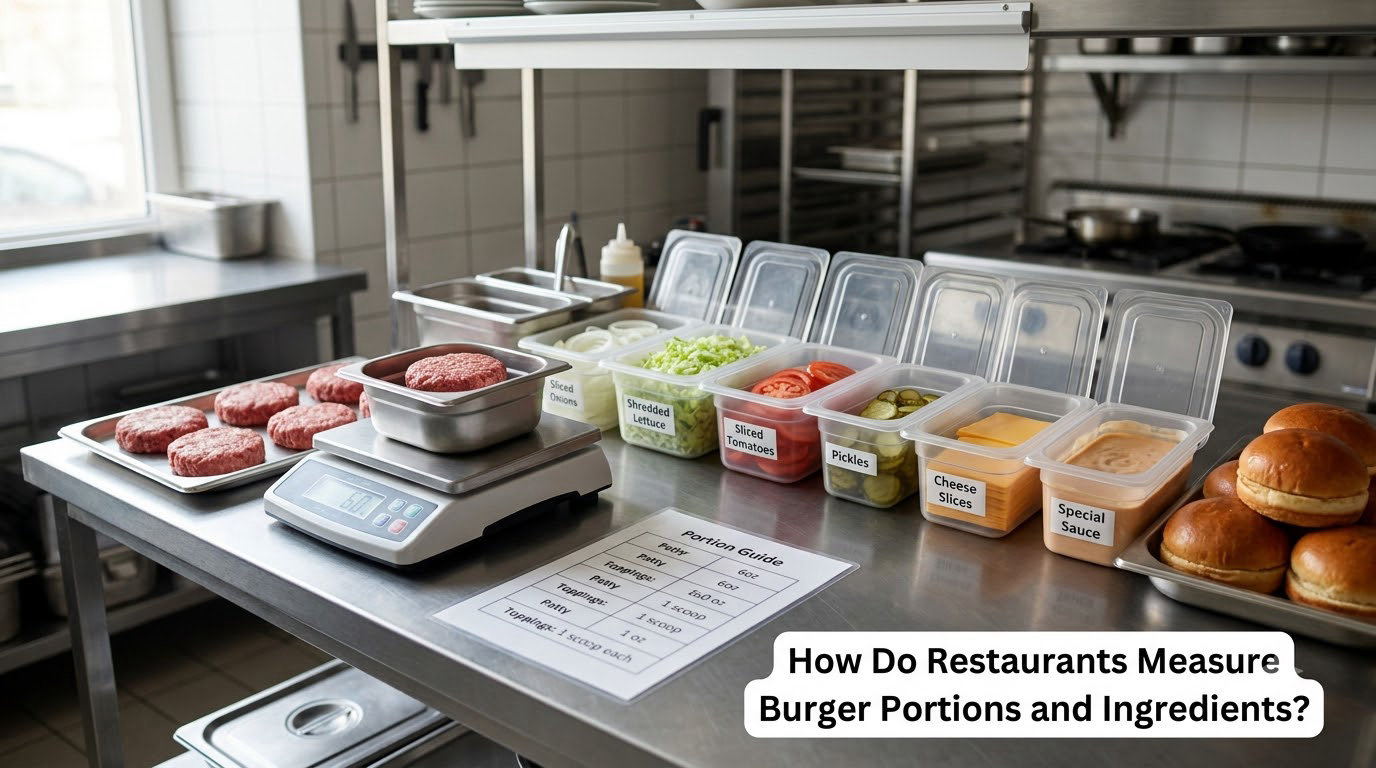
With a scale, a press or a scoop with a set volume, and a written recipe card that states the number in both ounces and grams. Kitchens that standardize on hand-portioning spend their whole service chasing variance.
The trick to sticky or soft beef is working it cold. Cold beef portions cleanly and presses flat; warm beef smears, clings to the scale, and drags your spread to an inch past the target. That single habit does more for consistency than most people expect.
A typical spec sheet for a smash-style patty looks like this. The numbers vary by kitchen, but the fact that they exist does not.
| Spec point | Common target | Why it matters |
|---|---|---|
| Raw patty weight | 2 oz (57 g) for a classic smash | Sets cook time and food cost per serve at once |
| Thickness | 1/8 inch before pressing | Determines how fast the center catches up with the crust |
| Fat ratio | 80/20 as the industry default | Predictable shrinkage and moisture |
| Grind | Medium, coarse enough to keep texture | Finer grind dries out and spreads more |
| Surface temperature | 375–400°F on a flat top | Enough contact for the Maillard browning |
| Press | One press, about 5–7 lb, held 15 seconds | Builds the lacy edge without tearing the patty |
| Cook time | 45–60 seconds total on a hot flat top | Short, fixed, and identical every service |
| Pull temperature | 155–158°F, verified with a probe | Allows for carryover cooking into the safe window |
| Rest | About 2 minutes before assembly | Juices redistribute instead of running out on the first bite |
The rest of the ingredients matters too. Sauces get ladled with a marked scoop, onions and pickles come out of labeled containers with a consistent line cook portion, and the recipe card names one specific SKU for the cheese so a supply swap does not quietly change the burger.
Seasoning is simpler than most people assume. Salt goes on the raw patty at a fixed moment in the process, usually right before it hits the heat, and nothing is added mid-cook except what the spec calls for.
How Do Restaurants Control Burger Cooking?
By controlling the surface the patty touches and by checking the result, instead of trusting the clock alone. A flat top is preheated well past service temperature, and its surface temperature is verified before the first patty lands.
Rushes are where heat control gets interesting. A griddle has a limited amount of stored heat, and six patties dropped at once will drop its surface temperature. Good kitchens stagger the drops, keep a measured gap between patties, and plan batches so the recovery time is part of the cook time rather than a surprise.
| Surface | Usual temperature band | What to expect |
|---|---|---|
| Flat top griddle | 375–400°F | Even recovery, good for high volume, forgiving timing |
| Cast iron or steel plate | 450–500°F | Faster sear and crisper lace, less tolerance for a cold start |
| Home skillet | Medium-high, preheated 3–5 minutes | Works, but thermal mass is small so temperature swings faster |
Pressing follows one rule: press once, at a fixed pressure, for a fixed time, then leave the patty alone. Lifting it early or pressing twice costs you the crust you already built.
Why do chains flatten their burgers so hard?
Because contact time on a hot flat top is what produces the browning crust, and a domed ball of beef only touches in one spot. Pressing spreads the meat across the surface so the whole face browns in the same window. The flattening is a deliberate contact technique, not a shortcut.
Doneness and carryover cooking
Cooks pull patties a few degrees below target because the patty keeps cooking once it leaves the heat. Ground beef has to reach 160°F (71°C) internally per USDA guidance, so the pull and the carryover both have to be planned.
An instant-read thermometer in the pass is what turns a guess into a check. Color alone is unreliable, especially on lean blends, and the cooks who wait for a deep brown color are the ones handing you dry patties.
Why Do Restaurant Burgers Taste Better After Resting?
Because a patty that goes straight into a bun pushes its juices out on the first bite. A short rest lets those juices redistribute through the meat instead of leaving with the press.
Roughly two minutes is the usual window for a thin patty. It also gives the carryover cooking time to finish, so the center arrives at temperature while the surface still has its crust.
The tension is service speed. A ticket that takes forty-five seconds per burger cannot afford a five-minute rest, so kitchens usually rest patties in small batches, warming the bun while they wait, and hold the rest window rather than the individual burger.
How Do Restaurants Keep Burgers Warm Without Ruining Them?
They keep cooked patties at or above 140°F (60°C) and they limit how long a patty sits. Holding is a short transfer, not storage.
Three things ruin a held burger, and all three are easy to fix:
- Dryness — a hot patty left uncovered loses moisture fast. Covered holding at temperature does far less damage than an open pass.
- Crowding — patties stacked on each other steam each other and the crust goes soft. One layer, or a very short stack.
- Overheating — a patty held too long at temperature keeps cooking and dries out from the inside. Holding time is measured in minutes, not tens of minutes.
Batch timing is the smarter fix. Cooking smaller batches on a staggered schedule means patties are closer to their rest window when the ticket prints, so less time is spent holding at all.
What Makes Burger Assembly Repeatable?
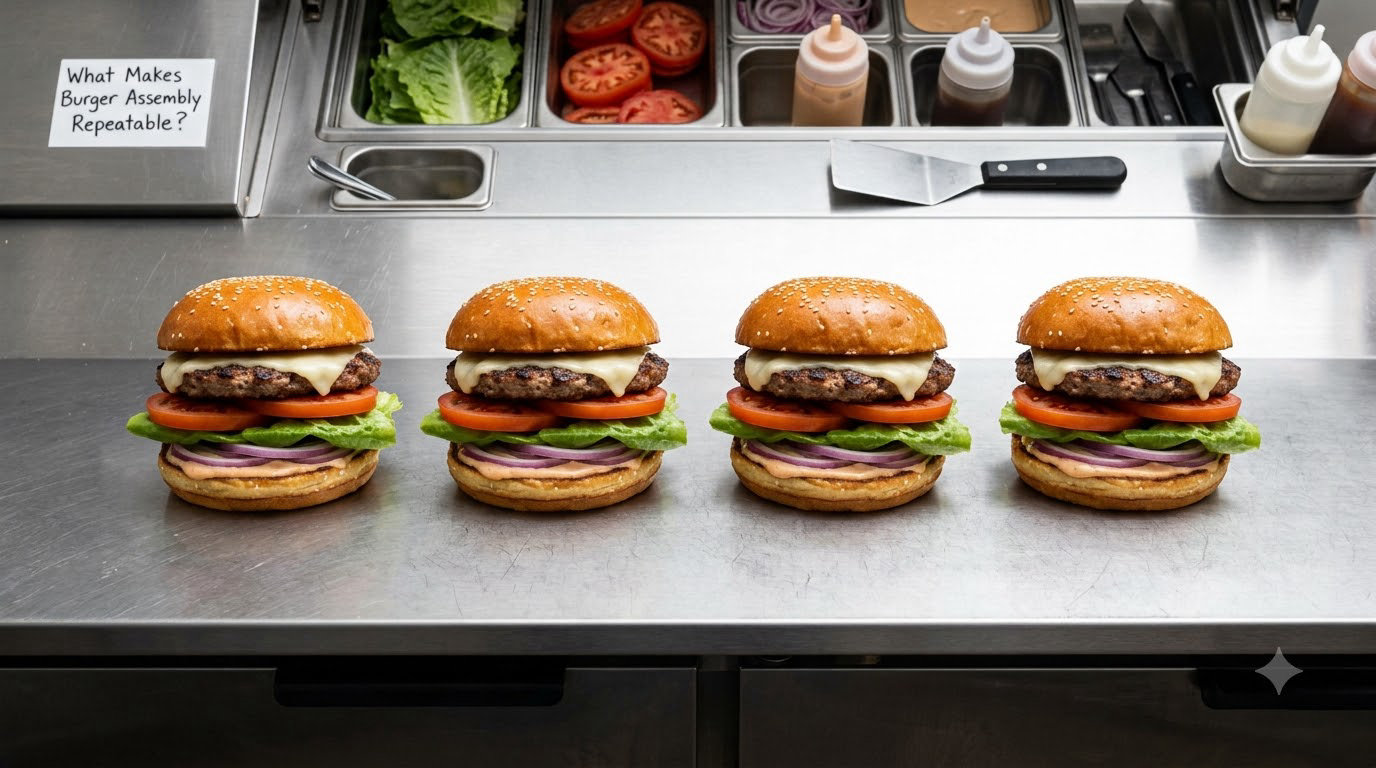
A fixed build order. The person at the window assembles the same burger in the same sequence every time, which means the sauce lands in the same place and the toppings sit at the same height on every order.
The details that matter in practice: toast the bun face-side down for a set number of seconds and only one side; spread sauce to the edge on the heel rather than dolloping it in the middle; put the heaviest wet toppings closest to the patty so the bun does not slide; and finish every build with the same orientation so the customer sees the same face.
Stacking is done with a tool or a consistent hand motion rather than improvised. Then the expo looks at it against the standard. A build check takes a few seconds and catches the failures that a cooking spec cannot.
How Can Home Cooks Copy a Restaurant System?
You can get most of the benefit with a cheap scale, one timer, and a written card. Here is the version that works in a home kitchen.
- Weigh every patty. A kitchen scale is the single highest-impact tool. Target a set weight and check it instead of shaping by eye.
- Form patties ahead of time, while the beef is cold. Portion and press before you start cooking, on parchment, in the fridge.
- Prep all toppings before the heat goes on. Nothing gets measured with a pinch mid-cook.
- Preheat once and hold one temperature. Pick a surface and temperature, preheat fully, and stop adjusting mid-burger.
- Run one cook time that works. Start with about 60 seconds total for a 2 oz patty on a hot flat top, then check with a thermometer and write down what actually worked for your pan.
- Rest, then assemble in a fixed order. Two minutes, same sequence, every time.
Keep a small note card next to the stove. Weight, temperature, seconds, rest time. The first three burgers are guesswork; after that you have a spec, and a spec is what actually makes a burger repeatable.
Frequently Asked Questions
How do restaurants make every burger taste the same?
They treat the burger as a product with a written spec: fixed raw weight and thickness, a named fat ratio and grind, a controlled flat-top surface temperature, a timed press, a fixed cook time per side, and a probe check before service. Patties are weighed and formed cold ahead of the rush, cooked in staggered batches so the surface recovers between drops, and assembled at the pass in one fixed order.
Should restaurant-style burger patties be pressed before cooking?
Yes, and the press is one of the main consistency tools. Pressing spreads the beef across the hot surface so the whole face browns in the same short window instead of only where the patty touches. Most kitchens use one press of roughly 5-7 pounds held about 15 seconds, then leave the patty untouched. Pressing a second time, or lifting early, tears the crust that just formed.
How long can a cooked burger patty be held before serving?
A few minutes, covered, at or above 140F (60C). Holding is meant to be a short transfer to the pass, not storage. A patty left uncovered, crowded under other patties, or held long enough to keep cooking loses moisture and goes dry inside the crust. Kitchens avoid the problem by cooking smaller staggered batches so patties reach the window near the end of their rest time.
Why do homemade burgers shrink while cooking?
Fat and water leave the patty as heat hits it, and lean, finely ground beef loses more than fatty coarse beef. The second cause is the one people miss: you season salted beef too early. Salt drawn before cooking pulls moisture out of the surface and the patty tightens faster. Portion to a set raw weight, season right before the patty hits the heat, and expect a fairly predictable shrink once you fix those two things.
What is the safest internal temperature for a ground-beef burger?
USDA guidance is 160F (71C) internal temperature for ground beef, and cooks pull patties a few degrees below that because carryover cooking finishes the job after the patty leaves the heat. Verify with an instant-read thermometer rather than judging by color, which is unreliable and tends to push people toward overcooked, dry patties.
Can I prepare burger patties ahead of time?
Yes, and it is standard practice in a restaurant kitchen. Form them cold, weigh each one, press them to a set thickness, lay them on a parchment-lined sheet and refrigerate covered until service. Operators report that house-made portioned patties brown faster in the cooler than frozen ones, partly because the exposed surface oxidizes, so keep them covered and use them within a day or two.
Conclusion
If you take three things from this, take these. Weigh your patties instead of eyeballing them. Set one surface temperature, one press time and one cook time, then verify with a thermometer. Write down your build order and follow it the same way every time.
That is how restaurants keep burgers consistent every time. Nobody is cooking from memory at 1 pm on a Saturday, and once you stop doing it either, your burger stops depending on the pan, the mood, or the last one you made.