
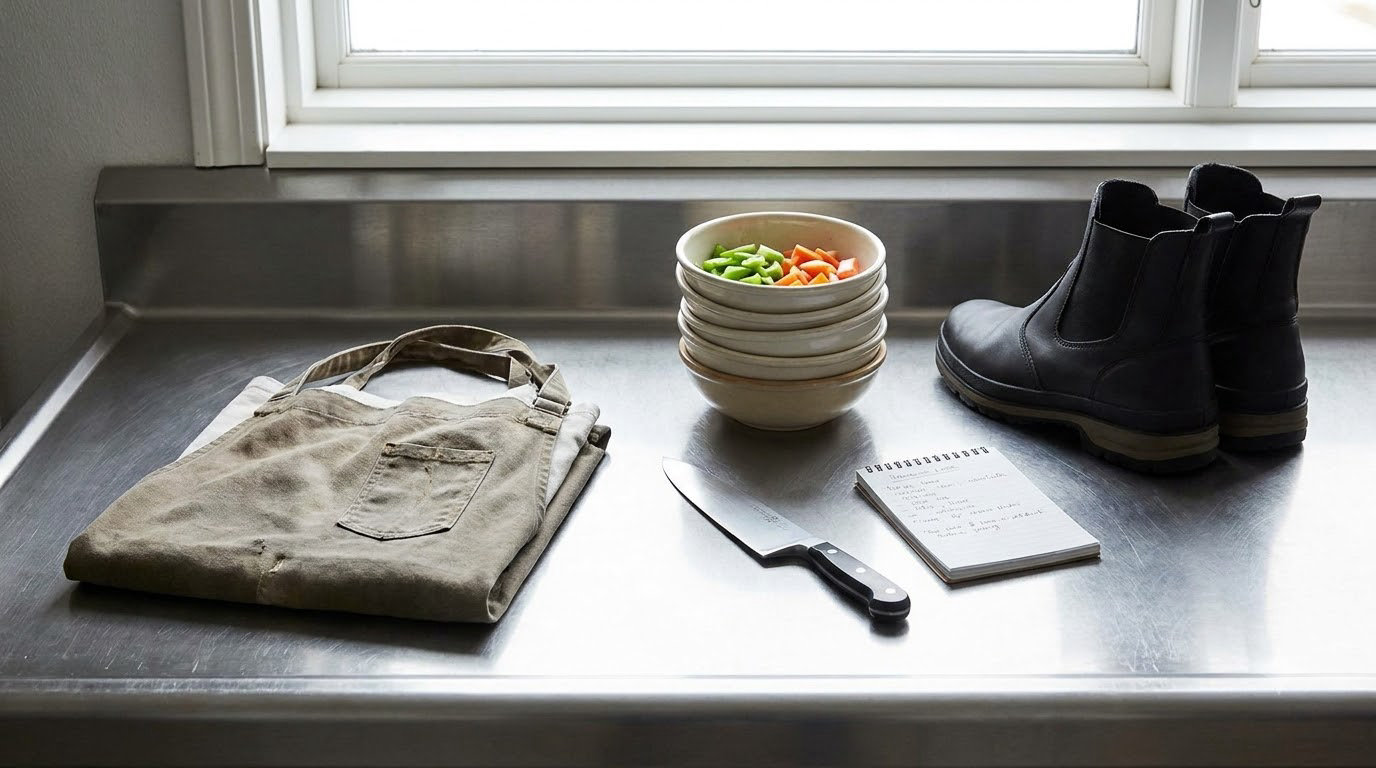
You survive your first week as a line cook by arriving early, learning the menu fast, setting your station to par before every service, speaking the kitchen’s call language out loud, and asking for help early instead of quietly drowning. A line cook is the back-of-house cook who owns one station on the line, prepping, cooking, and plating menu items to standard while keeping that station stocked, clean, and safe.
Here is the honest version. Your first week is loud, hot, and long. You will stand for most of it, you will burn something, and you will get corrected in front of people who were correcting each other before you walked in. That is normal, and it is also temporary. What decides how week one feels is how deliberately you work through the seven shifts.
This guide walks the whole arc, shift by shift, with the small observable habits that separate the cooks who move up a line from the ones who wash dishes for a decade. It should take about twenty minutes to read and a week to actually do.
What You Need Before Your First Shift
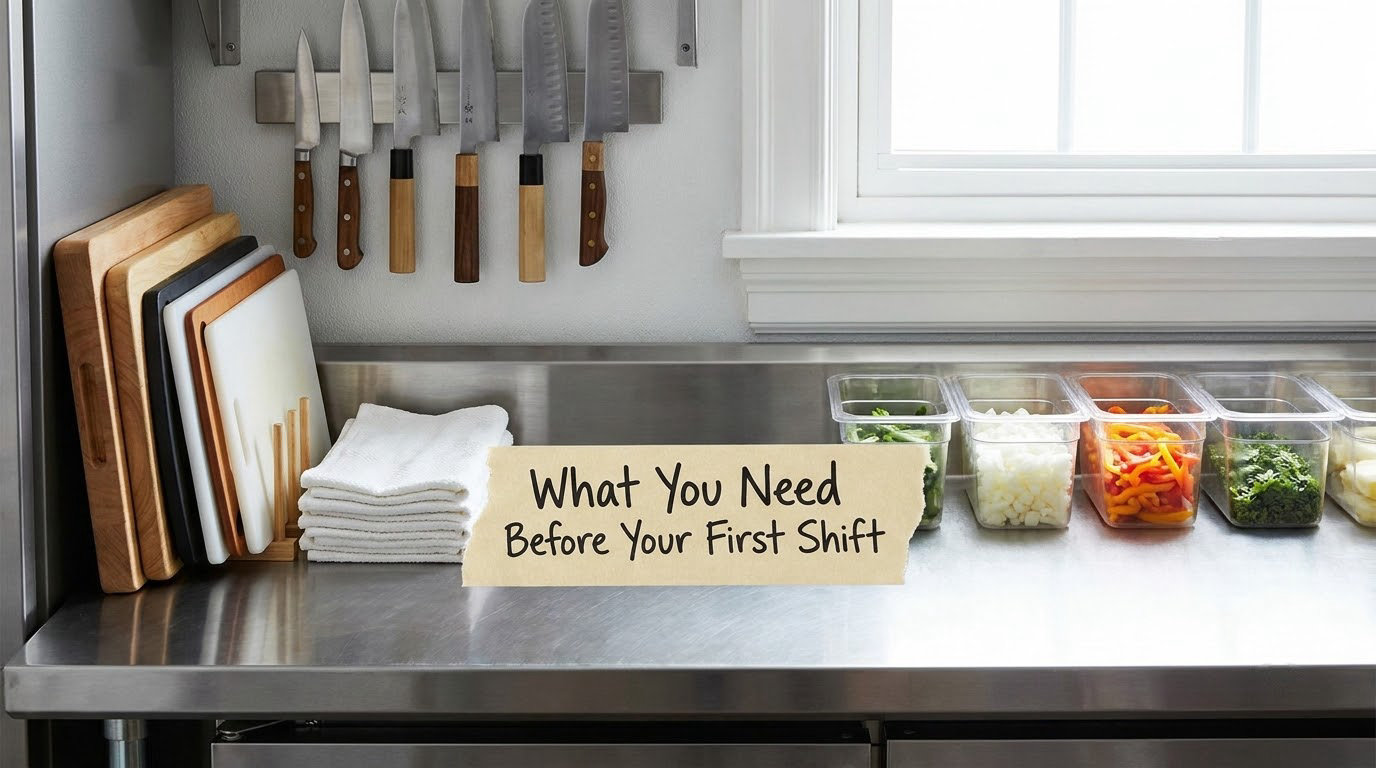
Arrive early enough to be useful, not late enough to be obvious about it. Cooks on r/KitchenConfidential consistently say to show up around 9:30 to get the line ready before service, and that advice holds at almost any concept. Confirm the exact call time with whoever is scheduling you, then plan to be in the building fifteen minutes before it.
What to bring or confirm
Most kitchens provide the heavy tools, so ask before you buy anything. A chef de garde manager, a line cook, and a sous chef will each own a different kit, and showing up with gear someone else provided reads as a small insult.
- Non-slip, closed-toe shoes. You will be standing on wet tile near a hot line. This is the single most important thing on the list.
- A knife you can sharpen. If the kitchen does not hand you one, bring your own chef’s knife and a honing steel. Cooks on ChefTalk tie speed directly to knowing your own tools.
- Two side towels minimum. One for you, one for the station. Cooks on r/KitchenConfidential say to keep extra towels on your station at all times.
- A notebook and a pen that stay in your apron pocket.
- Hair restraint, apron, and closed collar if the kitchen does not supply them.
Food safety you should know before you touch a knife
Know the numbers, not the vibe. The USDA minimum internal temperature for poultry is 165°F (74°C), ground meat is 160°F (71°C), and whole cuts of beef, pork, lamb, and fish are 145°F (63°C) with a three-minute rest. Use a calibrated thermometer every time; the back of your hand is not a thermometer.
Two more rules that get cooks sent home: keep raw protein below and separate from ready-to-eat food, and label and date everything you put in the walk-in cooler. Rotate first in, first out. If you cannot say out loud when something was cut and where it went, you have already lost the room’s trust.
Line safety that is not optional
Announce yourself. Say “behind” when you walk behind anyone carrying something hot, and “hot behind” when the pan is hot. Say “sharp” when you set a knife down within reach of someone working, and “corner” when you turn a corner at speed. Most kitchen injuries happen because someone made a sound the other person could not make for them.
Keep your towel away from the burner. Carry the knife tip down, blade facing behind you, and use a cutting board that has a flat side on the counter. Never pass food over someone else’s head.
How to Survive Your First Week as a Line Cook, Step by Step
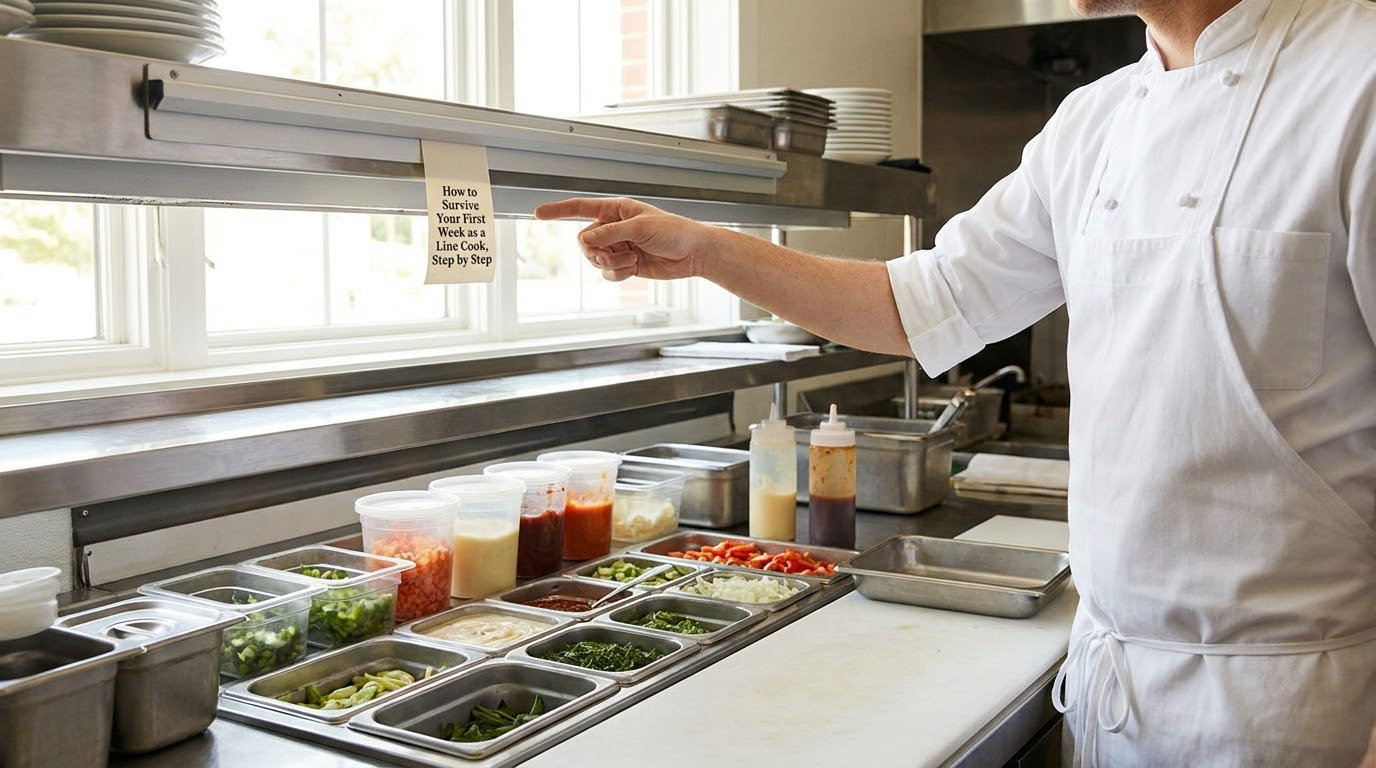
Most line training runs on three phases: watch, shadow, then run with someone close. A good first week moves through all three on purpose rather than waiting for a chef to hand you a station.
Day 1: Learn the room, touch nothing sharp
Your only job is orientation. Learn the shape of the kitchen: where the walk-in is, where the pass and expo are, where the dish pit is, where towels live, where the first aid kit is, and where the fire extinguisher is. Write all of it down.
Get the menu, read every item, and identify the eight to ten items you will cook most often. Do not try to memorize them. Just know they exist.
Success signal: you can walk to any item in the walk-in without being told where it is, and you know who your direct supervisor is.
Days 2 and 3: Shadow, then prep
You are behind the line, watching an experienced cook work, and your job is to observe with intent. Watch how they call tickets back, how they sequence a ticket with six items on it, how they tell expo they are running low. Keep your mouth closed and your notebook open.
By day three, you should be doing prep under supervision: portioning proteins, labeling containers, breaking down proteins, producing a sauce or a stock, cutting garnishes that are not time-critical. The rule from the ChefTalk threads is simple: if you are not cooking, you are stocking your station or doing mise en place.
Success signal: your station is ready to par at the start of service without someone telling you what is missing.
Days 4 and 5: Run the station with a person next to you
Now you cook, but someone experienced stays within arm’s reach. Your ticket time will be bad. That is fine for two more shifts. What matters in week one is accuracy and the volume, not the speed.
After service, write down every note you got from your chef while you still remember the wording. Then rewrite your station setup sheet for the next shift based on what actually ran out.
Success signal: you finish a full service with under five verbal corrections, and your close gets signed off without a redo.
Days 6 and 7: Get in the weeds and call for help
By now the rushes are yours to survive. Your job this week is to practice asking for help at the right moment, which is earlier than you think. When you have more tickets than you can hold, say it out loud: “I have three down, I’m in the weeds on tickets five through seven.” That sentence is not an admission of failure. It is how the line protects itself.
Finish the week by doing a clean close every single night, including the ones you are exhausted from.
Success signal: you have run a full service start to finish, including the breakdown, and you know what your station needs on day two before you arrive.
How to Run a Station Without Falling Behind
Mise en place is everything that happens before the ticket arrives. Set your station to par: enough of each item in your section to cover the expected covers plus a buffer, in the right place, in the right container, labeled and dated.
Then the rush is mostly management of your own attention. Read the whole ticket before you start, not the first line. Group items that share a cook time and fire them together instead of serially. Build every cold item on the ticket first, because cold items wait while hot items do not. Call tickets back to expo so they know what you have.
Work in a fixed order every service: fire, plate, call, wipe, reset. The order is muscle memory, and muscle memory is faster than thinking. Clean as you go, because the version of you at the peak of a rush is only as good as the station you built twenty minutes earlier.
When you genuinely cannot keep up, say the number of tickets you have rather than saying you are fine. New cooks hide their pile because they think it makes them look slow, and the pile is what actually makes the whole line slow.
How to Communicate Clearly with Chefs and Coworkers
Confirm the ticket before you cook it. Repeat the modifiers back in the order the expo said them, especially allergies and substitutions. Allergies get repeated once more, loudly, and never treated as a preference.
Learn the calls your specific kitchen uses, because language is not standardized. Most kitchens use behind, hot behind, sharp, corner, and cover. Common line shorthand includes all day for an item that sold out, and 86 for an item that is done and needs to come off the board. If your kitchen says something different, that is the correct word there.
Report problems when you see them, not when the guest does. Low on a protein, a burner that will not light, a sauce that broke and needs a rework. A short call to expo on the 86 list saves more time than a fast plate ever will.
Talk to people, not about people. If a chef corrects you in front of the kitchen, answer “yes, chef,” fix it, and ask about it privately ten minutes later. That conversation is the whole culture in miniature, and how you handle it is what people remember.
Common First-Week Mistakes and How to Fix Them
1. Skipping station setup because service feels close. You think a fast setup buys goodwill. Actually a bad station costs you tickets. Fix: build a written setup list the first day and run it every shift until it is automatic. Set up for the next cook as well as yourself.
2. Guessing when you are not sure. Guessing on an allergy, a cook temperature, or a modifier is the one mistake that ends a first week early. Fix: when you do not know, stop the item and ask. Nobody has ever been fired for asking whether a sauce is finished.
3. Working through fatigue without a break or water. The standard line advice from r/KitchenConfidential is to drink plenty of water all shift, and it is right. Standing for a full double on a hot line in the wrong shoes is how cooks hurt. Fix: keep a bottle within arm’s reach of your station and drink between every ticket, not during a lull you may never get.
4. Mishandling food under pressure. Rushing makes people skip handwashing, skip labeling, and stack raw over ready-to-eat. Fix: slow down for the safety steps even when everything else is fast. A correction is cheaper than a sick guest.
5. Going silent when you fall behind. This is the mistake that turns a busy service into a disaster. Fix: give expo a running count. “I have four tickets in front of me” is a useful piece of information; silence is not.
6. Leaving a dirty close. You crash or get cut at 1 a.m. and leave the station filthy. Fix: clean as you go all night so the close is twenty minutes of breakdown, not an hour of rescue. Set the station for the opener regardless of your own state.
A few bonuses worth taking. Learn your three menu items inside out and own them completely. Write down the par for every item in your section. Ask for a mid-shift conversation after your first service instead of waiting for a review nobody schedules. And eat something real before you clock in, because you will be too busy to eat during.
Frequently Asked Questions
How do I get ready for my first shift as a line cook?
Show up fifteen minutes early, dress in non-slip closed-toe shoes, and bring a side towel, a notebook, and a pen. Before your shift, know where the walk-in, the pass, the dish pit, and the fire extinguisher are. Review the menu and identify the eight to ten items you will cook most often. Arrive hungry but not starving, and assume the first thirty minutes will be setup, not cooking.
What should I do if I cannot keep up with tickets?
Tell expo out loud and give a number rather than an impression. Saying I am in the weeds with four tickets in front of me lets the line reroute work and reorder tickets, which is exactly what it is designed to do. Keep cooking while you talk. If you hide the pile for a few minutes, four tickets become twelve and the recovery gets much harder.
How do I call out orders correctly on a busy line?
Read the whole ticket, then repeat it back to expo in the order you heard it, with modifiers last. Say every modifier explicitly instead of assuming expo knows the ticket. Repeat allergy items a second time, loudly. Use your kitchen’s own wording, since calls differ from restaurant to restaurant, and make eye contact when you give the call so the person receiving it actually hears you.
What if I make a mistake during service?
Fix it or tell someone who can fix it, right away, and never hide it. Say yes, chef, correct the issue, and keep moving. Then ask your supervisor about it ten minutes after service, when it is quiet, so you actually understand the rule you broke. Mistakes are a normal part of a first week; covering one up is not.
How soon should I ask a chef for help?
Ask the moment you are unsure, which is earlier than most new cooks manage. That covers tickets, quantities, temperatures, station procedure, and anything you could not find in the walk-in. Ask during prep rather than mid-rush when you can, but never let a rush push a question you were already going to ask. Cooks who ask in week one get trusted faster, not slower.
How do I close a line-cook station properly?
Clean as you go during service so the close is short. At the end, break down your station, wipe and sanitize surfaces, store or label leftovers with a time, deep clean equipment you used, restock your station to par for the opener, and wipe down your station map area. Most kitchens also need burners off, gas verified, and floors mopped. Ask what your closing checklist requires and run it the same way every night.
Start tomorrow, not Monday. Confirm your call time, get the uniform and shoes sorted tonight, and write down the three menu items you are most likely to cook on your first shift. Everything else in your first week as a line cook builds on those three small things plus the habit of saying out loud what you need before you are underwater.