
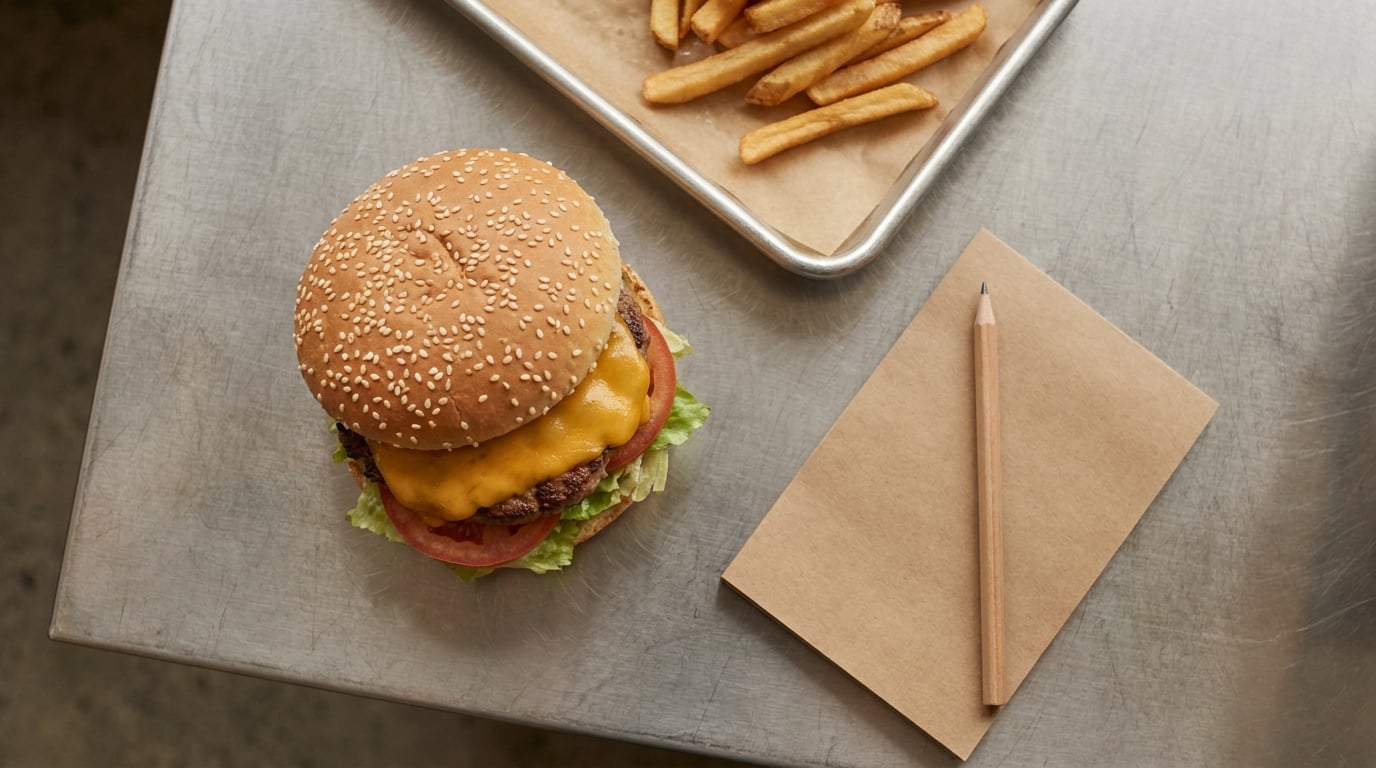
Restaurants price a burger by dividing the full plate cost by a target food cost percentage, then checking that number against nearby competitors. A 4-ounce cheeseburger that builds out near four dollars usually lands between thirteen and fifteen dollars on a casual dining menu.
The catch is that a four dollar burger is not a four dollar burger. Between the price on the menu and the plate that leaves the pass, roughly seven dollars and change goes to labor, rent, utilities, insurance, card processing, and the profit the owner keeps for the risk. This explainer walks through that whole path, from the raw material in the walk-in cooler to the number printed on the board.
The figures below are typical US ranges for an independent restaurant. Beef prices swing by region and by season, and every operator’s rent and wage base differs, so treat the worked numbers as a template rather than a quote.
Table of Contents
- How Restaurants Price a Burger on the Menu
- What Determines the Cost of a Burger
- How Do Restaurants Set a Menu Price
- Step 1: build the true plate cost
- Step 2: pick a target food cost percentage for the concept
- Step 3: layer in everything food does not cover
- Step 4: check the market
- Step 5: set the price so it reads well
- Which burger is your Star, and which is your Dog
- How restaurants price a burger on the menu when beef costs spike
- How Do Location, Brand, and Demand Affect Burger Prices
- Worked Example: Pricing a Basic Cheeseburger
- How to Tell Whether a Burger Is Good Value
- Frequently Asked Questions
- Conclusion: Start With Food Cost, Then Add the Rest
How Restaurants Price a Burger on the Menu
Menu pricing is the decision of what number a guest sees. The restaurant’s cost of that burger is a different number entirely, and the gap between the two is where every other expense lives. Calling a 3.80 dollar plate cost “the price of the burger” confuses cost with price, which is the most common mistake in the whole conversation.
So how do restaurants price a burger on the menu in practice? Most operators work from a cost-plus formula, cross-check it against the local market, and then adjust the ending digits for how the price reads. Some do it backwards, deciding the market position first and letting the cost fit inside it. The cost-plus route is the one that survives a beef spike, so that is where this article starts.
The formula in one line
Menu price equals plate cost divided by target food cost percentage. A 3.80 dollar burger at a 30 percent target gives 12.67, which most operators round to something that reads naturally, in this case 12.95.
Two things hide in that formula. The plate cost only covers food, so it pays for roughly a third of the price, and the target percentage is a choice about concept tier, not a law of nature. A gastropub and a neighborhood fast food place use the same burger and pick very different targets.
What Determines the Cost of a Burger
Restaurants evaluate the patty or alternative protein, the bun, cheese, toppings, sauces, portion weight, supplier pricing, waste, and packaging. In practice most of the money sits in two lines: the protein and the side.
The protein is priced by weight and grade, so a 4-ounce portion of an 80/20 blend and a 4-ounce portion of a lean blend cost meaningfully different amounts per pound. Ground beef is also a commodity that tracks wholesale cattle markets, and a national chain buying by the trailerload will beat a single-location order on the same cut.
Portion weight is where a lot of guessing happens. Raw weight is not cooked weight, and a patty loses roughly a quarter of its mass to moisture and fat during cooking, so a spec written in raw ounces delivers a smaller plate than the number implies. Experienced operators write the raw spec and the cooked spec both, then check a finished patty with a scale at least once a week.
Trim and drop loss is the number that quietly breaks margins. A 4-ounce raw order does not yield four clean ounces on the grill, so a small waste allowance belongs in the plate cost. Skipping it is a common source of the claim that food cost numbers calculated on paper never match the actual numbers at the end of the month.
Packaging is the line that gets forgotten most often. A clamshell, a printed sleeve, a foil wrap, a sticker, and a bag add up, and they only appear on delivery orders while the food cost percentage in the accounting report counts all of them. Delivery also brings a commission, which is an operating cost rather than a food cost, so it belongs in a different bucket.
What a typical 4-ounce cheeseburger costs to build
These are illustrative figures for an independent US casual dining kitchen, in US dollars per burger.
| Cost input | Per burger | Share of plate cost |
|---|---|---|
| Beef patty, 4 oz raw | 1.55 | 41% |
| Brioche bun | 0.45 | 12% |
| American cheese, one slice | 0.28 | 7% |
| Produce: lettuce, tomato, onion, pickle | 0.32 | 8% |
| House sauce | 0.12 | 3% |
| Fries portion, 4 oz | 0.48 | 13% |
| To-go packaging and lid | 0.38 | 10% |
| Trim, drop and waste allowance | 0.22 | 6% |
| Total plate cost | 3.80 | 100% |
A published concept guide for burger-and-fries operators lands in almost the same territory, with a 4-ounce burger at a 4.10 dollar plate cost sold at 15.00 dollars for a 27.33 percent food cost. Two independent sets of numbers arriving within a few cents is a decent sign that the build is realistic.
How Do Restaurants Set a Menu Price
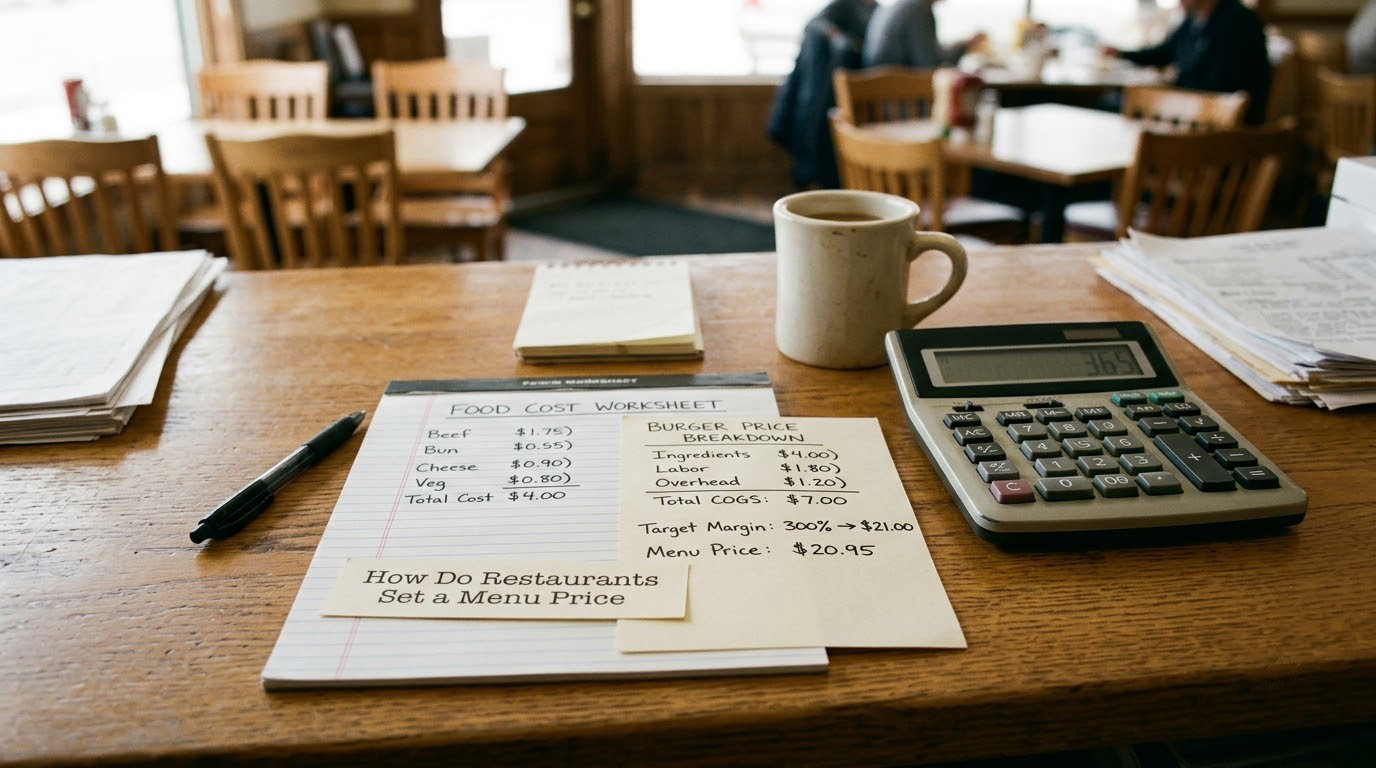
The process runs in five steps. Build the plate cost, pick a target food cost percentage for the concept, layer in the costs food does not cover, check the market, then set the ending digits. Operators who skip step four end up with a perfectly calculated price that nobody in the neighborhood will order.
Step 1: build the true plate cost
Cost one burger the way a guest would eat it, not the way the invoice arrives. That means the patty, the bun, the cheese, the produce, the sauce, the side portion if the burger comes with one, the packaging, and a waste allowance. Check the number against your last invoice cycle, because invoice prices and the per-serving math inside the distributor’s price sheet are not always the same thing.
Step 2: pick a target food cost percentage for the concept
The band you choose is a statement about your tier and your volume. The table below shows common operator targets, the math on the 3.80 dollar example, and what a diner tends to see on a real menu in each segment.
| Concept type | Target food cost | Menu price from a 3.80 plate cost | Typical real menu price |
|---|---|---|---|
| Value QSR or fast food | 26-30% | 12.67-14.62 | 5-9 |
| Fast casual | 28-32% | 11.88-13.57 | 9-13 |
| Casual dining | 30-34% | 11.18-12.67 | 13-18 |
| Gastropub or craft burger bar | 32-38% | 10.00-11.88 | 17-24 |
| Hotel or premium dining | 25-30% | 12.67-15.20 | 25 and up |
Notice how the math column and the real menu column point in opposite directions. Gastropubs run a higher food cost percentage yet charge more, because the percentage is a slice of a much larger price. This is where a lot of confused cost discussions go wrong: a low food cost percentage is not proof of a cheap burger.
Step 3: layer in everything food does not cover
A menu price that only funds ingredients is a loss. Here is roughly where each dollar of a 15.00 dollar casual dining burger goes, using the 4.10 dollar plate cost above.
| Where the money goes | Amount | Share of menu price |
|---|---|---|
| Food and beverage cost | 4.10 | 27% |
| Labor, including management | 4.50 | 30% |
| Occupancy: rent, utilities, property | 3.00 | 20% |
| Other operating: insurance, supplies, marketing, card fees, delivery commissions | 1.80 | 12% |
| Owner profit | 1.60 | 11% |
| Menu price | 15.00 | 100% |
That split is close to the 30/30/30/10 rule operators often repeat for a healthy restaurant: about 30 percent food, 30 percent labor, 30 percent occupancy and operating, 10 percent profit. It is a rough frame, not a standard, and a delivery-first kitchen replaces part of the labor line with platform commissions.
Step 4: check the market
Pull the menus of the three or four places your guests actually consider. If the calculated price lands far outside that band, the cost has to give before the price does. Practitioners on restaurant forums are blunt about this: if your numbers demand a price nobody nearby charges, the fix is the portion, the sourcing, or the concept, not stubbornness on the board.
Step 5: set the price so it reads well
Finish with psychology. Value items often land on a nine or a ten-dollar price with no cents, while premium items take a ninety-five ending. Dropping the dollar sign keeps attention on the food. Avoid clustering every burger within a few dollars of the others, since that flattens the menu and gives guests no reason to trade up. One expensive burger on the board quietly makes the mid-priced one look reasonable.
Which burger is your Star, and which is your Dog
Menu engineering sorts every item by popularity and by contribution margin. High popularity and high margin makes a Star, and it earns the top of the menu and the best description. High popularity and low margin makes a Plowhorse, which is usually the right candidate for a small price move. Low popularity and high margin is a Puzzle that needs a better description or a better position. Low popularity and low margin is a Dog, and the fix is usually to take it off.
Run that matrix on the burger section specifically. A signature burger that sells a hundred a day at a thin margin is doing more damage than it looks, because it also occupies the space a well-priced burger could be selling in.
How restaurants price a burger on the menu when beef costs spike
Raising the price by the full amount of a cost increase is the move most owners try first, and it is the one that fails most often. When food costs rise faster than wages and rent, guests will absorb part of the increase through portion changes instead.
Value engineering is the alternative. A 4-ounce patty can become 3.5 ounces, a blended cheese can replace a single origin slice, a house sauce can carry more of the flavor than a bought one, and a slightly different bun often costs less with no guest noticing. Run the plate cost again after each change, and if the price still has to move, move it in small steps: specials and bundles first, then a full menu change over a few weeks, with servers trained to sell the value rather than apologize for the number.
How Do Location, Brand, and Demand Affect Burger Prices
The same burger costs different amounts in different rooms. A downtown storefront with heavy foot traffic carries more rent, so the same 3.80 dollar plate cost needs a higher price or a higher volume to clear the same margin. An airport or tourist-zone location charges for the convenience and the captive audience, and delivery-first kitchens price for commissions they pay to the platform rather than for the dining room they never use.
A neighborhood spot with lower rent and a nearby national chain has the opposite problem, and a good one. The chain’s burger is a commodity priced on national volume, so competing on price alone is a losing game. The independent wins on taste, portion, freshness, and customization, and it can charge more for those things when the market supports it.
Brand does the same work as location. A burger sold as a plain menu item sits near the commodity price. The same patty with a dry-aged blend, a house bun, and a hand-cut garnish becomes a different product, and guests will pay for the difference when the menu tells them why. Branding without a real difference is the failure mode: the price goes up, the value does not, and the burger turns into a Dog.
Daypart and occasion pricing matter too. A quiet Tuesday afternoon has empty seats and a fully paid staff, so a limited-time offer in that window can pull demand without touching the regular dinner price. Delivery menus are usually priced above the in-restaurant menu on purpose, because the platform takes a cut of the total order rather than of the burger alone.
Worked Example: Pricing a Basic Cheeseburger
Take the build from earlier: 3.80 dollars in plate cost. The operator runs a neighborhood casual dining room and targets a 32 percent food cost, which is normal for a room with table service.
3.80 divided by 0.32 gives 11.88. That is a real number, but nobody prints 11.88, so it becomes 11.95. A check of nearby menus shows the closest comparable burgers at 12 and 13, and this concept already has a 15 dollar signature burger, so 11.95 reads as the sensible choice rather than the cheapest one.
Now apply the same build to a second concept. A fast casual operator with the same plate cost targets 28 percent, gets 13.57, and prices at 13.50 while running a much faster turn on a smaller footprint with less labor per order. A gastropub with a 9.50 dollar plate cost at 35 percent arrives at 27.14 and prices it at 26.95 with a premium bun and a fried egg on top. Same category, three completely different economics.
One published reference point helps put all of this in scale: a burger-and-fries concept guide lists a 4-ounce burger at a 4.10 dollar plate cost, a 15.00 dollar menu price, and a 27.33 percent food cost. Those figures illustrate the shape of the math, and the specific numbers vary by region and change over time as beef and wages move.
How to Tell Whether a Burger Is Good Value
You will never see another restaurant’s plate cost, so judge value from what reaches the table. Start with the protein, since it is usually the largest line in the cost. A heavier patty with visible sear, a declared blend, and a cooked weight you can actually feel is a different product from a thin patty that relies on sauce for its character.
Then look at the parts that cost real money and get cut first. Fresh produce that has not browned, cheese that is sliced rather than shredded from a bag, a bun that is not stale at the edges, and a portion of fries that fills the container. Ground beef is a USDA food safety matter as well: cook ground meat to a minimum internal temperature of 160 degrees Fahrenheit, and keep raw patties cold during service.
Compare against two or three nearby menus rather than one. If a 14 dollar burger includes a side and customization and a 12 dollar burger does not, they are not the same product. Watch how often the place sells out, because a menu that runs out of its burger by 8 pm is telling you the price works.
For home cooks, the number on a restaurant menu is a useful benchmark and a poor recipe. A restaurant burger carries labor, rent, and profit inside that price, and a home plate with the same ingredients costs a fraction of it. Knowing that gap is what makes the menu price feel reasonable instead of outrageous.
Frequently Asked Questions
Why are hamburgers so expensive now?
A burger costs far more than its ingredients because food is only about a quarter to a third of the menu price. The rest pays for labor, rent, utilities, insurance, card processing, and delivery commissions. On a 15 dollar casual dining burger, roughly 4 dollars is food, 4.50 is labor, 3 is occupancy, and the remainder covers other operating costs and profit. Beef and dairy prices have also moved up, which pushes the food line higher.
What food cost percentage should a restaurant target for burgers?
Most independent operators land between 28 and 34 percent for a burger program. Value quick service runs closer to 26 to 30 percent because volume spreads labor, while gastropubs often sit at 32 to 38 percent to fund premium proteins. Treat these as starting bands, then check actual results monthly. A theoretical percentage that ignores trim, waste, and freebies will drift from the real number within a quarter.
Is a 32.8% food cost acceptable?
For a casual dining or fast casual concept, 32.8 percent is inside a normal band and usually healthy. The number only makes sense with context. A 32.8 percent food cost on a 6 dollar burger leaves about 2 dollars to cover labor, rent, and profit, while the same percentage on an 18 dollar burger leaves roughly 6. A low percentage on a low price is not the win it looks like on the report.
What is the 30/30/30/10 rule in restaurants?
It is a rough benchmark for a healthy restaurant’s spending split: about 30 percent on food, 30 percent on labor, 30 percent on occupancy and other operating costs, and 10 percent as profit. Owners use it as a sanity check rather than a target, because delivery-heavy kitchens trade part of the labor line for platform commissions and high-rent cities push occupancy above 30. Profit above the benchmark usually means an underinvested kitchen or staff.
What is the 60/40 restaurant rule?
The 60/40 rule is a simple break-even target: about 60 percent of sales should be food and beverage cost, leaving 40 percent to pay labor, rent, utilities, and profit. A restaurant that hits it has covered its operating costs. It is a diagnostic, not a pricing method, and it is far less useful today than it was decades ago, since labor, rent, and delivery fees have taken a much bigger share of the same dollar.
Why do delivery apps charge more for the same burger?
Delivery menus are priced higher on purpose, because the platform takes a commission on the order and the restaurant also absorbs packaging, discounting, and support. That commission is an operating cost, not a food cost, so it should not distort the food cost percentage or the plate cost of the burger itself. Restaurant owners generally treat the delivery menu as its own pricing decision rather than a mirror of the in-restaurant board.
Conclusion: Start With Food Cost, Then Add the Rest
How restaurants price a burger on the menu comes down to one division and three checks. Divide the full plate cost by a target food cost percentage, then confirm the result fits the local market, suits your concept tier, and reads well on the board. Everything else, labor, rent, delivery fees, and profit, lives in the space between the plate cost and the printed number.
If you are working this out for your own menu, the first action is simple: cost one burger the way a guest eats it, including the bun, the sauce, the side, the packaging, and a waste allowance. Then pick a realistic margin for your concept, check three nearby menus, and test the final price against the portion you are actually serving. Updated for October 2026, the numbers move with beef and wages, so recalculate rather than reusing a price from a spreadsheet you built last year.