
Nobody can name the person who invented the hamburger, and anyone who hands you a single confident answer is selling you something. The history of the hamburger in America runs from a German dish of minced raw beef printed in an English cookbook in 1758, through meat patties sold on bread at American fairs in the 1880s, to a sandwich a chain could produce ten thousand identical copies of in a day.
What actually happened was adaptation, and it is traceable. German-speaking immigrants brought the habit of shaping seasoned beef into a flat patty, city lunch counters put that patty between bread so a customer could eat it standing up, and by the 1920s small chains had turned the whole thing into an industrial product. This guide walks that line, and flags the parts where the record runs out.
Updated for 2026, and written for people who would rather make a good burger than argue about statues.
Table of Contents
- Where Did the Hamburger Come From?
- When Did the Modern American Hamburger Take Shape?
- How Did Immigrants and Working-Class Cities Shape the Hamburger?
- How Did Beef, Buns, and Condiments Become the Standard Combo?
- How Did the Hamburger Become an American Food Icon?
- A Timeline of the Hamburger in America
- How Did Regional Traditions Change the Hamburger?
- How Did Cheeseburgers, Specialty Burgers, and Fast Food Change It?
- What Does the Hamburger Mean in American Food Culture?
- Where Is the Hamburger Today?
- Frequently Asked Questions
- Conclusion
Where Did the Hamburger Come From?
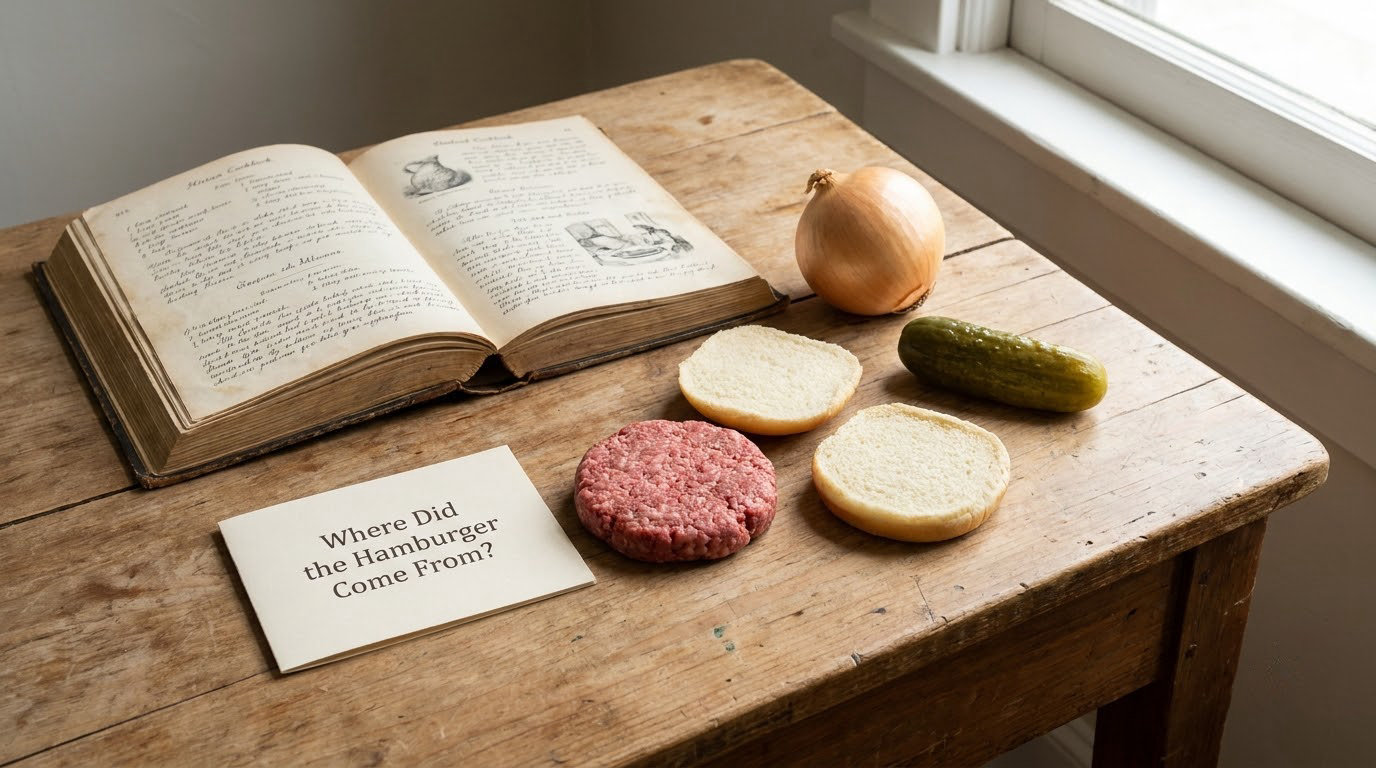
The history of the hamburger in America starts with German beef, not buns
The earliest ancestor of the burger is a dish Americans called Hamburg steak: raw or lightly cooked minced beef, seasoned, shaped into a flat cake, and seared. It is not a sausage dish, which is the source of much of the confusion in origin stories.
Hannah Glasse published a recipe for a “Hamburgh sausage” in her 1758 English cookbook The Art of Cookery Made Plain and Easy. That dish is a rich soup of veal, and later writers have quietly converted it into proof that the burger was British. A more useful trail runs through American cookbooks. Mary Randolph’s The Virginia House-Wife, published in 1824, contains a recipe for “Hamburg steaks” made from minced beef.
By the 1850s, beef patties of that kind were ordinary in American cooking. The sandwich itself was already a well-established American form, and beef had to be somewhere to go between two slices of bread. Hamburg steak simply supplied the filling.
Why Is the Chop Suey Burger Story Uncertain?
The chop suy burger theory says that Chinese-American restaurants, serving non-Chinese customers in the late nineteenth century, put a stir-fried beef patty on a bun. It is a tidy story and it circulates constantly, because it would make the burger an American-Chinese hybrid rather than a European import.
The evidence behind it is thin. There is no photograph of an early chop suy burger and no dated menu; the claim was popularized by a writer decades after the fact, and the restaurant version that does exist differs in flavor, texture, and sauces from the plain griddled patty that American lunch counters were selling in the 1890s. Most food historians treat it as a folk memory rather than a documented origin, and the honest answer is still no.
The naming history has its own tangle. One persistent idea says the word came from a German shipping line founded in 1847, and another says it came from a village in New York state. The first has no evidence behind it, and the second is only half wrong: Hamburg, New York is a real town, but nobody has ever produced a Hamburg, New York restaurant selling hamburgers.
When Did the Modern American Hamburger Take Shape?
The recognizable hamburger settles into place between roughly 1885 and 1920, in dense American cities rather than at any single invention moment. Ground beef was a byproduct of a beef industry that produced more than cities could eat fresh, so cheap mince was abundant and underused.
Lunch wagons, saloon counters, market stalls and railroad lunchrooms all sold a patty on bread at a few cents, eaten in a few minutes, standing up. A 1896 Chicago newspaper carried an advertisement for a hamburger sandwich sold by the wagon at the stockyards, which shows the item was already a commercial street food rather than a novelty.
Naming the dish did not mean inventing its ingredients or its format. The language shifted first, and the language is the real historical record. Cookbooks and menus moved from “Hamburg steak” to “hamburger steak” to “hamburger sandwich,” and the final shortening to “hamburger” came from the American habit of letting “-burger” stand alone.
One correction that is worth making once, because it gets repeated constantly: an 1834 menu supposedly from Delmonico’s in New York is routinely cited as proof of an early American hamburger. That menu is almost certainly a later reprint of a sheet from the 1890s. It is an anachronism, not evidence.
How Did Immigrants and Working-Class Cities Shape the Hamburger?
The cities that made the hamburger were industrial port cities full of recently arrived immigrants: New York, Baltimore, Philadelphia, New Orleans, St. Louis, Chicago. German-speaking arrivals brought the custom of eating minced beef formed into patties, and they settled in neighborhoods with the kitchens, griddles and small restaurants to cook it.
Wage labor created the demand. A factory hand or a dockworker needed hot food in five minutes, eaten with one hand, at a price that did not require planning. A patty on bread met all three conditions. It needed no knife, no plate, and no table, and it did not go cold on the walk back to the shop.
Cheapness was structural, not an accident of the era. Beef offcuts and trim were ground because there was no better use for them, which meant a patty cost a fraction of what a steak cost. Every city with a stockyard had the same arithmetic available.
Immigrant cooks also mattered more as competitors and adapters than as originators. In Chicago the sausage sandwich and the hot dog with mustard were the dominant street formats, and hamburgers had to win a crowded fight for the same lunch hour.
How Did Beef, Buns, and Condiments Become the Standard Combo?
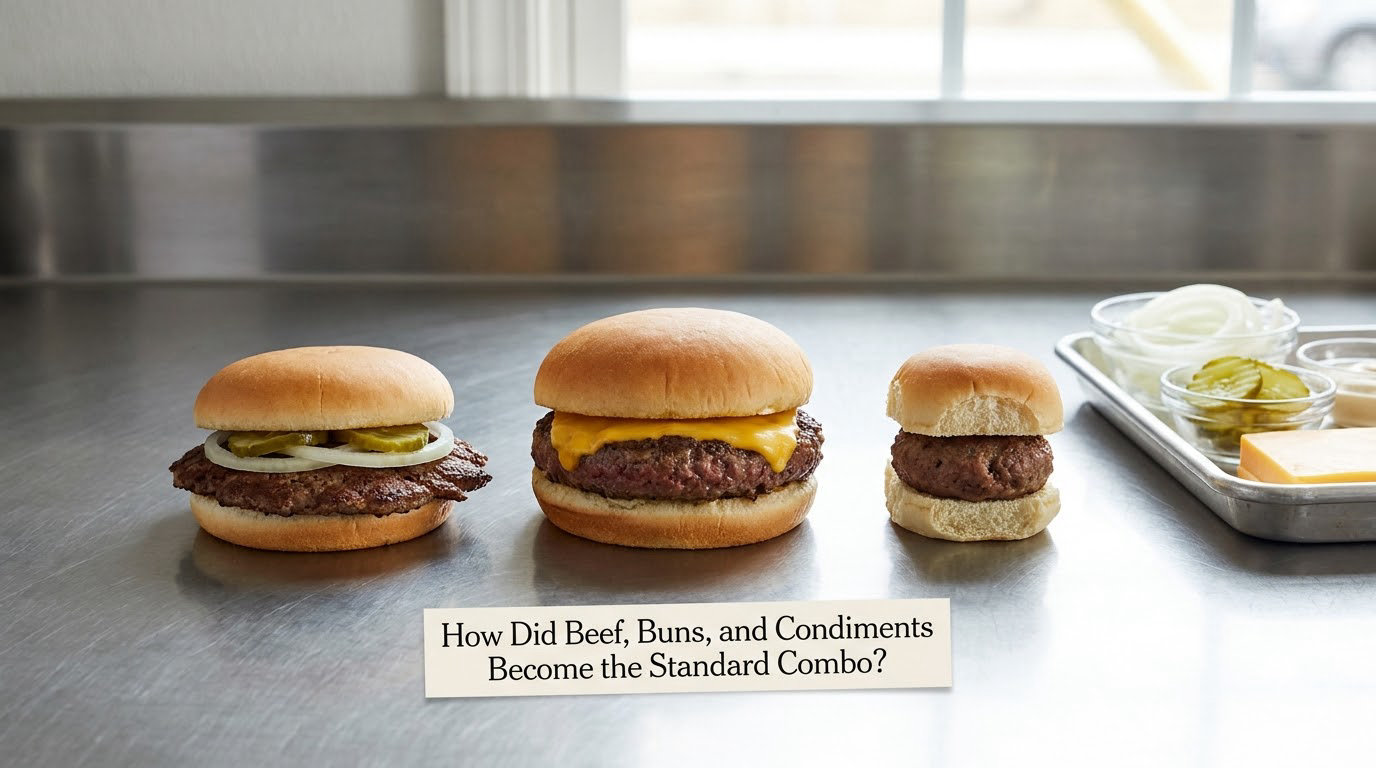
For its first decades the patty usually went on toast. The dedicated hamburger bun was not standard tableware in American homes, and the sandwich you were handed in 1900 was frequently a grilled slice of bread doing a job it was never designed for.
Griddle cooking is what fixed the patty’s shape. A flat top holds a smash, and a smash is what makes a hamburger a hamburger rather than a loose serving of beef. The onion, the pickle, the tomato, the relish and the mustard came from the same practical logic, using what a diner had, dressing it in seconds, and making a cheap sandwich look generous.
There was never one accepted recipe. Two diners in the same city in 1915 could order burgers that shared nothing but the meat, and regional habits were established early, which is a theme that returns later in this article.
The buns finally took hold in the 1930s and 1940s, and largely from independent operators rather than the chains. Los Angeles burger stands and San Francisco lunch counters started baking buns in house, or buying them from a local bakery, and the round soft bun became the container that the early history had been missing. That shift is the strongest argument for treating White Castle, a few years later, as the company that defined what a hamburger was rather than the company that invented it.
How Did the Hamburger Become an American Food Icon?
Then the food changed hands. Upton Sinclair’s The Jungle in 1906 made the public wary of the American meatpacking industry, and hamburgers were caught in the reaction, because a loose ground-meat product was the least identifiable thing in the case. By 1917 several states and cities had gone as far as banning the sale of made-from-scratch hamburgers from public counters.
White Castle answered with science instead of denial. Its 1921 Wichita launch marketed inspection, cleanliness, and a sealed paper wrapper, and it leaned on a relative of co-founder Edgar Ingram who headed a state health board, which is a good example of how the industry rebuilt trust rather than argued for it. Inside the wrapper was also a square patty cooked on a flat top, small enough to eat in a few bites, and priced at five cents.
The chains followed in a fast sequence, and the format repeated. Kewpee arrived in 1923, White Tower in 1926, Little Tavern in 1927, Krystal in 1932, and Bob Wian’s Big Boy in the mid-1930s with its double-decker special. The McDonald brothers opened their original restaurant in California in 1940 and refined an assembly line the company called the Speedee Service System in 1948, which served a limited menu made to move in seconds. Ray Kroc took the system public, and the company that many people associate with the hamburger was still a regional operation until the 1950s.
What sealed the icon status was postwar and suburban. Cars, highways, drive-ins and takeout packaging made a car-shaped meal, and the Big Mac, launched in 1967, made the double-decker burger a permanent reference point. By the time the hamburger was a global export, it was no longer a regional dish that happened to be popular. It was the food that carried the idea of America.
What did Americans call hamburgers during World War II?
Still hamburgers. The wartime renaming was a fundraising device rather than a linguistic shift, and newspaper advertisements and menu boards from the war years show burgers sold under patriotic names such as Liberty burgers and Victory burgers, with a stated portion of proceeds going to war bonds. Menu development across the industry shrank patties and used soybean oil in place of rendered beef fat to stretch supplies, which is part of why chains were already perfecting standardized, repeatable production before the drive-in era peaked.
A Timeline of the Hamburger in America
| Year | Event | Who or where |
|---|---|---|
| 1758 | Recipe for “Hamburgh sausage” published in English, a soup dish that later gets misread as a burger origin | Hannah Glasse, The Art of Cookery |
| 1824 | “Hamburg steaks” recipe printed in an American cookbook | Mary Randolph, The Virginia House-Wife |
| 1847 | German transatlantic shipping line founded; later named, without evidence, as the source of the word | Hamburg America Line |
| 1880s | Beef patties on bread sold at fairs, markets and lunch wagons in American cities | Street vendors, urban lunch counters |
| 1891 | Onion-topped ground beef patty served at a fair near Waco, Texas, recalled later by the operator’s grandson | Oscar Weber Bilby |
| 1896 | Newspaper advertisement for a hamburger sandwich sold by wagon at the Chicago stockyards | Chicago press |
| 1900 | Hamburger steak served from a lunch counter in Connecticut | Louis Lassen, New Haven |
| 1904 | Hamburgers served at the St. Louis World’s Fair; a New York newspaper calls one vendor an innovation on the pike | St. Louis, Missouri |
| 1906 | The Jungle damages public trust in processed meat, including ground beef | Upton Sinclair |
| 1917 | Several states ban the sale of made-from-scratch hamburgers at public counters | US state and city health departments |
| 1921 | White Castle opens in Wichita, Kansas, selling five-cent square patties on soft buns with a five-hole shape and a sealed wrapper | Walter Anderson and Edgar “Billy” Ingram |
| 1923-1936 | Burger chains multiply: Kewpee, White Tower, Little Tavern, Krystal, Big Boy’s double-decker | US lunch counters and drive-ins |
| 1924 | Cheese added to a hamburger in Pasadena, California | Lionel Sternberger, Hatfield’s |
| 1940 | McDonald’s original restaurant opens in California; the Speedee Service System arrives in 1948, with the Big Mac in 1967 | Richard and Maurice McDonald |
| 1940s | Patty melt built in Connecticut; butter burger and smoked patty styles consolidate in the Midwest and Southeast | US regional diners and stands |
| 1950s-1960s | Franchising, standardization and the Big Mac Index carry the burger worldwide as a symbol of the United States | McDonald’s; The Economist |
| 1990s-present | Smash-burger revival, independent experimentation and plant-based patties broaden the category | Modern US restaurants |
Read that table with one filter on and you will not need to take my word for anything. Rows with a document behind them are the ones with a date in a newspaper, a menu, a court record, or a photograph. The rows about named inventors are almost always somebody’s memory, recorded later, of a fair or a lunch counter in a city where nobody wrote anything down.
How Did Regional Traditions Change the Hamburger?
Americans never agreed on one burger, and they were not supposed to. The differences track climate, immigration patterns, and what a diner’s kitchen could do at speed, and the variations are old rather than recent inventions.
In New England, thin patties cooked fast on a flat top and served on toast or a bun became the house style. In the Midwest, smoke and butter became signatures: butter burgers, where the patty is cooked in butter and cheese goes on top, and charbroiled versions built around a smoked patty. The patty melt, griddled meat and melted cheese pressed together on griddled bread, came out of Connecticut lunch counters in the 1940s and stayed a New England order ever since.
The Upper Midwest went further, with a cheese or raw-meat pocket filling that cheesesteak and burger traditions share, invented in the Minneapolis area in the 1950s and later litigated over its name. A southern burger tradition in the Carolinas added pimiento cheese, and the grease for those patties has been kept and passed along in some shops for the better part of a century.
Drive-in and tavern styles are their own category. A counter, a grill, a car at the window, and no expectation that anything is plated. Two chains that still run on that logic started decades apart on purpose, one in California in 1948 and one in Virginia in 1986, and both built their reputations on a single patty cooked in a way almost nobody else could copy.
How Did Cheeseburgers, Specialty Burgers, and Fast Food Change It?
Cheese turned the sandwich from a regional item into a category. Adding it in Pasadena in 1924 seems trivial now, but it is the first example of the customization that would define the burger: one ingredient, added on request, that produced a new and more popular version of the same food. The patty melt and the cheeseburger share a birthday.
Specialty builds followed the same logic, layer after layer. Bacon, a fried egg, a chili, a patty of a different meat, or a regional cheese, each one a local answer to the question of what belongs between the bread. Restaurants built reputations on one such build and defended its name, which is why so many regional burgers come with a story attached and a trademark application behind it.
Fast food changed the scale, not the idea. Once a chain could hold a patty to a fixed weight, cook it to a fixed time, and serve it in a fixed wrapper, the burger stopped being a regional dish and became a manufactured product with a national footprint. That consistency is the real achievement of the 1940s and 1950s, and it is also the reason a home cook and a chain cook can now disagree about what a proper burger is and both be right.
What Does the Hamburger Mean in American Food Culture?
It is an inexpensive meal first, which is where its power comes from. A burger has always been the food you can afford without planning, and that has kept it in reach of people a fine dining menu never would have reached.
It is also the most customizable food Americans have, which makes it a quiet measure of what a place is. Condiments, toppings, and the choice of patty do the work that a long menu does at a restaurant with a wait, and asking for one burger with and one without says more about the diner than most conversations do.
Third, it is a cultural export with a scoreboard attached. From the late 1980s onward, economists have used the price of a Big Mac in different countries as a stand-in for how developed a market is. The joke is the point: Americans measure the world, and other countries measure the Americans, in hamburgers.
Finally, it is a competition ground. Chain against independent, franchise against franchise, national version against regional version, and every one of those fights is settled at a lunch counter rather than in a boardroom. That is why the regional burger sections above still matter. Somebody in every town is defending a version of this sandwich against something with a drive-through.
Where Is the Hamburger Today?
The current revival is a rediscovery, not an invention. Smash burgers went back into fashion because a home cook and a line cook discovered that a hard press on a screaming hot flat top gives you a browned, crusted patty and a bun that never turns to mush, which is a technique that flat-top restaurants have used for a century.
At the other end, premium chains made patties larger, ingredients more visible, and the build more layered, and the burger became a thing people photograph before they eat. Delivery apps and late-night ordering turned it into a category that competes on convenience rather than on a parking lot.
Plant-based patties arrived as a third option, and the interesting part is that they borrow the same visual language, browned crust and all, which says how settled the burger’s format has become. The main argument now is not what a burger looks like. It is who cooks it and how fast.
For cooking at home, one practical note carries more than any history lesson. Ground beef is ground meat, so cook patties to 160 degrees Fahrenheit (71 degrees Celsius) in the thickest part, and let ground-meat products sit in the refrigerator rather than the freezer, since freezing degrades their texture.
Frequently Asked Questions
Who invented the hamburger in America?
No single person invented it. Charlie Nagreen is credited with serving a ground beef patty on bread at a Missouri fair in 1885, the Menches brothers claimed a Columbus, Ohio fair in the 1880s, Oscar Weber Bilby served an onion-topped patty in Texas in 1891, and Louis Lassen and Fletcher Davis are both named in later retellings. The record is thin enough that the honest answer is that the hamburger has several parents and no proven first author.
Was the hamburger invented in the United States?
Not exactly. The patty came from Europe, where minced raw beef shaped into a flat cake was already a common dish by the 1700s, and the word came from Hamburg. The American sandwich is American, though, because Americans were the ones who put that patty between bread so it could be eaten standing up, sold it at city lunch counters, and then industrialized it into a fast-food product.
What was the first hamburger called?
Early Americans most often called it a Hamburg steak or a hamburger steak, and the patty on bread was usually described as a hamburger sandwich. The shortened standalone word hamburger followed the American habit of letting the -burger ending stand on its own, the same way that cheeseburger, bacon burger and veggie burger work today. Hamburg itself is where the word comes from, not a burger joint in New York.
What is the oldest hamburger restaurant in America?
Louis’ Lunch in New Haven, Connecticut claims to be the oldest hamburger restaurant in America, with roots in a 1895 lunch counter, though its own date was documented long after the fact. White Castle, which opened in Wichita in 1921, is the oldest surviving hamburger chain and is the company that really defined the burger as ground beef on a bun, sealed and served over the counter.
Why is the hamburger important to American food culture?
The burger is cheap, fast, customizable, and portable, which made it the meal of immigrants, factory shifts, road trips, and drive-throughs in a single form. It also acts as an export of American identity: the Big Mac has been used for decades as a stand-in for a country’s standard of living, and the regional versions of the burger map the country’s regional differences more clearly than almost any other food.
Conclusion
The history of the hamburger in America is a story of adaptation rather than a single confirmed invention. German beef, American bread, city lunch counters, a food-safety scare, and assembly-line kitchens each did their part, and every claim about one inventor rests on a document thinner than people assume.
So start where the history actually starts: a plain ground beef patty, cooked hard on a hot surface, on a bun. Get that right and everything else, every regional topping, every chain, every argument about who did it first, is a footnote to one good sandwich.