
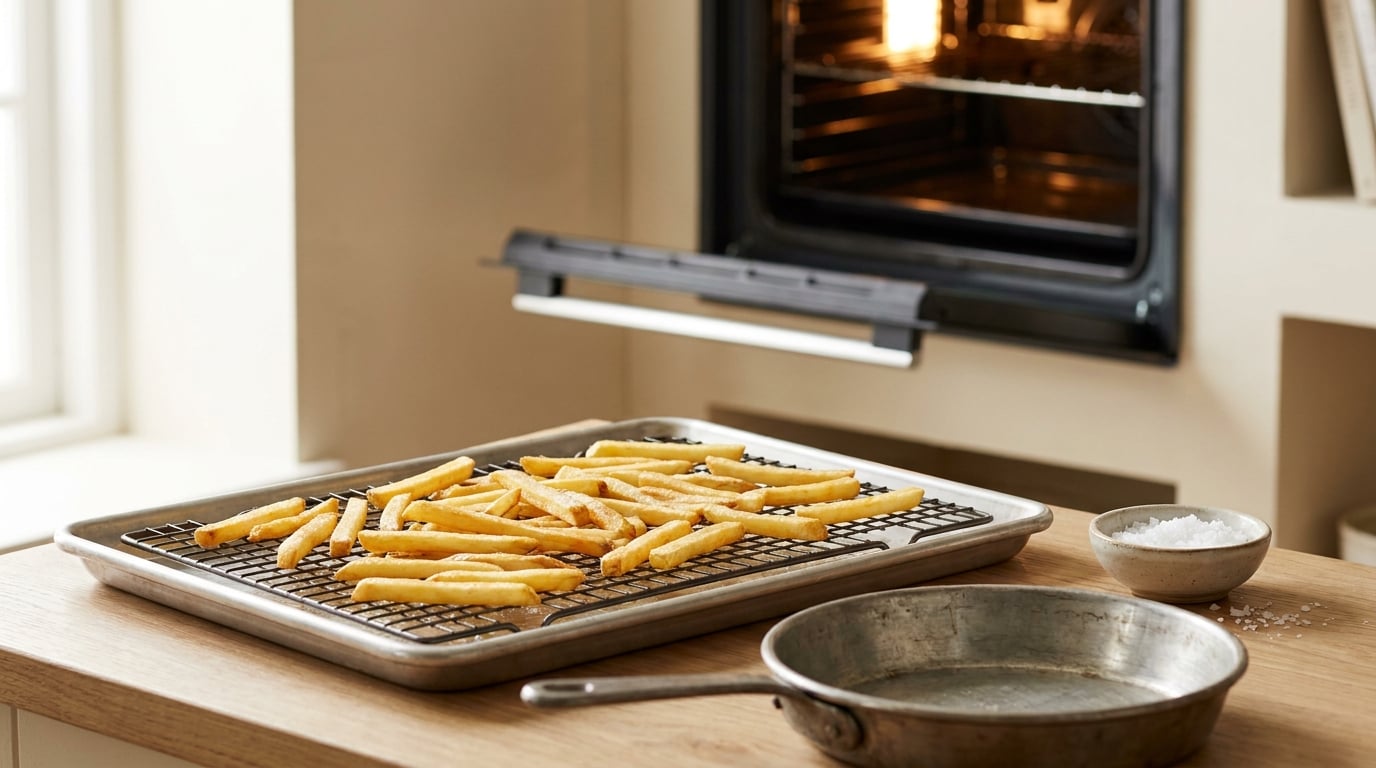
How to keep fries hot and crispy while serving comes down to two things: dry heat and moving air. Hold them at 300-325F in a warm oven or under a heat lamp, spread in a single layer and never covered, and they stay hot roughly 20 to 30 minutes with the crust intact. Cover them or pile them deep and trapped steam softens the shell in about two minutes.
I learned this the expensive way, holding a bank of fries under a heat lamp during a holiday rush and watching them go limp and greasy while they sat there. Nothing in the fryer was wrong. The holding was wrong.
What follows works for a restaurant line, a food truck, a party platter, or a home kitchen that wants fries to survive the walk from the stove to the table. The whole thing takes about two minutes of setup per batch.
Table of Contents
- What You Need
- Step-by-Step: Keep Fries Hot and Crispy
- Common Mistakes
- Frequently Asked Questions
- How long can you keep fries hot and crispy before serving?
- Can I keep fries in the oven while everyone eats dinner?
- Should I cover fries with foil or a lid while serving?
- What is the best way to reheat fries so they stay crispy?
- Does adding salt before serving help fries stay crisp?
- What container keeps fries crisp during serving?
What You Need
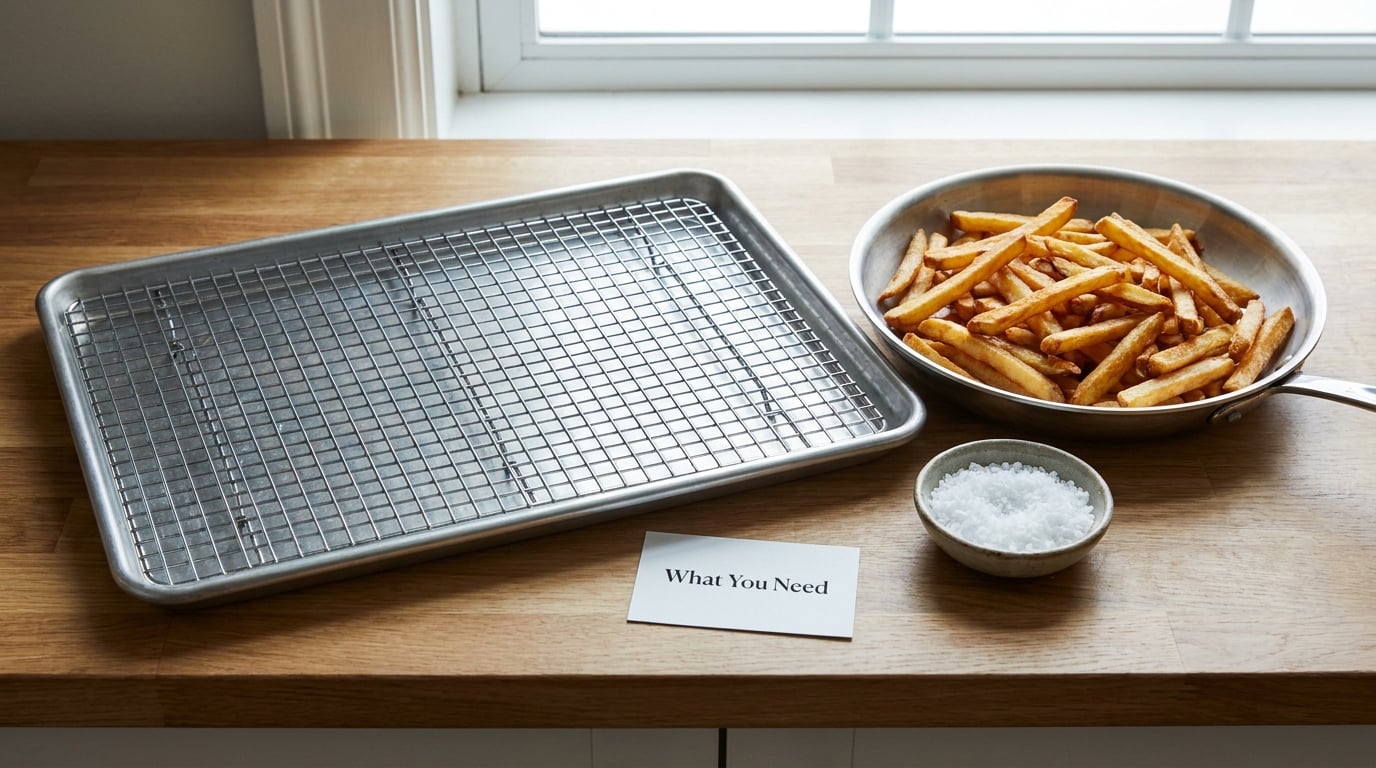
None of this is specialist equipment. You need a surface that lets moisture escape and a source of gentle heat.
- Wire cooling rack set over a rimmed baking sheet. The rack holds fries off the pan so hot air reaches every side and oil drains away instead of pooling underneath.
- Rimmed baking sheet to catch the drip. A flat unrimmed sheet traps oil under the fries and creates a soggy contact patch.
- Parchment or silicone mat, optional. A bare stainless pan works too, and it crisps the base a little more aggressively than parchment does.
- A spider or slotted spoon for lifting fries out in one shake rather than pouring them.
- Coarse salt and a shaker for finishing while the fries are still hot.
- A warm oven or heat lamp set between 300F and 325F, plus a low-sided metal serving pan or platter for the table.
Step-by-Step: Keep Fries Hot and Crispy
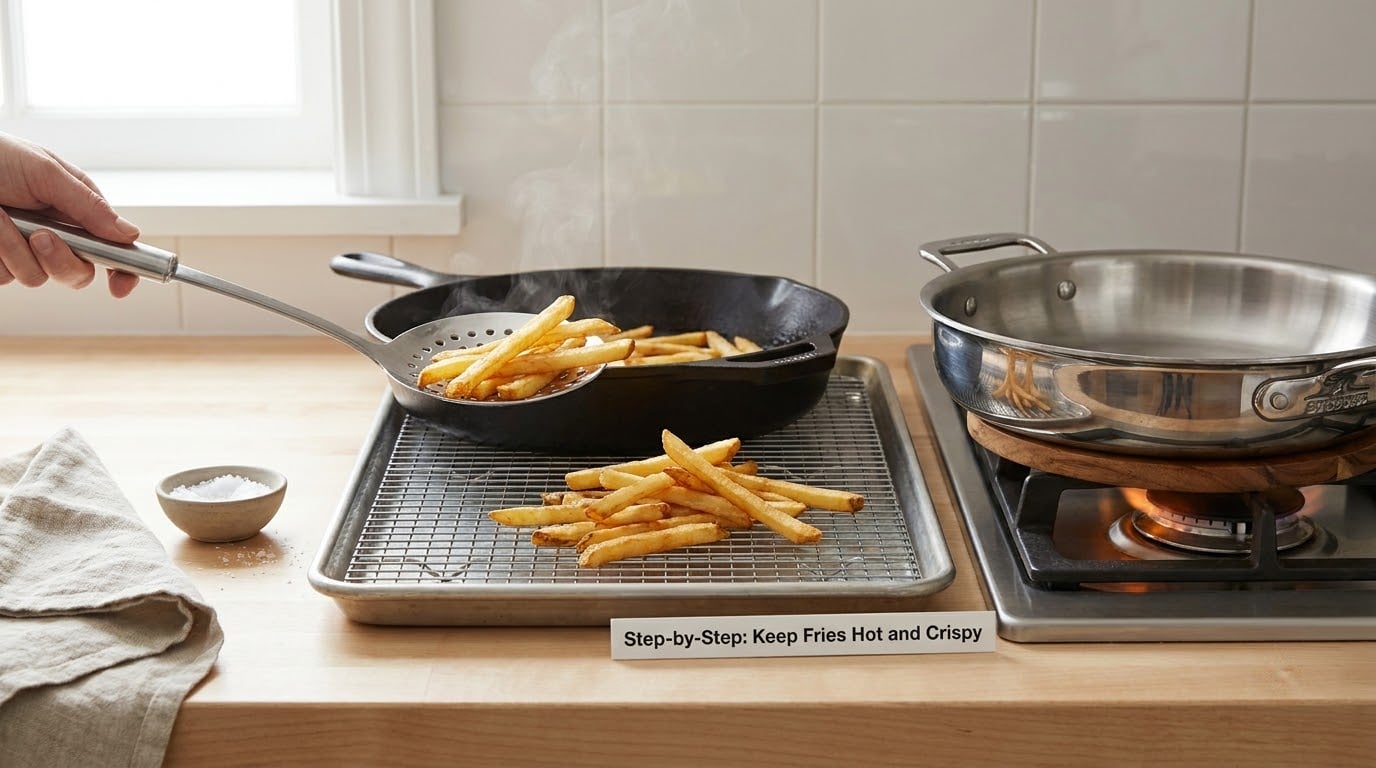
The order matters. If you drain first, salt second and hold third, the fries will make it to the table still crunchy. Here is the sequence I use.
How to Keep Fries Hot and Crispy While Serving
Serving is where good fries die, and the damage comes from three habits: covering them, piling them, and salting them cold.
Warm your serving pan in the oven for five minutes before the batch comes out, then set the fries in one loose layer. If a heat lamp is doing the work, keep it 6 to 10 inches above the food and rotate the pan every few minutes so no single spot dries out and browns while the rest cools.
Do not put a lid on, do not wrap in foil, and do not seal a box. Anything that traps vapor will soften the crust within minutes, even at the right temperature.
| Holding method | Temperature | Expected crispness hold |
|---|---|---|
| Warm oven, single layer, uncovered | 300-325F | 20-30 minutes at full crunch |
| Heat lamp, pan rotated every few minutes | Warm setting, lamp 6-10 inches up | 10-20 minutes, best used for short gaps |
| Preheated serving pan on the table, no heat source | Pans to roughly 140F | 10-15 minutes for a large group |
| Lidded container or foil-wrapped tray | Any | Crisp for about 90 seconds, then limp |
Finish with salt while the fries are still hot, then toss once so the seasoning grips. If you salt cold fries, most of it rolls off onto the pan.
Choose the Right Fry and Oil
Oil temperature is the single biggest lever you control. Cook at 350 to 375F, and treat anything under 350F as a soggy batch, which is the point drivers and line cooks on the forums keep repeating. Cold oil soaks starch into the surface instead of setting it, so the fries fry and then limp within minutes of draining.
Batch size matters just as much. A full basket drops the oil temperature fast, and a basket so full that fries float on each other cooks unevenly and steams on contact. Work in smaller baskets, even if that means more fry cycles.
For a longer hold, double-fry. Cook at 300 to 325F for four minutes to set the interior, rest, then finish at 375F. The home cook’s version is a 50/50 plain flour and cornstarch coating with a pinch of baking powder, the trick several cooks describe on r/AskCulinary. Thick cuts and wedges outlast thin shoestring fries for the same reason: there is less surface area going limp.
Drain Without Steaming
Get fries out of the oil the second they are done. Lift with a spider, shake twice, and lay them on the rack in a single layer. Do not tip the whole basket onto a towel, because a heap of fries steams itself and the bottom layer turns soft in under a minute.
Salt within about a minute of draining, while the surface is still hot and dry. Skip the paper-towel rest for more than a minute or two; a towel holds the vapor, which is exactly what you are trying to avoid. The rack over a rimmed sheet is better because air moves on both sides.
Warm your oven before the first fry rather than after, so the hot window is open when the batch is ready.
Use a Small Batch and Reheat in Small Portions
Serving in waves beats serving everything at once. A second fry of eight portions starts and finishes while the first batch is still crunching, and nobody gets a plate of fries that has been sitting since the top of the hour.
When fries do soften, heat brings the crust back. Never use the microwave alone. It heats the water inside the potato, which softens the shell in the same way a cover does.
| Reheating method | Temperature and time | Resulting texture |
|---|---|---|
| Wire rack in a hot oven | 400F for 8 to 10 minutes | Crispest, most even result |
| Air fryer | 400F for 5 to 7 minutes, shaking once | Very crisp, quickest option |
| Toaster oven on a baking sheet | 400F for 8 to 10 minutes | Close to a full oven on small batches |
| Microwave alone | 30 to 45 seconds | Soft, rubbery shell |
| Microwave then oven | 30 seconds, then 5 minutes at 400F | Good revival when the center is cold too |
Chop soft fries into roughly two-inch pieces before reheating, as Chatelaine suggests, so the inside reheatens at the same rate as the shell.
Common Mistakes
Nearly every soggy plate traces back to one of these.
- Covering the fries. Correction: never lid, wrap or seal while hot. Use an open pan and let the vapor leave.
- Piling them high. Correction: one loose layer on a rack, and use a second pan instead of a deeper heap.
- Resting them on paper towels for minutes. Correction: drain on a rack over a rimmed sheet, then season and move them on.
- Frying below 350F or with a full basket. Correction: keep the oil between 350F and 375F and work in smaller baskets.
- Holding a large batch through a rush. Correction: fry in waves and swap the pan, rather than cooking for the whole crowd at once.
- Salting after they cool. Correction: season within a minute of draining and toss again just before serving.
- Reheating in the microwave. Correction: oven, toaster oven or air fryer at 400F, with a short microwave only as a head start.
One safety note, because the temperature that protects quality is not the temperature that defines safety. USDA guidance for hot holding is 135F or above, which is lower than the 300F-plus at which fries stay properly crisp. Hot holding above 135F keeps them safe; holding them warm and dry at 300 to 325F keeps them good. Fries that cool below 135F for more than two hours should be discarded, and you cannot bring that back with a blast of hot air.
On a party scale, the same rules apply with bigger numbers. r/Chefit users delivering 40 servings point to thick cuts or wedges and a coating before frying, and both hold far better than a thin shoestring batch. Fry in staggered waves, park the finished pans in the warm oven uncovered, and set the platters out as the waves come out rather than all at once.
Frequently Asked Questions
How long can you keep fries hot and crispy before serving?
In a warm oven at 300-325F, single layer and uncovered, fries hold full crunch for about 20 to 30 minutes. Under a heat lamp the window is shorter, roughly 10 to 20 minutes, because the lamp dries the top faster than the bottom. On a preheated serving pan with no heat source, budget 10 to 15 minutes. Past that, plan a reheat in a 400F oven or air fryer rather than hoping.
Can I keep fries in the oven while everyone eats dinner?
You can, and it is the best of the holding options, but turn the oven down to its lowest setting near 300F and leave the pan uncovered with a rack underneath. A higher setting keeps them hot but slowly bakes and dries them, which makes the shells brittle by the end of the meal. If your oven runs hot, hold them in it while the main dish finishes and move them to a preheated platter for the table.
Should I cover fries with foil or a lid while serving?
No. A crisp crust is porous, and moisture still moving out of the potato turns into steam the moment you seal the pan. That steam condenses on the shell and rehydrates it, which is why covered fries go from crunchy to limp in well under two minutes. The same rule applies to takeaway boxes: use a vented container with an absorbent liner, not a sealed clamshell.
What is the best way to reheat fries so they stay crispy?
Use a wire rack set over a baking sheet in a 400F oven for 8 to 10 minutes, or an air fryer at 400F for 5 to 7 minutes with one shake partway through. The rack is what makes the difference, since air reaches the underside too. Avoid the microwave on its own. If the centers are cold as well, give them 30 seconds in the microwave first, then finish them in the hot oven.
Does adding salt before serving help fries stay crisp?
Salt does not make fries crisper, but timing decides how well they are seasoned. Salt sticks to hot, dry surfaces, so season within about a minute of draining and toss again just before they hit the table. Fries seasoned after they have cooled mostly drop the salt onto the pan. Salt also pulls a little surface moisture, so it works best right after the drain and before the holding period.
What container keeps fries crisp during serving?
A shallow, low-sided metal pan or platter with nothing on top of it. Give it five minutes in the oven at 300F to warm up first, spread the fries in a single layer, and keep a second pan rotating in the warm oven so you are never serving from a pan that has been sitting. For transport, a vented box with a paper liner absorbs surface oil without trapping vapor, which is what keeps delivery fries from arriving limp.
Do one thing first: preheat the oven to 300F and get a rack sitting over a rimmed sheet before you drop any oil. Fry at 350 to 375F in small baskets, drain onto that rack in a single layer, salt while hot, and leave everything uncovered. That setup alone holds more crunch than any container you can wrap around it.