
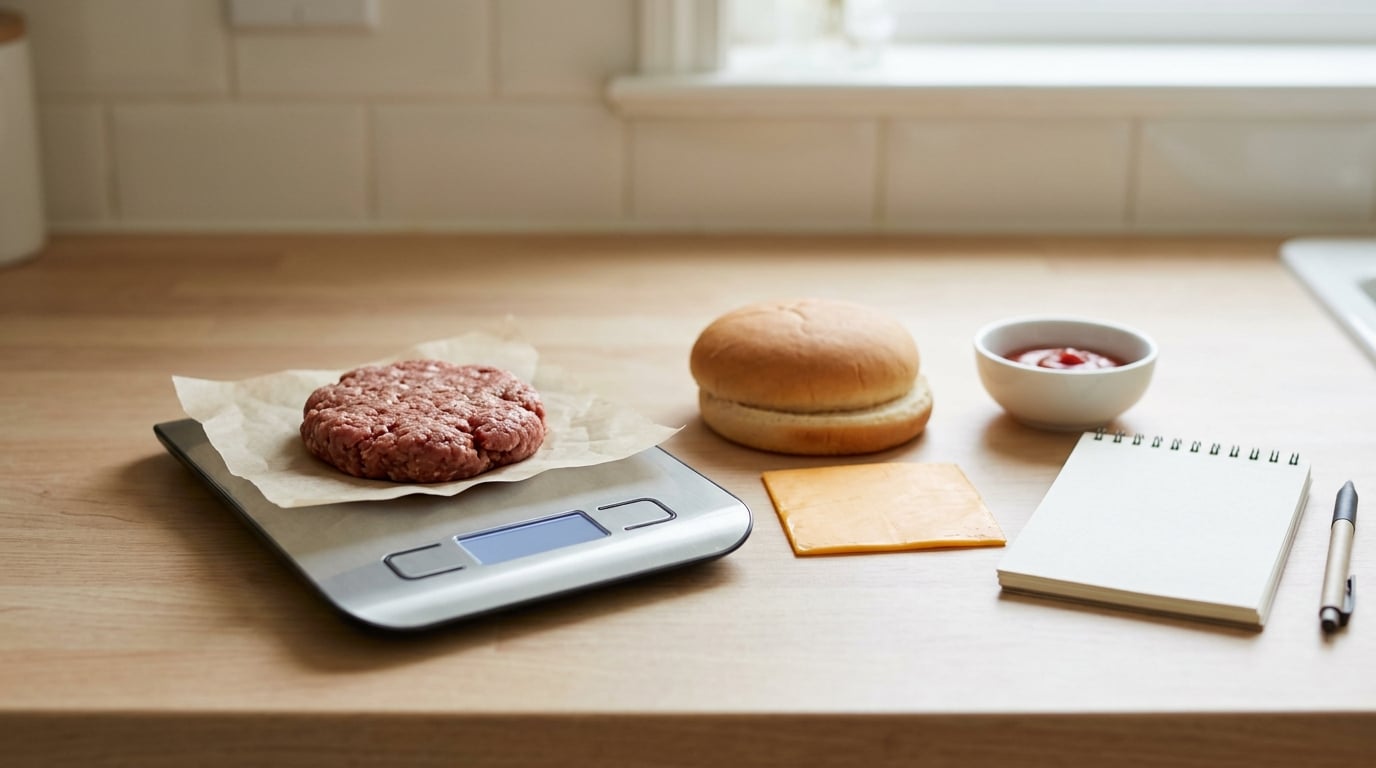
To count calories in a homemade burger, weigh each part separately, convert every weight into calories using the kcal per 100 g figure on its nutrition label, then add the parts up including the oil used in cooking. It takes about five minutes once you have a kitchen scale.
The reason it’s worth doing is that a homemade burger is one of the easiest meals to get wrong. Databases mostly describe restaurant burgers, so if you search “cheeseburger calories” you’ll land on a figure of roughly 300 kcal for a single-patty sandwich. The burger most people assemble in their own kitchen is nothing like that.
A brioche bun, a 150 g patty of 80/20 beef, a slice of cheddar, two strips of bacon, two tablespoons of sauce and a teaspoon of cooking oil lands somewhere around 950 calories. Same name, four times the number. Once you break the burger into components, the estimate stops being a guess and starts being arithmetic you can repeat on any build.
Table of Contents
- What You Need
- Step-by-Step: How to Count Calories in a Homemade Burger
- Common Mistakes
- Tips for a More Accurate Burger Estimate
- Frequently Asked Questions
- Do homemade burger calories change after cooking?
- How do I count calories when I do not have a food scale?
- Should I use the raw or cooked weight of burger patties?
- How many calories do common burger toppings add?
- Can I use a restaurant’s nutrition information for a homemade burger?
- Why is my homemade burger calorie estimate different from a restaurant’s number?
- Conclusion
What You Need
None of this needs special equipment, but four things make the difference between a real number and a hopeful one.
- A kitchen scale. A cheap gram scale that reads to 1 g is enough. Volume readings are the problem, because a cup of shredded cheese and a “1/4 lb” patty are both approximate in ways that throw off your total.
- The package, or reliable reference data. Keep the nutrition label for your ground beef, bun, cheese and sauce nearby. If the packaging is gone, use the values in USDA FoodData Central, which is where most label figures are originally drawn from.
- A written build. Write down the ingredients before you start cooking, including the small ones. Half the reason homemade calorie counts go wrong is that the oil and the sauce never make it onto the list.
- Measuring spoons and a calculator. Tables and spoons beat eyeballing for oil, butter and condiments, and you will be multiplying and dividing more than you expect.
MyFitnessPal and Cronometer both let you build a recipe from individual ingredients, which saves the arithmetic once you are logging regularly. Neither replaces the scale at the start; they just stop you retyping the same four numbers every Sunday.
Step-by-Step: How to Count Calories in a Homemade Burger
Choose and Weigh the Burger Components
List every edible thing going into the burger before anything is cooked. That is the patty, the bun, the cheese, every vegetable, every sauce and spread, plus any fat used in the pan.
Weigh each one and write the number down in grams before assembly. Weigh the raw patty rather than the cooked one, because that is the weight printed on the beef label. Weigh the whole bun, not the two halves, since the label figure is for the full roll.
Small items deserve their own line. A tablespoon of mayonnaise is 94 kcal, which is more than a slice of tomato, and it disappears into the build so fast that nobody counts it twice. I keep a running list in a notes app with three columns: item, grams, calories.
Find the Calories per 100 Grams for Each Ingredient
Nutrition labels are printed per serving, and the serving is rarely the amount you used. What you want is the calorie density, written as kilocalories per 100 g, which is what lets you scale to any weight.
For a packaged item, divide the calories on the panel by the serving weight in grams, then multiply by 100. If the panel says 250 kcal per 113 g serving, that is about 221 kcal per 100 g. For loose beef from a supermarket case pack, the per-100 g figure is usually printed right on the tray card, along with the lean percentage.
For an ingredient with no label, take the USDA FoodData Central entry and record the number along with the reference you used. State the weight with every figure, because a calorie number without a weight is not a fact, it is a vibe.
Calculate Each Ingredient’s Calories
The formula is the same for everything:
calories = (weight in grams ÷ 100) × kcal per 100 g
Here is a realistic patty calculation. A 150 g patty of 80/20 ground beef, where the tray card lists 240 kcal per 100 g:
(150 ÷ 100) × 240 = 360 kcal
Now the bun. A 60 g brioche bun at about 415 kcal per 100 g gives (60 ÷ 100) × 415 = 249 kcal. A 57 g plain white roll at about 250 kcal per 100 g gives 143 kcal. Same method, and you can see immediately why the bun deserves its own line in your log.
Because lean percentage changes the density of beef so much, here is what a 4 oz (113 g) patty tends to run at across the blends you will actually find in the case. Treat these as a starting range and let the label override them.
| Ground beef blend | Approx. kcal per 4 oz (113 g) | Approx. kcal per 100 g |
|---|---|---|
| 70/30 | 330–345 | 290–305 |
| 75/25 | 290–305 | 255–270 |
| 80/20 | 245–265 | 215–235 |
| 85/15 | 210–230 | 185–205 |
| 90/10 lean | 170–185 | 150–165 |
| 93/7 | 145–160 | 128–140 |
| 95/5 | 115–130 | 100–115 |
That spread is why a 4 oz patty logged as “one hamburger patty” in a database can be off by 200 kcal depending on what the app assumes. Specifying 80/20 removes the guesswork.
Add the Toppings and Condiments
Vegetables contribute less than most people expect, while sauces and cheese carry a surprising share of the total. Here is what the common ones actually add, using a typical portion for each.
| Topping or sauce | Typical portion | Approx. calories |
|---|---|---|
| American cheese | 1 slice, 20 g | 70–80 |
| Cheddar | 1 slice, 28 g | 110–120 |
| Swiss | 1 slice, 25 g | 95–110 |
| Mayonnaise | 1 tbsp, 14 g | 90–95 |
| Ketchup | 1 tbsp, 17 g | 15–20 |
| Mustard | 1 tsp, 5 g | 3–5 |
| BBQ sauce | 2 tbsp, 34 g | 55–70 |
| Ranch or special sauce | 2 tbsp, 30 g | 120–150 |
| Bacon | 2 strips, 22 g | 85–100 |
| Fried egg | 1 large | 70–90 |
| Avocado | 1/4 medium | 80–100 |
| Caramelised onion | 1/4 cup | 80–100 |
| Tomato | 2 slices, 25 g | 5–10 |
| Raw onion | 1/4 cup, 35 g | 15–20 |
| Lettuce | 2 leaves, 20 g | 3–6 |
| Pickles | 3 slices, 25 g | 5–10 |
Notice how two of the cheapest lines and one of the most expensive sit on the same burger. Two tablespoons of a thick special sauce costs roughly what a slice of cheddar does, and it never gets counted because it doesn’t look like food.
Here is a full build totalled line by line, which is the fastest way to see whether the method adds up to something believable.
| Component | Weight | kcal per 100 g | Calories |
|---|---|---|---|
| Brioche bun | 60 g | 415 | 249 |
| 80/20 beef patty, raw | 150 g | 240 | 360 |
| Cheddar slice | 28 g | 414 | 116 |
| Bacon, 2 strips | 22 g | 417 | 92 |
| Tomato, 2 slices | 25 g | 18 | 5 |
| Raw onion | 35 g | 40 | 14 |
| Lettuce | 20 g | 15 | 3 |
| Pickles | 25 g | 29 | 7 |
| Ketchup | 17 g | 101 | 17 |
| Mayonnaise | 14 g | 680 | 95 |
| Cooking oil retained in patty | 5 g | 884 | 44 |
Total: about 1,002 kcal for one burger. Nothing unusual in that build, and it is roughly three times the figure most databases quote for a cheeseburger.
Account for Cooking Weight Changes
Cooking reduces the weight of meat, and it reduces it a lot. A 150 g raw patty often lands at 115 to 120 g cooked, roughly a 20% drop, almost all of it water.
Those calories do not leave with the water, unless you drain the fat or throw away the juices. So the practical rule is simple: calculate from the raw weight and log it as a raw-weight number. If you only have a cooked weight, add about 20% to the grams before multiplying, or look up the cooked entry in a database and check it against your blend.
One exception is rendered fat. If you brown the patty and the pan ends with a visible slick of liquid fat, that fat is leaving the burger. A tablespoon of it is around 115 kcal, and it is worth noting how much went down the drain rather than pretending the whole tablespoon stayed in the meat.
While the meat is in the pan, cook it to a 160 F (71 C) internal temperature. That is the USDA minimum for ground beef, and a probe thermometer is the only way to know you got there.
Check the Serving Size and Round the Result
Decide now whether the number you calculated is one burger or the whole batch, because a recipe that makes six patties has produced six answers, not one. Weigh the finished assembly and compare it with the sum of its parts as a sanity check; a large gap usually means something skipped the list.
Then round. A figure like 997 kcal implies a precision you do not have, because your bun might be 55 g or 65 g and your “1 tbsp” of oil might be 10 g or 15 g. Report a range of about 950 to 1,050 kcal and your estimate is honest. Within 10% to 20% of the true figure is entirely normal for home cooking, and anyone claiming five-percent accuracy on a homemade burger is reporting a number they copied, not one they measured.
Common Mistakes
Forgetting the cooking fat. A teaspoon of oil is 40 kcal, a tablespoon is 120 to 130. A tablespoon of butter is about 100. If you brown patties in a skillet with oil, count what stays in the pan. Weigh the empty pan, weigh the pan with the fat in it, and use the difference. Grilling and air frying need no added fat, which is part of why they show up in lower-calorie builds.
Logging a label serving you did not eat. The panel says 3 oz, you used 5. Multiply by weight instead of accepting the printed calories, or your log will understate the patty by two thirds.
Treating calories as fat weight. Cooking weight loss is mostly water. A patty that loses 30 g in the pan has not lost 30 g of calories, and logging it as though it has is the most common arithmetic error in homemade tracking.
Ignoring the small repeated items. A drizzle of oil, a spoon of sauce, a pat of butter, a second slice of cheese. Individually they are noise; together they are 200 to 300 kcal, and they are the difference between your estimate and reality.
Treating a database figure as exact for your kitchen. Those numbers describe an average burger built to an average recipe. Yours has a different bun weight, a different blend and a different amount of oil, and the label on the package in your hand beats any website.
Using 90/10 lean and expecting restaurant results. Supermarket 90/10 is leaner than the blend most quick-service burgers use, so swapping to it changes the patty calories but not the rest of the build. The bun and the sauce do not get any smaller.
Tips for a More Accurate Burger Estimate
The batch method is the one most people in r/CICO and r/loseit end up using, and it is faster than per-ingredient math once you cook more than two burgers. Weigh the raw ingredients, total their calories, weigh the finished cooked food, subtract the weight of the pan, and divide by the number of portions. The r/gainit version describes it the same way: know the empty pan weight, add up the ingredient calories, then divide the net weight by servings. If you are eating the entire batch, there is no division to do.
If you have no scale, portions are still much better than guessing. A palm of raw meat is roughly 100 to 120 g, a cupped handful is about a cup, a thumb-sized dab of oil is roughly one teaspoon, and a fist is a cup to a cup and a half. r/nutrition threads make the point repeatedly that switching from eyeballing to cups produces a bigger accuracy gain than most people expect, because the errors stop being random.
Bun choice is the fastest lever you have, and it is often bigger than the beef decision.
| Bun option | Typical weight | Approx. calories |
|---|---|---|
| Plain white hamburger roll | 57 g | 140–150 |
| Brioche bun | 60–70 g | 250–290 |
| Whole wheat bun | 60 g | 130–150 |
| Whole-grain mixed roll | 43 g | 110–120 |
| Lettuce leaves (2 large) | 40 g | 5–10 |
| Portobello cap | 100 g | 20–30 |
Moving from a brioche bun to whole wheat saves about 100 kcal without changing the build at all. A brioche bun on an 80/20 patty is 600 kcal before a single topping lands on it.
If you want the same burger with fewer calories, these are the swaps that do the most work.
| Instead of | Use | Saves (approx.) |
|---|---|---|
| Brioche bun | Whole wheat bun | 100–140 kcal |
| 80/20 patty | 90/10 lean patty | 80–90 kcal |
| Double patty | Single 150 g patty | 350–400 kcal |
| Cheddar slice | American cheese slice | 40 kcal |
| Mayonnaise (1 tbsp) | Mustard or plain sauce | 85–90 kcal |
| Two strips of bacon | Extra vegetables | 85–100 kcal |
| Butter or oil in the pan | Grill or air fryer | 100–130 kcal |
Stack four of those and you are at roughly 500 kcal for a burger that still has beef, cheese and a bun in it, which is why a homemade build lands in a completely different range from the 300 kcal figure on most restaurant menus. That gap is the whole reason to count at home: the database number was never describing your kitchen.
Finally, give yourself permission to be approximately right. Forum threads on tracking are full of people abandoning the log over a 40 kcal discrepancy, which is the worst trade available. Consistent estimates that are off by 10% to 20% will keep you in control of your intake; perfect estimates that take twenty minutes will not survive a busy week.
Frequently Asked Questions
Do homemade burger calories change after cooking?
The number you log should not, though the weight will. A 150 g raw patty often cooks down to about 115 to 120 g, and nearly all of that loss is water rather than calories. Calculate from the raw weight and log it as a raw-weight figure, or add about 20% to a cooked weight before converting. The exception is rendered fat that drains off and gets discarded: that portion is genuinely gone.
How do I count calories when I do not have a food scale?
Switch from eyeballing to fixed portions, which is where most of the gain comes from. A palm of raw meat is roughly 100 to 120 g, a cupped handful is about a cup, and a thumb-sized dab of oil is about a teaspoon. Use the same measures every time, write them down, and treat the result as a range of plus or minus 15%. A consistent rough number is far more useful than an exact one you only get once.
Should I use the raw or cooked weight of burger patties?
Use the raw weight, because that is the weight printed on the ground beef label and the figure your calorie database is built around. A 4 oz raw patty of 80/20 runs about 245 to 265 kcal, while 93/7 runs about 145 to 160 kcal, so the blend matters more than the cooking. If all you have is a cooked weight, increase the grams by roughly 20% before converting.
How many calories do common burger toppings add?
A slice of cheddar adds about 110 to 120 kcal and American cheese about 70 to 80, while a tablespoon of mayonnaise adds roughly 90 to 95 and a tablespoon of ketchup only 15 to 20. Two strips of bacon run 85 to 100 kcal, a fried egg 70 to 90, and a quarter of an avocado 80 to 100. Tomato, lettuce, onion and pickles add roughly 5 to 20 kcal between them, so vegetables are rarely where the calories hide.
Can I use a restaurant’s nutrition information for a homemade burger?
Only as a rough starting point, not as your total. Restaurant figures assume their own bun weight, their own blend, often a pre-portioned thin patty and no added cooking fat. A home build with a brioche bun, an 80/20 patty, cheese, sauce and a teaspoon of oil can run three times higher. Use the restaurant number to sanity check the order of magnitude, then build your own total from weights and labels.
Why is my homemade burger calorie estimate different from a restaurant’s number?
Because the two burgers share a name and little else. Databases average a thin single patty on a standard roll, while a home build usually uses a heavier patty, a larger enriched bun, added cheese and sauce, and oil or butter in the pan. Once those are counted, the homemade version often lands between 500 and 1,000 kcal. That is not an error in your arithmetic; it is the difference between an average and your actual dinner.
Conclusion
Start with the patty and the bun, because those two set the floor and the ceiling. Weigh them, convert the grams using the kcal per 100 g figure, then add every topping, sauce and spoonful of oil on its own line.
When you are done, compare that total against the serving size you actually plan to eat, then round it to a range. A figure that is roughly right and repeatable will do far more for your tracking than a precise one you cannot produce on a weeknight.