
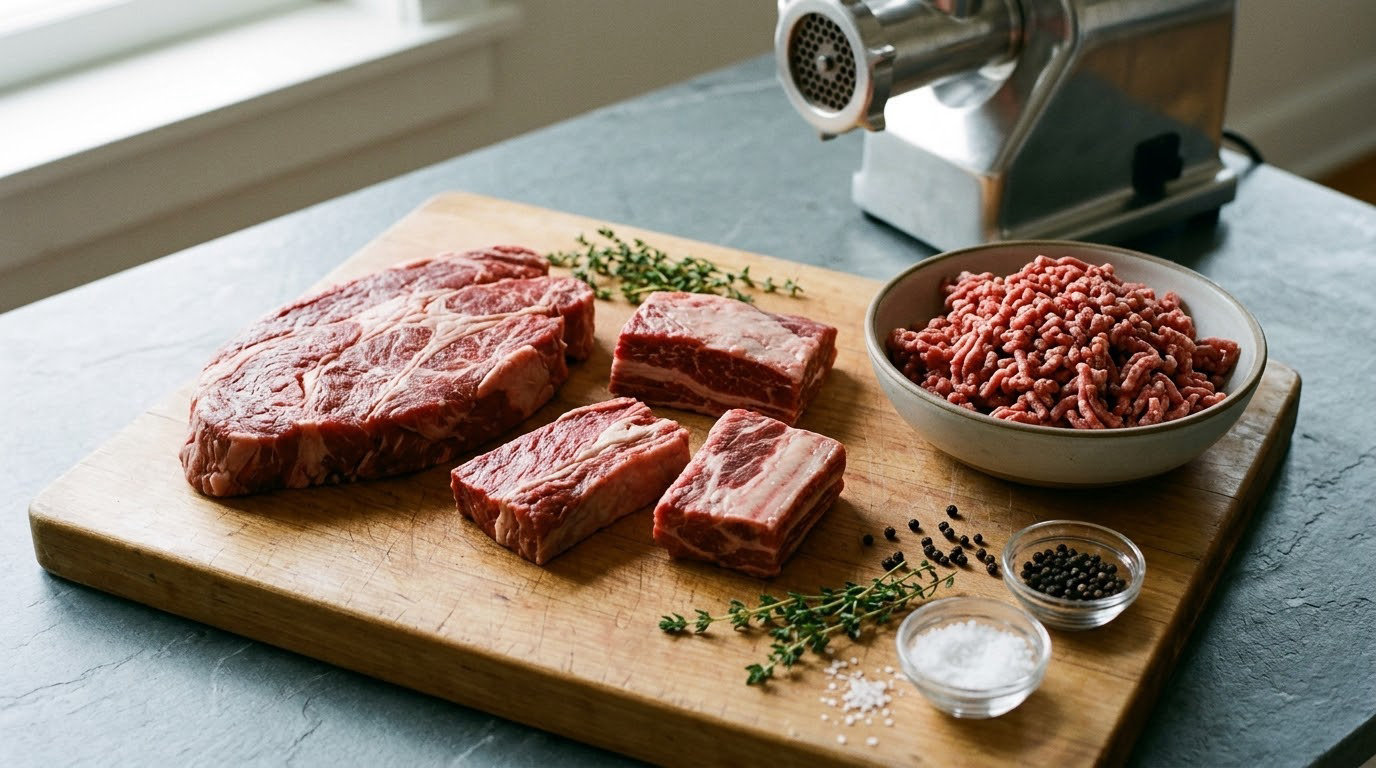
Chuck is the base cut most burger blends start with, ground to about 80/20, and everything else in the bowl is there to balance it. Brisket point brings a coarse steak-like chew, short rib brings fat and depth, and lean round or sirloin keeps the patty firm and the cost reasonable. That is the short answer to what cuts make the best burger blend.
The reason blends beat single cuts is simple. One cut forces you to choose between flavor and structure, and no single cut does both well. Chuck is delicious and fatty but soft enough that patties can slump. Round holds together beautifully and costs less, but on its own it eats like a hockey puck.
Home grinders on cooking forums keep arriving at the same three-cut trio, usually with a leaner fourth cut added. A common one is 70 percent brisket to 30 percent chuck, because straight brisket grinds too loose and wants to fall apart. The other camp skips the recipe entirely and grinds plain chuck with salt, pepper and granulated garlic, no blend at all.
Both camps are right, which is really the point. Read on for which cut plays which role, what fat percentage to target, and how to order the whole thing at the counter.
Table of Contents
- What Cuts Make the Best Burger Blend?
- How to Choose Cuts for Flavor, Fat, and Texture
- Which Beef Cuts Work Best in a Burger Blend?
- What Is the Best Chuck-to-Sirloin Ratio?
- Named Burger Blends by Style
- How Do You Build a Burger Blend for Different Cooking Methods?
- How to Order a Custom Blend at the Butcher Counter
- How to Grind Burger Meat at Home
- Why Your Burgers Fall Apart, Shrink, or Taste Greasy
- Frequently Asked Questions
- Conclusion
What Cuts Make the Best Burger Blend?
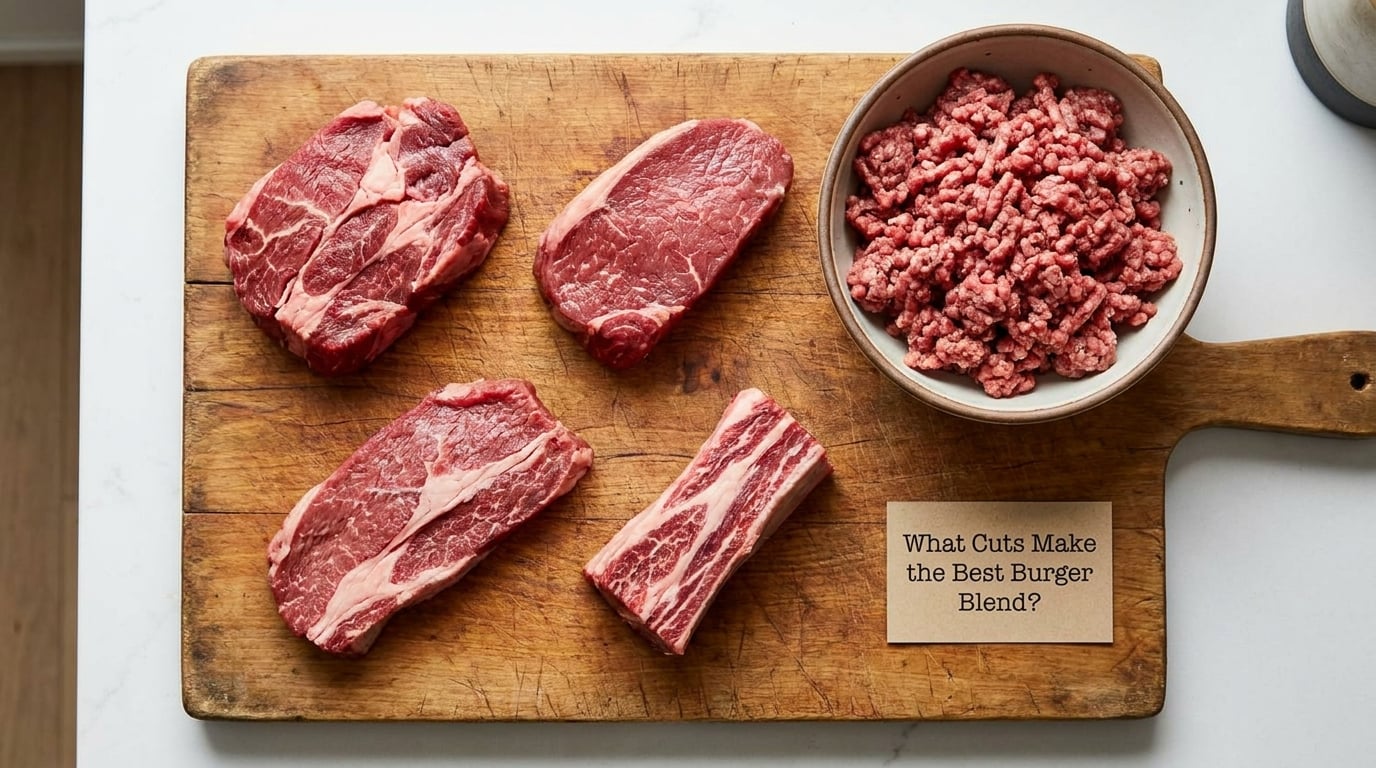
The best burger blend is fatty, well-muscled chuck at roughly 80/20 as the base, brightened with 20 to 30 percent ground brisket point for chew, and finished with lean round or sirloin for structure and to pull the fat back toward 20 percent. Skip the lean cut and the patty spreads. Skip the fatty cut and it dries out.
Think of a blend as three jobs rather than three cuts. One job is beefy flavor, which comes from muscle that has done work and carries connective tissue. Chuck, brisket, short rib and round all qualify; sirloin and tenderloin barely do. The second job is fat, which renders during cooking and bastes the meat from the inside. The third is lean meat, which gives the patty something to hold onto.
Fat percentage is the number most people are actually shopping for, and 80/20 is the anchor almost everybody lands on. Cook’s Country has put ground chuck ahead of ground sirloin, ground round and generic ground beef in blind tastings, which lines up with what butchers have always said. The video explainers that keep ranking for this question say the same thing: 80/20 is ideal, chuck is the gold standard, and brisket adds the chew.
Ground chuck and chuck are not the same product, by the way. Chuck is the cut, shoulder meat that is well worked and marbled through. Ground chuck is just chuck that has already been through a grinder, and in most cases coarsely ground. If you are buying pre-ground, look for a coarse grind, since fine ground chuck turns pasty on the counter and gives you a denser, more uniform patty.
How to Choose Cuts for Flavor, Fat, and Texture
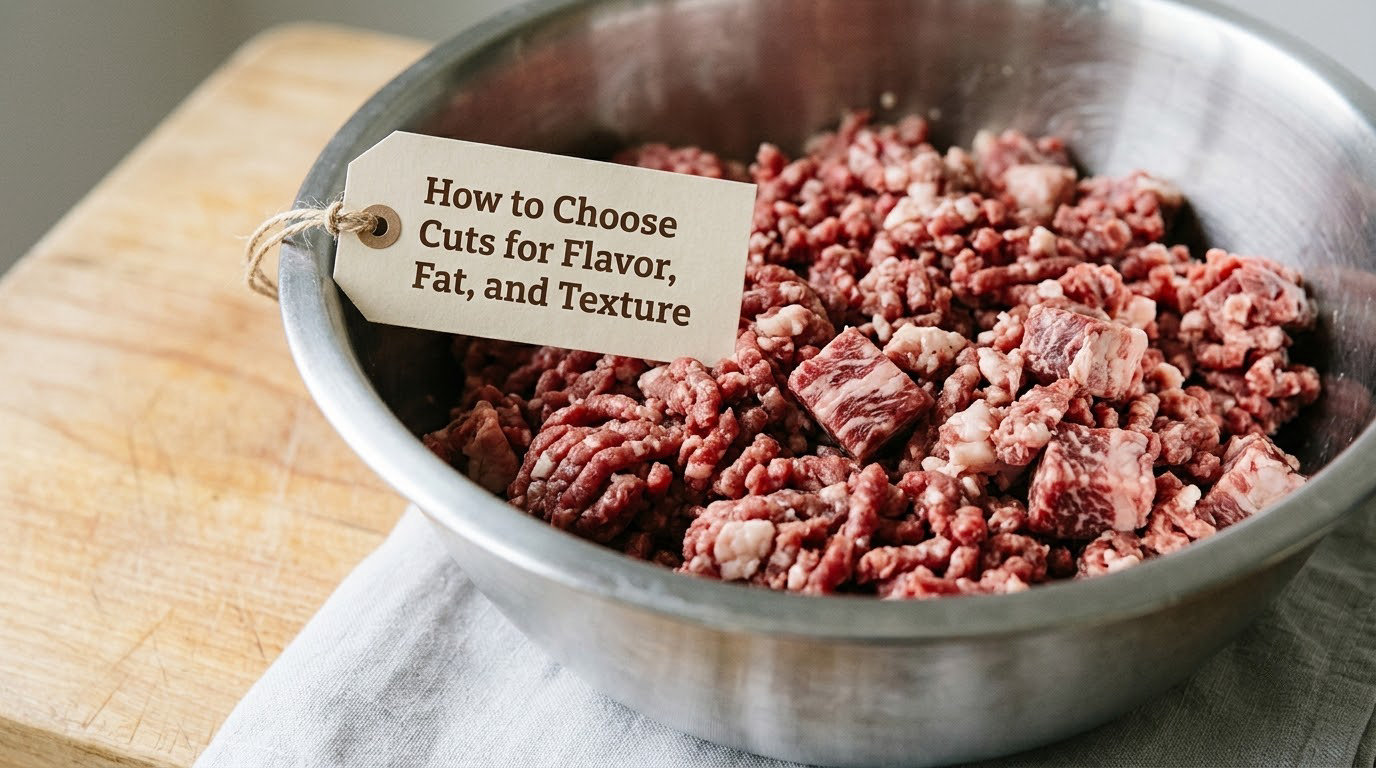
Four qualities decide whether a cut earns a place in the blend: beefy flavor, fat for juiciness, lean meat for structure, and chew. Every cut scores differently on those four, and once you can score a cut yourself you never need a blend recipe again.
Flavor tracks how much the muscle has worked. A cow’s shoulder, brisket and rump do the lifting, the pushing and the walking, so they build connective tissue and myoglobin, both of which taste like beef. The loin muscles along the spine do very little, so they taste mild and almost buttery. That is not bad, it is just a different job.
Fat decides juiciness and shrink. Fat renders at cooking temperature and carries flavor into the crust, and it also lubricates the bite. More fat means more shrink and more grease in the pan, which is why an over-rich patty can lose a third of its size before it hits the plate and leave a puddle behind.
Texture is the part most blends solve badly. A patty needs connective tissue to act like glue, and brisket and round carry more of it than sirloin. That is why brisket-forward blends hold together despite tasting lean, and why a sirloin-heavy patty crumbles the moment you flip it.
Price is the fifth variable and usually the one that decides the recipe. Chuck and brisket sit at the top of the range because they are in demand, while round, sirloin and flank sit well below. A blend that leans on the cheaper cuts and uses fatty chuck as the seasoning is the single most useful cost trick in burger-making.
Which Beef Cuts Work Best in a Burger Blend?
The table below covers the nine cuts that matter for burger work, what each one tastes like, how fatty it runs once trimmed sensibly, and the job you should give it. Fat figures are typical ranges for meat trimmed to about a quarter inch of external fat, not lab measurements, since the same cut varies a lot animal to animal.
| Cut | Flavor | Typical fat | Texture | Relative price | Best role in the blend |
|---|---|---|---|---|---|
| Chuck (shoulder) | Deep, beefy, the reference flavor | 15 to 20 percent | Coarse, loose, holds when cold | Moderate | The base, 60 to 80 percent of the mix |
| Shoulder clod | Beefy, slightly darker than chuck | 15 to 20 percent | Coarse and loose, similar to chuck | Moderate | Budget stand-in for chuck in big batches |
| Brisket point | Rich, smoky-potential, fatty | 15 to 20 percent trimmed | Coarse chew, excellent binder | Higher | Add 20 to 30 percent for chew and structure |
| Brisket flat | Clean and beefy, less rich | 8 to 12 percent | Tight grain, slightly dry on its own | Higher | Lean half of a brisket blend, needs fat added |
| Short rib | Rich, marrow-heavy depth | 20 to 30 percent raw | Fine strands, very tender | Moderate to higher | 5 to 15 percent for flavor and moisture |
| Sirloin | Mild, slightly sweet, silky | 8 to 12 percent | Fine, soft, low binder | Moderate | Lean counterweight to fatty cuts |
| Top round | Clean beef, lean | 8 to 12 percent | Fine and springy, great binder | Lower | Structure and cost, pair with plenty of fat |
| Bottom round | Clean and mild | 8 to 10 percent | Fine, firm, holds patties well | Lower | Bulk lean in cheap large-batch blends |
| Tri-tip (bottom sirloin) | Beefy and herb-friendly | 10 to 15 percent | Coarse grain, juicy | Moderate | Cheap flavor boost in place of chuck |
Chuck: the base cut most blends start with
Chuck is the default for a reason. It is well worked, deeply flavored, and it carries a good amount of intermuscular fat, the marbling that stays in the meat rather than sitting on the surface. Ground coarsely, it forms a patty that holds together cold and cooks to a deeply browned crust.
The only real complaint about chuck is that it is soft, which means a pure chuck patty can spread on a hot griddle. That is a fat and heat problem, not a cut problem, and a little lean round or sirloin fixes it in seconds.
Brisket point vs brisket flat: which half to ask for
Ask for the point half when you want chew and richness. The point is fattier and looser in grain, which makes it a great binder as well as a flavor source, and it grinds into a coarse texture that survives a hard sear.
The flat half is leaner and tighter, closer to a steak in grain. On its own it makes a drier burger, so if you buy the flat, add fat from another cut or grind it in with more chuck. A 50/50 point-and-flat request is a good middle path, and it is what many butchers will default to if you just say brisket.
Short rib: flavor and fat, trimmed hard
Short rib is the most intensely beefy cut on the list, but the version you want is not the one on the menu. Short rib arrives with a thick cap of external fat, and grinding that in gives you a greasy burger that shrinks badly. Ask the butcher to trim it to a quarter inch before grinding.
Use it sparingly. Five to fifteen percent of the blend adds depth and moisture that nothing else can match, and beyond that it starts to dominate.
Sirloin: the lean, silky add-in
Sirloin is the most misused cut in burger-making. It is mild, low in fat, and low in connective tissue, so it is a poor solo burger and a great counterweight. A fifth of the blend as sirloin pulls a fatty mix back toward the fat percentage you actually wanted.
People ask constantly whether you can mix sirloin and chuck. Of course you can, and it is the most common two-cut blend there is. What you cannot do is use sirloin alone and expect a juicy burger.
Round: cheap structure that needs fat
Top and bottom round are the cheapest real beef you can buy, and they grind into a fine, firm texture that holds a patty together better than anything else in the kitchen. They are also lean enough to taste dry on their own, which is exactly the reason they work in a blend.
The shrink problem is the one everybody runs into: a burger loses a large share of its original size and the fat pools in the pan. A lean round base with a modest amount of fatty chuck added for moisture and flavor is the way to fight that.
What cuts make the best burger blend by texture?
Match the blend to the bite you want. Tender and juicy comes from high fat and low connective tissue, so go 60/40 chuck and short rib or chuck and sirloin. Crisp-edged burgers want more fat and a coarse grind, so a fattier chuck blend sears harder.
Smoky and hearty patties need chew to stand up to smoke, so add brisket point, and leaner blends suit a tender chop. Burger-shop style patties that are thick, uniform and mild come from a fine-ground sirloin and round mix finished with cheese, which is the one place lean actually works.
Cook’s Country is the most-cited authority in this niche, and its verdict, ground chuck ahead of ground sirloin, ground round and generic ground beef, is the closest thing to an official answer. Read on for the ratio math.
What Is the Best Chuck-to-Sirloin Ratio?
Ground beef in the United States can be no more than 30 percent fat by law, which is why you will never see a 40/60 label on a package. Butcher-shop blends break past that line all the time, and that is fine, it is also why shop blends can taste richer than anything from the supermarket case.
The ratio ladder below covers what you will actually see, and how each one behaves in the pan. For chuck and sirloin specifically, 80/20 is where most people land, and 70/30 is the step up when you want a rougher, more decadent patty.
| Ratio | How it cooks | Best for |
|---|---|---|
| 90/10 | Cooks lean, shrinks less, needs a binder and a fatty topping | Lower-fat cooking, burgers topped with cheese or mayo |
| 85/15 | Firm, mild, still holds together well | Everyday patties you want to keep neat |
| 80/20 | Juicy, well browned, the standard | The default choice for almost everyone |
| 75/25 | Very juicy, noticeably more shrink | Rich, restaurant-style patties cooked on a griddle |
| 70/30 | Rich and loose, can spread on a hot pan | Smashed patties and low-and-slow smoke |
| 60/40 | Rich enough to taste almost braised | Smokehouse blends, where the long cook forgives softness |
Fat varies inside a single cut more than most people expect. Chuck from the shoulder end and chuck from the rib end do not grind identically, and a blend is only as even as its parts. A good rule is to cut the meat into similar-sized chunks before it goes in the grinder so everything renders at the same rate.
If your grind is too lean, the fix is fat, and the options are sirloin for a small addition, a fatty cut of chuck for a large one, or a small amount of pure beef fat or suet. One note worth heeding: adding pure fat before freezing can leave the grind rancid within about six months, so add fat close to when you plan to cook.
If your grind is too greasy, the fix is lean, and round or sirloin is what you want. Add it a few percent at a time and mix cold, because you cannot take fat back out once it is in the bowl. Draining visible fat from a package is a different matter, and it costs you flavor along with the grease.
Now for the question that keeps showing up in search. There is no 5/6/7 rule for burgers in any culinary school, food safety authority, or butcher trade guide, and no recognized fat ratio goes by that name. What you are usually landing on is a misremembered fat ratio, most often 80/20, or a confused reference to the five, six and seven things that make a good burger: good meat, the right fat, coarse grind, a hard sear, proper salt, a hot pan and a decent bun. The real numbers are 80 percent lean to 20 percent fat.
Named Burger Blends by Style
These are the blends worth committing to memory. Each one is a specific ratio of named cuts, and each solves a different problem.
| Style | Cuts and ratio | Result | Best for |
|---|---|---|---|
| Classic | 80 percent chuck, 20 percent sirloin | Juicy, balanced, holds together | The reliable everyday burger |
| Brisket-forward | 70 percent brisket point, 30 percent chuck | Coarse chew, firm patty, big flavor | Thick grilled patties that need structure |
| Smokehouse | 60 percent chuck, 30 percent brisket point, 10 percent short rib | Rich, soft, smoke-friendly | Low-and-slow cooking |
| Lean | 90 percent sirloin, 10 percent chuck | Firm, mild, less shrink | Cheese or sauce carries the richness |
| Smash | 85 percent chuck, 15 percent short rib, fine to medium grind | Craggy edges, maximum crust | Thin patties on a ripping hot flat-top |
| Butcher trio | 60 percent chuck, 20 percent brisket point, 20 percent short rib | Layered depth, very beefy | Cookouts where you want it to taste special |
| Cheap and juicy | 50 percent bottom round, 30 percent sirloin, 20 percent fatty chuck | Firm bulk lifted by fat and flavor | Large batches without the premium cut cost |
That last row is the one to remember if you cook for a crowd. Buy the lean cheap cuts for bulk, then use the fatty cut the way you would use seasoning. Plenty of cooks insist plain chuck with salt, pepper and granulated garlic makes the best burger there is, and the logic carries over: the fatty cut supplies flavor, the lean cut supplies shape.
On the celebrity question, Gordon Ramsay’s published burger blends run on the fatty side of ordinary, typically a chuck-forward mix with brisket in the bowl, and the popular takeaway is that he calls for a high-fat, coarse blend seared hard. The takeaway is right even when the exact numbers float around, which is a good reminder to trust the ratio logic over the name attached to it.
How Do You Build a Burger Blend for Different Cooking Methods?
The same blend behaves differently depending on heat, time and surface, so match fat and firmness to the method rather than picking one recipe for everything.
| Method | What the blend needs | Notes |
|---|---|---|
| Cast iron or flat-top griddle | 80/20 to 70/30, coarse grind | Fat is what makes the crust, keep the heat high and press once |
| Gas or charcoal grill | 80/20 with brisket for chew | Keep a cooler zone, or the fat renders before the center cooks |
| Smash burger | Higher fat, finer grind, thin patties | Fat must hit the pan as fat, not as clumps, to crisp the edges |
| Low-and-slow smoke | 70/30 or richer, texture matters less | Long cook forgives soft patties, avoid very lean mixes |
| Skillet or pan | 80/20, moderate weight | Butter in the pan or a cheese on top makes lean blends work |
Richness also decides what you put on the patty. A 70/30 blend needs almost nothing on it, maybe salt and a thin sauce. A lean 90/10 blend needs fat from somewhere, so add cheese, mayonnaise, or an egg and breadcrumbs as a binder, which is how poultry and lean blends are usually kept together.
Seasoning works best in two places. Salt and pepper go into the meat lightly so they season all the way through, and a coarse salt goes on the surface right before the sear for crust. What goes inside is a matter of taste, but the mixing is the same: handle the meat gently and stop as soon as it looks combined.
How to Order a Custom Blend at the Butcher Counter
Most people freeze at the counter because they do not know what to say. Ask for the fat level and the cuts by name, and the conversation gets much shorter.
Walk up and say something like: I would like two pounds for burger patties, 80 percent chuck and 20 percent sirloin, coarsely ground, fat trimmed to about a quarter inch. Ask what fat percentage their ground chuck runs and whether they will mix in a little brisket point for chew. Request a short rib addition by weight, and ask them to trim it first.
A few details worth pushing for. Keep the meat cold from the counter to the fridge, and if you are driving more than twenty minutes, bring a cooler. If they do not grind in store, buy the meat in chunks and decide about grinding yourself. And if they do grind, ask them to grind it coarse and to mix the batches together afterward, because two blended parts ground separately will not be one even mix.
One last point on pre-ground versus grind-in-store. Supermarket ground beef is fine for weeknight patties and it is consistent, which some people prefer. It is also uniform, meaning you get the same texture every time and no control over the ratio. A grinder at home is a small one-time cost and it opens up every blend on this page.
How to Grind Burger Meat at Home
Grinding is less intimidating than it looks. The whole job is six steps and about fifteen minutes.
Chill the meat first. Part-freeze the chunks for twenty to thirty minutes until they are firm but not solid, and put the grinder parts in the freezer while you wait. Cold meat grinds clean instead of smearing. Trim as you go, and pull any silver skin or thick seams, because connective tissue you do not want is hard to remove after grinding. Pick a coarse plate, roughly a quarter inch, since fine grind is for sausage and makes dense, uniform patties.
One pass is usually right for a coarse burger grind, with a second light pass only if you want a finer texture. Feed it slowly and let the grinder do the work, because pushing too hard heats the meat and you end up with a pasty texture. Keep it cold by grinding in small batches and returning the finished meat to the fridge. Then rest the ground meat in the fridge for 20 to 30 minutes before forming patties, since cold meat shapes cleanly and warm meat sticks to your hands.
For batching, buy about three-quarters to one pound of raw meat per person, which yields a generous cooked portion. Form patties and freeze them in single layers, or freeze the ground meat in loose balls so you can portion later. Patties freeze flatter and cook more evenly than a solid frozen block.
On safety, grinding spreads surface bacteria through the whole batch, which is why ground beef cannot be eaten rare the way a steak can. The USDA safe minimum internal temperature for ground beef is 160 degrees Fahrenheit, or 71 degrees Celsius, measured in the thickest part of the patty with a thermometer.
Why Your Burgers Fall Apart, Shrink, or Taste Greasy
Nearly every bad burger traces back to fat, binder or handling. Here is the symptom list.
| Symptom | Likely cause | Fix |
|---|---|---|
| Patty falls apart when flipped | Too lean, or the meat was overworked | Add 10 percent more fatty cut, mix gently, chill before forming |
| Patty is greasy or pools fat | Too much fat, or an untrimmed cap ground in | Add lean round or sirloin a few percent at a time |
| Patty tastes dry | Over 90 percent lean, or cooked too far past done | Raise fat to 80/20, pull it at 160 degrees, add cheese or sauce |
| Patty shrinks dramatically | Fat above 25 percent plus high heat | Lower the fat and use a gentler finish |
| Burger tastes waxy or dull | Ground too fine and worked too long | Use a coarse plate, one pass, minimal handling |
Overworking is the silent one. Mixing the meat until it feels sticky and pasty squeezes out the air, tightens the proteins, and gives you a dense, rubbery patty that still dries out anyway. Mix until it looks combined, then stop.
Frequently Asked Questions
Is 80/20 the best fat ratio for burgers?
For most home cooks, yes. An 80 percent lean to 20 percent fat blend gives you the juiciness and crust people associate with a good burger without the grease and shrink of a fattier mix. Go richer for smash patties and low-and-slow cooking, and leaner only when cheese, mayonnaise or a binder is adding fat and structure on top.
What is the 5 6 7 rule for burgers?
There is no recognized 5/6/7 rule for burgers in any culinary school, food safety authority, or butcher guide. What usually appears is a garbled reference to an 80/20 fat ratio, or a list of the things that matter: good meat, the right fat, a coarse grind, a hard sear, salt applied at the right time, a hot pan and a decent bun. The real number to remember is 80/20.
What is Gordon Ramsay’s best burger meat blend?
His published burger blends are fatty and coarse, usually a chuck-forward mix with brisket added for chew and structure, seared hard on a very hot pan. The exact percentages float around between sources, so the reliable part is the logic: high fat for crust, brisket for chew, and a short cook. That is the same reasoning behind the 80/20 chuck and brisket blend in this guide.
Should I trim the fat cap before grinding burger meat?
Trim the thick external caps, yes, and leave the intermuscular marbling alone. A heavy fat cap ground into the mix gives a greasy burger that shrinks badly, while the fat inside the muscle is what keeps the patty juicy. Ask your butcher to trim to about a quarter inch, which removes the cap without stripping the meat.
Can you drain the fat from 80/20 ground beef?
You can, but you lose flavor with the grease, and 80/20 is already balanced. Draining works best if the ground beef was stored in a cold shape and you lift the solid fat from the top rather than straining everything through a sieve. If you want less fat, adjust the blend instead, using more round or sirloin in the mix.
What internal temperature should ground beef reach?
The USDA safe minimum internal temperature for ground beef is 160 degrees Fahrenheit, or 71 degrees Celsius, measured in the thickest part of the patty. Grinding spreads surface bacteria through the whole batch, so unlike a steak, ground beef is not safe to eat rare. Rest the patties a few minutes after cooking so the juices settle before you serve them.
Conclusion
Start with 80 percent chuck and 20 percent sirloin, coarsely ground, and cook it hot with a coarse salt on the surface just before the sear. That one blend teaches you what fat does, and everything after that is a small adjustment: add brisket point for chew, add short rib for depth, or lean it out with round when you are cooking a big batch on a budget.
If you take one thing from what cuts make the best burger blend, take this: pick the fatty, well-worked cut as your base and the lean cut as your support. Chuck, brisket and short rib are the flavor, and round or sirloin is the structure that keeps the patty honest.