
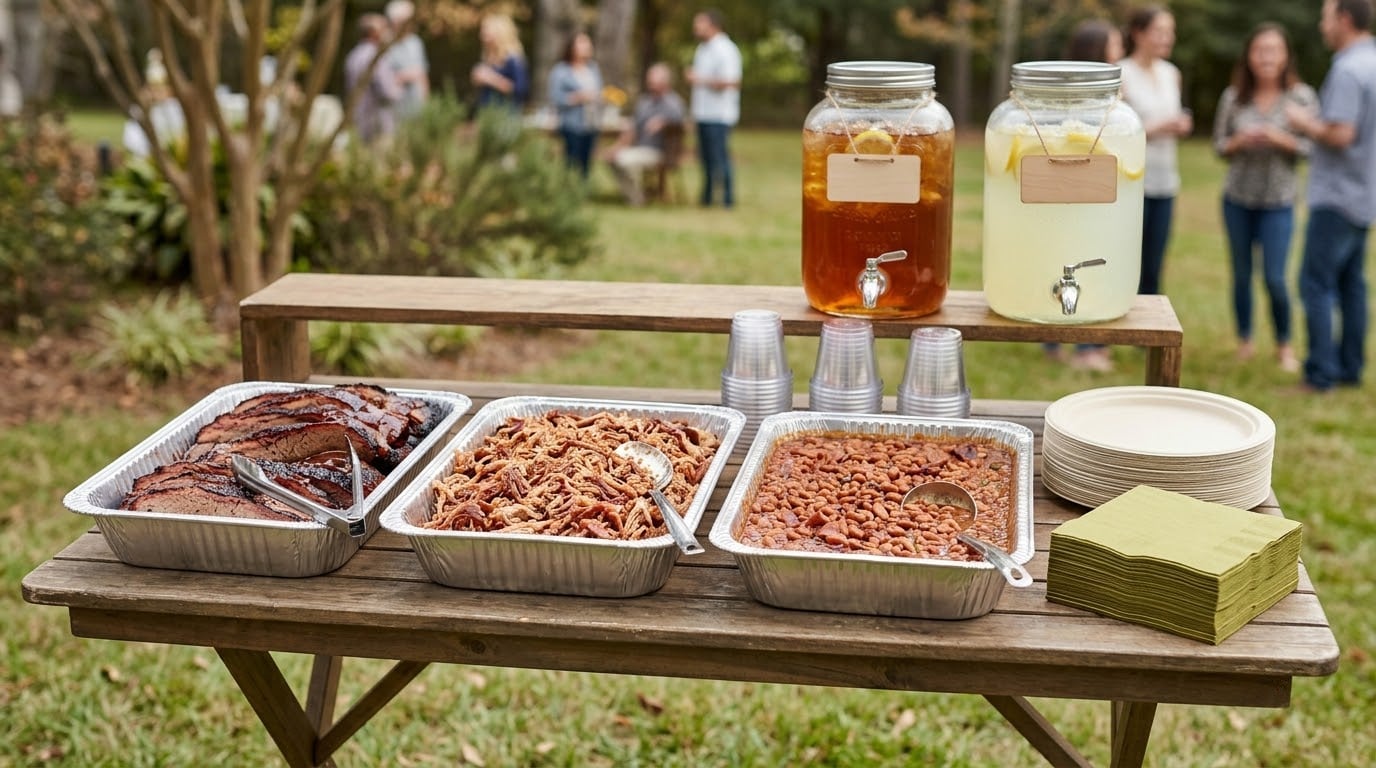
Most hosts pay $14 to $30 per guest for a standard two-meat BBQ buffet with sides, $10 to $16 per guest for drop-off service, and $35 to $60 or more per guest for plated meals or premium cuts. These are typical US ranges, and they shift with your region, guest count, menu, and how much service you want. Here is how the number is built, so you can budget before you call a single vendor.
One thing worth knowing up front: the per-guest price you see advertised rarely equals the number on the final invoice. Delivery, service charges, gratuity, rentals, and tax all sit on top. Budget with the extras included from the start and you will not be surprised in week two.
Table of Contents
- How Much Does It Cost to Cater a BBQ?
- What Affects the Price?
- Ways to Save on a BBQ Catering Bill
- Frequently Asked Questions
- Is 10 lbs of meat enough for 30 people?
- How much will it cost to feed 40 guests with BBQ catering?
- How much is buffet catering for 150 people?
- What is the cheapest food to cater a party?
- How much should I tip a BBQ caterer, and what gets billed extra?
- How do I keep BBQ food safe when I pick it up or serve it myself?
- Bottom Line
How Much Does It Cost to Cater a BBQ?
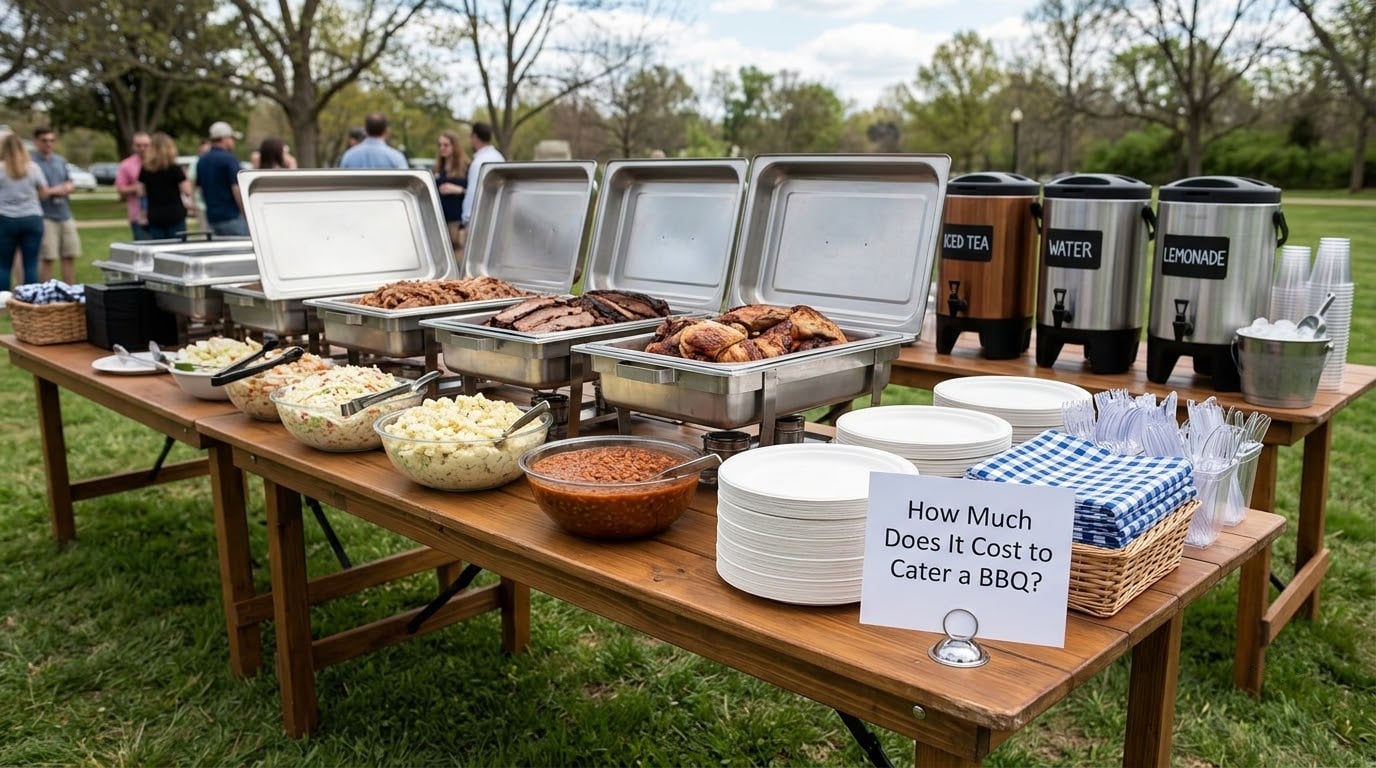
The fastest way to compare quotes is per guest, not per package. Two vendors quoting $380 and $520 for the same party are only meaningfully different if you know how many people each feed.
How much BBQ catering costs per person
| Service level | Typical cost per guest | What you get |
|---|---|---|
| Pickup or drop-off trays | $10 to $16 | Meat and sides in half pans, paper or plastic ware, no staff |
| Staffed buffet | $14 to $30 | Two or three meats, three or four sides, servers, chafers, setup and cleanup |
| Full service with a carving station | $25 to $40 | On-site smoker, carved-to-order brisket, servers, cleanup |
| Plated service | $35 to $60+ | Seated courses, servers clearing tables, often rentals included |
Sides sit at roughly $0.30 to $0.85 a serving, and consumables like plates, napkins, cups, and gloves add about $1.10 a guest on top of the food. A vendor quoting $18 per person for a buffet is spending a few dollars on food, a few on labor and consumables, and carrying margin for the rest.
If you need exact numbers for a burger-forward menu, our How Much Meat per Burger Patty? Size Guide covers raw-to-cooked weights the same way.
What should I budget for 40, 50, or 100 guests?
Read the row for your headcount. The low tier is a two-meat drop-off, the mid tier is a staffed buffet, and the high tier adds premium cuts, a carving station, or plated service.
| Guests | Low tier | Mid tier | High tier |
|---|---|---|---|
| 10 | $120 to $200 | $180 to $300 | $350 to $600 |
| 20 | $200 to $320 | $320 to $500 | $700 to $1,200 |
| 25 | $250 to $400 | $400 to $625 | $875 to $1,500 |
| 40 | $400 to $640 | $640 to $1,000 | $1,400 to $2,400 |
| 50 | $500 to $800 | $800 to $1,250 | $1,750 to $3,000 |
| 75 | $750 to $1,200 | $1,200 to $1,875 | $2,600 to $4,500 |
| 100 | $1,000 to $1,600 | $1,600 to $2,500 | $3,500 to $6,000 |
| 150 | $1,500 to $2,400 | $2,400 to $3,750 | $5,200 to $9,000 |
Small events carry the worst per-guest rate, and that is not the vendor gouging you. One Texas caterer lists a drop-off plate at $16.46 a person, but a six-person package works out to $20.00 each. A delivery minimum around $100 and a delivery fee near $25 mean a 10-guest order is really a 15-guest order with the difference thrown away. Below 25 guests, grocery-store trays or a home cook usually beat a caterer on price.
What each meat costs and what it does to the bill
Meat is the largest line item and the one most hosts misjudge. Buy raw, serve cooked, and the gap is big. Brisket can lose a third of its weight to trim, and pulled pork can lose closer to half, so raw = cooked divided by 0.60, then rounded up to whole packages. That math is why a quote that looks cheap on paper lands higher on the invoice, and it is also why burgers shrink so much on the grill.
| Meat | Rough price per raw pound | Typical cook loss | Cooked pounds per 100 guests | Cost contribution per guest |
|---|---|---|---|---|
| Pork shoulder for pulled pork | $2.00 to $2.60 | 40% to 50% | 50 to 60 | $2.00 to $2.75 |
| Chicken quarters | $1.40 to $2.00 | 25% to 30% | 80 to 90 | $1.20 to $1.75 |
| Brisket | $5.00 to $8.00 | 30% to 35% | 70 to 80 | $4.50 to $7.00 |
| Sausage | $3.00 to $4.50 | 20% to 25% | 90 to 100 | $2.75 to $4.00 |
| Pork ribs | $4.50 to $7.00 | 30% to 35% | 60 to 70 | $4.00 to $6.00 |
Chicken and pulled pork are the budget anchors. Brisket and ribs are the line items that quietly double a per-guest price, and they are why a plated wedding quote can run past $300 a head while a neighbor’s backyard cook-up costs a fraction of that.
How much barbecue to buy per person
| Guest type | Meat per person, cooked | Note |
|---|---|---|
| Average adult, buffet line | 1/3 to 1/2 lb | Most vendors plan on 1/3 lb and hope nobody takes seconds twice |
| Heavy eater or big men at the table | 1/2 to 3/4 lb | The group that quietly wrecks a portion estimate |
| Children | 1/4 to 1/3 lb | Plan on two or three sides per child, not four |
| Buffet with a staffed carver | 1/2 to 3/4 lb | A carving station ports on what it weighs, so size up |
Sides land at about a third of a pound per guest, so three sides for 50 people means roughly 50 pounds of mac and cheese, 50 pounds of coleslaw, and 50 pounds of baked beans before the potato salad. Desserts usually add $2 to $4 a guest, and that is a flat add-on, not a rounding error.
A worked example: 50 guests, staffed buffet, two meats
Take 50 guests and a brisket-plus-pulled-pork menu. At half a pound of cooked meat each, that is 25 cooked pounds per meat, or roughly 36 raw pounds of brisket and about 45 raw pounds of pork once you divide by yield and round to whole pieces.
Multiply: brisket at $6.50 a pound on 36 pounds is $234, pork at $2.40 on 45 pounds is $108, so meat lands near $342. Add four sides at $0.55 a serving, about $110. Add consumables at $1.10 a guest, $55. Total food and supply cost lands around $507, or just over $10 a guest.
Now add what the vendor carries: about 12 labor hours at $22, roughly $264 in labor. Add fuel and wood, insurance, mileage, card processing, and rentals for chafers, fuel bottles, tables, and serving pans. Land on a 30% margin and the quote lands somewhere in the $16 to $22 per person range, which matches what advertised mid-tier quotes look like. You can redo this arithmetic for your own headcount and menu, and it is the fastest way to spot a quote that is padded or one that is too thin to feed people.
What Affects the Price?
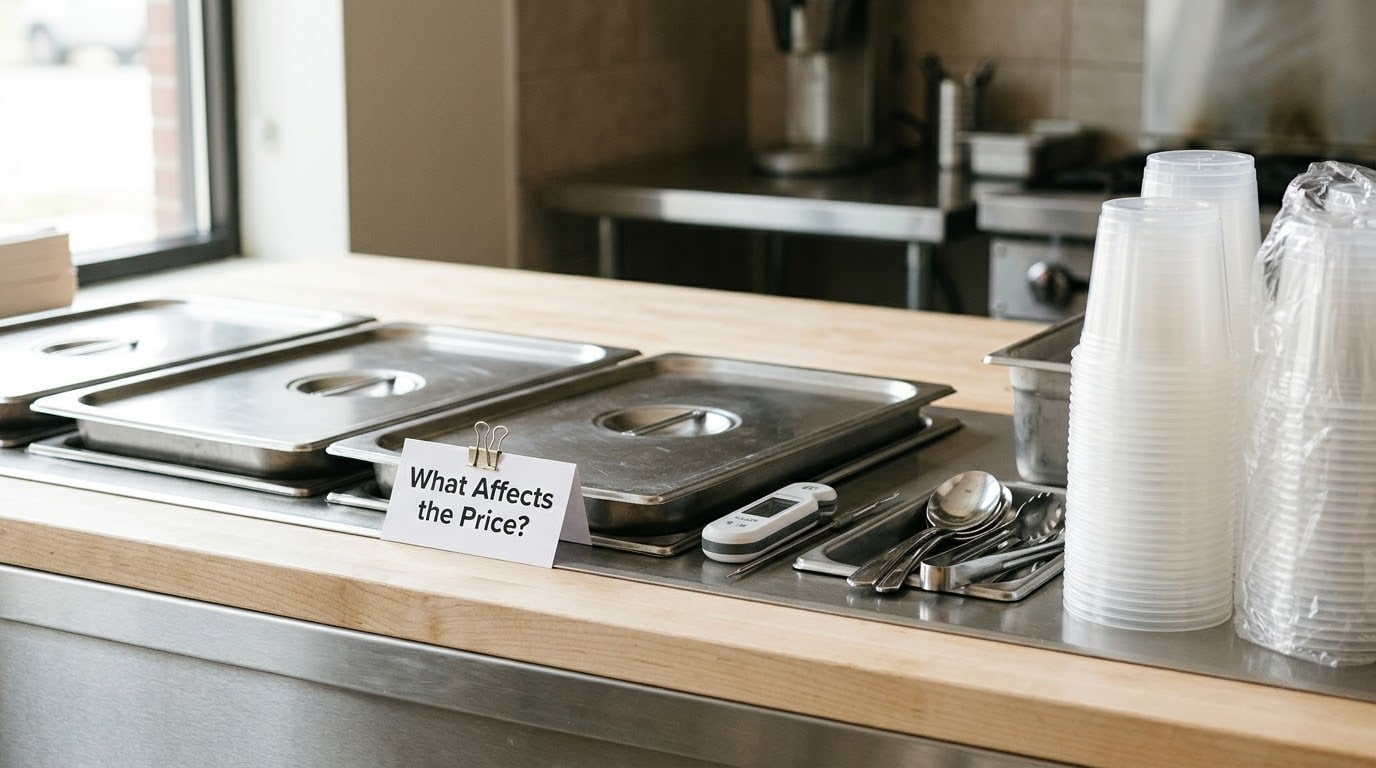
Guest count drives everything else, and the relationship is not linear. A vendor has to staff the job, fire the pit, and make the trip whether you feed 20 people or 200, so the fixed costs spread thinner as the headcount grows. That is why 150 guests often costs fewer dollars per head than 40.
Region matters as much as the menu. The same two-meat buffet that a Texas pit quotes in the mid-teens can run well past $30 a head in a high-cost coastal market or an upscale wedding suburb. Carolina-style shops tend to sit at the low end, and areas with heavy restaurant labor and high rent sit higher. If you get a quote that seems out of line, ask two more vendors in your own market before assuming the number is wrong.
Menu style sets the ceiling. Smoked chicken, sausage, and pulled pork keep costs low. Brisket, ribs, and a carved station push them up fast, and a plated menu with servers and rentals adds again. On-site smoking looks impressive and is one of the most expensive options, because the rig travels, gets fueled, and the crew stays longer.
Then there is the quiet stuff. Rentals for tables, linens, chafers, fuel, and tenting can be $5 to $15 a guest or a flat $300 to $800 depending on the order. Delivery is often a flat $25 to $150 with a minimum spend. Service charges commonly run 18% to 22% of the food subtotal, and gratuity is often calculated after that service charge, which is how a quiet 18% becomes closer to 22% on the real bill. Sales tax adds a final layer depending on the state.
| Usually included in the per-guest price | Usually billed extra |
|---|---|
| Meat and sides in the advertised quantities | Delivery and travel fees |
| Basic paper or plastic ware | Service charge of 18% to 22% |
| Setup, chafers, and cleanup at the site | Gratuity |
| Standard condiment bar | Tables, linens, tenting, beverage service |
| Standard side and roll quantities | Extra pans of sides, dessert, and premium cut upgrades |
| Delivery within the published radius | Sales tax, card processing, overage past the headcount deadline |
Alcohol is its own line. Beer, wine, and a bar server typically come at $6 to $15 a guest, and many venues require licensed bartenders and insurance, which some caterers will not provide at all. If you plan to serve drinks, ask whether your caterer is permitted to pour or whether you need a separate licensed service.
Duration sneaks into the bill. An event that runs three hours is a different job than one that runs six, and servers usually bill a minimum of four to five hours. A late drop-off that has to sit hot for an extra hour may also add a fee, so agree on the delivery window and the pick-up time in the contract.
Dietary needs can move the whole quote. A gluten-free or vegan guest often means a separate cook, separate pans, and separate service utensils rather than a substitution, and some vendors price that as a per-person surcharge. Ask early; a gluten-free guest discovered the morning of the event is an expensive problem.
If you are weighing catering against doing it yourself, the break-even usually lands around 30 to 40 guests. Below that, a grocery run plus pans and ice usually beats a quote once rentals and delivery are added. Above 40, catering takes over, mostly because the pit time, the fuel, and the day of cleanup add up fast. Pitmasters who post their numbers on BBQ Brethren use a simple rule: triple your food cost to find a fair per-head price, which lands near $12 a head for two meats and two sides at quarter-pound portions. Vendor prices run higher because that figure covers labor, overhead, and margin, not just the smoker.
Food safety, whether you hire or handle it
Whoever holds the food, the rules are the same. Keep hot food at 140°F or above and cold food at 40°F or below, and use a thermometer rather than guessing. Cook poultry to 165°F, ground meats to 160°F, and whole cuts and fish to 145°F.
Leave the meat in the danger zone, 40°F to 140°F, for no more than two hours, and one hour if the day is above 90°F. If you are picking trays up early, refrigerate anything you are not serving within two hours, and read our How Long Does Ground Beef Last in the Fridge? guide before the event day. The cost of throwing out a tray is always higher than the cost of a cooler.
Ways to Save on a BBQ Catering Bill
Start with drop-off. Moving from a staffed buffet to trays delivered and set up drops the per-guest rate by several dollars because you lose the servers, the chafers, and much of the setup labor. If the venue has staff who can manage the line, most hosts never miss the difference.
Cut meats, not sides. Dropping from three meats to two is a real saving, maybe $2 to $4 a guest. Dropping a side usually costs less, and sides are what people remember the next day. Keep mac and cheese, coleslaw, and baked beans; consider dropping the potato salad if someone already offered to bring a dish.
Bring your own drinks. Self-serve sodas and water from a store run for a fraction of a per-guest beverage charge, and cold-pressed lemonade or sweet tea in dispensers is a step up for a small outlay. If alcohol is involved, weigh the venue’s rules before assuming you can save anything.
Rent only what gets used. One catering order can include tables, linens, tenting, chafers, fuel, and serving pans you never touch. Ask for an itemized rental list and cut the pieces the venue or the caterer already provides. For a backyard event, folding tables and a trash can usually do the work of a full rental package.
Get the fee list in writing before you sign. Ask what the delivery fee is, whether a travel fee applies to your address, what the service charge percentage is, whether gratuity is added automatically, and what cleanup covers. A contract that states a final headcount deadline and a per-person rate is the one thing worth negotiating for, because it locks the number you care about.
Ask for the per-person floor and the small-package tier. Vendors price by package, and a 15-person party is often cheaper as a package plus a few extra pans than as a scaled-down quote. It also helps to say out loud which line items you would drop: the carving station, the second side, the premium cut. Most vendors will reshape the quote rather than lose the job.
Finally, order the right amount. Plan portions at 1/3 to 1/2 pound per adult, add about 10% for a buffet where nobody portions the meat, and set your headcount deadline about a week out. Servers have a rule of thumb worth keeping: a 100-headcount job frequently serves 115 plates. That extra 15% is not waste, it is the difference between a comfortable line and an empty tray at 7pm.
Frequently Asked Questions
Is 10 lbs of meat enough for 30 people?
Not if those are cooked pounds. At a third of a pound per adult, 30 adults need about 10 cooked pounds, and 10 raw pounds yield roughly 6 to 7 cooked pounds after trim and cook loss. Plan on 14 to 15 raw pounds for 30 adults, and add about 10% for a buffet line where nobody is portioning the meat. Kids need closer to a quarter pound each.
How much will it cost to feed 40 guests with BBQ catering?
Most hosts pay between $640 and $1,000 for a staffed two-meat buffet for 40 people, or about $16 to $25 each. A drop-off order for the same group runs $400 to $640, and a plated or premium-cut menu with a carving station can reach $1,400 to $2,400. Add delivery, service charges of 18% to 22%, gratuity, and rentals, which together can add 25% or more to the food subtotal.
How much is buffet catering for 150 people?
Expect $1,500 to $2,400 for drop-off trays, $2,400 to $3,750 for a standard staffed buffet, and $5,200 to $9,000 for plated service or premium cuts at a larger event. Prices at this headcount are per guest lower than at 25 or 40 because fixed costs like staffing, fuel, and travel spread across more plates. A carving station and on-site smoker add the most at this size.
What is the cheapest food to cater a party?
Pulled pork, smoked chicken, and sausage are the cheapest real BBQ proteins, while brisket and ribs cost the most per guest. Potato salad, coleslaw, and baked beans are cheaper sides than prepared mac and cheese, and sweet tea or lemonade costs less than a bottled beverage package. Skipping the service tier matters more than the menu: drop-off instead of staffed buffet is usually the single largest saving available.
How much should I tip a BBQ caterer, and what gets billed extra?
Many contracts add an 18% to 22% service charge and then a gratuity on top of it, so check whether gratuity is already included before adding anything. If it is not stated, 15% to 20% of the food subtotal is a normal range. Delivery, travel, rentals, extra pans, dessert, and sales tax are almost never in the advertised per-guest price, which is where surprise costs usually live.
How do I keep BBQ food safe when I pick it up or serve it myself?
Keep hot food at 140°F or above and cold food at 40°F or below, and use a thermometer instead of guessing. Cook poultry to 165°F, ground meats to 160°F, and whole cuts and fish to 145°F. Do not leave food between 40°F and 140°F for more than two hours, or one hour above 90°F. If you collect trays early, get them into a cooler or refrigerator within that window.
Bottom Line
Decide the guest count and the service tier first, since those two choices move the price more than anything on the menu. Then get a per-guest quote that states in writing what it includes, and add a 25% cushion for delivery, service charges, gratuity, rentals, and tax before you commit. If the number still stings, drop the service tier and the carving station before you drop the food.