
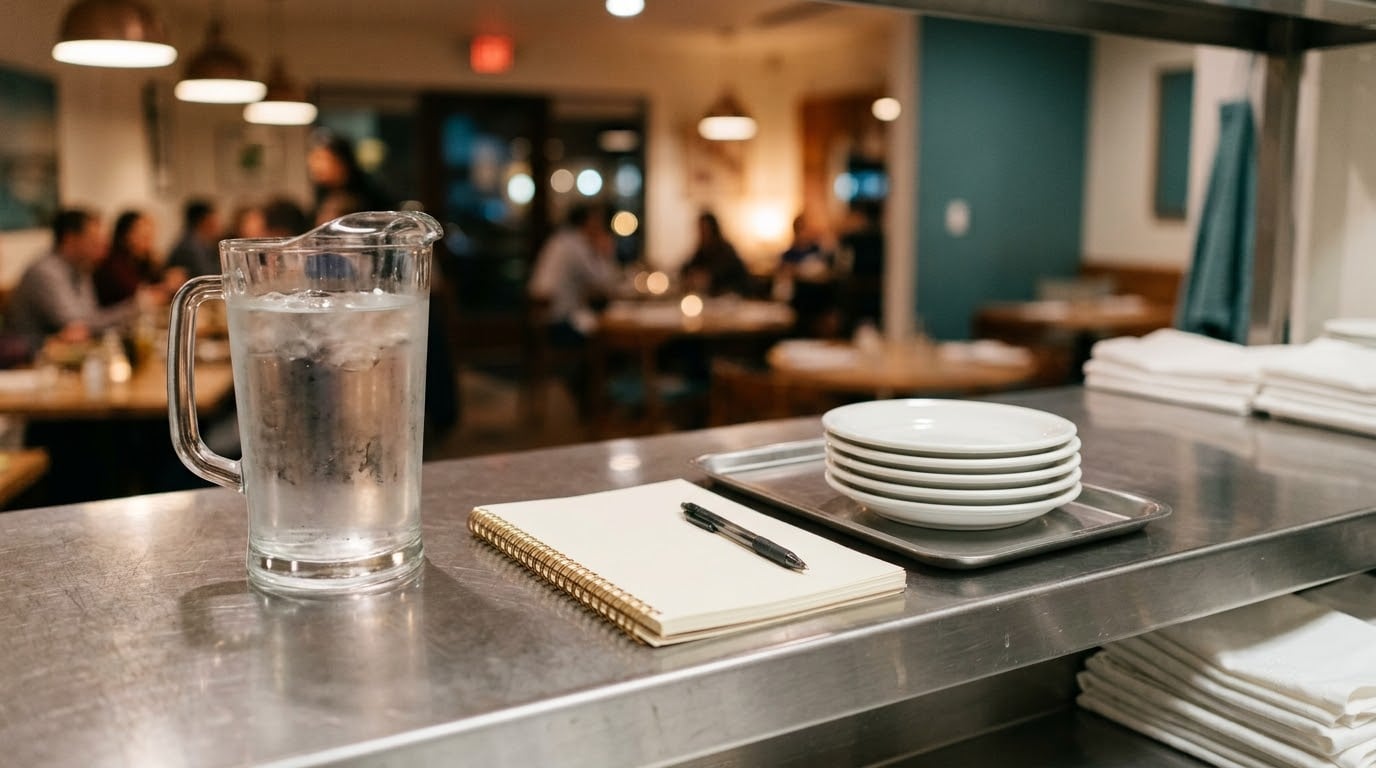
A good server makes the meal happen without the guest ever having to ask for it. You greet people fast and warmly, you know the menu well enough to recommend honestly, and you refill the water before the glass empties. Everything below is how to be a good server in a restaurant, from the pre-shift prep through closing the check.
None of it is talent. It is a sequence of small, learnable moves, and the ones that matter most are the least glamorous: writing the order down, repeating it back, clearing every plate before the next course lands, and never making a guest hunt you down.
I have watched new servers lose tables over things they had no idea were costing them. A guest waited eight minutes for a water refill and never said a word about it, then tipped 12 percent. Another server misheard “no onions” as “no onion slices,” and the guest never came back. Nobody files a complaint about a server who was never there.
So this guide walks through a full shift in order, tells you what good looks like at each step, and finishes with the mistakes that quietly separate the servers who get big tips from the ones who wonder why they do not. A note on wording: here, a server means the restaurant role. Same as a waiter or waitress.
Table of Contents
- What You Need
- Step-by-Step: How to Be a Good Server
- Step 1: Prepare Before the Shift
- Step 2: Greet Guests Warmly and Promptly
- Step 3: Read the Table Without Being Intrusive
- Step 4: Explain the Menu Clearly
- Step 5: Take and Repeat Orders Accurately
- Step 6: Keep the Table Updated
- Step 7: Handle Requests and Problems Calmly
- Step 8: Close the Meal Smoothly
- Step 9: Reset and Reflect After the Shift
- Common Mistakes
- Interrupting a conversation to check in
- Assuming the order instead of asking
- Memorizing orders instead of writing them down
- Disappearing mid-meal
- Leaving an empty water glass on the table
- Squatting beside a table
- Dodging the check
- Over-apologizing and blaming the kitchen
- Wording that puts you on their side
- Pressure upselling
- Telling a guest it is not your section
- Frequently Asked Questions
- What to Do First on Your Next Shift
What You Need
Knowing how to be a good server starts before the door opens. You are not learning to be charming at full volume. You are learning a set of procedures well enough that they run without thinking, which frees up the part of your attention that actually reads people.
Menu and 86 knowledge
Read the menu the day before, not during the rush. Know the ten dishes that sell fastest and the three that people most often send back. Learn what was 86’d tonight, because the board changes at four o’clock and a guest who orders a special you did not realize was gone gets an answer you should have had ready.
Also know how the kitchen builds each dish. Whether the fries are baked or fried, whether the sauce contains dairy, whether the burger is finished with butter. Those three facts answer most questions a table will ask you.
Allergen and dietary notes
Servers get taken to trust with allergies, and a wrong answer there is a serious problem rather than an awkward one. Know which dishes are vegetarian, vegan, or gluten-free by design rather than by substitution, and know where cross-contact happens. The shared fryer, the toaster, the cutting board, the same spoon in the gravy are the real answers.
When you are not sure, the right move is to go find out. Say that you will check with the kitchen rather than guessing. Guests forgive a thirty-second delay; they do not forgive a confident wrong answer.
A working order pad and a pen
Guests can see when you write things down, and they trust you more for it. A pad with a pen attached, plus a spare in your apron, is not optional equipment. So are reading glasses in dark dining rooms where the menu type is small. That single habit saves the awkward lean across the table.
POS access and the 86 board
Log into the point-of-sale system before service and learn the three buttons you will use most: send, void, and comp. Know how to fire a table correctly, because firing at the wrong moment either strands the kitchen or dumps food out early. If your restaurant runs a separate kitchen display, ask the expo what your server cues mean.
A staged side station
Veteran servers describe the same pre-shift ritual every time: full water pitchers on the bus station, brewed coffee ready, side items stocked, takeout boxes and pens within reach. Pre-staging is the difference between a smooth service and a scramble. It takes ten minutes and it saves twenty on every rush.
Knowing who expo is
Find out before the shift who runs the window, who is on the line, and who approves a comp. When something goes wrong, you will need all three, and the middle of a Friday rush is the worst time to discover you do not know.
One more thing worth having: a manager who trusts you with the section. That trust is built the boring way, by being early, being honest about a mistake before they find it, and never disappearing during service.
Step-by-Step: How to Be a Good Server
Step 1: Prepare Before the Shift
Arrive early enough to do sidework properly, not fast enough to fake it. Check the 86 board, read tonight’s specials, glance at your section, and stage your station with full pitchers and coffee. Skim the menu again if you work somewhere with a rotating board.
Then write down the handful of things you will most likely be asked tonight: the two most popular mods, the allergy question you always get, and what is sold out. Having those answers ready is what lets you greet with confidence instead of making a guest wait while you hunt.
How you can tell it worked: a guest asks a menu question and you answer in the same breath, without walking away or checking anything.
Step 2: Greet Guests Warmly and Promptly
Aim to make contact within about thirty seconds of them sitting down. That does not mean rushing over mid-conversation. It means being the server they can see when they look up, with a smile already in place, so nobody has to wonder whether they were noticed.
Keep it short and warm. Introduce yourself by first name, offer water and confirm the party size, and ask about seating preferences such as bar or table. Note any request in your POS rather than hoping you will remember it ten minutes later.
On forced introductions, diners tend to dislike the scripted version. “My name is X and I’ll be your waiter tonight” reads like a chain-restaurant line. “Hi, I’m X, I’m going to take care of you” lands like a person. Same information, different weight.
How you can tell it worked: the table is drinking water before you leave, and no one has to look around the room twice to find you.
Step 3: Read the Table Without Being Intrusive
This is the skill veteran servers name first, and it is the one nobody teaches properly. You are not mind-reading. You are picking up a few signals and adjusting your distance.
- Party size and pace. A two-top ordering slowly is usually a date or a conversation. A six-top that has ordered fast and is laughing loud is heading toward a long meal, and they will want refills less often than you think.
- Conversation density. If every guest is talking, do not interrupt with a question. Glasses get filled on the way past instead. The table that has gone quiet, or that is looking around, wants you to come over.
- Children and accessibility needs. A high chair, a kid who cannot reach the menu, or a guest who needs a specific seat changes the rhythm of the whole table. Clear the walkway early.
- Signals of wanting quiet service. Phone calls, work laptops, or a guest reading alone all mean fewer check-ins. Standing still for ten seconds at the edge of the table does more than hovering at the elbow.
The physical habits matter as much as the reads. Never squat down next to a table to take an order. Never reach across a guest to reach the salt. Never touch a shoulder as a fake friendly gesture. Standing servers who appear calm look competent even when the kitchen is behind.
How you can tell it worked: nobody at your tables ever had to raise their voice or wave to get your attention.
Step 4: Explain the Menu Clearly
Describe dishes in your own words, not by reading the menu back at the table. Guests can tell the difference instantly, and they are listening for judgment as much as information. The plain version works: it is a double smash burger, it has American cheese and house sauce, it comes with fries, and people order it more than anything else here.
Answer ingredient and preparation questions honestly, including the ones that might lose you the sale. Saying you do not love a dish builds more credibility than recommending everything, and a confident honest answer often produces a second order and a bigger tip.
Be ready for the four questions that come up most. What is good here? Is it spicy? Can I change it? What goes with it? Answer those four well and you can handle a table that has never read a menu before. If a table is stuck between two dishes, ask one qualifying question, recommend one, and do not hedge.
It also helps to know what leaves the kitchen fastest, since that is what a guest asking “what’s good” usually wants. On a burger menu, that is a useful skill on its own, and our guide to how to judge a good burger when eating out covers the same idea from the guest’s side. If the table is watching what cooks, if the kitchen is loud, and if the table is uncertain about salt, the flavor conversation runs the same way. We also have a look at how to make low-sodium burgers that still taste good, which comes up often when a guest asks for a lighter option.
How you can tell it worked: the table orders quickly and asks follow-up questions about what they are about to eat.
Step 5: Take and Repeat Orders Accurately
Order accuracy is the number one fear in every new-server conversation, and it is mostly solved by habit. Write it down. Every item, every modifier, every timing instruction, written where the guest can see you writing it.
Then repeat it back before you leave the table. Not a summary, the actual order: the patty cooked medium, no pickles, the fries well done, the burger first because one guest is in a hurry. Guests routinely correct you during the repeat-back, which is exactly why it exists. That correction is a save, not an embarrassment.
Enter it into the POS correctly, firing each item as the kitchen expects it, and double-check anything unusual like an allergy note or a course timing. Fire when the guest is settled and has their drink, not when you are bored or when the kitchen is slammed.
On splitting and modifications: repeat mods verbatim rather than rephrasing them into something vaguer. “No cheese” repeated as “no cheese” is exact. Rehearsed into “light on the dairy,” it becomes a mistake waiting to happen.
How you can tell it worked: every plate that lands matches what was said out loud at the table, and no guest has to send anything back.
Step 6: Keep the Table Updated
The best check-in is the one nobody needed to request. Water glasses and drink refills on the way past, empty plates cleared the moment the course is done, and each course cleared before the next one arrives so the table is never working around used plates.
Drop the food, then come back in about sixty to ninety seconds with a short question: how is everything, anything else you need, is the temperature right. That single return is where you catch a cold burger or a plate that needed a minute longer.
Match the interval to the table. A four-top with a steak that just landed needs thirty seconds. A party deep in a celebration does not. If the kitchen is behind, say so plainly and give a time: the kitchen is running about ten minutes behind on mains, and I will bring your drinks out now. Guests forgive a real answer far more than a vague one.
Coordinating matters too. Tell the kitchen about the allergy, tell expo about the timing, tell the bar about the wine order. Most of what looks like chaos from the dining room is one person not relaying one fact.
How you can tell it worked: no glass on your section ever empties without someone refilling it, and the table never opens a menu to remind you what they ordered.
Step 7: Handle Requests and Problems Calmly
Something will go wrong. The question is whether you get smaller or bigger. The sequence that works is short: acknowledge it, apologize once, act, follow up.
Acknowledge means naming the problem out loud. Guests forgive it fast when they know you heard it. Apologize once, sincerely, without excuses. “I am sorry, your fries were cold, I will get them out right now” beats a paragraph about how the pass was backed up.
Act on what is within your control: a remake, a comp, a substitution, a manager for anything larger. Avoid blaming the kitchen in front of the guest. The kitchen does not have a table, and making them the villain costs you a customer to protect a coworker who will not even know it happened.
Then follow up before the guest has to ask again. Return, confirm it is fixed, and move on without narrating. If the answer is not in your hands, give the guest a name and a timeline rather than a shrug, and tell your manager what happened plainly, not defensively.
How you can tell it worked: the table finishes the meal normally. A problem handled well is usually forgotten by dessert, while a problem handled badly is what they mention at the table on the way out.
Step 8: Close the Meal Smoothly
Watch for the signal rather than guessing at a time. The signals are consistent: guests shift in their seats, start gathering belongings, glance toward the server station, set a card down, or eat dessert more slowly while talking. Walking up with the check while they are still finishing dessert feels like being rushed.
When you do spot it, approach casually and give them a choice rather than an assumption: whenever you are ready, I can bring the check whenever you like, or leave it here with you. Guests who want to split it usually tell you right then, which is better than discovering three separate payments at the end.
Present it discreetly and to the whole table, not just the person who seemed to be paying. Handing the check to the man because he is holding a card, while ignoring the person who booked the reservation, is a small error that lands badly.
On payment: run the card without announcing the total, return the card with the receipt, and if someone hands you cash, count the change out loud on a plate so nobody has to do math at a loud table. Never leave change loose on the table. Split checks are easy when you ask early and awkward when you guess.
Then thank them, and let them go. A sincere thanks is enough. Asking for a review at the table, or telling them how much you hope they tip well, turns a good ending into a transaction.
How you can tell it worked: the check arrived without anyone waving you down, and no one had to ask twice.
Step 9: Reset and Reflect After the Shift
The last hour decides whether tomorrow is easier. Clear every table fully: crumbs, glasses, silverware, and the check folder. Restock the side station so the next shift is not hunting for pitchers at 6 p.m. Wipe your section down before you leave.
Then take two minutes with your pad. Which orders went wrong and why. Which tables waited longest for a water refill. What you should have known about that special. Servers who write three notes at the end of a week improve noticeably within a month, mostly because they notice the same pattern twice.
Close out anything you promised. If you said you would look up a wine pairing for a regular, look it up tonight while you still remember the table.
How you can tell it worked: the next shift starts with an empty section and a full station, and you arrive knowing the one thing you want to do better.
Common Mistakes
Almost every service error below is invisible to the guest while it is happening. That is why they are worth naming. Each one has a fix you can practice on your next shift.
Interrupting a conversation to check in
The fix is to stand at the edge of the table, not the middle of the conversation, and to read the room before speaking. If everyone is talking, refill on the way past instead.
Assuming the order instead of asking
“Did you want that medium?” lands as doubt. Confirm doneness, sides, and mods every single time, even when you are sure. Certainty is how the wrong plate reaches a guest.
Memorizing orders instead of writing them down
Guests notice, and they read it as carelessness. Write it down, then repeat it back.
Disappearing mid-meal
The worst thing a server can do is vanish for fifteen minutes. Set yourself a check-in rhythm by course and stick to it even when the section is quiet.
Leaving an empty water glass on the table
This is the single most neglected task in the industry and diners notice every time. Fill glasses on the way past, before the table finishes the one they have.
Squatting beside a table
It is an intimacy that was not offered. Stand when you take an order in most rooms, and drop to a crouch only when a guest is seated low and you would be blocking their view.
Dodging the check
Guests who ask for the check and wait are irritated, and irritation shows up in the tip. Watch for the signal and bring it within a minute or two of a request.
Over-apologizing and blaming the kitchen
Apologize once, fix it, move on. Repeating the apology six times makes the guest comfort you. Naming the kitchen as the cause makes them defend a stranger.
Wording that puts you on their side
Drop “you guys,” “sweetie,” “honey,” and “no problem.” Say “my pleasure” or “certainly” instead. Use “no problem” only in an answer to a genuine question about inconvenience, not as a filler after every thank you.
Pressure upselling
Recommending the most expensive bottle to every table reads as a commission hunt, and the tip usually drops rather than rises. Make one suggestion that fits what the guest actually ordered, offer a pairing once, and let the answer be no.
Telling a guest it is not your section
Saying “that is not my section” hands the guest a problem. Help, or ask a manager to help. It is the fastest way to make a guest feel abandoned, and the other servers hear about it by lunch.
Frequently Asked Questions
What makes a good server?
A good server is someone who makes the meal happen without the guest ever having to ask for it. That means greeting quickly and warmly, knowing the menu well enough to recommend honestly, taking accurate orders, refilling drinks before they empty, and closing the check without making anyone hunt you down. Diners describe the ideal server as one they never had to think about.
What are the common mistakes new servers make?
The recurring mistakes are memorable ones: memorizing orders instead of writing them down, assuming a modification instead of confirming it, squatting beside the table, forgetting to refill water, using words like you guys or sweetie, disappearing for long stretches mid-meal, and dodging the check after the table asks for it. Most are habits, and habits are the easiest thing for a new server to change.
What are the five core skills of a server?
Five skills carry the job: product knowledge, communication, order accuracy, table reading, and recovery. Product knowledge means answering any menu question without checking. Communication means writing orders down and repeating them back. Order accuracy means no modifications get lost. Table reading means setting the right service level. Recovery means fixing a mistake quickly without blaming anyone.
How do I read guests without being annoying?
Read pace, conversation, and body language rather than trying to guess personality. A loud, fast-ordering table wants less attention than a quiet two-top who keeps glancing around. Stand at the edge of the table instead of leaning in, refill on the way past rather than interrupting, and adjust your check-in frequency to how long the meal has been running. If nobody has had to ask you for anything, you have read it right.
Is 27 too old to be a server?
No. There is no age cutoff for the role, and the experience most servers lack in their twenties is the one older hires already have: reading a difficult table, staying calm during a bad rush, and not taking a guest’s mood personally. Plenty of people move into serving in their twenties, thirties, forties, and beyond. What matters is whether you want the work.
Can you make six figures as a server?
At the busiest restaurants in high-cost cities, some servers do reach six figures in annual take-home pay. It takes volume, an excellent check average, and often a six-day week, and most of the people who get there were not there in their first year. The same job also pays poorly at a quiet restaurant with a weak check average, so the restaurant you pick matters more than the years you put in.
What to Do First on Your Next Shift
Pick one habit and run it for a week. For most new servers, the highest-return choice is the simplest: write every order down and repeat it back to the table before you leave it. Accuracy is what protects everything else, because a table that trusts your orders stops worrying and starts enjoying the meal.
Add one more thing before you leave tonight: two notes in your pad. What went wrong, and what you would do differently. Write them while you still remember the table. Do that on a regular basis and you will be the server other new hires come and ask for advice, which is where the money starts.