
How much do line cooks make? Most earn roughly USD 16 to 22 an hour in the US, with the national average near USD 18 — about USD 37,700 a year working 40 hours a week, before overtime. Once city, restaurant type and the hours actually worked get factored in, that single average tells you very little.
Figures below come from the Bureau of Labor Statistics Occupational Employment and Wage Statistics program (restaurant cooks, SOC 35-2011, May 2024 release) plus published salary ranges from job aggregators. These are typical US ranges, not guarantees: they shift by region, by season and by how generous a particular employer is.
Table of Contents
- How Much Do Line Cooks Make? Pay at a Glance
- Do Line Cooks Get Paid by the Hour or a Salary?
- How Much Do Line Cooks Make After Overtime?
- What Line Cook Jobs Pay the Most?
- What Affects Line Cook Pay?
- Line Cook Pay by US Region
- Do Line Cooks Receive Tips?
- Benefits That Add Value Beyond the Hourly Wage
- Ways to Save
- Frequently Asked Questions
- What to Do First
How Much Do Line Cooks Make? Pay at a Glance
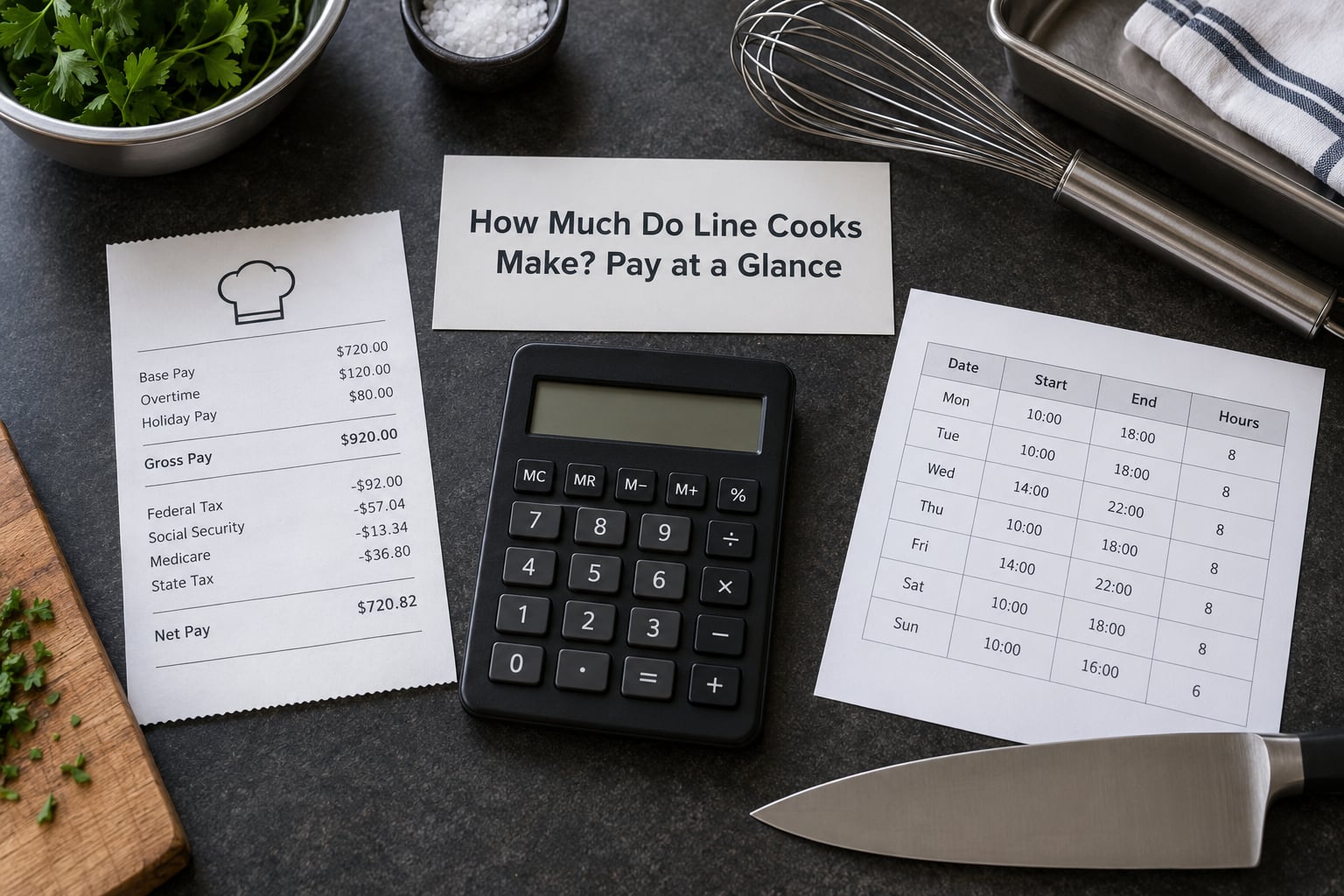
Most line cooks sit in a narrow band. The BLS mean for restaurant cooks was USD 18.14 an hour, or USD 37,730 annually, in the May 2024 OEWS release, and a quarter of cooks were earning USD 14 an hour or less at that time.
| Level | Hourly | Annual at 40 hrs | Weekly | Typical schedules |
|---|---|---|---|---|
| Starting (25th percentile) | 14.00 or less | about 29,100 | about 560 | Part-time, fast food, split shifts |
| Typical average | 18.14 | 37,730 | about 726 | Full-time, casual dining or fast casual |
| Experienced band | 21.00 to 23.00 | 44,000 to 48,000 | about 840 to 920 | Full-time, fine dining or banquet line |
City salary pages tend to publish wider ranges than BLS. Indeed lists cooks nationally from USD 11.28 to 25.37 an hour, and its city pages cluster between USD 15 and 23 depending on the market. ZipRecruititer’s national band runs USD 12 to 20.
What a line cook actually does
A line cook is a back-of-house cook who owns one or more stations on the hot line during service. The grill cook, the sauté cook and the fry cook are all line cooks; the title describes the place in the kitchen, not the seniority.
A typical station list covers mise en place prep before service, cooking menu items to order during service, portioning and plating, keeping the station stocked and clean through the shift, rotating stock, and holding food at safe temperatures. A cook who runs two stations also covers the break and the floor, which is exactly why cross-training gets you a new rate rather than a pat on the back.
That definition matters for the pay question, because it explains why the BLS category is so wide. “Cooks, restaurant” (SOC 35-2011) includes the crew at a highway diner and the crew at a tasting-menu restaurant in the same bucket. Fast food cooks are tracked separately by the BLS, which is why the national average is pulled downward relative to what a full-service line cook actually earns.
Those three numbers disagree, and that is normal. BLS counts every establishment, including small kitchens where a cook wears several hats. Aggregator pages weight self-reported salaries from people who searched recently, which skews toward active job seekers and higher-cost metros.
Do Line Cooks Get Paid by the Hour or a Salary?
Nearly every line cook is paid an hourly base wage. Salaried kitchen roles exist, but they are less common at the line level and more common higher up, where a sous chef or kitchen manager is carried on salary and expected to absorb whatever hours service demands.
Hourly pay is straightforward until the question becomes how many hours you are actually paid for. Full-time under federal law generally means 40 hours in a workweek, and non-exempt kitchen staff earn time-and-a-half past 40 in that week. Unpaid prep time, break time or closing time can still show up as hours on a time card that never make it onto a paycheck.
Take a cook at USD 17 an hour. At exactly 40 hours a week, that is USD 680 a week and USD 35,360 a year. The same cook at 45 hours, with the extra five at time-and-a-half, brings in USD 807.50 a week and USD 41,990 a year. At 50 hours it is USD 935 a week and USD 48,620 a year.
That spread — roughly USD 13,000 a year between a 40-hour and a 50-hour week — is larger than most raises people get. It is why a job posting’s hourly number tells you almost nothing about the annual number unless you know the schedule.
How Much Do Line Cooks Make After Overtime?
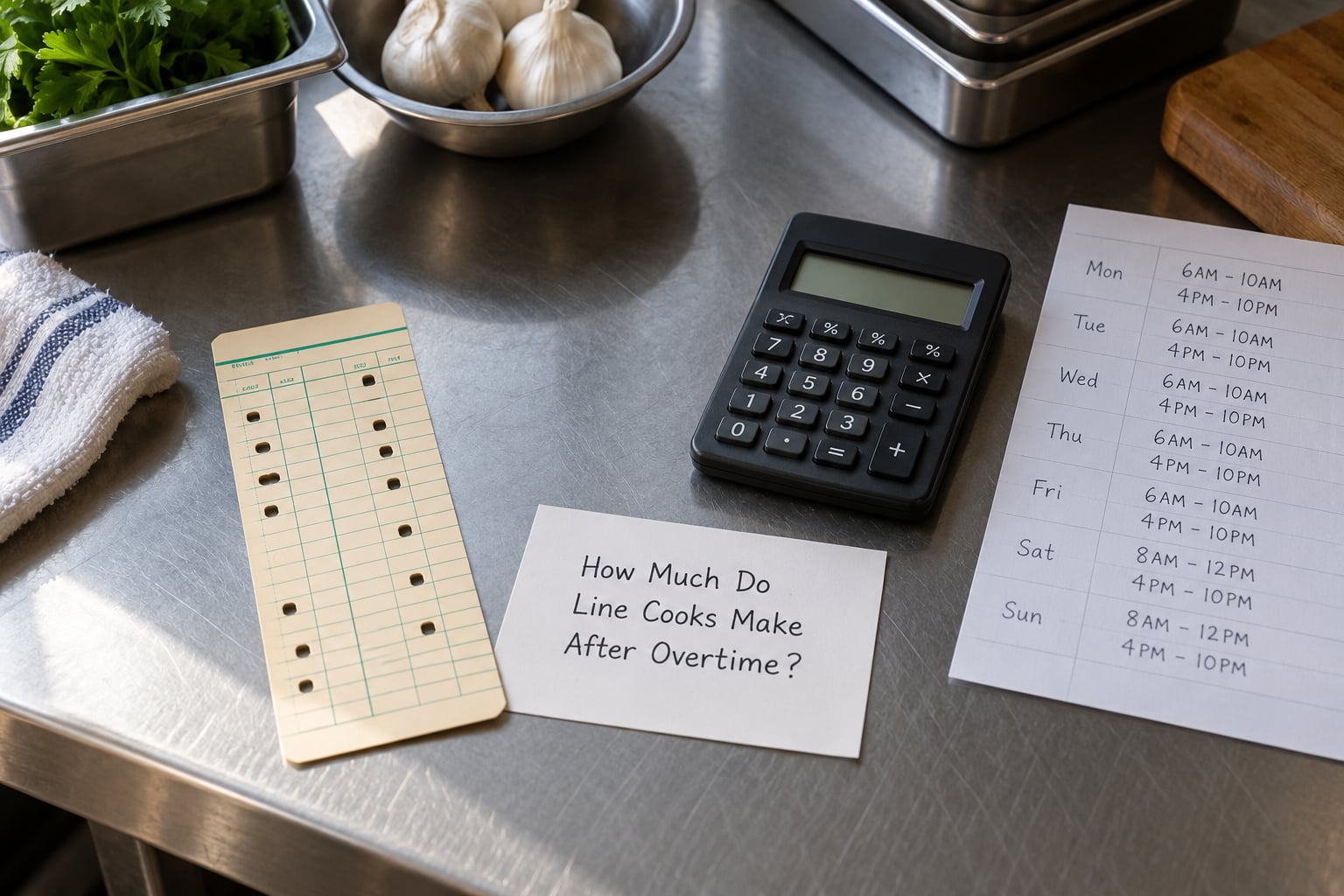
Overtime is where kitchen pay quietly changes shape. Fast-paced restaurants run on doubles and split shifts, so a cook working a 50-hour week sees the base rate do less of the work and the overtime line do more.
Under federal rules, non-exempt employees generally earn time-and-a-half past 40 hours in a week and past 12 hours in a single workday. States differ. California, for example, adds daily overtime past 8 hours and double time past 12 in a day, which matters enormously for a cook working a 10-hour lunch shift.
Double time is rarer in restaurant kitchens than in hospital or hospital-adjacent food service. It usually shows up as a shift premium, a holiday or closing premium, or a manager-only position where overtime is paid straight time.
How much do line cooks make at 45 or 50 hours a week?
Run the same USD 17 base rate through three realistic weeks and the answer is clear: hours, not raises.
| Hours per week | Regular pay | Overtime pay | Weekly gross | Annual gross |
|---|---|---|---|---|
| 40 | 680.00 | 0 | 680.00 | 35,360 |
| 45 | 680.00 | 127.50 | 807.50 | 41,990 |
| 50 | 680.00 | 255.00 | 935.00 | 48,620 |
A cook holding two part-time kitchen jobs at 25 hours each does not get overtime at all, so the same 50 hours can pay less than 40 hours plus time-and-a-half in one place. Cooks say this repeatedly in kitchen forums: the schedule, not the headline rate, is the real negotiation.
What Line Cook Jobs Pay the Most?
Within the kitchen, the pay ladder runs on station ownership. A cook who can run sauté and grill and close alone is worth more than a cook who needs a station assigned every shift, and employers price that in as a different job rather than a raise on the same one.
| Role | Typical US base | What moves the rate |
|---|---|---|
| Kitchen assistant / dishwasher | Entry band, often near state minimum wage | Full-time hours and benefits decide more than skill |
| Prep cook | Entry to mid band | Volume, food safety certification, morning shift |
| Line cook | About 18.14 average (BLS, May 2024) | Station ownership, cross-training, restaurant type |
| Banquet cook | About 37,200 annual (Zippia listing data) | Event volume, off-site catering runs |
| Sauté or grill cook | Mid to upper band, often 1 to 3 an hour over line rate | Fine dining menu complexity, butchery, seasonal menu |
| Sous chef | Often 22 to 28 an hour or a salary in the 55,000 to 75,000 range | Scheduling, ordering, training, closing duties |
| Head cook / chef de cuisine | About 47,500 for head cook (Zippia); Glassdoor’s chef average is about 50,326 | Full kitchen management, larger team, bigger menu |
| Executive chef | Well above the line rate; BLS puts the top 10 percent of chefs and head cooks above 46 an hour | Multi-unit oversight, cost control, P and L |
Two of those rows come with an asterisk worth naming. Glassdoor’s chef average of USD 50,326 blends every kind of cook under one title, which is why it lands below what a sous chef makes and well below what a corporate or private chef earns. One private-chef forum thread quoted corporate sous roles at USD 65,000 to 85,000, and private chef work starting near USD 130,000. Those lanes exist, they are a different career, and they are not what a line cook job posting is describing.
Another wrinkle: the sous promotion is often a pay cut in raw dollars. A cook with ten years in at two hourly jobs can out-earn a first-time sous salary. Cooks with a decade of service say this out loud in forums, and it is the single most common reason experienced cooks stay on the line instead of moving up.
What Affects Line Cook Pay?
Location is the biggest lever, and it is not a close contest. A cook in a high-cost coastal metro sees published city ranges at the top of the band, while the same job in a lower-cost interior market sits several dollars an hour lower. Published city pages make the spread easy to see: Fairhaven, Massachusetts shows an average of USD 19.58 an hour, while Bradenton, Florida shows USD 16.16 to 21.82, Champaign, Illinois USD 15.27 to 22.62 and Hendersonville, North Carolina USD 16.38 to 22.74.
Restaurant type comes next, and the spread runs from fast food to country clubs.
- Fast food and fast casual sit at the bottom of the band, with high volume, predictable hours and often the cleanest benefits package of the lot.
- Casual dining chains cluster in the middle, with predictable schedules and shift differentials on weekend or late closes.
- Fine dining pays above the middle for stations like sauté and butchery, and pays less for the same hours when the menu is narrow.
- Country clubs and private clubs tend to pay above casual dining for steadier hours, though the pace is slower.
- Banquet and catering pay a middling rate but can pay well in a season with heavy event volume, and the work travels.
- School, hospital and corporate food service pay near or slightly below casual dining but run on predictable daytime hours, which is the trade some cooks actively want.
Then there are the levers a cook controls. Station ownership and cross-training are the two that consistently show up in cook-owned threads as the reason a rate went up. A working cook with four-plus years called USD 16 to 17 a strong base and attributed the increases that followed to being cross-trained on multiple positions, in a “what’s a fair wage for a restaurant line cook” thread on r/batonrouge.
A certified food protection manager credential matters less for the rate and more for access to jobs that will pay it, and a union kitchen runs on a published scale, so the negotiation happens against a sheet rather than a personality.
Line Cook Pay by US Region
Regional comparisons are hard because published salary pages are local, not comprehensive. The examples below are the published city ranges actually on record for this topic, used as anchors rather than a full 50-row table.
| Region | Representative published range | What drives the spread |
|---|---|---|
| Northeast | Fairhaven, MA: average 19.58, range 16.58 to 23.14 | High housing cost, denser restaurant market |
| South | Hendersonville, NC: 16.38 to 22.74; Bradenton, FL: 16.16 to 21.82 | Lower cost of living, faster turnover |
| Midwest | Champaign, IL: 15.27 to 22.62 | College-town demand lifts the top of the range |
| West Coast | Consistently publishes at the top of the national band | State minimum wage schedule and employer cost base |
| Mountain West | Sits between Midwest and West Coast bands | Smaller market, fewer employers, tourism-season swings |
One thing that base rate hides: the same USD 16 an hour buys very different lives in different metros, and the extras do not scale with rent. A meal discount is worth more at USD 18 an hour than at USD 26. That is why cooks comparing cities argue about cost of living rather than the published rate, and why a high base rate in an expensive metro does not automatically beat a lower one in a cheaper city.
Do Line Cooks Receive Tips?
Usually not. Line cooks work back of house, and back-of-house staff are not tipped employees under the federal tip rules, so the wage on the job posting is the wage that hits the bank, minus deductions.
Two things change that. First, some restaurants put kitchen staff on a shared pool with servers, either by policy or by pressure, which cooks on kitchen forums describe as a sore spot in several markets. A tip credit arrangement, where the employer pays a lower cash wage and expects tips to make it up, applies to tipped front-of-house roles; it can affect a back-of-house worker in a restaurant that runs as a single tipped pool.
Second, service charges are not tips. A large-party service charge, a delivery fee split, or an automatic gratuity added to a check goes to the business before it is distributed, and the rules for who receives it differ by state and by venue.
The practical move is simple. Before you accept, ask for the pay structure in writing: base rate, whether overtime is paid, whether you are in any pool, and how service charges are handled. A restaurant that will not answer plainly is telling you something.
Benefits That Add Value Beyond the Hourly Wage
At USD 17 an hour, a benefit package can be worth more than a raise, and it is the part of the offer that is easiest to check.
- Health insurance, which at these wages is usually an employer contribution you would otherwise pay out of pocket.
- Employee meals, often a real meal during or after a shift, sometimes with a small discount on bring-home food.
- Paid sick leave, because a kitchen illness removes your income and your ability to work both at once.
- Retirement contributions, including the employer match. This is the one benefit that compounds.
- Shift differentials, a per-hour add-on for late closes, weekends, holidays or split shifts.
- Paid training or cross-training hours, which tell you whether the employer expects you to grow or expects you to cover gaps.
- Schedule predictability, which is not a perk on paper but is worth real money when you are planning childcare, classes or a second job.
To price an offer, do the boring version. Multiply your per-paycheck insurance premium by 26, add the annual value of meals you would otherwise buy, add sick days you would otherwise lose, and then compare the total against the hourly rate at the other job.
One restaurant owner quoted in a kitchen forum put their cooks at about USD 22 to 25 an hour after tips and called that about USD 52,000 a year plus sick time. Treat that as one kitchen’s disclosure rather than a market rate — it is also a good illustration of why an owner’s number and a salary site’s number rarely match.
Ways to Save
Kitchen income is irregular in ways most jobs are not, so the money strategy is mostly about smoothing the swing rather than cutting coffee.
Compare the full offer, not the rate. Two kitchens at the same hourly rate can differ by several thousand dollars a year once health insurance, meals, sick time and schedule are counted. Get the schedule in writing, too, because 40 predictable hours and 45 unpredictable ones are not the same job at the same price.
Budget against your slowest months, not your best. Restaurant hours collapse in a bad January and expand in a holiday season, and a budget built on a December paycheck fails by February.
Watch the two expenses a kitchen schedule quietly inflates: eating out after a late shift, and the commute. A 1 a.m. finish can turn a cheap dinner into an expensive one, and split shifts can add a second daily commute for the same number of hours.
Use the benefits that come with the job. A retirement match left on the table is money declined, and a meal plan you ignore is a raise you turned down. This is general budgeting guidance and not individual tax or financial advice; run your own numbers and check what your own employer offers before changing anything.
| Line item | Example monthly amount | Notes |
|---|---|---|
| Base wages at 45 hrs | 3,499 | 807.50 gross per week, 52 weeks |
| Tips | 0 | Back-of-house roles are usually not tipped |
| Estimated deductions | about minus 1,050 | Rough placeholder at roughly 30 percent; verify on your own pay stub |
| Take-home | about 2,450 | Before rent and bills |
| Rent | your number | The largest fixed line |
| Transport | your number | Include the cost of a second commute on split shifts |
| Groceries | your number | Subtract employer meals if you actually use them |
| Phone, insurance, subscriptions | your number | Small lines that add up |
Frequently Asked Questions
What is the starting wage for a line cook in the US?
Starting line cook pay is set by state law, so the floor is the state minimum wage. BLS data show a quarter of restaurant cooks earning USD 14 an hour or less, while ZipRecruiter publishes a national band of USD 12 to 20. Entry cooks in fast food sit at the bottom, with full-service kitchens paying several dollars more. Ask for the posted range plus the expected hours.
Do line cooks usually receive tips?
No. Line cooks work back of house, and back-of-house staff are normally paid a straight hourly wage with no tips attached. Some restaurants run a single shared pool, and in states that allow tip credits the cash wage can be lower than the posted rate. Service charges such as large-party gratuities or delivery fees are not tips and are distributed by the business under its own rules. The one thing to do is ask, before you start, for the pay structure in writing.
Which US city pays line cooks the most?
High-cost coastal metros publish the highest rates. Fairhaven, Massachusetts shows an average of USD 19.58 an hour with a range of 16.58 to 23.14, which sits above the national mean of USD 18.14. West Coast markets generally publish at the top of the band, helped by state minimum wage schedules. Compare the take-home rather than the rate: rent, commute and whether the employer offers health insurance decide which city actually pays better.
Can a line cook become a sous chef?
Yes, and station ownership is the usual route. A cook who runs two stations, closes alone and orders product is the candidate a sous chef promotion is built from. Cross-training and a food safety certification make you eligible, but the raise can disappoint: a first sous salary sometimes pays less than two hourly line cook jobs. Ask about the posted range before you take the title, and treat any schedule improvement as part of the compensation.
How should I compare two line cook job offers?
Line them up on the same four numbers: base rate, realistic weekly hours including overtime, benefits, and schedule predictability. Two offers at USD 17 can differ by several thousand dollars a year once health insurance, meals and sick time are priced in. Ask each employer for the schedule in writing and for a written pay structure covering overtime and service charges. Then budget against your slowest month, not your busiest one.
What to Do First
Decide the number you actually need to take home each month, then work backwards to the hourly rate your realistic hours can support. If you are still searching how much do line cooks make in your own city, treat that published figure as the starting point and compare offers on base pay plus overtime, benefits, meals and schedule quality rather than the posted rate alone.
If you are negotiating, point at the published range for your city, name the stations you can run, and ask in writing. Cooks do not get stuck because the work is hard; they get stuck because nobody made the pay structure clear at the door.