
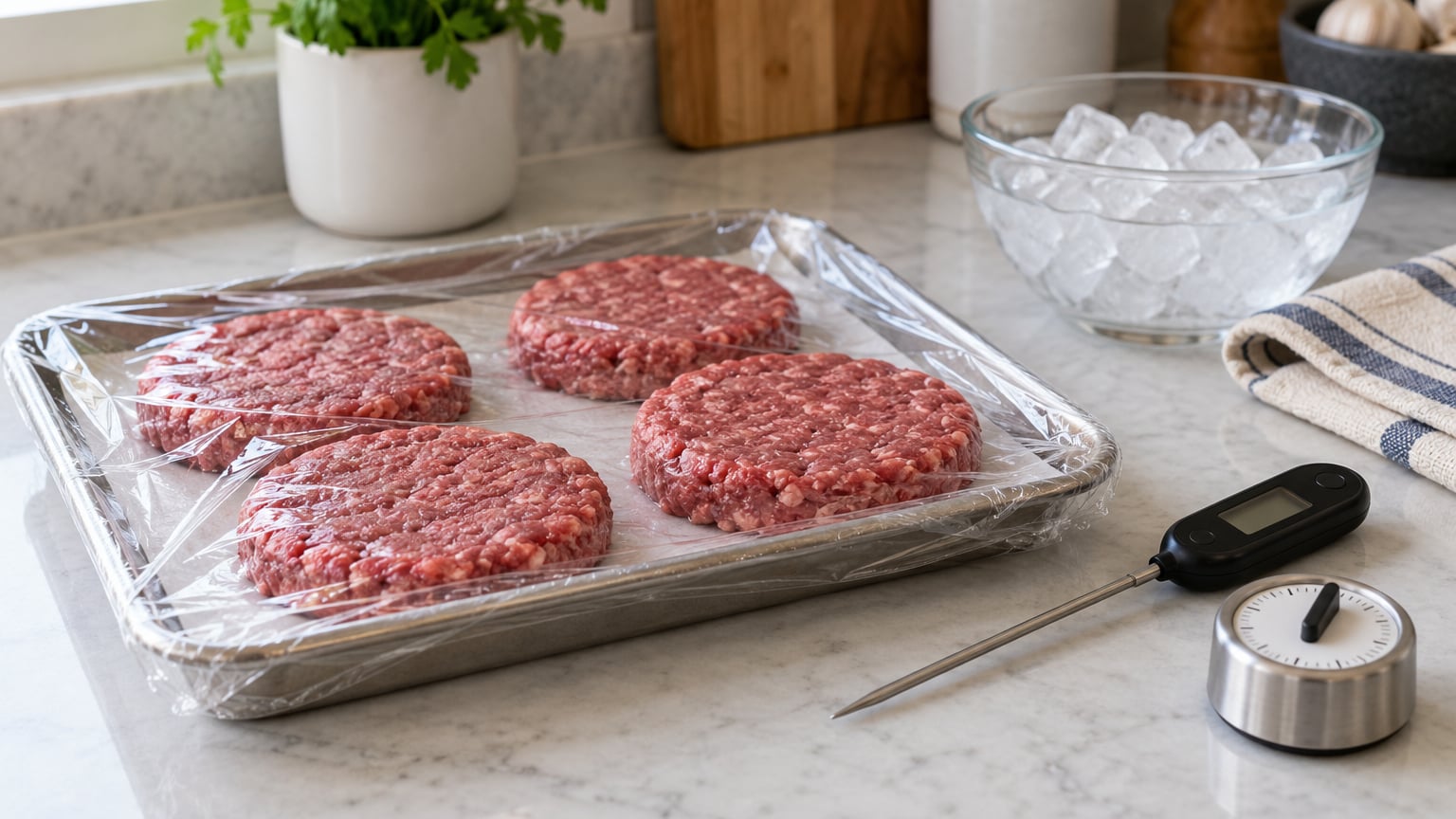
Raw meat can sit out at room temperature for a maximum of two hours before it becomes unsafe to eat, and only one hour when the air is above 90F (32C). The USDA Food Safety and Inspection Service calls that span the temperature danger zone, the range between 40F and 140F where bacteria multiply fast. Time out of the fridge plus time on the heat both count against the limit.
I cook a lot of burgers and I have made this mistake more than once, usually on a warm Saturday when the grill is going and everybody is asking about food. The fix is boring and works every time: put a timer on it.
Below is what the two-hour rule actually covers, what room temperature means in real kitchens, how to thaw meat without breaking the rule, and what to do with a package of meat that has already been sitting out longer than it should have.
Table of Contents
- How Long Can Raw Meat Sit Out? Quick Safety Guide
- What Counts as Room Temperature?
- Does the 2-Hour Rule Apply While Thawing Meat?
- How Do I Keep Raw Meat Safe Before Cooking?
- How Can I Tell Whether Raw Meat Is Still Safe?
- What If Raw Meat Has Already Been Left Out Too Long?
- How Does This Apply to Burgers, Wings, and Grilling?
- What Is the Safest Way to Use Leftover Raw Meat?
- Frequently Asked Questions
- The Safest Next Step
How Long Can Raw Meat Sit Out? Quick Safety Guide
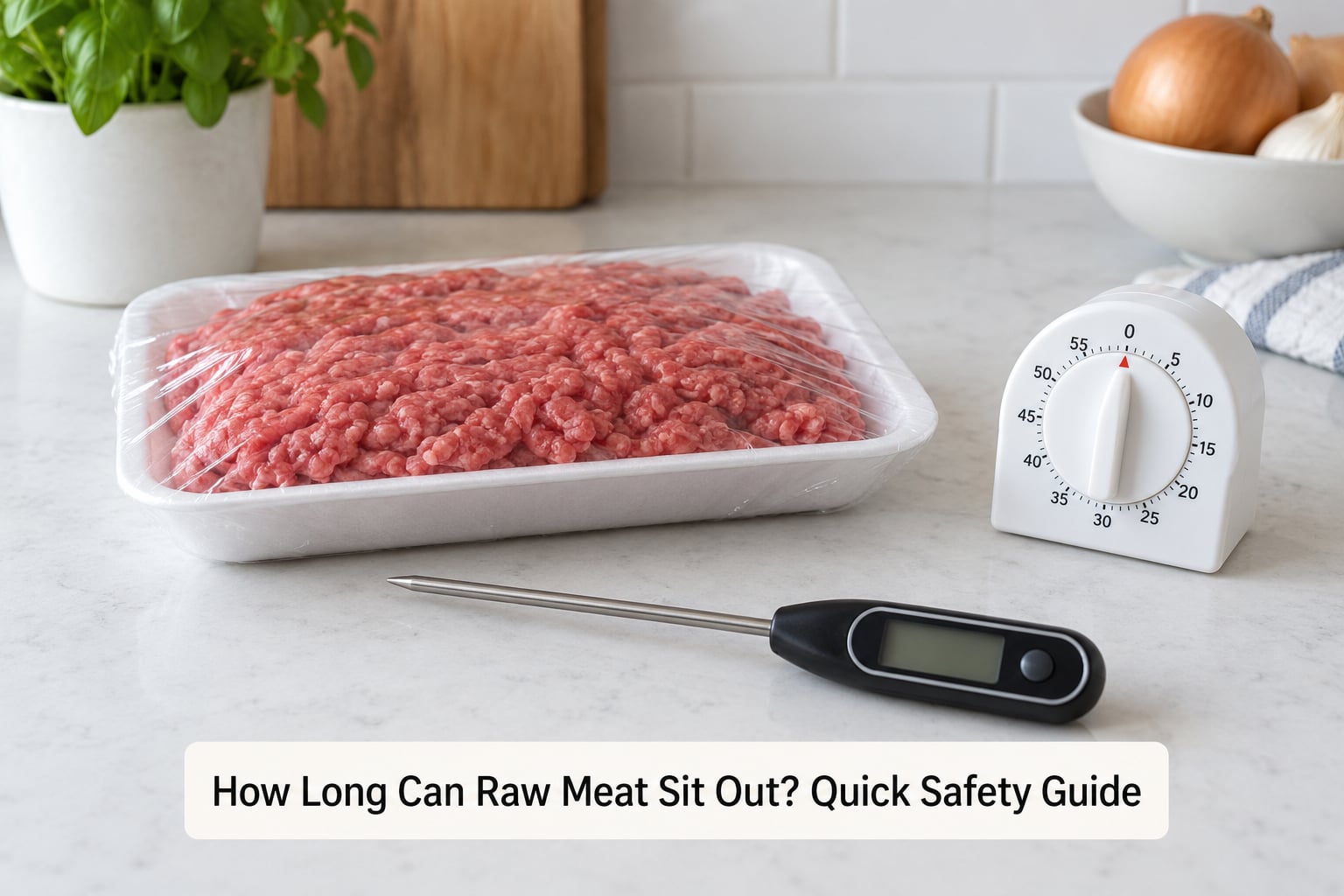
The direct answer: two hours unrefrigerated, one hour when the surrounding temperature is above 90F. Everything else on this page is a detail of that rule.
Raw meat should never be in the temperature danger zone, 40F to 140F (4C to 60C), for longer than that. Bacteria such as Salmonella, E. coli O157:H7 and Listeria can double in number roughly every 20 minutes inside that range, which is why a single plate of patties sitting in the sun for an afternoon is not a small mistake.
| Situation | Maximum time unrefrigerated | What to do |
|---|---|---|
| Counter or table below 90F | 2 hours | Cook promptly or refrigerate |
| Above 90F, hot car, sunny patio | 1 hour | Keep it on ice or discard |
| Marinating on the counter | 1 to 2 hours at most, then refrigerate | Move it to the fridge, not the grill |
| Thawing on the counter | Not safe at all | Use fridge, cold water or microwave |
| Refrigerator at 40F or below | 1 to 2 days for raw cuts and ground meat | Keep sealed and low in the fridge |
| Still frozen | No time limit | Cook from frozen or thaw safely |
Two details catch people out. First, the clock is cumulative, so 40 minutes of counter time plus 20 minutes in a hot pan while the grill preheats means you are at one hour, not 40 minutes. Second, covering the tray with foil or plastic wrap changes nothing, because wrap traps heat instead of removing it.
If you want the short version of the whole article, read the first two tables and skim the section on meat that has already sat out. If you want the reasoning behind the numbers, keep going.
What Counts as Room Temperature?
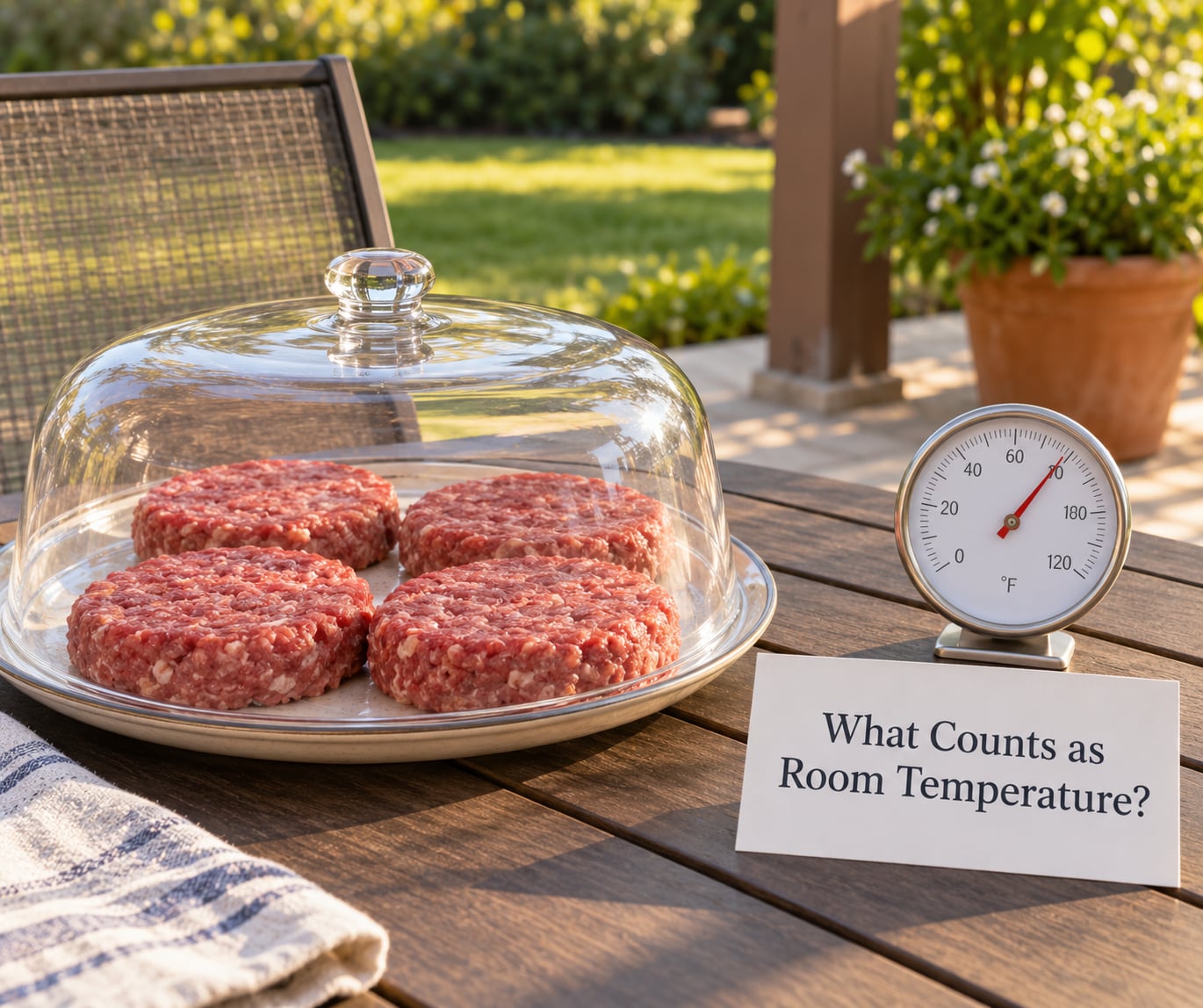
Room temperature, for the purposes of this rule, means ordinary indoor air, roughly 68F to 75F. The two-hour figure was not picked for comfort, though. It is a deliberately conservative consumer limit that assumes a warm kitchen, a busy cook and no thermometer in hand.
Conditions that push you into the one-hour rule sooner:
- A kitchen above 90F, which is rare indoors but normal in parts of the country in summer.
- A parked car, which climbs well past 100F within minutes even on a mild day.
- A patio table in direct sun, where the surface itself heats the plate.
- A grill with a hot lid closed, which turns the shelf beside it into a warming cabinet.
- A crowd, since every added oven, hotplate and pot of coals pushes the room temperature up.
What matters is the temperature of the food, not the air reading on your phone. A platter sitting on a sunlit metal table can be well into the danger zone even when the shaded air around it feels fine, and a thick frozen roast in a warm kitchen can spend an hour below the danger zone in the center while the outside warms.
When in doubt, treat warm weather, sunlight or a parked car as the one-hour case. Nobody has ever regretted throwing out a tray of patties early. Plenty of people have regretted the other call.
Hot weather is the most common way the two-hour rule gets broken
Nobody plans to leave chicken on the porch for six hours. What happens is that the meat comes out of a cooler, sits on the table while everyone grabs a drink, then goes back out. Each step is short, and the total is not.
A food thermometer solves this without any guessing. Push it into the thickest part of a patty, and if the reading is 40F or under, you have time. Above 40F, you are on the clock and you have less of it than you think.
Does the 2-Hour Rule Apply While Thawing Meat?
Yes, and this is where the rule gets broken most often. Meat left on the counter to thaw is sitting at room temperature for hours on end, so the two-hour limit has already been passed before anyone touches a pan.
The reason is straightforward. A frozen roast thaws from the outside in. The outer few centimeters reach the danger zone within the first hour while the center is still ice, so the part most likely to grow bacteria warms up first and waits longest for you to cook it.
| Thawing method | Typical time | Condition | Safe? |
|---|---|---|---|
| Refrigerator | About 24 hours per 2 to 3 lb of meat | Keep in a tray on the bottom shelf | Yes, and the usual best choice |
| Cold water | About 30 minutes per pound | Sealed bag, water under 40F, changed every 30 minutes | Yes, cook right after |
| Microwave | 5 to 10 minutes per pound | Cook immediately, never refreeze | Yes, time matters |
| Cook from frozen | Runs 50 percent longer | Loosen packaging, use a shallow pan | Yes, for whole cuts and steaks |
| Kitchen counter | Unpredictable | No tray, no timer, no control | No |
Packaging changes the pace more than most people expect. Vacuum-sealed and frozen brick meat thaw faster and more evenly than loose portions in a tray. A frozen ground beef block that came from a store freezer can need well over a day in the refrigerator before it is workable, which is why meat thawing is a planning problem rather than a last-minute one.
If you need it faster than that, move it to cold water, not the counter. Change the water every 30 minutes so it stays under 40F, and cook the meat as soon as it is thawed. If it goes back into the fridge after a cold water thaw, cook it within a day or two rather than freezing it again.
We keep ground beef in the freezer constantly, and the How Long Can Burgers Stay in the Freezer? Safe Storage guide covers how long a portion stays usable there. The short version is that a frozen burger is only as good as the thawing plan behind it.
How Do I Keep Raw Meat Safe Before Cooking?
Keeping raw meat safe is mostly about closing the gaps where time gets lost. Store it cold, separate, and cook it on a schedule rather than on a mood.
On the way home from the store
Cold groceries go home first. Raw meat should be the last thing you pick up and the first thing into the refrigerator, and an insulated bag keeps it below 40F on a long drive or a warm walk home. If you have more than about a half hour of unrefrigerated transport in hot weather, a cooler with ice is the difference between safe and discarded.
In the refrigerator
Keep the refrigerator at 40F or below and check it with an appliance thermometer once a season, because the dial on the inside of the door is a rough estimate at best. Store raw meat on the bottom shelf in a sealed container or tray so a leak cannot reach cheese, produce or ready-to-eat food.
Raw ground beef, poultry and seafood go below cooked leftovers and above ready-to-eat items. If you want the full breakdown on storage windows, How Long Does Ground Beef Last in the Fridge? covers that one in detail.
At the counter during prep
Bring only what you are working on. A whole family dinner of raw patties does not need to come out of the fridge at once, and a small amount out for a short time is far easier to keep inside the limit than a mountain of it. Wash hands with soap and water for 20 seconds after handling raw protein, and use a separate cutting board, or wash the one you used before it touches salad or buns.
Marinating works the same way. The marinade goes in with the meat in the refrigerator, not on the counter beside the grill.
How Can I Tell Whether Raw Meat Is Still Safe?
You usually cannot, and that is the honest answer. Smell, color and texture are quality signals that humans have been misreading for a very long time, not safety tests.
Color is the worst of them. Beef can look brown well before it is safe, because myoglobin oxidizes with exposure to air rather than with cooking. Turkey thigh meat stays pink at a safe temperature, and a steak can pull from the grill at the right internal temperature while still looking underdone in the center. Ground meat can look perfectly grey and be undercooked.
Smell fails in both directions. The sour or ammonia smell people associate with spoiled meat often comes from spoilage bacteria and temperature abuse, not necessarily the pathogens that make you ill. Pathogens like Salmonella and E. coli can be present without changing how food smells at all. And food that smells fine can absolutely make you sick.
What actually decides safety is a record of time and temperature. When did it come out of the fridge, what was the air temperature, how long until it hit heat. If you did not note that, you are guessing, and the safe guess about meat that sat out unrefrigerated for hours is to discard it.
Package dates are worth reading but not much. A Best If Used By date is about quality, flavor and texture. A Use By date on infant formula is a safety date. Nothing on a package of fresh meat tells you how long it is safe to leave it sitting on your counter, because that depends on where you put it, not on when it was packed.
Never taste food to check whether it is safe. That is how people get sick.
What If Raw Meat Has Already Been Left Out Too Long?
Work through it in order rather than by instinct. How long has it been out, what was the air temperature, and what kind of meat is it.
Under two hours, at room temperature below 90F: refrigerate or cook it right now. You are fine. Put it back in the fridge if you are not cooking yet.
Between one and two hours in hot weather above 90F: same answer, act now. The clock ran out earlier.
Past the limit: discard it. Two to four hours unrefrigerated is past the consumer guideline for any raw meat, and there is no reading on a thermometer that brings it back. Poultry, ground meat and anything marinated on the counter go first, with no debate. Whole muscle cuts get a little more grace in commercial kitchens, but the USDA consumer rule does not make that distinction, and neither should your kitchen.
More than four hours: discard without discussion. This is the clearest call on the page. If you cannot remember when it came out of the refrigerator, treat that as more than four hours.
Cooking does not rescue it. Heat kills most vegetative bacteria such as Salmonella and E. coli, which is why a well-cooked steak is usually fine. What it does not destroy are the heat-stable toxins some bacteria leave behind while sitting in the danger zone, including those produced by Staphylococcus aureus. Those survive the temperatures you use on a grill or a skillet, and they are what make a well-heated meal a bad meal. Refrigerating it afterward stops further growth but does not reverse growth that already happened.
One more thing makes this harder than it sounds: symptoms can appear anywhere from a few hours to several weeks later, and people rarely connect a stomach bug next week to a plate of chicken two weekends ago. That gap is exactly why the anecdotal approach fails, and why the answer for meat that blew past the limit stays the same.
If someone in your household is pregnant, over 65, immunocompromised or caring for an infant, discard anything that came close to the limit without discussion. The conservative call is the right one.
How Does This Apply to Burgers, Wings, and Grilling?
Grilling is where the rule gets tested, because burgers, wings and marinades all want to sit out while a hot grill gets going. Here is how the risk stacks up by type.
| Type of meat | Relative risk | What to watch |
|---|---|---|
| Poultry, ground meat, injected or brined products | Highest | Bacteria are distributed through the meat, not just on the surface |
| Fish and shellfish | High | Very perishable, degrades fast in the danger zone |
| Commuted and sausage products, including bismarck roast beef | High | Salted surface hides spoilage and bacterial growth |
| Whole muscle steaks, chops and roasts | Lower | Bacteria sit on the surface, which is why searing helps |
For burger patties, take out only the number you are grilling right now and put the rest back immediately. Thawed patties are worse candidates for sitting out than frozen ones, since they arrive at room temperature ready to grow.
Raw wings are the highest-risk item on a typical cookout. Thaw them in the refrigerator overnight, then keep them on ice rather than on a bare table. If you are brining, the brine belongs in the fridge for the whole duration.
When the food is on, use a thermometer rather than color. These are the USDA safe minimum internal temperatures:
| Food | Minimum internal temperature | Rest time |
|---|---|---|
| Poultry, ground meats, sausage, hot dogs | 165F (74C) | None required |
| Ground beef and pork | 160F (71C) | None required |
| Beef, pork, lamb and veal steaks, chops and roasts | 145F (63C) | 3 minutes |
| Fish and shellfish | 145F (63C) | None required |
Tempers belong inside the same two-hour window as everything else. Twenty to sixty minutes on the counter before cooking is fine and helps a thick steak cook evenly, but it is not a free extra hour. Our Food Safety Rules for Grilling Meat covers the rest of the cookout side, from cooler packing to when a patty is done.
What Is the Safest Way to Use Leftover Raw Meat?
Raw meat that stayed refrigerated at 40F or below follows a completely different clock than cooked leftovers, and it is the clock people get wrong most often.
Raw cuts, ground meat and poultry stay usable for 1 to 2 days in the refrigerator. Fish and shellfish get 1 day. Chunks or roasts cut from a bigger piece get the same window as the whole cut, so trimming a steak into portions at home does not reset the clock.
For longer storage, freeze it. Ground beef and organ meats keep about 3 to 4 months frozen, steaks and chops about 4 to 12 months depending on the cut, and cured or cured-and-smoked products 2 to 3 months. Freeze in airtight packaging, and write the date on it with a marker.
Marinated meat is raw meat with a deadline of its own. In the refrigerator, keep large pieces up to about 2 days, steaks and chops 1 day, and ground meat 1 day, because the acidic marinade does not stop bacteria on the surface. Used marinade gets refrigerated separately, and any raw meat it touched should not be eaten after that marinade has sat warm, even briefly.
Cooked leftovers have their own rule, unchanged in spirit: get them into the fridge within two hours, eat them in 3 to 4 days, and freeze anything beyond that. Reheat to 165F. Raw meat never mixes into this category, so keep the two separate in your planning.
Frequently Asked Questions
Is it safe to eat raw meat that was left out overnight, even covered?
No. Covering the tray with foil, plastic wrap or a bowl does not change anything, because the wrap holds in warmth rather than removing it. If raw meat sat out overnight, it is well past the two-hour limit, or the one-hour limit in hot weather. Discard it rather than cooking it, since heat kills most bacteria but not the heat-stable toxins they leave behind.
How long can I leave raw meat on the counter to thaw?
You should not leave raw meat on the counter to thaw at all, even for a few hours. The outside enters the danger zone within about an hour while the center is still frozen. Thaw in the refrigerator for roughly 24 hours per 2 to 3 pounds, in cold water changed every 30 minutes for about 30 minutes per pound, or in the microwave and cook it straight away.
Why is meat not thawed on the kitchen counter?
Because heat moves from the outside inward. A frozen roast warms at the surface long before the center loses its ice, so the portion that grows bacteria fastest is the portion that waits longest for you to start cooking. On a warm day that waiting period can stretch across the entire cooking session, which is why the USDA names the refrigerator, cold water and microwave as the only approved methods.
Is raw chicken left out for four hours still safe to cook?
No. Poultry is among the highest-risk raw meats, and four hours is double the two-hour consumer limit, or four times the one-hour limit above 90F. Cooking chicken to 165F kills Salmonella and Campylobacter, but it cannot destroy heat-stable toxins already produced while the meat sat warm. Discard it, and do not taste it to find out.
What is the 4-hour rule for the danger zone, and does it apply at home?
The 4-hour rule comes from the FDA Food Code, which governs restaurants and other foodservice operations running under commercial supervision with documented procedures and temperature logging. The USDA consumer guidance is deliberately more conservative at two hours, or one hour above 90F. At home, follow the two-hour rule; the longer foodservice allowance is not a safe default for a home kitchen.
The Safest Next Step
Start a timer the moment raw meat leaves the refrigerator or its packaging. Keep it cold when you can, cook it promptly rather than in stages, and discard anything that passes the two-hour mark, or one hour in hot weather.
Nothing on this page requires special equipment or a second opinion. A kitchen timer and a cheap thermometer are enough to answer the only question that matters, which is how long the meat has been unrefrigerated. If the answer is unclear, throw it out. A fresh package costs less than a bad week.