
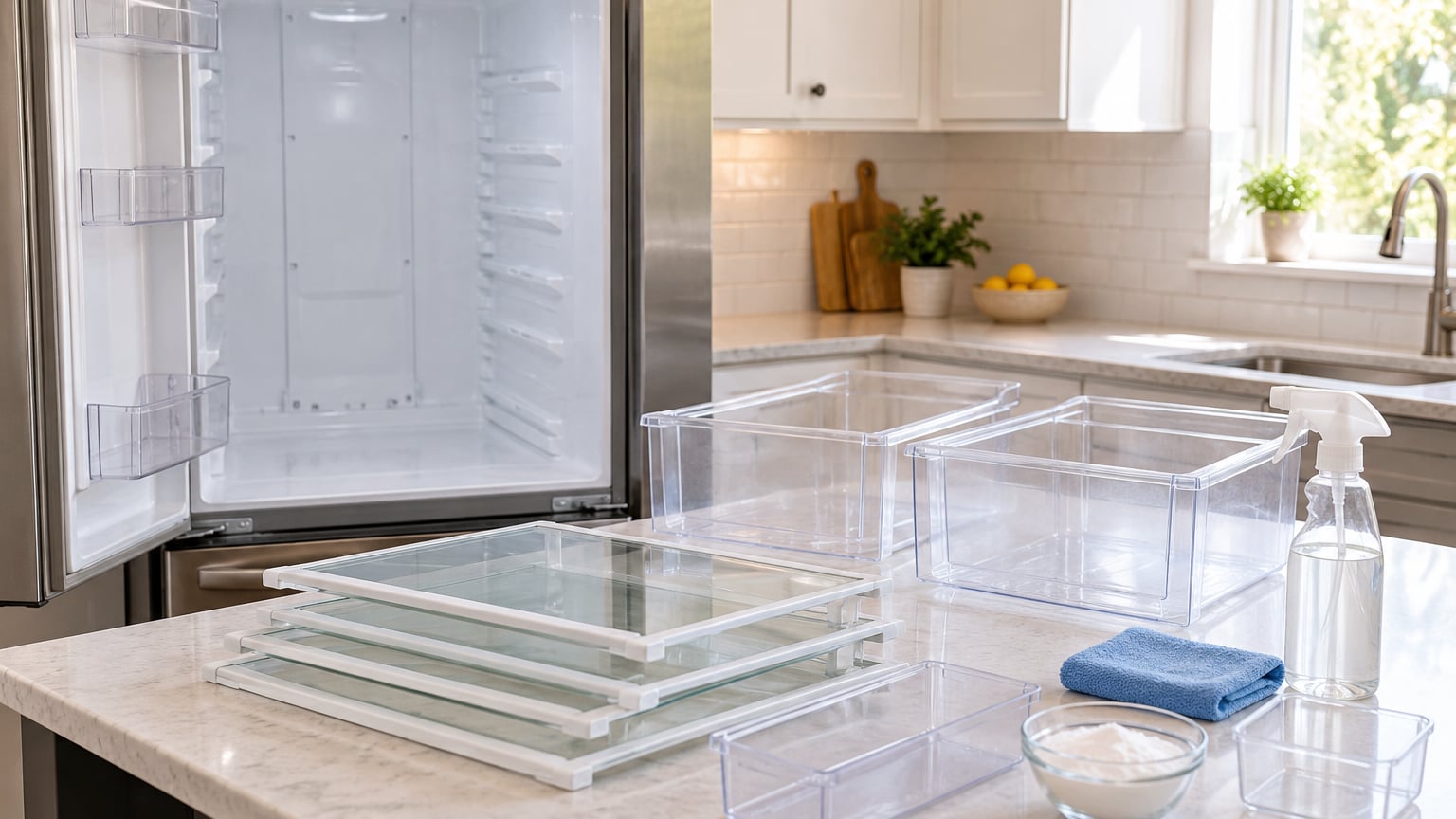
The fastest way to clear a smelly fridge is to clean the source, not cover it up. Wipe every surface with a 1:1 mix of white vinegar and water, wash the shelves and drawers, then leave an open box of baking soda or a bowl of activated charcoal inside to absorb what the sponge missed.
That takes about an hour of work plus a day of air time. The part most people skip is finding the actual source, which is usually a dried spill nobody can see rather than something rotten sitting in plain view.
Food safety first: if the odor followed a power outage and the fridge sat above 40F for four hours or more, the USDA says discard the perishable food no matter how it looks or smells. Nobody should be sniffing leftovers to decide whether they’re safe. For more on that decision, how long ground beef lasts in the fridge covers the storage windows that matter most.
What You Need

None of this is expensive and most of it is already in a kitchen cabinet. The list is short because the method is mechanical: wash, dry, then absorb.
- A mild dish soap and warm water for removable parts
- White vinegar for the 1:1 cleaning solution
- Baking soda, decanted into a shallow container or small plate
- Activated charcoal bags or a bowl of loose activated charcoal, if you have them
- A soft cloth or sponge, plus a toothbrush for the door gasket and shelf channels
- A cooler with ice packs, for holding food safely during the clean
- An old towel for the floor, since the drip pan step is wet work
Skip the aerosol air fresheners and the heavy fragrance sprays. They cannot be used in a food storage space, and they add a chemical scent to the air your food sits in.
Step-by-Step: How to Get Rid of Fridge Odors for Good

Work top to bottom and keep food cold while you do it. The whole sequence takes about 45 to 60 minutes of hands-on time, then 12 to 24 hours of drying with the door open.
Step 1: Empty the Refrigerator and Find the Source
Put everything into the cooler, working shelf by shelf so you are not hauling a week’s groceries across the kitchen twice. Take the freezer compartment down to empty as well, since odors move between the two.
Now look at what you pulled out. Common culprits, in the order I find them: a leaking container that pooled under a crisper drawer, a head of greens or berry punnet that turned to liquid, raw fish or seafood in a tray that was not sealed, strong cheeses or cured meats in an open package, and a sauce or condiment nobody has touched since last summer.
Smell each sealed container with the lid just cracked, not wide open. If a sealed item smells wrong on the inside, the package is the problem, and wiping the shelf will not help until that item goes in the bin.
Step 2: Clean the Shelves, Drawers and Interior
Pull out every shelf, drawer, bin and door shelf that the manufacturer allows you to remove. Wash them in warm soapy water, rinse, and pay attention to the underside of each shelf, which is where dried spills dry into a film.
For fixed surfaces, mix equal parts white vinegar and cool water in a spray bottle and wipe the interior walls, the underside of the door liner and the fixed shelf channels. Wipe the door gasket with a damp cloth and a drop of soap, working around the whole seal, because that rubber lip traps smell and gunk in ways a flat wall does not.
Scrub the narrow grooves where shelves slide using an old toothbrush. If your fridge has a replaceable air filter, pull it out and rinse it under cool water, or swap in a new one if the manual calls for it. Check the owner’s manual before rinsing anything marked dishwasher-safe, and never spray cleaner directly onto a surface that drains into the fridge floor.
Step 3: Dry the Fridge Completely
This is the step people rush, and it is the reason smells come back. Wipe moisture out of the drawer channels, the shelf rails and the gasket crease with a dry cloth, then prop the door open and let the interior air out.
Give it several hours, or overnight if you can spare the empty space. Warm, damp plastic and insulation is exactly the environment that grows the bacteria producing the smell in the first place, so reassembling a wet fridge undoes half the work you just did.
Step 4: Deodorize the Empty Interior
Baking soda is the workhorse. Decant an eighth to a quarter cup into a shallow dish or small plate and set it on a shelf near the front where the air moves across it. It takes up to three days to clear a stubborn odor, and you replace it roughly every three months.
Activated charcoal works faster and harder, and it only does its job when air moves through it. Keep the bag or bowl uncovered and not wedged in a corner, so there is some circulation past the surface. That is the whole difference between charcoal that works and charcoal sitting uselessly in a sealed box.
Other options exist with different strengths. Rolled newspaper stuffed into both compartments is the traditional approach and the one the USDA recommends alongside vinegar. Coffee grounds and uncooked oats in a dish work as mild absorbers when baking soda has gone stale. A cut lemon or lemon peel helps a light onion or garlic smell but does very little against anything rotten.
Once the food goes back in, keep the charcoal or soda dish out of the door shelf, where it sits in the least-moving air.
Step 5: Prevent Odors From Returning
Most repeat smells are a storage problem, not a cleaning problem. Put leftovers in airtight containers rather than loosely covered bowls, and put raw meat and seafood on the bottom shelf in a sealed tray so a leak cannot drip onto anything below.
Keep the fridge at 37 to 40F and the freezer at zero. A fridge that drifts warm lets food spoil faster than you smell it, which is where most of these odors start.
Do a five-minute sweep once a week: check the oldest containers, the produce drawer and anything with an unclear date. Wipe spills the day they happen. That single habit removes more fridge odors than any deodorizer.
For cooking temperatures, poultry needs an internal 165F, ground meat 160F, and whole cuts and fish 145F. When you cook meat for leftovers, cool it fast and refrigerate it within two hours, since slow-cooling food is what turns into the smell everyone ends up searching for.
Why Your Fridge Still Smells After a Deep Clean
A fridge can look spotless and still smell because the odor never lived on a surface. If you have wiped everything down and the smell is still there, it is coming from one of these places.
- Insulation foam. Odors soak into the foam lining the walls and door. This is the honest limit of every home remedy, and it is why a smell can persist for weeks or months after a thorough clean.
- The drip pan. Meltwater collects in the pan under the freezer compartment, and food particles in that warm standing water are a reliable source. Remove and clean it according to your manual, or use the freezer defrost cycle to empty it.
- Mold in the drain tube. The drain channel that carries defrost water out of the compartment can clog and grow mold, which produces a musty smell with no food involved at all.
- Evaporator coils. Dust on the rear coils plus condensation is a musty magnet. Vacuum them gently without bending the fins.
- Behind and underneath the fridge. Pull it out and clean the floor and wall behind it. Grime there, and a gap that lets warm room air in, both make the compressor run harder and the interior smell worse.
- A mechanical fault. A sharp chemical or sweet oily smell that appears with no food spill is not a cleaning problem. That is often a refrigerant or compressor issue, and a humming that changes pitch, warm spots inside, or ice that never fully melts on the back wall all point the same way. Shut it down and call a technician rather than cleaning harder.
If the smell only hits you when the door opens and the food itself smells fine, cold air holds less capacity for odor compounds, so the concentration is highest in that first breath. Warming the room and leaving the door open helps some people for exactly that reason, but it is a supplement to cleaning, not a substitute.
Common Mistakes
How to Get Rid of Fridge Odors Without Masking the Problem
These are the habits that keep a fridge smelly for months. Most people are not cleaning badly, they are cleaning in a way that cannot work.
- Covering the smell instead of cleaning the source. A lemon peel on a shelf treats nothing. Odor compounds come from bacteria metabolizing food, and they have to be removed physically.
- Mixing cleaners. Never combine bleach with vinegar or ammonia. The gas that produces can injure you, and inside a small closed fridge it concentrates fast.
- Leaving food exposed. Open leftovers and uncovered onion and garlic re-odor the compartment within days. One sealed container makes the whole fridge quieter.
- Ignoring the gasket and channels. The shelves get all the attention. The rubber door seal and the narrow shelf rails hold nearly as much residue and get cleaned almost never.
- Using fragrance sprays indoors. Aerosol air fresheners and scented candles do not remove odor; they add a chemical scent to the same air the food is in, and some aerosol propellants are not meant for that space at all.
- Scrubbing stainless steel with baking soda. Baking soda is a mild abrasive. On stainless exteriors it can dull the finish, so keep it for the interior and use the manufacturer’s approved cleaner outside.
- Reassembling before everything is dry. A damp interior seals in the conditions that created the smell.
On timing, so expectations are realistic: vinegar and soap clear a light smell in hours, baking soda takes up to three days, and charcoal starts working the same day with air moving past it. A smell soaked into insulation can take weeks and may need days of open-door airing between attempts.
Frequently Asked Questions
How do I get rid of bad smells in my refrigerator?
Empty the fridge and the freezer into a cooler, sort everything and discard anything questionable. Wash all removable shelves, drawers and door bins in warm soapy water, then wipe the fixed interior, door gasket and shelf channels with a 1:1 mix of white vinegar and water. Dry thoroughly, leave the door open overnight, then set out baking soda or activated charcoal to absorb what remains.
What can I put in my fridge to stop the smell?
An open box of baking soda in a shallow dish is the standard answer: put an eighth to a quarter cup on a shelf near the front and replace it about every three months. Activated charcoal works faster but needs air moving across it, so keep it uncovered and out of a corner. Rolled newspaper, coffee grounds and uncooked oats are milder options that help on light odors.
How long does it take for fridge smell to go away?
A light smell usually clears within hours of a vinegar wipe-down. Baking soda needs up to three days, and activated charcoal can start working the same day if air circulates past it. Odor that has soaked into the insulation foam takes much longer, often weeks, and benefits from a day of airing with the door open after each cleaning.
Why does my refrigerator smell bad even though there is nothing bad in it?
The source is usually hidden rather than missing. Check the drip pan under the freezer compartment, the floor under the crisper drawers, the door gasket crease, the shelf channels and the drain tube, where mold can grow in defrost water. Pull the fridge out and clean behind and under it too, and replace the air filter if your model has one.
Can I put charcoal in my fridge?
Yes, food-grade activated charcoal is safe to use in a refrigerator as long as it is kept in a bag or bowl so no loose charcoal can contact food. It is not the same as the briquettes used for grilling, which should never go in a fridge. Charcoal adsorbs odor molecules on its surface and works best when uncovered with some airflow moving past it.
What are the signs of a dying refrigerator?
A sharp chemical or sweet oily odor with no food spill usually points to a refrigerant or compressor fault rather than dirt, and that needs a technician. Other signs include a compressor that runs constantly or cycles on and off quickly, warm spots inside, a freezer that never gets fully cold, water pooling under crisper drawers that is not condensation, and ice building up on the back wall. Persistent musty odor from the drain tube can also mean mold that needs clearing.
The Short Version
Pull everything out, find what is actually causing it, wash the removable parts, wipe the interior and gasket with 1:1 vinegar and water, and let the fridge dry completely with the door open. Then leave baking soda or activated charcoal inside for a few days and fix the storage habit that created the problem in the first place.
If the smell does not move after two full attempts, stop cleaning and check the drip pan, the drain tube and the space behind the fridge. And if it smells chemical rather than food-related, call a technician before you wipe anything else.