
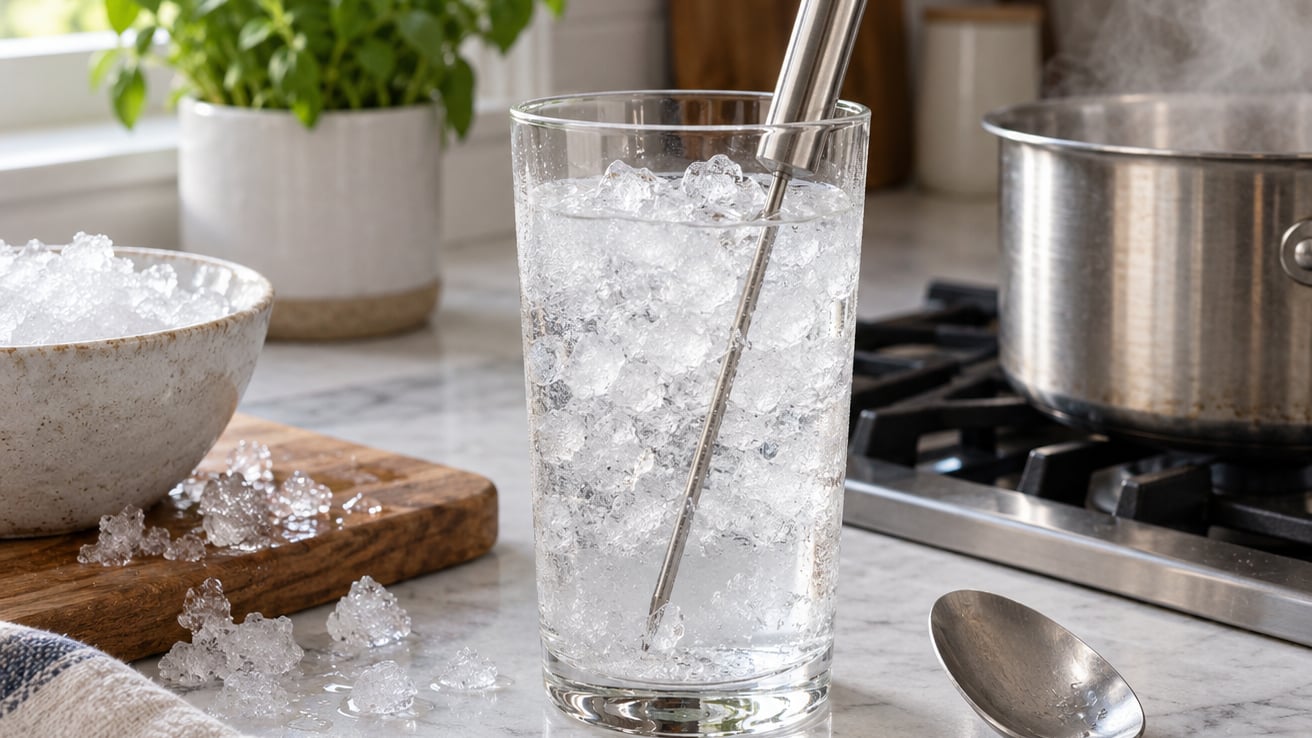
To calibrate a meat thermometer, test it in a well-packed ice bath until the probe reads 32°F (0°C), or in boiling water until it reads 212°F (100°C) at sea level, then adjust the nut or calibration button until the display matches. It takes about five minutes and needs nothing but ice, water, and a glass.
I check mine before any cook that matters. One analog dial in my drawer read 40°F in the ice bath, which meant every steak I had cooked from that thermometer was a few degrees cooler inside than I thought.
Most drift is boring. The thermometer gets dropped, gets left in a hot smoker, loses its battery, or simply ages. Any of those can move the reading, and every doneness decision you make afterward rests on that number. For the wider picture on safe temperatures, read our food safety rules for grilling meat guide before you start adjusting anything.
What You Need
You need very little for either method.
- A tall glass or cup — narrow ones are the worst option, because the probe touches the sides. A straight-sided drinking glass or a tall measuring cup works best.
- Crushed or shaved ice — bagged ice you can crush, or ice made in a countertop machine. Cubed ice from a tray works, just crush it first.
- Cold tap or distilled water — just enough to fill the gaps between the ice.
- A spoon — for stirring and packing the ice.
- A pot and a stirring tool — for the boiling water method.
- Your thermometer — and, if you have one, a second thermometer you trust. Comparing two units is the fastest way to catch a probe that has died.
Before you start, figure out which kind you are holding, because the fix differs.
Analog dial (bimetallic) thermometers usually have a small slotted calibration nut on the back of the dial. The case that came with it often has a hole or clip that doubles as the wrench. If the nut is missing, a small flat screwdriver usually works in a pinch.
Digital instant-read thermometers come in two flavors. Some have a calibration or reset function buried in the button sequence, usually on models from ThermoPro, Chefstemp, INKBIRD, and Meat Instrument. Many others are sealed and cannot be adjusted by the user at all, so check the manual before you spend time on it.
Leave-in pit probes — the wired or Bluetooth kind — usually have no user adjustment. Your leverage there is the app: compare what the phone shows against a separate reference thermometer in the same ice bath to see whether the fault is the probe or the transmitter.
How to Calibrate a Meat Thermometer: Step-by-Step
The ice bath is the more accurate of the two methods and the one to use unless the manufacturer tells you otherwise. A freezing point of pure water does not move with elevation or barometric pressure the way boiling point does, so the ice bath gives you the same answer whether you are at the coast or up a mountain.
Use the Ice-Water Method for Most Thermometers
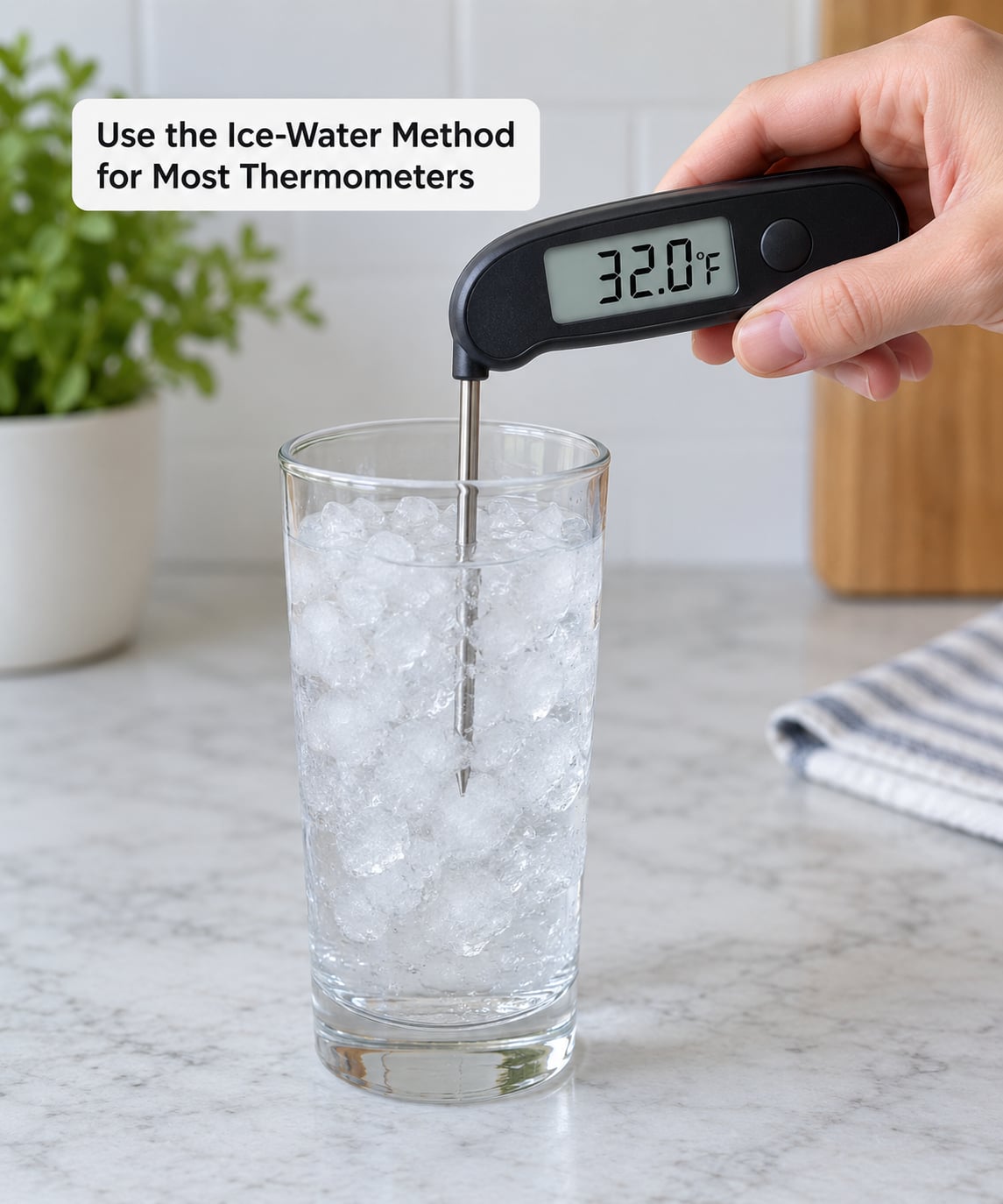
Fill the glass about halfway with crushed ice, then add cold water until the ice is fully packed and there are no dry pockets. Stir, add more ice if the surface looks slushy, and let the bath sit for a minute or two so it settles into a uniform 32°F (0°C).
- Make the bath. Half crushed ice, half cold water, packed tight enough that no air gaps remain.
- Stir and settle. Stir, wait about two minutes, top up with ice if the slush thins out.
- Insert the probe in the center — not against the glass, not resting on the bottom. Suspend it if you can, or use a spoon to hold it centered.
- Wait about 30 seconds, or until the reading stabilizes and stops moving.
- Read the display. A good thermometer sits at 32°F (0°C), give or take a degree or two.
- Adjust if needed, then retest. Turn the calibration nut or use the reset function until the display matches, then pull it out, dry it, and do it again in a fresh part of the bath.
The probe must not touch the sides or the bottom of the glass, because glass conducts heat from the room and the glass surface reads warmer than the bath. A probe resting against a warm wall will show 36°F in water that is a true 32°F, and you will chase a phantom error for an hour.
Do the test three times and compare. If the numbers vary by more than a degree or so between runs, the problem is your technique or the thermometer, not the thermometer’s calibration.
Use Boiling Water When the Manufacturer Recommends It
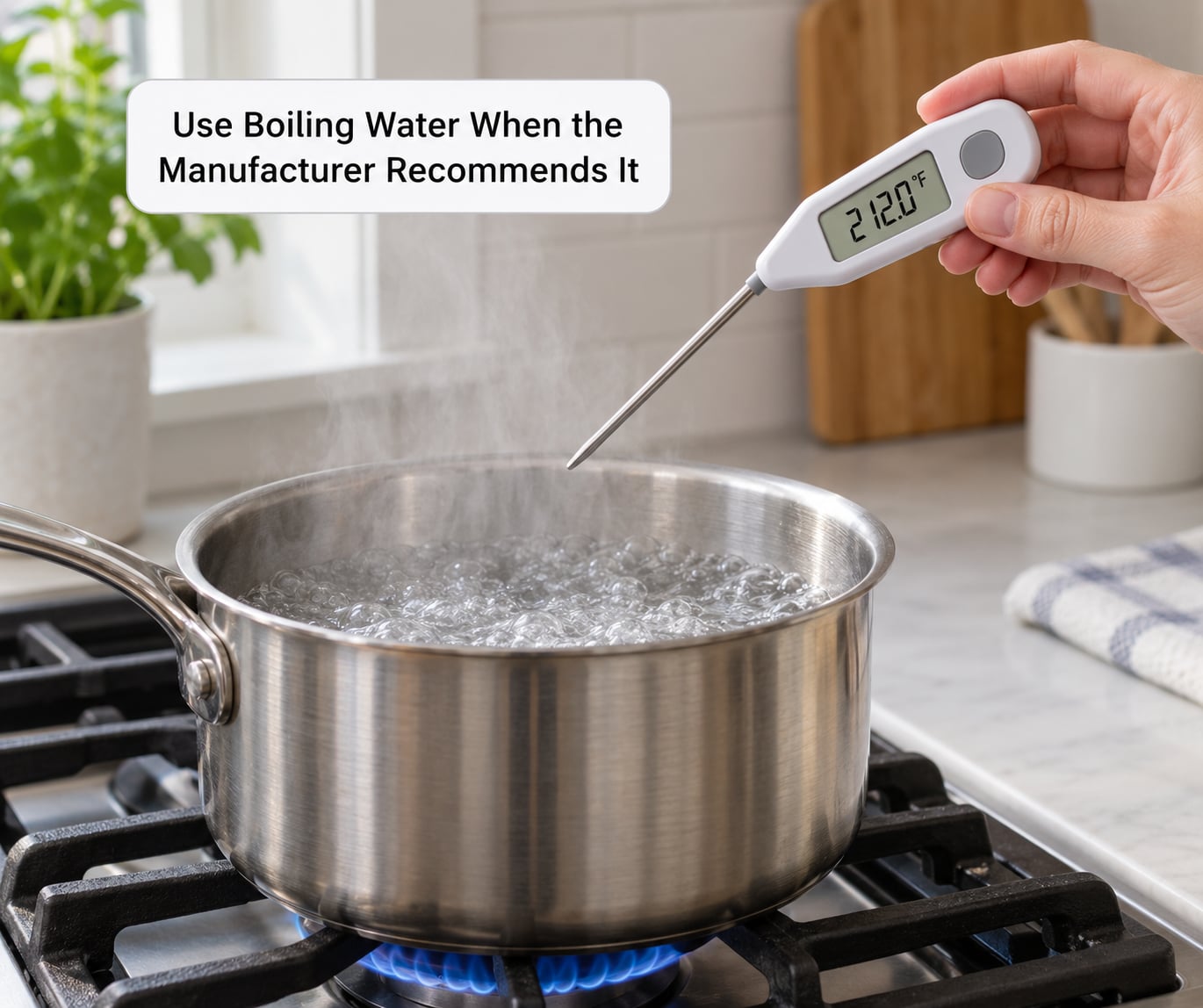
Some thermometer instructions specify the boiling point method, and it is the better choice when you cook at high temperatures often — a smoker pit probe, for instance.
- Bring a pot of water to a rolling boil and turn the heat down just enough to keep it bubbling steadily.
- Lower the probe into the water so the sensing element sits a couple of inches below the surface, not on the bottom or against the side. Clip it to the pot rim if the handle allows.
- Wait about 30 seconds for the reading to stabilize. Boiling water is turbulent and the first reading is usually the least trustworthy.
- Compare against your local boiling point, not against 212°F unless you are at sea level.
- Adjust and retest. Hold the unit steady with a utensil, not your fingers near the steam.
| Elevation | Boiling point (°F) | Boiling point (°C) |
|---|---|---|
| Sea level | 212°F | 100°C |
| 1,000 ft | 210°F | 99°C |
| 2,000 ft | 208°F | 98°C |
| 3,000 ft | 206°F | 97°C |
| 5,000 ft (Denver, roughly 5,280 ft) | about 203°F | about 95°C |
| 8,000 ft (Mexico City area) | about 197°F | about 95°C |
Rule of thumb: expect roughly 2°F less for every 1,000 feet of elevation. If you calibrate a pit probe against a 212°F target at 5,000 feet, you have built in a 9°F error and your brisket stall will never look right.
Check the Final Reading and Temperature Accuracy
A thermometer inside 2°F (1°C) of the known value is doing its job. That is the band most home cooks accept, and it is tight enough for food safety. If it is off by 3 to 5°F, adjust if you can, otherwise write the offset on the handle with a scratch of marker and add it to every reading. Beyond about 5°F, or if it drifts between cooks, replace it.
The catch that catches people: a thermometer can be right at 32°F and still wrong at 212°F. That is span error, and no amount of nut-turning fixes both points at once. If the ice bath and the boil disagree about how far off it is, trust the ice bath for your cooking, because that is where most of your accuracy matters.
Once it reads true, use it against these minimum internal temperatures:
| Food | Minimum (°F) | Minimum (°C) |
|---|---|---|
| Poultry and ground poultry | 165°F | 74°C |
| Ground beef, pork, lamb | 160°F | 71°C |
| Whole cuts of beef, pork, lamb, veal (with a 3-minute rest) | 145°F | 63°C |
| Fish and shellfish | 145°F | 63°C |
Apply your known offset to these numbers. If your probe reads 2°F low in the ice bath, pull your burger at 162°F (72°C) instead of 160°F. Our guide to telling when a burger is done without a thermometer covers the touch-and-time cues worth cross-checking against the number.
Common Mistakes
- Loose ice. A half-full glass with floating cubes reads 34°F or higher and looks like a bad thermometer. Pack the ice until the bath cannot hold any more.
- Probe touching glass or the bottom. The most common error by far. Use a wider glass or hold the probe centered with a spoon.
- Not waiting for a stable reading. Ten seconds is rarely enough for a cold probe to settle. Wait 30 seconds, then read only when the number stops moving.
- Using 212°F above sea level. At 5,000 feet your water boils near 203°F. Calibrating to the sea level number makes the probe worse.
- Assuming every digital thermometer can be adjusted. Plenty are sealed. Check the manual for a calibration function before you start turning buttons in a sequence.
- Trusting the hold button. On some cheap models the hold freezes an early reading mid-stabilization. If the number looks stuck, release hold and watch it again.
- Dirty probe. Carbon and dried bits insulate the sensor and skew everything. Wipe and sanitize before and after the test.
- Calibrating to fix a placement mistake. If the reading jumps around while the probe sits in one spot, that is not drift. Re-seat the probe and wait longer.
Two habits prevent most surprises. Check in the ice bath whenever you change batteries, drop the unit, or notice a reading that feels off. And keep the same thermometers in rotation rather than swapping models every cook, so you learn one instrument’s quirks instead of relearning them each time.
Frequently Asked Questions
How do I know if my meat thermometer is accurate?
Test it in a well-packed ice bath of crushed ice and cold water, with the probe suspended in the center and not touching the glass. Wait about 30 seconds for the reading to stabilize. A thermometer within 2°F (1°C) of 32°F (0°C) is accurate enough for home cooking. Repeat the test three times; if the readings disagree with each other, the issue is your technique, not the calibration.
What temperature should a calibrated thermometer read in ice water?
A correctly calibrated meat thermometer should read 32°F (0°C) in a properly packed ice bath. The bath needs to be roughly half crushed ice and half cold water, packed tightly with no dry pockets, and the probe must hang in the center without touching the sides or bottom. A reading of 31°F to 34°F is normal tolerance; anything beyond that means the bath or the thermometer is the problem.
Can I calibrate a meat thermometer with boiling water?
Yes, but only if the manufacturer approves it. Bring a pot of water to a rolling boil, hold the probe a couple of inches below the surface and away from the bottom and sides, and wait about 30 seconds for a stable reading. Water boils at 212°F (100°C) only at sea level, so at elevation you need the local boiling point or you will introduce an error of several degrees.
How often should I calibrate my meat thermometer?
Test it when you buy it, after any drop or battery change, and before a cook you care about, such as a whole turkey or a long brisket. After that, twice a year is plenty for most home kitchens. Any time a reading looks wrong, skip the schedule and test it immediately, because drift tends to show up as a slowly widening gap between what you read and what the food actually is.
What should I do if my thermometer will not hold a steady reading?
Check the bath before you blame the instrument. A loose ice bath, a probe resting on the glass, or a dirty probe all cause readings that wander. Clean the probe, remake the ice bath, suspend the probe in the center, and wait the full 30 seconds. If it still will not settle in fresh ice water, or if the display drops out entirely, the unit is failing and needs replacing.
Start With the Ice Bath
Fill a tall glass with crushed ice and a splash of water, stir, suspend the probe in the middle, and wait 30 seconds. If it reads 32°F (0°C), you are done and can go cook. If it does not, adjust the nut or calibration function and test once more before you trust it with a turkey. Once you have it right, size your patties to match the cook using our meat per patty size guide.