
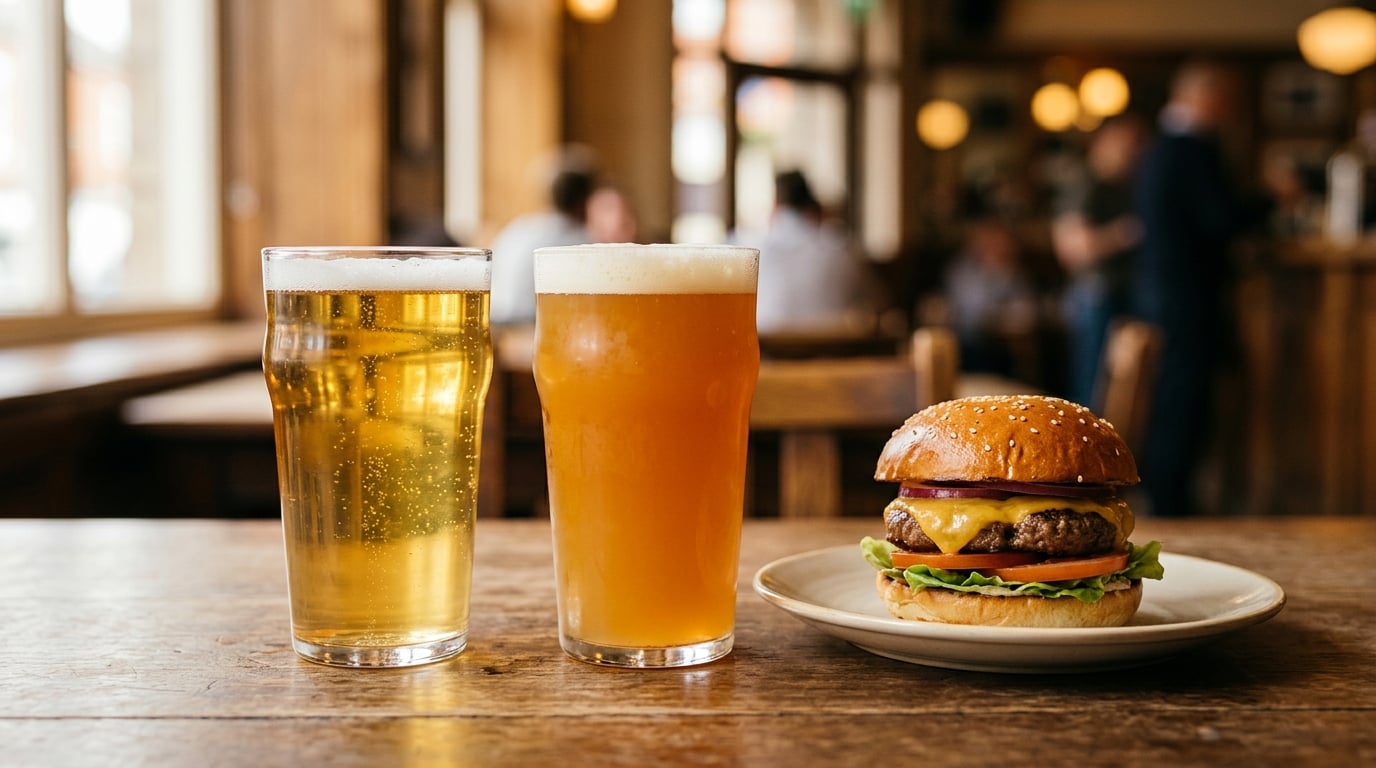
Pick the beer to match the burger, not the other way round. A lightly seasoned beef patty with a slice of American cheese wants a crisp, clean lager, while a double with bacon, blue cheese and heavy char wants a hop-forward IPA that can stand up to all of it. That single rule resolves almost every IPA vs lager with burgers argument, including most of the ones people have online.
An IPA is a top-fermented, hop-led ale, usually amber to golden and often cloudy, with bitterness and citrus, pine or tropical fruit on the nose. A lager is bottom-fermented and cold-conditioned, so it comes out pale, very clear and clean, with malt and sometimes a little sweetness underneath. One is built for aroma and bite, the other for refreshment. Neither is automatically correct.
Below I break down where the two styles actually diverge, which burger each one handles better, and how to pick a bottle at the store without getting lost in beer jargon. Last updated for 2026.
Table of Contents
- IPA vs Lager With Burgers at a Glance
- How Beer Flavor Changes With Burger Style
- Where IPA and Lager Taste Most Different
- Which Beer Works Best With Classic Cheeseburgers?
- Which Beer Handles Spicy and BBQ-Topped Burgers?
- Which Beer Pairs With Rich, Cheesy Burgers?
- IPA vs Lager for Grilled, Fried, and Vegan Burgers
- How to Choose the Right Beer at the Store
- Which Should You Choose?
- Frequently Asked Questions
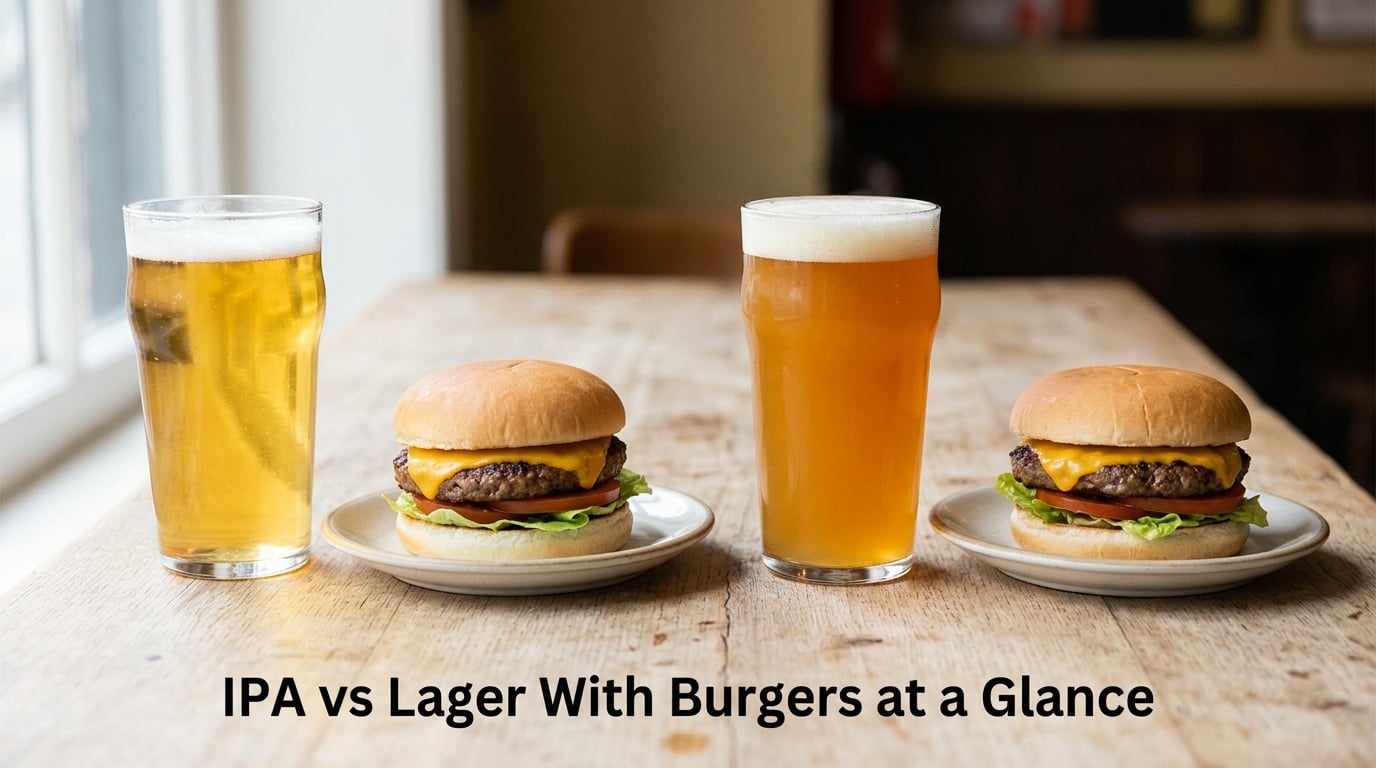
IPA vs Lager With Burgers at a Glance
| Criterion | IPA | Lager |
|---|---|---|
| Flavor centre | Hop aroma and bitterness | Malt and crispness |
| Typical aroma | Citrus, pine, resin, tropical fruit | None to faint, sometimes bready or floral |
| Bitterness | High, sometimes very high | Low to moderate |
| Malt character | Minimal, often dry | Bready, sometimes biscuity or caramel |
| Yeast character | Fruit-forward, sometimes spicy | Neutral, very clean |
| Appearance | Hazy and unfiltered, or clear gold | Pale and bright, almost always clear |
| Carbonation | Medium to soft | Firm and lively |
| Typical ABV | 5.5 to 7.5 percent, hazy styles run higher | 4 to 5 percent |
| Best burger match | Loaded, spicy, blue cheese, double patty | Plain patty, grilled chicken style, veggie patty, first beer of the afternoon |
| Main risk | Hops can bury a delicate or sweet burger | Can taste thin next to heavy char and toppings |
Short version: IPAs suit bold, spicy and richly topped burgers, while lagers are more forgiving and more versatile with classic, mild and heavily loaded burgers. The IPA is usually the stronger beer, so if you plan to eat rather than sip, that matters more than people expect.
How Beer Flavor Changes With Burger Style
A burger is a delivery system for four strong flavors at once: fat, salt, char and umami. Beer pairs well when it pushes back on at least one of them, and pairs badly when it simply matches the burger and adds weight.
Fat and carbonation are the easy pair. The bubbles in any beer physically lift the film of saturated fat off your tongue, which is why a fizzy lager feels like it cleans up after a greasy bite. Bitterness does the same job differently. Hop bitterness registers as a slightly dry, astringent note, and that dryness is the counterweight to the deep savoury umami of seared beef.
Char needs malt, not hops. The blackened crust on a grill is bitter and roasted, so a beer with some biscuity or caramel malt underneath gives the char somewhere to sit. A bone-dry, aggressively bitter West Coast IPA can make a heavily charred patty taste like a mistake.
Sweetness is where lagers have to watch themselves. A sweet glaze on a burger, a honey mustard sauce, or a barbecue sauce with real sugar will turn a thin lager cloying in a hurry. A dry-hopped or hoppy lager handles that combination far better than the same beer with a plain patty.
| Burger type | Best beer style | Why it works | Example |
|---|---|---|---|
| Plain cheeseburger | Light lager or German pilsner | Stays out of the way of beef and American cheese | Bitburger |
| Grilled burger with mustard and pickles | Vienna lager | Toasty malt matches the bread, moderate bitterness cuts the fat | Any decent amber lager |
| Double bacon cheeseburger | West Coast IPA | Bitterness and dryness cut through fat and salt | Badger Brewery West Coast IPA |
| Blue cheese burger | Porter or imperial stout | Roast and cocoa echo the blue cheese funk | Porter with a roasty finish |
| BBQ or pulled pork burger | Vienna lager or amber ale | Caramel malt meets sweet smoke without adding more sugar | Amber ale |
| Blackened or hot chicken burger | Hazy or New England IPA | Soft carbonation, low-ish bitterness, big tropical aroma | Any NE IPA under 7 percent |
| Spicy burger with jalapenos | Session IPA or pilsner | Hops reinforce the heat instead of fighting it, at a drinkable strength | Session IPA |
| Lamb burger | Hazy IPA | The lamb is fatty and gamey, and the juicy tropical hops soften it | New England IPA |
| Veggie or black bean burger | Kolsch or pale ale | Enough malt to stand up to a soft, vegetal patty | Kolsch |
| Sweet-glazed burger | Dry-hopped lager or a pale ale | Bitterness and hop aroma keep the glaze from flattening the beer | Dry-hopped pilsner |
That table is a good default, not a law. The variable that overrides it is how heavily seasoned the burger is, which is the same thing the decision rule says in fewer words.
Where IPA and Lager Taste Most Different
The real split happens in the fermenter. Ales ferment warm with top-fermenting yeast at temperatures that let the yeast make fruit and spice compounds, and a modern IPA also gets a heavy dose of hops late in the boil or after fermentation. Lager yeast works cold, slowly, and leaves almost nothing of itself in the glass, so what you taste is the malt and the water and the bubbles.
That is why an IPA can taste citrusy or piney with no hop bitterness at all, a hazy style that is mostly aroma, and why a lager can taste faintly sweet and bready with almost no aroma. The two families are not shades of the same beer. They start in different directions.
How IPA vs Lager With Burgers Balances Fat, Heat, and Char
Bitterness is the IPA’s whole advantage over a burger, and it works on two of the burger’s four flavors at once. Dryness counters umami, so a hoppy beer makes seared beef taste more like beef and less like a salt hit. The same bitterness sits against fat, and a fatty burger, whether lamb, double patty or bacon, is exactly what a West Coast IPA was built to cut through.
Lager does not have that bitterness to spend, so it spends carbonation instead. Firmer bubbles scrub more fat per sip, which is why a cold pilsner with a plain cheeseburger feels like the burger is being rinsed clean. What a lager cannot do is fight char or stand up to a pile of toppings, and that is where a thin light lager starts to look like it has nothing to say.
Char is the one flavor that actually argues for malt. A well-conditioned Vienna or Czech lager brings biscuity and caramel notes that sit under the crust nicely. A dry, resinous IPA does the opposite and makes the same crust taste harsh.
The forum crowd mostly agrees on the mechanism, and it is worth listening to because the community is split right down the middle on the conclusion. On the Northern Brewer Forum, a user posted: “Vienna lager with any meal. Me like my burgers with a cold ipa.” One person, both sides. On Smoking Meat Forums, another dismissed the default outright: “Light lagers are not going to cleanse the palette. Craft stuff works well. Pale ales, IPA.”
Both are right, and the disagreement is really about what is on the bun. Someone describing “burgers” in the plural is probably thinking of a loaded cookout burger. Someone describing a plain patty is right that a light lager cleans the palate better. On Brewver Forums, one poster summed up the compromise most people land on: “an IPA and lager always has to be there. If no flights, IPA first then the interesting option. If available I like to go Kolsch or Czech lager.” Both on the table, interesting one second.
Which Beer Works Best With Classic Cheeseburgers?
For a plain beef patty with a slice of American cheese, lager wins, and it is not close. The burger is doing all the talking. You want a beer with a clean finish and enough carbonation to reset your palate, not one that adds a second flavor conversation to a two-ingredient sandwich.
A German pilsner is the most useful default here. Reddit’s r/food crowd keeps naming the same example, with one commenter noting that “German pils is a little lighter, sharper in the bitterness, can have the same earthy hops aroma. Bitburger is a good example.” That description is exactly right for a cheeseburger: enough bitter edge to notice, not so much that it competes.
This is also the case where an IPA can go wrong. On a very lightly seasoned patty with a pale bun and mild cheese, a full-strength West Coast IPA reads as an acquired taste that nobody asked for, and the beer ends up more bitter than the food is savoury. If you want hops with a simple burger, a session IPA or a pale ale gets you there without the mismatch.
One caution on cooking: if you want a light lager with a plain burger, cook the patty to 160 F for ground beef, then rest it a couple of minutes before you build. A patty straight off the grill is juicier than you want when the beer is doing the cutting.
Which Beer Handles Spicy and BBQ-Topped Burgers?
Heat changes which IPA you want, and this is where the sub-styles earn their keep. If the burger is genuinely hot, with fresh chilies, hot sauce or a blackened crust, a West Coast IPA’s aggressive bitterness can make the heat feel worse. Hazy and New England IPAs are softer: lower perceived bitterness, dense tropical and citrus aroma, and gentler carbonation that cools rather than sharpens.
People on Reddit’s r/beer make the same call for fatty, gamey burgers, noting that lamb “has a high fat content and a lot of depth” and that “a better fit would be a NE/Hazy IPA.” A hot chicken burger sits in the same territory.
Smoky barbecue burgers are different again. The sauce brings its own sweetness, so what you want is a dry, bitter edge to stop it flattening. A dry-hopped lager or a pale ale does that without pushing you over 5 percent ABV, which matters when the sauce is making you thirsty. On Homebrew Talk, one thread had someone pairing a Czech dark lager with burgers and calling the combination “ok beer.. and fantastic burgers,” which points the same direction: malt and roast under the smoke, not more hops.
For a burger with moderate heat, you can go either way. A pilsner at 4.5 percent refreshes you through a hot meal, and a session IPA adds aroma without adding much alcohol. Reserve the double IPA for a burger that is rich but not hot.
Which Beer Pairs With Rich, Cheesy Burgers?
Rich is where an IPA finally gets to justify itself, and where a third option starts to make sense. A double patty with bacon, cheddar and mushrooms is a lot of fat and salt in one mouthful. A West Coast IPA’s dryness and carbonation are the best contrast you can buy, which is why the classic answer here is a pale, clear, sharply bitter IPA rather than a hazy one.
Blue cheese changes the answer. Its salty, moldy funk wants roast, coffee and cocoa notes, and hop bitterness alone will not meet it. This is the one burger where a stout or porter is the correct call and both IPA and lager are compromises. Forums agree on the ale side of the map too, with a Homebrew Talk user noting that “hamburgers and sausages are hearty enough for either kind of ale,” which is a fair summary of the ale-versus-lager debate as it plays out at a grill.
Cheddar and mushrooms are easier than blue cheese. A moderate pilsner or Kolsch handles both, since the cheese is mild and the mushrooms add umami rather than funk. Bacon and egg, a fried patty, or a burger with a heavy sauce pushes the same way: more bitterness, more carbonation, more body than a light lager.
The failure mode here is overdoing it. An imperial IPA at 9 percent beside a double patty is not a pairing, it is two heavy things at once, and by the second burger you will not taste either one.
IPA vs Lager for Grilled, Fried, and Vegan Burgers
Char and smoke lean toward malt. A well-grilled burger with dark edges is asking for a Vienna lager or a Czech lager, because the toasted bread notes sit under the crust without adding sweetness. A very pale lager next to heavy char is the pairing most likely to taste thin and slightly metallic.
Fried patties and chicken sandwiches want the opposite. Very hot frying means very crisp edges, and a beer with high carbonation and a dry finish is the right counterweight. A pilsner or a dry-hopped lager works well, and an IPA is fine if you like the hops in there.
Plant-based patties are the genuinely hard case. They are usually softer, wetter and more vegetal than beef, and a thin lager simply disappears against them. Most people land on a Kolsch or a pale ale, which has enough malt body to register without a heavy hop load burying the patty. A toasted bun changes the calculation, because now there is bread to pair with and a lager’s malt notes finally have something to work against.
Lamb and lamb-and-ricotta burgers go the other way, toward a hazy IPA for the same reason r/beer users cite: the fat is high and the flavor is deep enough to handle hops. Whatever the patty, keep an eye on the ABV. A 7 percent hazy IPA over a multi-burger cookout adds up faster than people expect, and heavy salty food makes you drink without noticing.
How to Choose the Right Beer at the Store
Read the style, not the color. A dark beer is not automatically a better match for a burger, and a pale one is not automatically too light. Tasting frameworks people use the three C’s, appearance, aroma and carbonation, but for picking a burger beer only the third one really decides anything: how lively is it, and does that tell me it will cut the fat.
Here is what to look for on the label, in order of usefulness.
- Bitterness. If the beer lists IBU, anything above about 40 will handle a double patty, and anything under 20 will feel thin next to char. Most people do not have this number printed, so use aroma as your proxy: if the can smells like citrus or pine, there are hops in there.
- Sweetness. Read the malt descriptor. Biscuit, toast, bread and caramel are the ones that help. Anything described as sweet, honeyed or dessert-like will fight a sauced burger.
- Body. Words like light, thin, crisp and session describe a lean beer. Words like bodied, malty, chewy or roasty describe a full one. Match this to the burger, not to your mood.
- ABV. American IPAs commonly run 5.5 to 7.5 percent and hazy styles higher, while light lagers sit around 4 to 5 percent. If you intend to eat two burgers, a 7 percent IPA is a lot of alcohol in a sitting, and a session IPA or pilsner is the safer pairing.
- Carbonation. Look for words like sparkling, crisp, dry and effervescent. Those are the ones that will clean up the grease.
On lager sub-styles, which are not interchangeable with a light lager: a Czech or Bohemian lager has real malt depth, a German pilsner is sharper and more bitter, a Vienna lager is amber and toasty, and a Kolsch is a lighter, slightly fruity ale fermented cool in Cologne. Homebrew Talk users reach for Czech lagers and Brewver Forums users name Kolsch by name, which tells you both sell well against meat.
On IPA sub-styles: a West Coast IPA is clear, dry and bitter, which suits fatty burgers. A hazy or New England IPA is juicy, cloudy and lower in bitterness, which suits spicy and delicate ones. A session IPA gives you hop aroma at 3 to 5 percent for long cookouts. Imperial IPAs are for people who want the burger to taste like a side dish.
Serve them differently too. A lager wants to be cold, roughly 35 to 40 F, in a glass that lets you see the foam. An IPA is better slightly warmer, around 45 to 55 F, because cold suppresses the aromatics you paid for. Pour the lager first at a cookout and the IPA second, which is also what the Brewver Forums poster recommended above.
Which Should You Choose?
Best IPA for a burger: a West Coast IPA, dry and sharply bitter, when the patty is fatty with bacon, cheddar or mushrooms. Best lager for a burger: a Vienna or Czech lager, which has the malt depth to stand up to a grill without the bitterness of hops. Best for beginners: a pale ale or a pilsner, sitting between the two families and hard to get wrong.
Lowest alcohol option: a session IPA or a pilsner at 3 to 5 percent. This is the one I would actually put in front of a big group at a cookout, where a 7.5 percent hazy IPA across six people adds up in a hurry. Most reliable all-purpose pick: a pilsner or a dry-hopped lager. It handles a plain patty, a grilled patty and a moderately loaded burger without going wrong on any of them.
If you are at a brewpub with no flight and no idea, order the lager first, the way the community advice suggests, then move to something with more hops once you are into the meal. If you are cooking, there is one more trick: deglaze the pan with the beer you plan to drink. The burnt bits and fond come up into the sauce, the beer loses a little of its sharp edge, and it ties the plate and the glass together.
One more thing worth knowing, since it comes up constantly: Corona is a lager. So are Budweiser, Miller, Heineken, Pilsner Urquell and Modelo Especial. Knowing which family a beer belongs to tells you less about the burger than the sub-style does, which is why style on the label beats any reputation a brand has.
Frequently Asked Questions
Is IPA or lager better for a cheeseburger?
For a plain beef patty with American cheese, lager is usually the better choice. A pilsner or light lager cleans the fat off your palate and lets the beef and cheese taste like themselves. Reach for an IPA only when the burger is loaded, spicy or heavily charred. A thin lager next to a double patty with char and bacon can taste flat, and a full-strength IPA next to a plain patty tastes more bitter than the food is savoury.
Should I avoid IPA with spicy burgers?
Only the aggressively bitter kind. A West Coast IPA’s bitterness can make fresh chili or hot sauce feel worse, so for a hot burger pick a hazy or New England IPA instead. Those are softer, lower in perceived bitterness and full of tropical aroma, and they cool the heat rather than sharpening it. A session IPA works well too if you want the hop flavor without a high ABV alongside a spicy meal.
Does a darker or more bitter beer always taste better with burgers?
No. A dark beer is roasted rather than better, and bitterness only helps when the burger is rich enough to balance it. Very bitter beers make a heavily charred patty taste harsh, and light beers disappear against a double with heavy toppings. Match intensity to complexity: the more fat, char and sauce on the burger, the more bitterness and body the beer can carry.
What kind of lager pairs best with a loaded burger?
A Czech or Bohemian lager is the strongest all-round answer because its malt depth holds up against cheese and char. A Vienna lager is softer and toastier, which suits a grilled burger with mustard and pickles. A dry-hopped lager is the pick when the burger has a sweet barbecue sauce or glaze, since the hop aroma keeps the sweetness from flattening the beer. A thin light lager is the weakest option once the toppings pile up.
Can I use nonalcoholic beer with burgers?
Yes, and a NA lager or NA pilsner is usually the better pick of the two. The carbonation and hop profile still handle the fat and char, which is the whole job a beer is doing on the plate. A nonalcoholic IPA tends to taste more heavily hopped and less crisp, so pair it with a burger that has enough flavor underneath, such as a double patty with cheddar, rather than a plain one.
Start with the burger, not the beer aisle. Count the toppings: a plain patty gets a pilsner, a double with bacon and char gets a West Coast IPA, a hot burger gets a hazy IPA, and anything with blue cheese wants a stout. If the group is large and the afternoon is long, a session IPA keeps everyone at the grill and nobody under the table.