
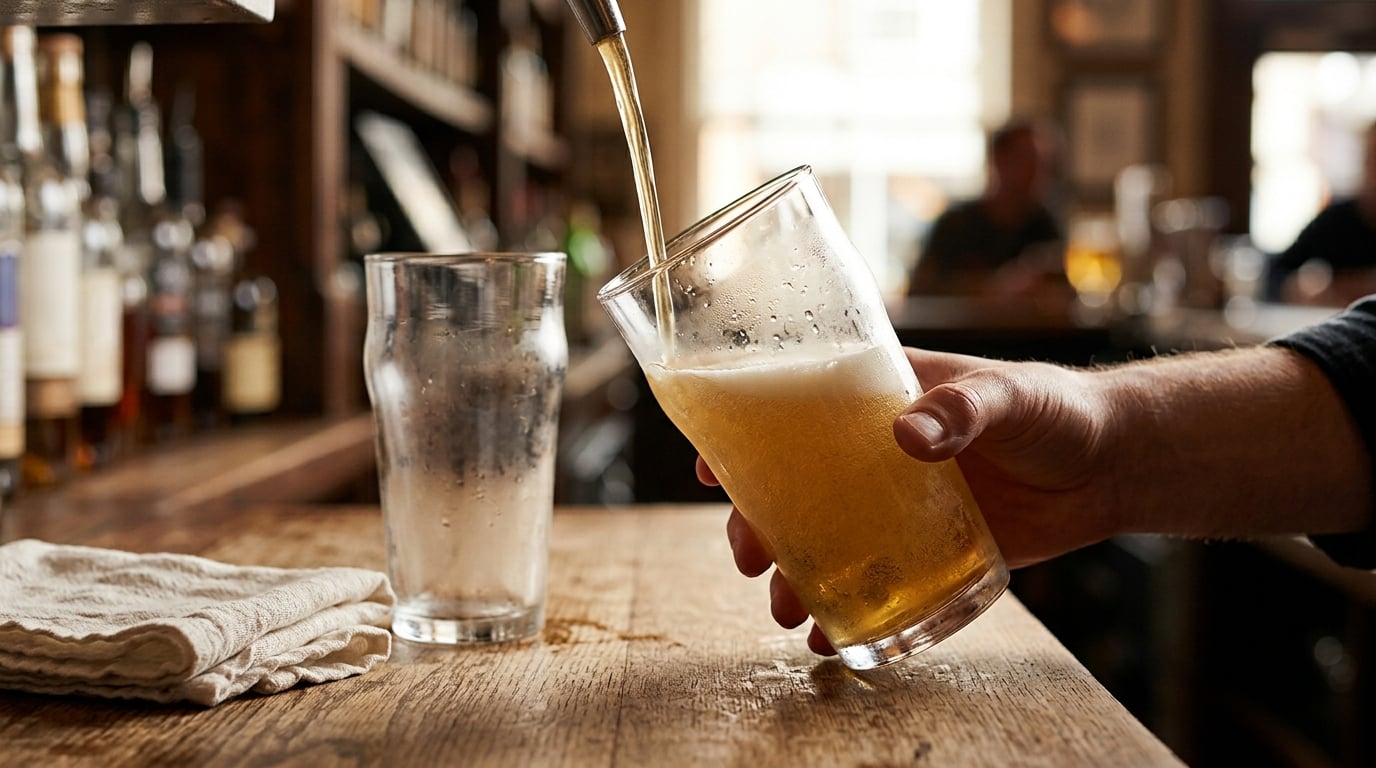
Pour beer without too much foam by tilting the glass about 45 degrees and running the beer slowly down the inside wall instead of dropping it into the bottom, then straightening the glass as it fills and stopping at a 1 to 1.5 inch head. Keep the beer and the glass cold, around 36-38F, and a clean pour takes about 15 seconds.
The foam is not the enemy. A thin head traps esters and hop oils and keeps oxygen out of the beer. What ruins a pour is turbulence: beer falling through air turns dissolved CO2 into gas faster than it can dissolve back, and a glass that ends up as three-quarters froth usually means flat beer underneath. Get the angle and the speed right and the problem mostly disappears.
Some pours foam no matter how careful you are, and that is where home kegerator owners get stuck. A 1 foot picnic nozzle hose running at 2-3 PSI and a standard 5 to 10 foot beer line at 10-12 PSI are two completely different setups, and only one of them can hold back pressure. The step method below fixes technique; the mistake list covers the system faults that survive it.
Table of Contents
- What You Need
- How to Pour Beer Without Too Much Foam: Step-by-Step
- Common Mistakes
- Frequently Asked Questions
- Why does my beer have too much foam when I pour it?
- Should I pour beer straight down or down the side of the glass?
- What temperature should beer be for pouring with less foam?
- How do I pour beer from a bottle without creating a huge head?
- How much foam should a beer have when it is poured?
- Can I remove excess foam after pouring a beer?
- Conclusion
What You Need
A cold, clean glass does most of the work. Chill it in the refrigerator or rinse it under cold water, then dry it with a lint-free towel. Detergent residue and fabric lint both give CO2 somewhere to escape, so a glass that was washed with dish soap and air-dried can hold almost no head at all.
Match the shape to the style. A nonic pint glass with an etched or dimpled base holds a stable head on lagers and pale ales, a tulip glass concentrates aroma on IPAs and anything aromatic, and a weizen glass with a thick flared top suits wheat beer and high-carbonation styles. Skip thick-walled souvenir glasses; the heavy base and rough surface give bubbles too many places to form.
You also need:
- A towel for gripping a cold glass and catching drips on the rim.
- The right temperature. Standard lagers and ales pour best at 36-38F. Nitro stouts are an exception at 42-44F, served cool rather than cold so the nitrogen stays in solution and the head pours creamy.
- Optional measuring aid. A pint marker or a simple eye-line on the glass beats guessing, because a 16 oz US pint and a 20 oz imperial pint leave very different headroom.
Never pour warm beer into a glass straight from a freezer. The temperature difference can crack thick glass, and a chilled glass in a warm room is fine; a frozen one is not.
How to Pour Beer Without Too Much Foam: Step-by-Step
- Start with the glass cold and clean. Cold surface, cold beer. If the glass is even 10 degrees warmer than the beer, bubbles form faster at the wall and cling to it.
- Hold the glass at roughly a 45-degree angle. Grip the base, not the bowl, so your hand does not warm the glass.
- Pour slowly down the inside wall, aiming at the middle of the slope. Not the bottom. The beer should slide, not fall. This is the single step that controls foam.
- Straighten the glass once it is about half full. Now you are deliberately dropping beer into the middle to build the head, and you control how much by how far you let it fall.
- Stop at a 1 to 1.5 inch head, close the tap, and let it settle for 20 to 30 seconds. Foam that keeps rising after the tap shuts is a pressure problem, not a pouring problem.
For bottled beer, do the same thing but pour in two stages: fill to two-thirds, pause for the head to settle, then top up. Bottles carry more carbonation than draft because the sugar is still doing work in the bottle, so an over-eager bottle pour foams twice as fast.
Guinness and other nitro stouts use the opposite technique on purpose. Let the first pour run all the way to the top, settle for about 30 seconds, then pour the rest with the widget just above the crown. The nitrogen widget is a plastic ball inside the can, and this staged pour is the whole reason the head comes out dense and creamy instead of airy.
How to pour beer without too much foam: the 45-degree tilt explained
Why pour at an angle at all? Because of what the fall does. Beer in a glass holds dissolved CO2 in solution. A column of beer dropping from height creates turbulence and entrains air, and every pocket of air becomes a nucleation point where gas escapes. Ten nucleation points become a million, and you get a head three times the size you asked for.
Running the beer down the wall keeps the stream in contact with a smooth surface, so it stays a sheet rather than a plunge. As the glass fills and you straighten it, you are switching from protecting the beer to building the head deliberately, and that is when a measured pour is better than a careful one.
Common Mistakes
Most excessive foam is one of four things: too high, too fast, too warm, or too dirty. Fix the matching cause rather than trying to pour around it.
- Pouring from too high. Fix: lower the bottle or can so the beer touches the glass wall at a distance of a couple of inches, not six.
- Pouring too fast. Fix: slow down as the glass fills. A 16 oz pour should take 10 to 15 seconds end to end.
- Serving the beer warm. Fix: keep the keg, the line, and the glass cold. Warm beer holds less gas, so more of it comes out of solution at once. Nitro styles are the deliberate exception at 42-44F.
- Using a dirty or detergent-coated glass. Fix: rinse with cold water only, or wash properly and dry with a lint-free towel.
- Not letting it settle. Fix: after the tap closes, wait 20 to 30 seconds. On a badly over-carbonated pour that may mean 5 to 10 minutes, as homebrewers on DIY Beer Community have found the hard way with 1 inch of beer under 5 inches of froth.
If your technique is right and the foam keeps coming, the fault is in the system. Home Brewers Association forum users force carbonating at 10-12 PSI and still finding the beer over-carbonated is a common report, and the answer is usually line length or a fault in the gas path.
| Cause | Symptom | Fix |
|---|---|---|
| Serving pressure too high | Pours as all foam, beer underneath is flat | Drop to 10-12 PSI for standard ales and lagers, then reassess |
| Line too short or kinked | Foamy, and the beer runs flat after the first glass | Use 5 to 10 feet of 3/16-inch line so restriction provides the back pressure |
| Dirty lines | Foam builds fast, flavors go off, gunk in the faucet | Clean the beer line every 2 to 3 weeks, or at minimum whenever it feels slimy |
| Failed seal or worn coupler | Constant hiss, foam regardless of pressure setting | Replace the coupler seals and check the O-rings on the keg connection |
| Warm line or faucet | Foam only on the first glass poured | Pre-chill the line in the freezer for 20 minutes or let the faucet run cold |
There is a deliberate counter-argument to the 10-12 PSI rule worth knowing about. Some homebrewers on HomebrewTalk carbonate above serving pressure on purpose so they can pour off a large head and still have a beer that is not flat, served cool rather than ice cold. It works, and it is a reasonable choice for a high-carbonation American pale ale. It is a bad idea for a nitro stout or a delicate lager.
The reverse failure is worth knowing too. A beer that pours with no head at all, even from a properly carbonated keg, usually points to detergent residue, a soft towel or fabric lint in the glass. Rinse and dry again before you touch the regulator.
Frequently Asked Questions
Why does my beer have too much foam when I pour it?
Four things cause it: pouring from too high, pouring too fast, serving the beer warm, or a dirty glass with detergent residue. If you have fixed all four and foam still pours, the problem is your system rather than your technique. Check serving pressure, beer line length and cleanliness, and the coupler seals.
Should I pour beer straight down or down the side of the glass?
Down the side. Tilting the glass about 45 degrees and running the beer along the inside wall keeps the stream from plunging through air, which is what turns dissolved CO2 into a runaway head. Straighten the glass once it is about half full, then pour into the centre to build a measured head.
What temperature should beer be for pouring with less foam?
36-38F for standard lagers, ales and IPAs, with the glass chilled the same way. Warm beer holds less gas in solution, so more escapes at once. Nitrogenated stouts are the exception: serve them at 42-44F so the head stays dense and creamy rather than turning airy.
How do I pour beer from a bottle without creating a huge head?
Use a two-stage pour. Tilt the glass 45 degrees, pour down the wall until it is two-thirds full, then stop and let the head settle for 20 to 30 seconds before topping up. Bottles are more heavily carbonated than draft because the sugar is still fermenting in the bottle, so they foam faster and punish a fast pour.
How much foam should a beer have when it is poured?
One to 1.5 inches of head on a 16 oz pint. That head is functional: it traps esters and hop oils and protects the beer from oxidation. More than about 2 inches usually means you poured too aggressively or the beer is over-carbonated at serving, and the beer underneath will taste flat.
Can I remove excess foam after pouring a beer?
Yes, and you do not have to throw the beer away. Wait 20 to 30 seconds for the foam to settle, then skim or spoon off the excess, or pour the glass down to just above the head and top it up with a slower, angled pour. A heavily over-carbonated pour can need 5 to 10 minutes before the foam collapses.
Conclusion
Start here: put a cold, clean glass under the tap, tilt it about 45 degrees, and pour slowly down the inside wall before you straighten it. Stop at a 1 to 1.5 inch head. If foam still floods the glass, the next thing to check is your serving pressure and beer line, not your wrist.