
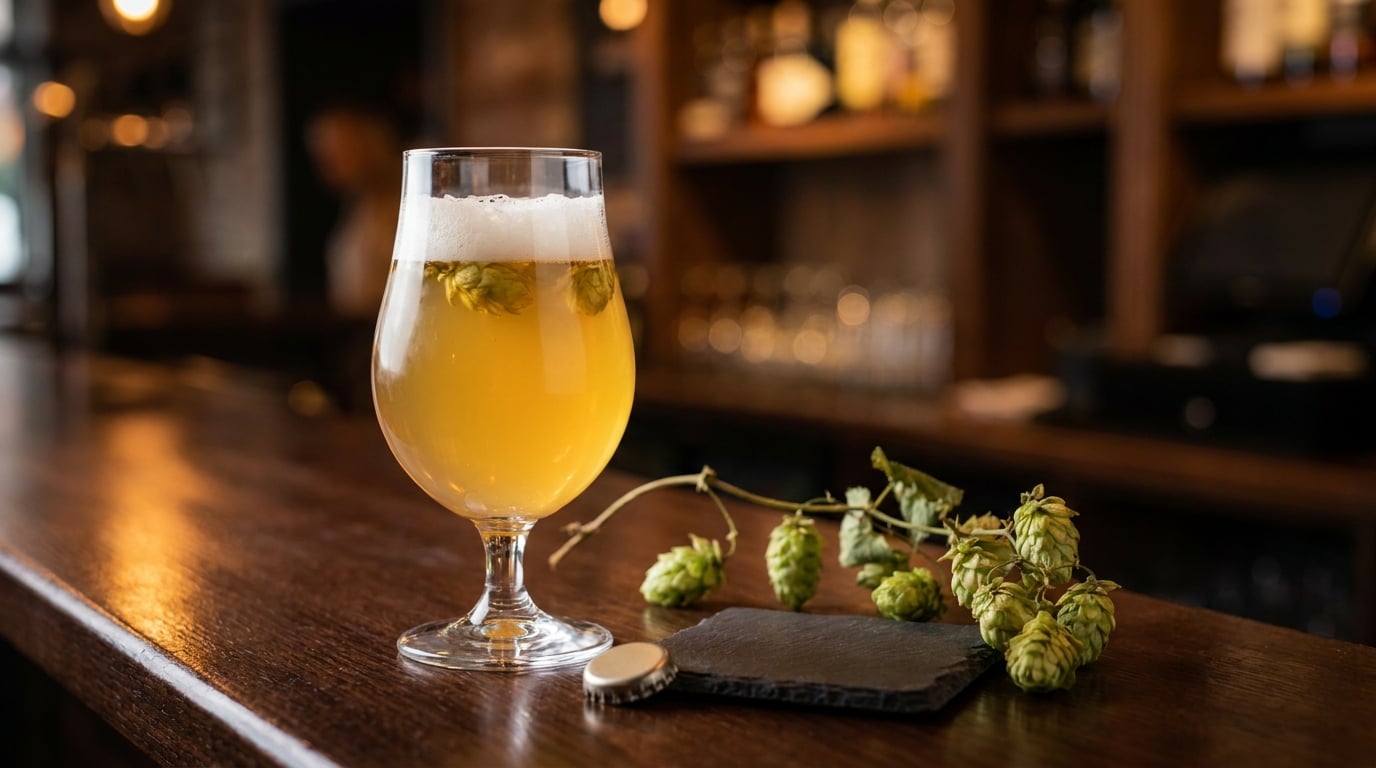
Hoppy means a beer where hops are a dominant, obvious part of what you smell and taste. A hoppy beer has a noticeable aroma, flavor, or bitterness that traces back to hops, the cone-shaped green flowers of the Humulus lupulus plant. It does not mean strong, heavy, or aggressively bitter.
Hoppy, defined: a beer with a prominent aroma, flavor, or bitterness contributed by hops, the dried cone flowers of the climbing plant Humulus lupulus. A beer can be intensely hoppy and still taste mild, or gently hoppy and still taste sharp.
That last part trips people up. I have poured two IPAs for the same person on the same night, and one got a “hoppy!” while the other got a confused frown. Same glass, same temperature, same word describing two completely different beers.
Here is the short version, which is the answer most people are actually looking for:
- Hoppy is not a synonym for bitter. Bitterness is one of three things hops do, and often the smallest one.
- Hoppy covers aroma and flavor too. Citrus, pine, tropical fruit, resin, flowers, grass, spice.
- Timing decides which sensation you get. Early kettle additions deliver bitterness, late additions and dry hopping deliver aroma with almost no extra bitterness.
If you only remember one thing: when someone says a beer is hoppy, they are almost always talking about the smell and the flavor, not the sour scrunch at the back of your throat. Updated for 2026, and still true.
Table of Contents
- What Does Hoppy Mean in Beer?
- How Do Hops Change a Beer’s Aroma, Flavor, and Bitterness?
- What Beer Flavors Make a Beer Taste Hoppy?
- Is Hoppy the Same as Bitter?
- Which Beer Styles Are Usually Hoppy?
- How to Taste Hoppy Beer
- How Hop Variety and Brewing Method Affect Hoppy Flavors
- Frequently Asked Questions
- What to Do First
What Does Hoppy Mean in Beer?
A beer is called hoppy when you can clearly taste or smell something that came from hops, and it is one of the loudest characteristics in the glass. Hops arrived in European brewing in the Middle Ages, brought by traders and monks who valued the plant as a preservative, and over centuries brewers learned to use it for aroma and flavor as well as keeping beer stable.
What “loud” means is the problem, because the word covers at least three separate sensations that a drinker can pick apart. A beer can hit on all three, or on just one, and the difference changes everything about how it lands.
Some drinkers think the word is too vague to be useful, and they are not wrong. A beer writer on Hopsonomy’s Facebook page put it plainly: describing a beer as “hoppy” is just plain lazy, because is the beer bitter? Floral? Resinous? Those are three different beers. On r/beer, drinkers usually reach for a more specific word instead, and that is why tasting notes read the way they do.
So treat “hoppy” as the category and the tasting note as the detail. Hoppy is the family. Citrusy, piney, resinous, tropical, floral are the members.
How Do Hops Change a Beer’s Aroma, Flavor, and Bitterness?
Hops do three separate jobs in the kettle, and they come from two different parts of the plant. Alpha acids, which live mostly in the leafy bracts, boil into iso-alpha acids and produce bitterness. Essential oils, the oily, volatile compounds that smell like citrus or pine when you crush a fresh cone, survive the boil and produce aroma and much of the flavor.
How do you describe hoppy taste in beer?
You describe it in three parts, and the quickest way to keep them straight is to ask what you are noticing.
| What you notice | Where it comes from | How it shows up in the glass |
|---|---|---|
| Hop bitterness | Alpha acids boiled early in the kettle, converted to iso-alpha acids | A sharp, drying, sometimes slick finish that hits the back of the tongue |
| Hop aroma | Essential oils kept back by late kettle additions and dry hopping | Everything you smell before and after the first sip |
| Hop flavor | Essential oils, plus how the hops interact with yeast and malt | The taste in the middle of the sip, which is usually the juiciest or most aromatic part |
Bitterness is the only one you feel on your tongue. Aroma is pure nose, and flavor is the part that only exists once aroma and taste are working together, which is why a beer with weak aroma tastes blander than its bitterness number suggests.
Why two hoppy beers can taste nothing alike
Because “hoppy” says nothing about which of those three jobs a brewer leaned on. One brewery charges the first kettle with enough hops to get a firm bitterness floor, then dry hops generously for a big grapefruit peel nose. Another keeps the kettle additions modest and finishes with a single dry hop, landing on pine and a drier finish.
Malt, yeast, and carbonation change the picture too. A hop character in a pale, dry, well-carbonated beer reads as louder than the same character in a beer with a sweet malt backbone. Nobody adds hops twice and gets the identical beer.
What Beer Flavors Make a Beer Taste Hoppy?
Most of the flavors people call hoppy fall into a handful of families, and once you know them you can guess the beer before you read the label.
- Citrus — lemon, grapefruit peel, orange zest. The most common American hop note and the easiest to recognize.
- Pine — resinous, woody, sometimes Christmas-tree. Pines and the older American hops push this hard.
- Tropical fruit — mango, peach, melon, lychee, passion fruit. The signature of modern American aroma hops in hazy and New England-style IPAs.
- Stone fruit — apricot, peach, plum. Softer and rounder than citrus, often paired with a fuller body.
- Floral — perfumed, sometimes soapy. Classic Saaz-style character, and common in Bohemian pilsners.
- Herbal and grassy — chamomile, hay, fresh-cut green grass. Noble hops and a few English varieties lean this way.
- Resin and dank — sticky, waxy, earthy, sometimes close to a cannabis-adjacent note. The most polarising of the group.
- Spice — pepper, clove, spicy heat. Often from rye malt or peppery European hops rather than from hop aroma alone.
A citrusy West Coast IPA, a juicy hazy IPA, and a spicy rye beer can all be described as hoppy, and they share almost nothing in the glass. That is why “hoppy” alone is such a frustrating answer to give someone choosing a beer.
Is Hoppy the Same as Bitter?
No. They overlap, and a heavily bitter beer is usually also hoppy, but hoppy covers aroma and flavor while bitter is a single sensation on the tongue. The clearest example is a hazy IPA: saturated with hop aroma and hop flavor, yet often perceived as quite mild, because a thick, soft body and sweetness round off the bitterness.
IBU, the standard scale for hop bitterness, is where the confusion usually starts. Numbers on a menu describe potential bitterness from iso-alpha acids, not what you will taste, and a 70 IBU barleywine can taste gentler than a 50 IBU pale ale because of the extra malt sweetness and alcohol carrying it.
Perception is the whole game here. Sweetness softens bitterness, alcohol and carbonation sharpen it, a cold glass mutes it, and a warm glass amplifies it. That is the point the BeerAdvocate community keeps making: bitterness is how hard the taste receptors are firing, which is a different measurement than how much hop character a beer has.
Which Beer Styles Are Usually Hoppy?
IPAs are the usual answer, but they are far from the only one, and a style name only tells you where to start looking. Individual beers vary a lot inside every style, sometimes more than two different styles vary from each other.
| Style | Typical IBU range | What to expect |
|---|---|---|
| Double or Imperial IPA | 60 to 100 and up | Big in both directions, heavy resin and pine, often noticeably strong |
| West Coast IPA | 40 to 70 | Clear, dry, sharp, piney and resinous with a firm bitter finish |
| American Pale Ale | 30 to 50 | Balanced and hoppy, the middle ground most people start with |
| Hazy or New England IPA | 20 to 40 | Enormous tropical and citrus aroma, low apparent bitterness, soft and often juicy |
| Session IPA | 30 to 50 | Full hop flavor at a lighter strength, built for drinking more than one |
| Bohemian pilsner | 20 to 40 | Floral, spicy and herbal, genuinely hop-forward and barely bitter |
| India Pale Lager | 40 to 70 | Hop character over a clean, cold-fermented base, the lager answer to an IPA |
| Saison | 20 to 35 | Peppery, fruity, dry, with earthy hop edges rather than loud citrus |
| Amber ale and red ale | 20 to 40 | Toasty malt carrying a moderate, rounded hop middle |
| Pale lager and standard lager | 8 to 20 | A light grassy or floral touch, sometimes a small bitter snap at the end |
The naming convention adds to the muddle. Nothing in the words “India Pale Ale” says hoppy, but drinkers have read it that way for generations, and the same goes for India Pale Lager. Style labels are a hint, not a description.
What kind of beer is the least hoppy?
Light lagers, cream ales, and simple lagers sit at the bottom of the list. Fruit beers and wheats can be hoppy in aroma while tasting sweet, and stouts usually bury hop character under roast, so a coffee-like porter is not where you go for hops. Dark beers are not automatically low-hop, but they rarely put hops in front.
How to Taste Hoppy Beer
Tasting hoppy beer takes less effort than most people expect. You are not grading anything, you are just separating what you smell from what you taste, and that alone tells you more than any description on a tap handle.
- Pour into the right glass. A tulip or IPA glass concentrates aroma at the top; a pint glass works fine and gives you more headroom. Rinse it with cold water first if you have it.
- Get the temperature right. Beer straight from a fridge at 40°F tastes flat and muted. Let it sit until it feels less cold against your palm, usually 10 to 15 minutes for a full glass.
- Look before you smell. Color, clarity and foam tell you about body and carbonation, both of which change how bitterness lands.
- Smell, then smell again. Cup the glass, swirl gently, and take two short sniffs. The first pass finds fruit and citrus; the second pass usually finds pine, resin, or something earthier underneath.
- Sip small and pay attention to the first second. The opening impression is aroma and flavor. That is the hoppy part.
- Then follow the finish. The finish is where bitterness lives. A clean, dry, quick fade means mild bitterness; a long, drying, slightly slick tail means real bitterness.
- Compare against a style you know. Side by side with something familiar, a new hoppy beer becomes a set of differences instead of a mystery.
One more thing that helps: pour hoppy beers in the order of lightness on a tasting night, pilsner first, double IPA last. Your palate tires, and the last beer always tastes more bitter than it would have an hour earlier.
How Hop Variety and Brewing Method Affect Hoppy Flavors
Two beers can use the same amount of hops and taste nothing alike, because the variety and the timing do most of the work. The variety sets the flavor family, and the timing decides whether you get bitterness or aroma.
| Hop variety | Dominant flavor descriptor | Where you meet it |
|---|---|---|
| Cascade | Floral, spicy, evergreen | West Coast pale ales and classic American IPA |
| Centennial | Pine, resin, grapefruit | American pale ales and American IPA |
| Citra | Citrus, lime, tropical fruit | Modern American IPA and hazy IPA |
| Simcoe | Pine, earthy, resinous | American IPA and West Coast IPA |
| Mosaic | Blueberry, mango, citrus | New England and hazy IPA |
| Galaxy | Peach, passion fruit, citrus | Australian-leaning hazy and modern IPA |
| Amarillo | Sweet orange, melon | American IPA and pale ale |
| Nelson Sauvin | White peach, lime, tropical | New Zealand-style hazy and session IPAs |
| Saaz | Floral, herbal, spicy | Bohemian pilsner and Czech pale lager |
| Noble hops | Mild, earthy, grassy | Traditional Czech and German lagers |
The brewing method is the second half. Bittering hops go in early, at the start of the boil, because long boiling drives the bitterness in and blows the volatile aroma away. Whirlpool and late kettle additions plunge hops into very hot wort for a short time, pulling aromatics out with little extra bitterness. Dry hopping drops hops into the fermenter after fermentation, or right before packaging, and adds aroma and flavor with essentially no bitterness at all.
That is the answer behind a question homebrewers ask constantly. On HomebrewTalk, brewers keep running into the same moment: a beer tastes “too hoppy” and nobody can agree on what that means. In the kettle, hops are all bittering hops. If the beer is too bitter, the fix is timing and quantity, not more hops. If it is too aromatic or too green-tasting, the fix is a smaller or later addition.
Frequently Asked Questions
Does IPA mean hoppy?
Mostly by reputation rather than by definition. India Pale Ale was built around hops, and drinkers have read that name as a promise of hop aroma for well over a century. The style leaves plenty of room, though: a West Coast IPA is sharp, piney and bitter, while a New England IPA can taste juicy and soft with little perceived bitterness. Both are hoppy, just in very different ways.
Is hoppy the same as bitter beer?
No, though they often appear together. Hoppy is a category that includes aroma, flavor and bitterness. Bitter is one sensation on the tongue, produced when alpha acids from early kettle additions boil into iso-alpha acids. A hazy IPA is a good demonstration: heavy hop aroma and flavor, mild perceived bitterness, because a soft body and sweetness round the edge off.
Does dry hopping add bitterness?
Almost none. Dry hopping happens in the fermenter after fermentation, with no boil involved, so the alpha acids never get converted into the iso-alpha acids that create bitterness. What it adds is aroma and flavor, sometimes a great deal of it. If a beer tastes harsh rather than hoppy, the cause is usually early kettle additions, not the dry hop.
What kind of beer is the least hoppy?
Light lagers, cream ales and plain lagers are the least hoppy, usually landing somewhere around 8 to 20 IBU with a light grassy or floral touch. A light lager brand would not be described as hoppy, whatever the can says. Sweet wheat beers and fruit beers can smell very hoppy while tasting sweet, so aroma alone does not make a beer hoppy.
Do hops make you buzzed?
No. The intoxicating effect comes from ethanol, and the hops in a beer do not add any of their own. A heavily hopped IPA can be lower in alcohol than a bottle of pilsner, and a heavily hopped barleywine can be stronger. Buzziness tracks alcohol content and how much you drink, not how many hops went into the kettle.
Is hoppy beer better for you?
There is no mainstream guidance that treats hoppy beer as healthier than other beer, and hoppy usually signals more flavor and aroma, not a better or worse effect. Alcohol is ethanol regardless of hops, and standard advice on moderate drinking applies to every style. There is no special health case for IPAs, and if drinking affects your health, talk to your doctor rather than to a beer forum.
What to Do First
So, what does hoppy mean in beer? A beer that smells and tastes unmistakably of hops, from aroma, flavor or bitterness, and most often the first two. Start by tasting the nose separately from the taste, and every label on the shelf suddenly gets a lot more useful.
If you are still working out what you like, the fastest next step is a side-by-side of an American pale ale, a Bohemian pilsner and a hazy IPA. Same glass, same temperature, three sips. The difference between them is what hoppy actually means in practice.