
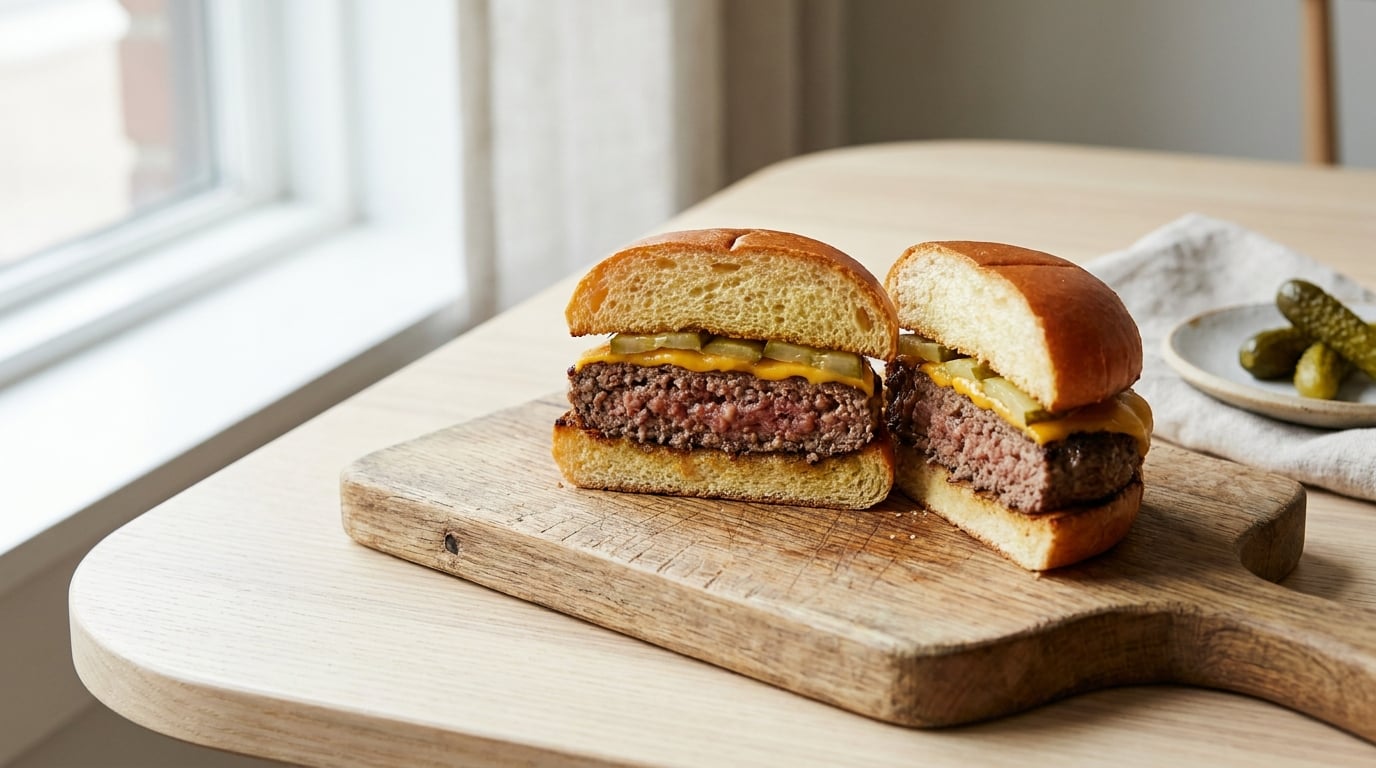
To judge a good burger when eating out, run it through nine checks in order: look at the crust and the bun, smell for real browning, take a slow first bite for salt and moisture, then watch what happens on bites two and three. If the beef is still the loudest flavor on your last bite, the burger is good. A bad one gives itself away much earlier.
Most of what separates a great burger from a disappointing one happens in under two minutes, then it’s gone. That is why people walk away saying “it was fine” when it wasn’t. Naming the cues turns a vague feeling about a meal into a standard you can apply anywhere.
Updated for 2026. Written by the BQM Burger desk, a group of people who eat out at burger bars, gastropubs and fast-casual counters several times a week and take notes on all of them.
Table of Contents
- How to Judge a Good Burger When Eating Out
- What Makes a Burger Taste Good?
- Look at the Burger Before You Bite
- Check the Patty
- Taste the Bun and Toppings
- Notice the Temperature, Texture, and Moisture
- Ask Whether the Burger Is Balanced
- Use Restaurant and Menu Clues
- A Simple Checklist for Your Next Bite
- Frequently Asked Questions
- The Bottom Line
How to Judge a Good Burger When Eating Out
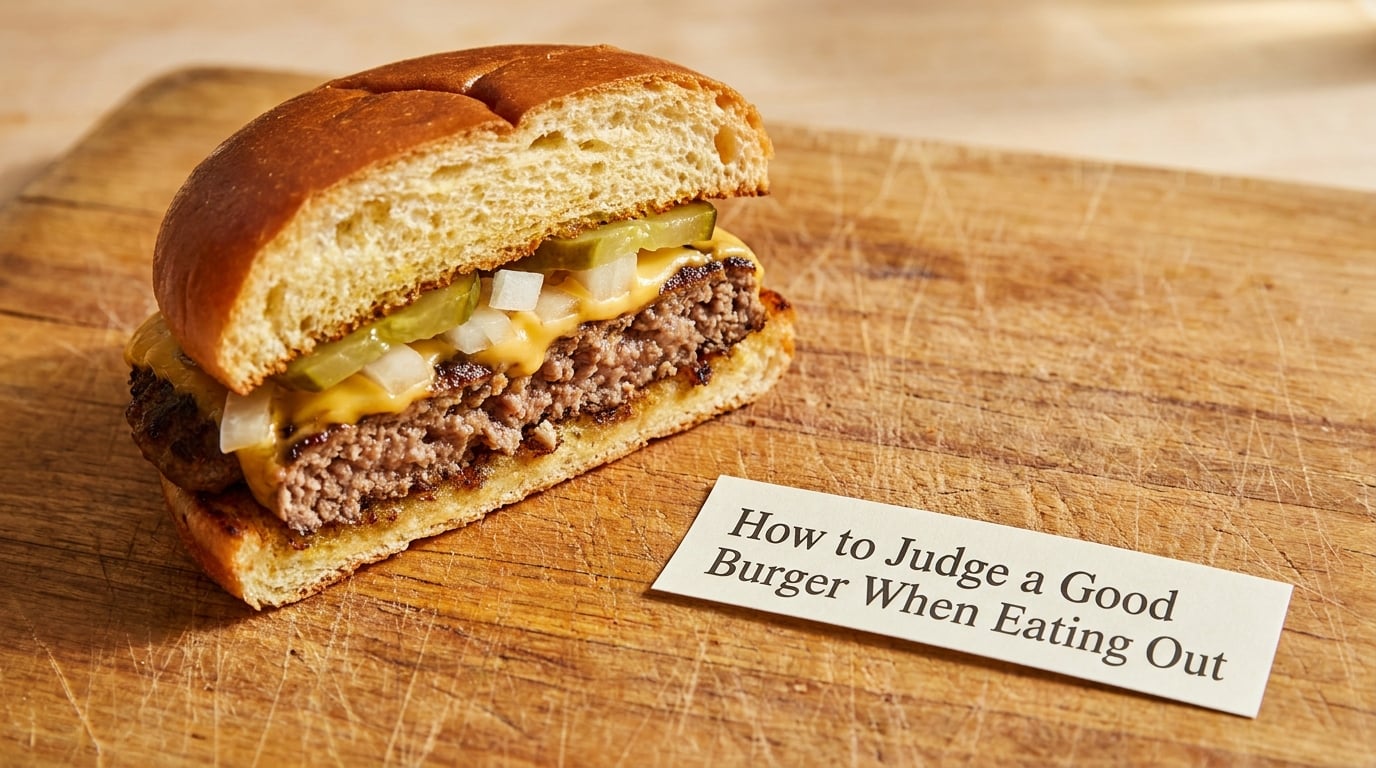
The framework below runs in three moments. Before you order, the menu tells you what to expect. When the plate lands, your eyes and nose do the first pass. Then the bites do the rest.
How to judge a good burger when eating out: the nine checks
- The crust is visible. You should see browning on the outside of the patty, not a uniform pale grey surface.
- It smells like beef, not freezer. Warm browning aroma with a faint sweetness beats any sour, chemical or icy note.
- The first bite is salted. Seasoning should register before the sauce does.
- The patty matches the bun. A double patty crammed into a single thin bun is a structural warning.
- The bun is toasted and fresh. Cut-side toasting and a soft-chewy crumb, never cardboard.
- The cheese has melted properly. Cheese that is still in rigid sheets means the burger sat too long.
- The center is hot, not just warm. A cold middle under a hot crust is a doneness problem.
- It is moist without dripping. One clean drip is fine. A puddle on the plate means the patty was under-seasoned and thin-fat.
- The finish is still beef. After the last bite you should remember beef, not grease or harsh salt.
Use them in that order because the early ones save you from eating the whole thing. Nobody wants to spend six bites discovering the bun was stale.
What Makes a Burger Taste Good?
You are tasting balance, not any single ingredient. A great burger has beef flavor that stays legible, fat that reads as richness rather than grease, seasoning that seasons the meat, and a bun soft enough to compress but sturdy enough to hold.
That last point trips people up. The patty carries the flavor, the bun carries the structure, and the toppings carry the contrast. When one part overwhelms the other two, the burger stops tasting like beef and starts tasting like one thing.
Cheese and sauce are seasoning as much as flavor. A slice of melted cheddar adds salt, fat and dairy depth. A house sauce adds acid or sweetness that cuts through the fat. A stack of raw pickles is not fussiness; acid is what keeps a rich burger from going flat on bite four.
Freshness is the quiet ingredient. A patty ground recently smells meaty and warm. Beef that has been sitting does not, and once the aroma is gone you cannot get it back with sauce.
Look at the Burger Before You Bite
Your eyes take about two seconds. Spend them. A good burger has a browned, uneven crust with darker lacy edges where the meat touched the cooking surface most, a bun that is golden at the cut face and soft on top, and a patty whose diameter matches the bun without spilling past it.
The lacy edge is the tell for a smashed patty. A thin patty pressed onto a hot flat-top develops a wide, crinkled, crisp fringe and a well-done crust while the center stays rare. That contrast is the whole point of the style, and it is visible from across the table.
Watch the proportion instead. The bun should be slightly wider than the patty, with the patty sitting low enough that it does not perch on the heel. A tall stack that towers over the bun will collapse before you finish it, and that collapse is usually the kitchen’s fault, not yours.
Then look at the toppings. Cheese should drape over the patty’s shoulders. Sauce should be spread, not poured in a single stripe. Onions and pickles should be distributed through the stack rather than all in one layer, so every bite tastes the same as the first.
Lean in before you eat. Browned meat gives off a warm, savory, almost nutty smell from the Maillard reaction. A sour, chemical, or freezer-case note means the beef is not fresh, and no amount of cheese will cover it.
Check the Patty
The patty decides whether a burger is worth the plate. Three things matter most: the crust, the moisture, and whether the beef flavor survives the seasoning.
Read the crust
Good crust looks like uneven caramelized patches, deeper brown than tan, with some darker almost-black edges. Uniform pale grey with no browning is the fastest way to identify a patty that was steamed, microwaved, or held. It will taste of almost nothing.
Charcoal-black all the way through the crust is the other failure. Heavy bitterness masks the meat and lingers long after the bite. Good char is a thin dark line, not a black layer.
Feel the texture through the bun
When you press the burger gently before lifting it, you should feel resistance, not give. A well-formed patty holds its shape. A loose one crumbles and falls out the second you take a bite, and you end up chasing beef down the plate.
Taste for beef, not filler
On the first bite, notice whether you can still taste the meat under everything else. Restaurants lean on a handful of flavor signals: 80/20 or 85/15 ground beef for fat, brisket and short rib blends for depth, cheese added near the end so it melts from residual heat. If the patty tastes uniform, bready, or faintly frozen, the grind is the problem, not the toppings.
Plant-based patties fail or succeed by different cues. They do not brown the way beef does, so look for grill marks or a seared surface and expect a denser, more uniform crumb. The flavor is milder and slightly sweet, and the patty is usually softer, so the risk is a mushy bun underneath rather than a dry one.
Taste the Bun and Toppings
Ask anyone who orders out what ruined their last burger and the answer is almost always the bun. Soggy beats dry every time, because a dry patty can be saved with sauce and a collapsed bun cannot be reassembled.
How the bun should feel
A potato bun should be soft with a slight chew and a faint sweet note. A brioche bun should be rich and a little heavier, and it can hide a mediocre patty, which is worth knowing. Either way the cut face should be golden from toasting, and the crumb should compress without tearing.
Freshness shows in the aroma. A stale bun smells faintly of cardboard or old bread. If that is the first thing you notice, stop there.
How the toppings should behave
Cheese should be melted into the patty, slightly glossy, and draping. Onions should be translucent at the edges, not raw and crunchy. Pickles should still have a snap. Sauce should be spread thin and even, and it belongs under the lettuce and above the patty so the bread never sits directly on wet sauce.
Check the order, because it decides whether the burger holds together. The stable stack runs from bottom: toasted bun, sauce, cheese on the patty, patty, onion, pickle, lettuce, then the top bun. Half the toppings on the bottom and half on top keeps it from being top-heavy.
Watch the bun-to-patty ratio
One thin bun should carry one patty, with maybe a second patty on a wider bun. When the burger overhangs the bun on every side, the first bite pushes everything out. A burger you can pick up with two hands and eat without a napkin fighting you is usually built by someone who ate one last week.
Notice the Temperature, Texture, and Moisture
This is where the judgment gets real. Bite one tells you about seasoning. Bite three tells you about the meat.
Cut into the patty, or lift the corner for a moment. The center should be hot to the touch, not merely warm. A hot crust with a cool middle happens when a burger is rested, held, or microwaved to recover.
For doneness, USDA guidance sets a safe minimum internal temperature of 160 F (71 C) for ground beef, and 145 F (63 C) for whole cuts of beef. Color is a poor substitute: a burger can look grey and be underdone, or look pink in a thin well-seared patty and still be safely cooked. If you did not order it that way, send it back.
Texture splits three ways. Crisp means the crust crunches on contact and the interior stays tender. Chewy means well-cooked but not overdone. Rubbery means cooked too long or pressed too hard, and no sauce rescues it.
Moisture is the number-one thing diners complain about missing, and the number-one thing good kitchens get right. A good patty releases a little juice when you press it. A dry patty absorbs its own fat and leaves the bun dry too, which is why dry and soggy often show up in the same bite. A well-seasoned patty at the right fat ratio stays moist; an under-seasoned, low-fat one shrinks and leaks.
Then count the bites. Dryness rarely shows on bite one. It shows on bite three, when the juices have run out and the bun has started to compact. If the bottom bun compacts into a wet wafer by bite two, the build failed.
Ask Whether the Burger Is Balanced
Ask one question: does every component have a job? Rich fat, salt, sweetness, acid, heat, smoke and freshness should each show up, and the beef should still be the loudest voice.
Balance is why a pickle matters. Acid cuts through fat, so a burger with pickles or a tangy sauce keeps tasting good on the last bite, while a burger without either turns heavy around bite four. Heat and smoke work the same way, in smaller doses. A burger with too much of either reads as a challenge rather than a meal.
The test is the finish. After you swallow, what is left? A good burger leaves a warm, savory, faintly sweet aftertaste, and you still remember the beef. A bad one leaves a slick film, a sharp salt hit, or a burnt-char bitterness that you cannot get out of your mouth by bite four.
Condiments are where balance most often breaks. Unrequested pickles, onion, tomato and three sauces all at once will bury the meat. If you want to taste the patty, order it plain, taste it, and add condiments yourself. This is the one adjustment worth making every single time.
Use Restaurant and Menu Clues
You can predict a lot before the plate lands. Menu wording is a reliable signal when you know what the words mean.
Words that usually mean something
- Cooked to order means the patty hits the surface after your ticket is called. It costs you a few minutes and buys you a real crust.
- Smashed means a thin patty pressed hard onto a hot flat-top, which produces the lacy edges and concentrated beef flavor. Expect a wider bun, because you will need it.
- A named blend (brisket, short rib, chuck and sirloin) means the kitchen cares enough to source specific cuts.
- Fresh, never frozen and grass-fed are sourcing claims. They are worth something, though grass-fed beef is leaner, so a good kitchen compensates with moisture or fat elsewhere.
- Steakburger blend usually means a pre-formed, portion-controlled patty, often frozen. It is consistent rather than special, and it is fine to order if you want a predictable burger.
Questions worth asking at the counter
Ask whether the patty is cooked to order, and ask for no condiments. That single request tells you a lot: a kitchen that will cook to your preference and build to your preference is a kitchen that is paying attention. One that refuses, or ignores the modification, has already answered the question about the burger before it arrives.
Sides and drinks are a secondary signal. Fries that are crisp, fries that are limp, a milkshake that tastes of actual milk, a beer list with more than one option: these are made by the same kitchen with the same attention. Burger menus are narrow, so the side is often the most honest thing on the table.
One diner-side etiquette point. Soggy bun, cold patty, wrong doneness, raw onion allergy, or a bun that falls apart on the first bite are all legitimate reasons to send it back. Not liking your own order of medium with pickles is not. Kitchen staff handle remakes best when the complaint is specific and factual.
A Simple Checklist for Your Next Bite
Run this once, the first time, and it becomes automatic. Nine rows, one per check.
| Check | Good signs | Bad signs |
|---|---|---|
| Crust | Uneven browning, lacy dark edges | Uniform pale grey, or black char |
| Aroma | Warm, savory, faintly sweet | Sour, chemical, icy |
| Seasoning | Salt registers on bite one | Only the sauce tastes salty |
| Proportion | Patty slightly narrower than the bun | Double patty in a single thin bun |
| Bun | Toasted cut face, soft and springy | Pale, cardboard, or already wet |
| Cheese | Melted, draping, glossy | Still in rigid sheets |
| Center | Hot all the way through | Hot crust, cool middle |
| Moisture | One clean drip when pressed | Puddle on the plate, or bone dry |
| Finish | Warm beefy aftertaste | Grease film or burnt-char bitterness |
When a burger is disappointing, do not eat the whole thing hoping it improves. Take the first two bites, apply the table, and decide. If the crust, the bun and the doneness all failed, the rest of the burger is not going to rescue it, and you have lost the price of the meal plus twenty minutes.
Two habits help more than anything else on this list. Order it plain, then add your own condiments, and ask for it cooked to your preference. Everything else on the checklist is observation. Those two are the levers you actually control.
Frequently Asked Questions
Is a pink burger okay to eat?
Color alone cannot confirm doneness, so use temperature instead. USDA guidance sets a safe minimum internal temperature of 160 F (71 C) for ground beef. A thin smashed patty can look pink at the center and still be safely cooked, while a thick grey patty can be underdone. If you did not order it pink, send it back.
How do you tell if a burger is done without a thermometer?
Press the center with a fingertip and compare the resistance to the palm of your hand. A rare patty feels soft like the base of your thumb when you touch it, medium feels firmer like the fleshy part just below, and well done feels hard with no give. A thermometer at 160 F for ground beef is still the only certain method.
How do you stop a restaurant burger from getting soggy?
You cannot fully control it, but you can change the odds. Order it without sauce, keep the lettuce as a barrier between wet toppings and the top bun, lift the top bun off and eat the bottom half first, and eat it in four bites rather than six. If the bun is already compacting by bite two, the build failed before you could do anything about it.
What order should burger toppings go in?
From the bottom: toasted bun, sauce, cheese on the patty, patty, onion, pickles, lettuce, top bun. Keeping the wet ingredients near the bottom and the dry crunchy ones above stops moisture from reaching the bun’s cut face, and spreading the toppings through the stack rather than layering them in one place makes every bite taste the same.
How do you describe a delicious burger?
Be specific rather than polite. Say the crust had lacy crisp edges, the patty stayed juicy to the last bite, the cheese melted right into the meat, the bun was toasted and held its shape, and the beef flavor was still the loudest thing. Concrete sensory detail is what a cook or a reviewer actually wants to hear, and it is far better received than a simple it was delicious.
What is the 5 6 7 rule for burgers?
There is no widely recognized diner-facing 5 6 7 rule for judging a burger, so be skeptical of any page that presents one as standard. Rules with that shape usually describe kitchen timing, a smoke-and-grill routine, or a home cook’s resting and press convention rather than anything you can apply across a restaurant menu. Judge on the nine checks in this guide instead.
The Bottom Line
A good burger is seared, seasoned, hot in the center, built on a toasted bun that matches it, and still tastes like beef on the last bite. Check it in that order and you will know within three bites whether the place is worth coming back to. Order plain and ask for your doneness, because those are the only two controls you actually have.