
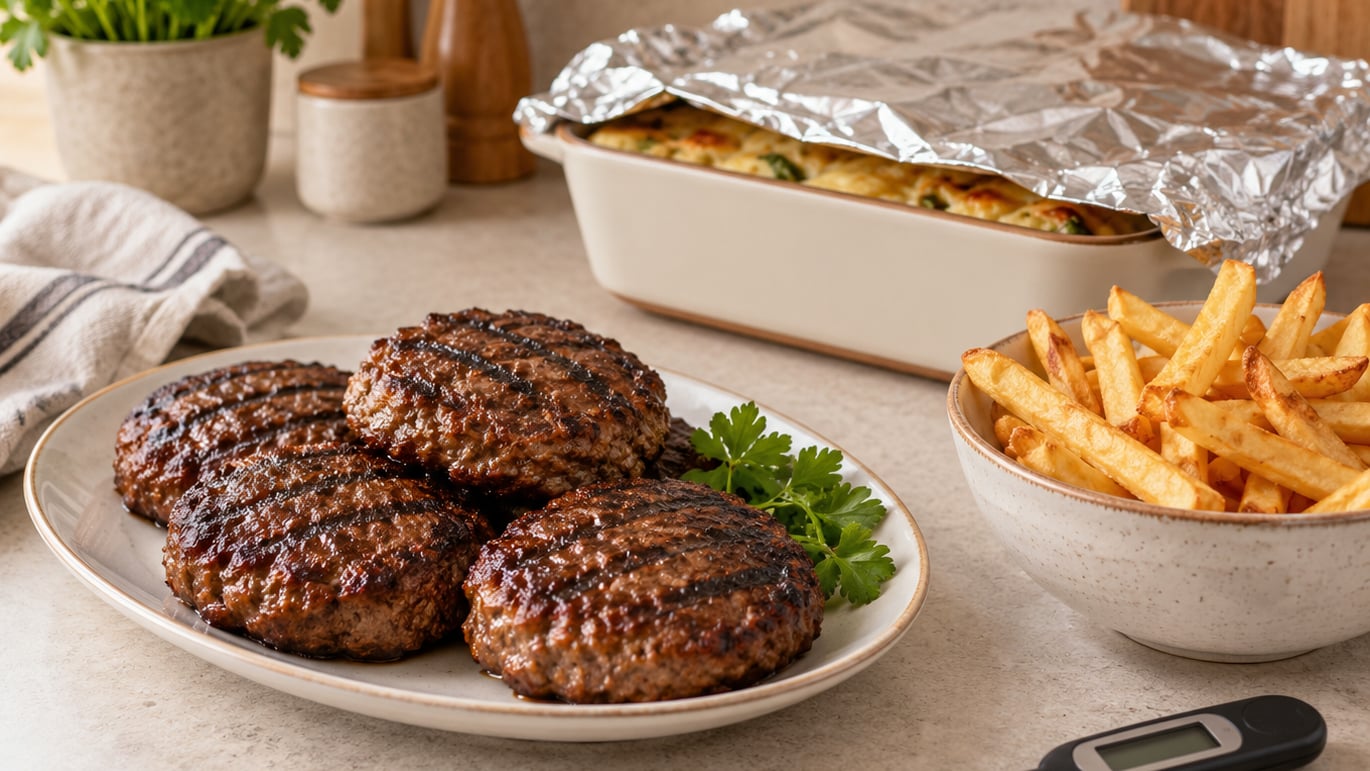
How long can cooked food sit out? Two hours at room temperature is the ceiling, or one hour when the air is above 90°F (32°C). The USDA’s two-hour rule starts the moment food leaves heat, and it applies to serving platters, buffets and counter leftovers alike.
The reason for the limit is temperature, not the clock on your wall. Between 40°F and 140°F (4°C and 60°C) — the food safety danger zone — bacteria such as Salmonella, Listeria and Staphylococcus aureus can double in number roughly every 20 minutes. And dangerous food usually looks, smells and tastes completely normal, so the only dependable protection is time and temperature control.
Below is how the rule works in practice, what room temperature really means, how to hold food safely while serving, and what to do with food that has already been out too long.
Table of Contents
How Long Can Cooked Food Sit Out?
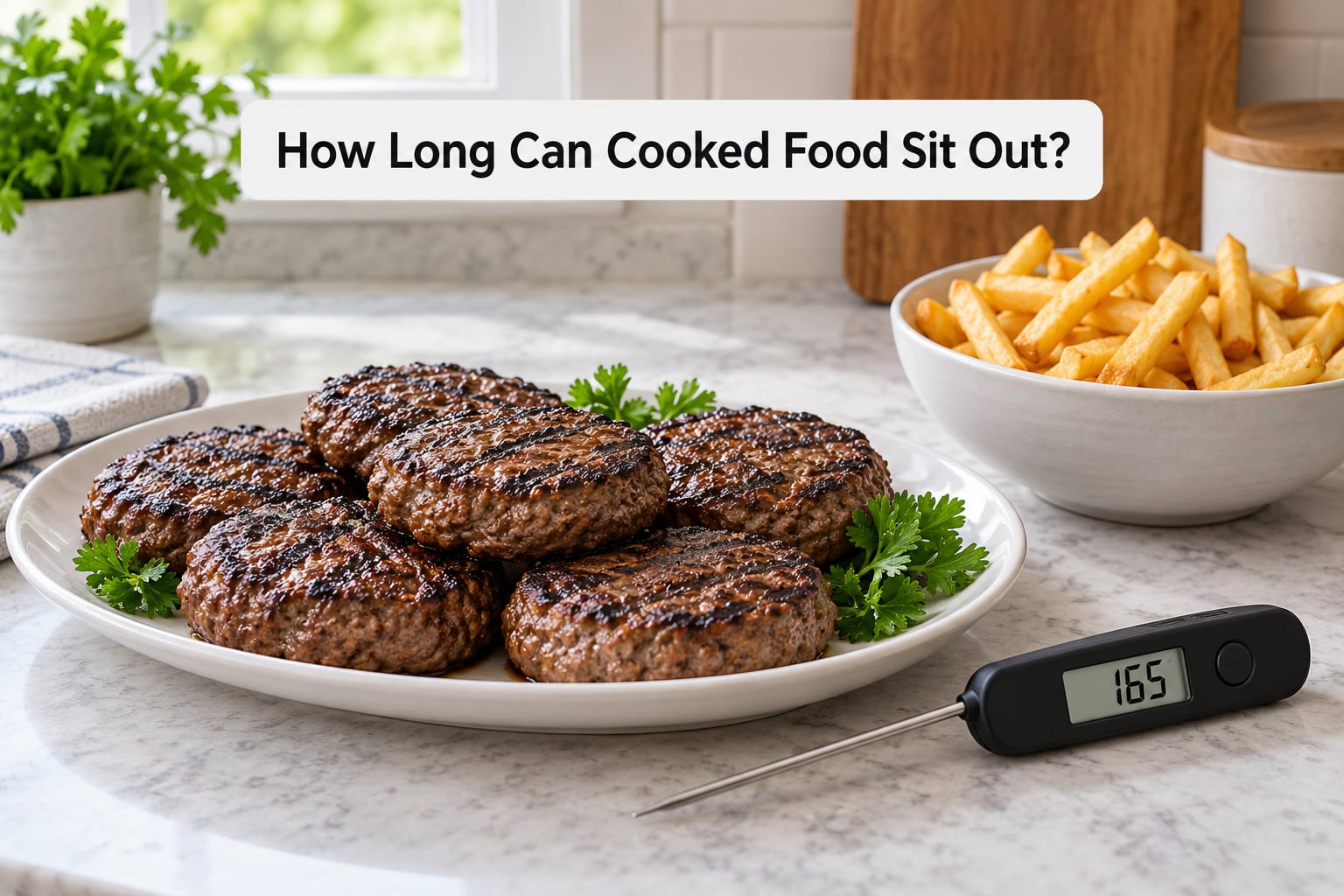
Two hours at room temperature is the ceiling, not a target. One hour is the ceiling when the surrounding air is above 90°F, and most home kitchens in summer run hotter than people expect.
The clock starts when the food leaves its heat source — the oven, the grill, the stove, the slow cooker. Food that comes straight out of the oven at 400°F spends the first part of those two hours cooling down through the danger zone, and that cooling time counts.
Serving counts too. Food that goes from the oven to a platter to a buffet table to a few plates to the counter has been in the danger zone the whole time, and it is out of time when two hours have passed from the moment it left the oven, not two hours after the last person took a plate.
Does food that has stopped cooking still count as safe to leave out?
Yes, “stopped cooking” and “safe” are different things. A roast sitting in a 140°F oven is not cooking any more, but it is also not in the danger zone, so it can stay there as long as you like. The same roast on a counter cools below 140°F within about half an hour, and from that moment the two-hour clock is running.
What Counts as Room Temperature?
Room temperature means anything between roughly 40°F and 140°F. There is no single number, which is why the same dish can be fine for two hours in one kitchen and a bad idea in another.
| Where the food is | Typical air temperature | Time limit |
|---|---|---|
| Air-conditioned kitchen | 68°F–72°F (20°C–22°C) | 2 hours |
| Warm kitchen with the oven on | 80°F–85°F (27°C–29°C) | 1 hour is the safe habit |
| Outdoor picnic or cookout in summer | 85°F–95°F+ (29°C–35°C+) | 1 hour |
| Inside a car on a sunny day | Quickly over 100°F (38°C) | 1 hour or less; treat as hot weather |
| Refrigerator at or below 40°F | 34°F–40°F (1°C–4°C) | 3 to 4 days for most cooked food |
| Hot holding at 140°F or above | 140°F+ (60°C+) | No limit while it stays above 140°F |
Sunlight matters as much as air temperature. A dish sitting in direct sun can be 20°F warmer than the air around it, and a covered casserole holds heat far longer than a shallow tray of cut vegetables.
If you want a number rather than a guess, an inexpensive instant-read thermometer in the thickest part of the food settles it in seconds. See our food safety rules for grilling meat for how to use one on large cuts and thin cuts alike.
The 2-Hour Rule and the 1-Hour Rule
The USDA guidance is short: refrigerate or freeze perishable food within 2 hours of cooking, or within 1 hour if the air temperature is above 90°F (32°C). Those are maximums for food held in the danger zone, not recommended storage times.
Does the two-hour rule include resting time?
Resting a cooked bird or large cut for 20 to 30 minutes to let the juices settle counts against the two hours, unless the food is held above 140°F (60°C) while it rests. A foil tent or a warm 200°F oven keeps it out of the danger zone; leaving it on the stovetop does not.
So what is the four-hour rule?
Two different things get called the four-hour rule, and that is where most of the confusion comes from. One version is a discard rule used in food service: food held hot at 140°F or above, or cold at 41°F or below, may be served for up to four hours before it must be thrown away, and any time it spends in the danger zone during that service is subtracted from the four.
The other version comes from food-code and food-service texts that say food in the danger zone may be held for up to four hours total under controlled conditions. That allowance is not something a home kitchen, a picnic blanket or a potluck table can guarantee, which is why the USDA consumer advice stays at two hours.
Do I need to cover the food while it sits out?
Covering is not what makes food safe or unsafe, and a lid does not pause the clock. Cover it to keep insects, dust and drips out, and leave it uncovered only when you need it to cool faster before refrigerating. A tight lid traps steam and warmth, which slows the decline into the danger zone in a cool room and does nothing for you in a hot one.
What if I only know the food has been out a while?
If you cannot remember when it went out, treat it as timed out. Every potluck table has a stew or a platter someone is hoping to save, and the honest answer to that hope is the same: unknown time means assume the limit passed.
What Food Temperatures Count as Safe?
Cooking and holding are two separate checks. You need the food to reach a safe internal temperature to cook it, and you need it to stay above 140°F (60°C) or below 40°F (4°C) to hold it safely for more than two hours.
| Food | Safe minimum internal temperature |
|---|---|
| Poultry — chicken, turkey, duck, and any stuffed meat | 165°F (74°C) |
| Ground meat — beef, pork, lamb, and meatloaf | 160°F (71°C) |
| Whole cuts of beef, pork, lamb, veal | 145°F (63°C) with a 3-minute rest |
| Fish and shellfish | 145°F (63°C) |
| Eggs, casseroles and leftovers being reheated | 165°F (74°C) |
Reaching a safe temperature at the end of cooking does not erase the time food spent warm in between. If a chicken breast hits 165°F, sits on a counter for three hours, and you sear it again, the total exposure is what matters.
How to Keep Cooked Food Safe While Serving
Serve in smaller batches than you think you need. Put out half the casserole, keep the rest in a warm oven above 140°F, and refill as the first dish empties. Refilling into a dirty platter also puts fresh, warm food straight into a bowl that has been sitting warm for an hour.
For hot food, use a chafing dish, a slow cooker on warm, a 200°F oven, or a preheated serving dish tucked under a foil tent. Anything that keeps the food at or above 140°F (60°C) means that time never entered the danger zone.
For cold food, keep it under ice. A bowl of ice under the serving platter works as well as anything you can buy, and cold dips and cut vegetables should stay at or below 40°F (4°C) the whole time they are out.
At picnics and cookouts above 90°F, the one-hour limit is the rule, and shade does not save you. A cooler with plenty of ice keeps food safely out of the danger zone for hours, so plan to serve from the cooler rather than from a table.
How to Store Leftovers Safely
Get leftovers into the refrigerator within the same two-hour window, and speed the cooling down while you do it. Large deep casseroles stay dangerously warm for hours because the center cools long after the edges do.
| Cooked food | Max time at room temperature | Keeps in the refrigerator | Keeps in the freezer |
|---|---|---|---|
| Rice and pasta | 2 hours, or 1 hour above 90°F | 3 to 4 days | 3 to 4 months |
| Cooked chicken and turkey | 2 hours, or 1 hour above 90°F | 3 to 4 days | 3 to 4 months |
| Cooked ground meat and meatloaf | 2 hours, or 1 hour above 90°F | 3 to 4 days | 3 to 4 months |
| Whole cuts of beef, pork or lamb | 2 hours, or 1 hour above 90°F | 3 to 4 days | 3 to 4 months |
| Cooked seafood | 2 hours, or 1 hour above 90°F | 3 to 4 days | 2 to 3 months |
| Cooked vegetables | 2 hours, or 1 hour above 90°F | 3 to 4 days | Varies; blanch first |
| Cooked potatoes, eggs and egg dishes | 2 hours, or 1 hour above 90°F | 3 to 4 days | About 3 months |
| Dips, spreads, cut fruit and cut vegetables | 2 hours, or 1 hour above 90°F | 3 to 4 days | Not recommended after freezing |
Divide deep dishes into shallow containers, loosely cover while they cool, and refrigerate. Depth, not container size, is what slows cooling. If you have no shallow containers, an ice bath around the bowl cuts the cooling time fast.
A slow cooker on warm is a hot-holding device only while it holds food at 140°F or above. A warm setting that sits around 120°F is technically below the danger zone but not reliable enough to rely on overnight, and the safe move for anything not kept properly hot is the refrigerator.
During a power outage, an unopened refrigerator keeps food cold roughly four hours. Discard perishables after that, or if the refrigerator stayed above 40°F for more than two hours. A full freezer holds safe temperatures for about 48 hours, half-full for about 24.
If pregnant, over 65, immunocompromised or caring for young children are at the table, use a stricter mental rule. Treat the limit as one hour indoors and 30 minutes in the heat, and skip anything you are unsure about. Our guide to how long ground beef lasts in the fridge covers the raw side of the same question.
Can You Reheat Food That Sat Out?
Reheating does not reliably make food that spent an unknown or excessive time at room temperature safe. Heat kills most live bacteria, but it does not destroy the toxins some of them produce, and reheating does not remove those compounds.
Rice is the clearest example. Bacillus cereus spores survive the cooking of cooked rice and can produce toxin that reheating does not neutralize, which is why rice that has sat out all day belongs in the bin even after a thorough reheating. Staphylococcus aureus toxin can persist the same way in reheated meat and potato salad.
Reheating is fine for leftovers that were refrigerated within two hours. Heat them to 165°F (74°C), refrigerate the portion you will not eat right away within two hours, and reheat leftovers only once or twice.
For anything that exceeded the limit, discard it. See also how long burgers stay in the freezer for storing cooked food you are keeping rather than tossing.
Frequently Asked Questions
Is it safe to eat cooked food left out for 4 hours?
No. USDA guidance for home kitchens is 2 hours at room temperature, or 1 hour above 90°F (32°C). The four-hour figure belongs to food service rules for food held above 140°F or below 41°F, where any danger-zone time is subtracted from it. A home platter on a table has no such control, so four hours is past the limit.
What is the difference between the 2-hour rule and the 4-hour rule?
The 2-hour rule is the consumer rule: refrigerate perishable food within two hours of leaving heat, one hour in hot weather. The 4-hour rule is a food-service allowance for food held at 140°F or above or 41°F or below, and it applies only under controlled temperatures. In a home kitchen, buffet or picnic, use 2 hours.
How long can cooked rice sit out?
Cooked rice follows the same limit as any cooked food: 2 hours at room temperature, 1 hour above 90°F (32°C). Rice is especially worth discarding when in doubt because Bacillus cereus spores survive cooking and the toxin they produce is not destroyed by reheating. Refrigerate it in shallow containers rather than a deep bowl.
How long can leftovers sit out at a party?
Count from the moment the food left the oven, not from when the last guest took a plate. That is 2 hours total on the table, or 1 hour if the air is above 90°F. Bring out small batches and refill from a hot oven or cooler rather than setting everything out at once, and discard what remains when the window closes.
Does reheating food that sat out make it safe?
Usually not. Heat kills live bacteria but does not destroy toxins made by organisms such as Staphylococcus aureus or Bacillus cereus, so reheating can leave food dangerous. Discard perishable food that sat out beyond 2 hours, or 1 hour above 90°F. Reheating to 165°F (74°C) is appropriate only for leftovers that were refrigerated within the limit.
What to Do First
Set a timer when food hits the table, put leftovers in shallow containers inside two hours, and throw away anything perishable that passed the limit. Yes, that means wasting food you paid for, and yes, it is still the right call. Knowing how long cooked food can sit out is only useful if you set the timer the moment it comes off the heat.
Source: USDA and foodsafety.gov guidance on perishable food time and temperature control.