
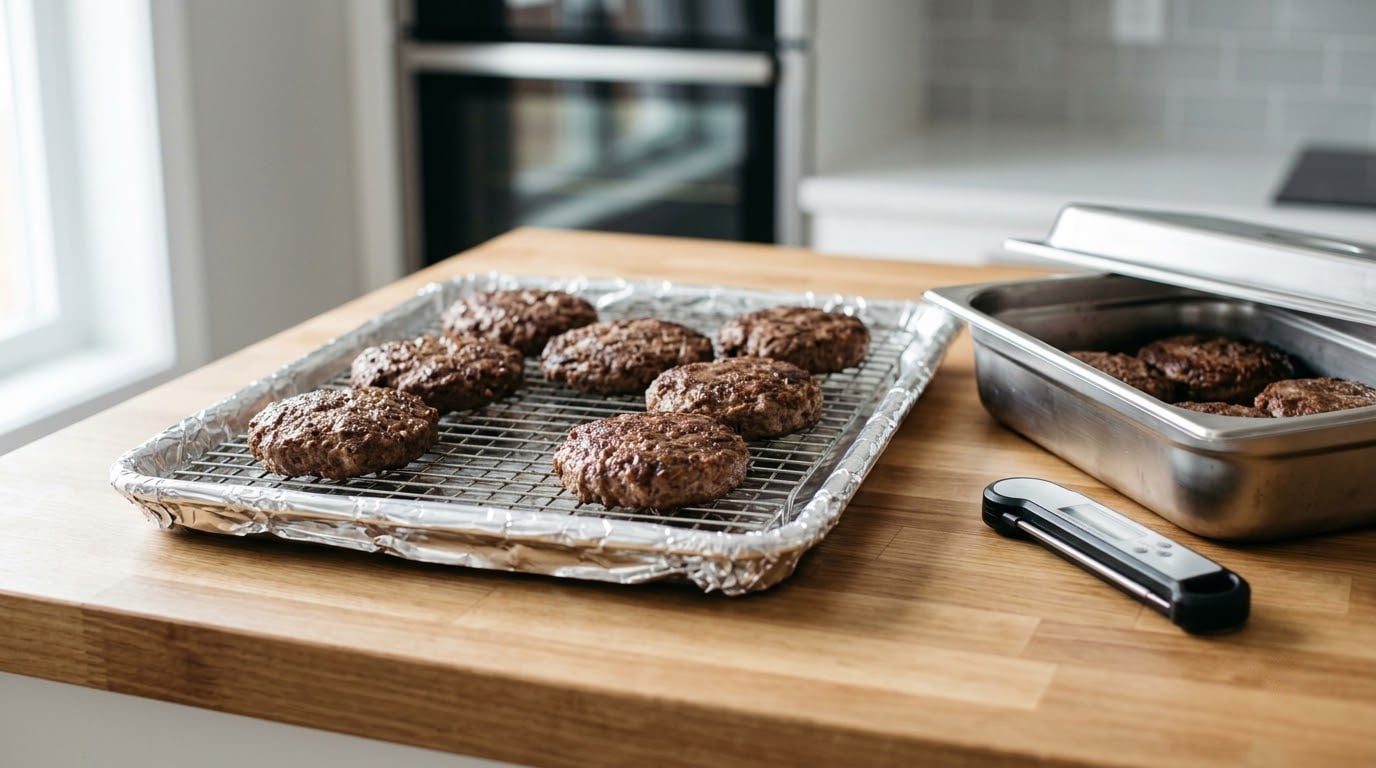
Keep burgers warm for a crowd by holding cooked patties in a covered, preheated vessel at 140F (60C) or above, in a single layer, with a loose foil lid rather than tight wrapping. A low oven, a warming tray, or an insulated carrier all work, and the right one depends on how long the patties wait and whether they travel. Assemble burgers only as guests order them.
The reason crowding cooks go wrong is rarely the temperature. It is heat plus time plus a sealed surface, which pushes moisture out of the meat and turns the bun to sponge. Once you separate the patties from the buns and from the wet toppings, most of the problem disappears.
Here is the setup I use for anything over about eight burgers, and the mistakes that quietly turn a good cookout into a tray of hockey pucks.
What You Need
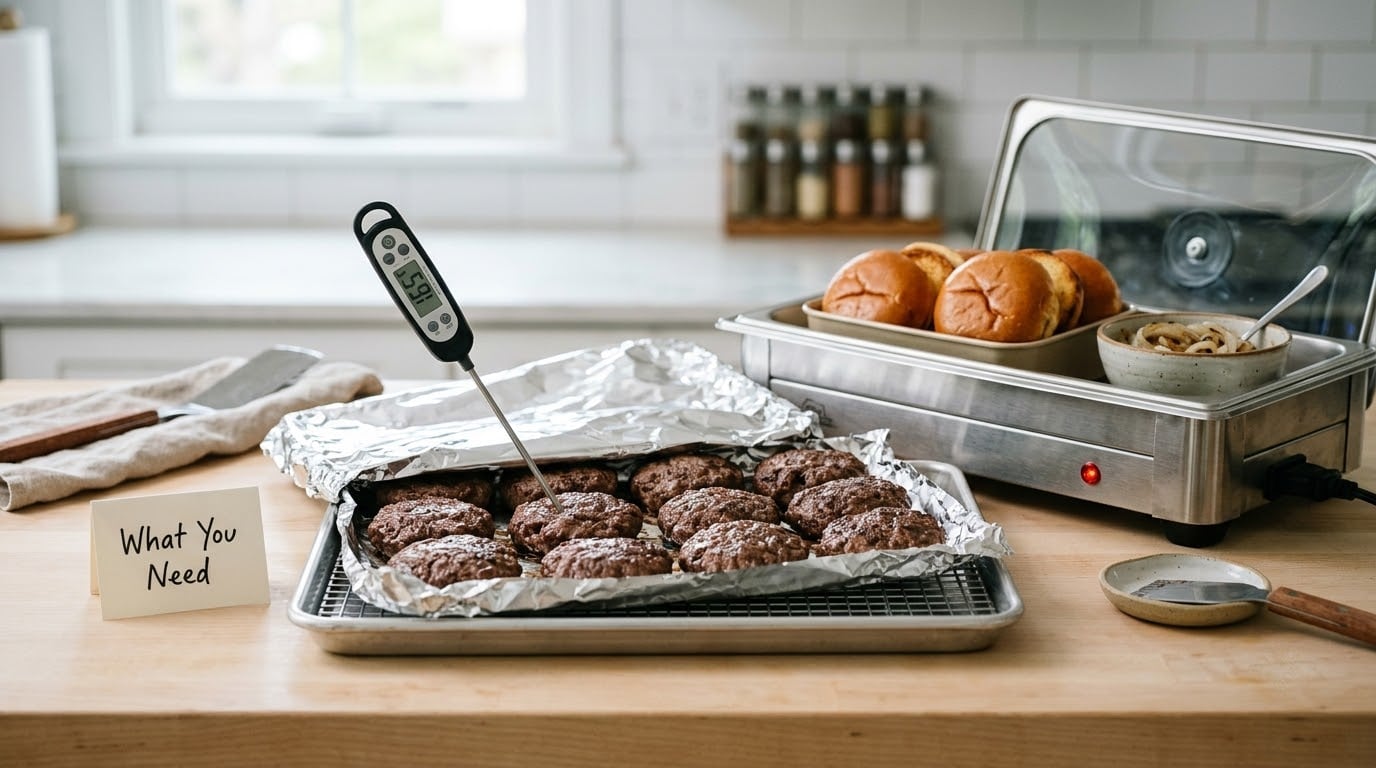
Start with the patties themselves, cooked and rested. Everything else supports them.
- A covered vessel: a rimmed baking sheet, an aluminum foil pan, a hotel pan, or a roaster pan. A wire rack set inside the pan keeps patties off the wet bottom.
- A heat source: a low oven, a warming tray or chafing dish, the cool zone of your grill, or an insulated cooler for transport.
- A loose cover: foil, a lid, or a tented sheet of parchment. Never a tight seal.
- An instant-read thermometer. This is the one tool that turns opinion into a decision. Check the patties and the holding vessel before you call people to the table.
- Shallow liquid where it helps: a splash of broth, au jus, or the drippings from the pan.
- Serving dishes and parchment or paper to line them, plus small bowls for condiments.
Which setup you pick comes down to one question: how long do these patties wait before anyone eats them?
Cooking ahead and holding for two hours is a different job from holding ten minutes while the rest of dinner finishes. For a long hold you want a vessel that holds heat and a source that tops it up, because a single preheated dish cools from the outside in. For a short hold, a pan in a 200F (93C) oven is more than enough. For transport, insulation matters more than heat, since the food arrives as the source of heat.
Step-by-Step
1. Finish Cooking the Burgers in Batches
Crowding the pan drops the surface temperature fast, and you get grey patties instead of a sear. Cook one layer at a time with room between each patty, then move finished batches straight to your holding setup.
Ground beef patties need to reach 160F (71C) internally. Check the thickest patty in the batch, inserting the probe into the center without touching the pan, and trust that reading over the rest. If you want to work ahead, you can pull patties early, hold them, and sear them in small batches to order at the end. That finish-sear approach spreads the work across the whole service window instead of front-loading it, and it is what most high-volume cookshops do for big batches.
2. Choose a Safe Holding Method
Pick the vessel before you light the grill, because retrofitting a holding station mid-service is when things fall apart.
A low oven is the easiest method for a home kitchen and handles 20 to 30 patties comfortably. Foil-wrapped patties at 150-170F stay hot for roughly an hour or two. A warming tray or chafing dish scales better and keeps a large batch above 140F (60C) without drying the crust out, since the heat comes up from below and water never touches the meat. A preheated insulated carrier is the transport option, and a slow cooker on its warm setting works for a dozen patties with an oven-safe bowl of water inside to keep the humidity up.
| Method | Holding temperature | Practical hold time | Capacity | Best for |
|---|---|---|---|---|
| Low oven, loosely covered | 150-200F | 1-2 hours | 1-2 sheet pans | Home kitchens, buffets |
| Broth or au jus bath | 140-160F | 1-2 hours | 1 hotel pan | Maximum moisture |
| Warming tray or chafing dish | 140F and above | 2-3 hours | 2-3 pans | Large crowds, long service |
| Insulated cooler with towels | Keeps 140F for about 2 hours | About 2 hours | 1-2 dozen | Tailgates, picnics, transport |
| Slow cooker on warm | 140-160F | 3-4 hours | 8-12 patties | Small batches, no oven |
Safe hot holding sits above 140F (60C). Below that floor, cooked ground meat should not sit out, and the two-hour rule applies: cooked meat left at room temperature for more than two hours goes in the refrigerator or in the trash, and that window drops to one hour when it is above 90F (32C) outside.
If you are moving cooked burgers somewhere else, pack them in the holding vessel first and carry that. Our guide to how to pack burgers for a picnic safely covers the cold-chain side.
3. Keep Burgers Warm for a Crowd Without Drying Them Out
Put cooked patties in a single layer on a warm sheet pan, ideally on a rack so the bottoms do not sit in their own juices. Spoon a thin layer of broth, au jus, or pan drippings into the pan without letting it touch the meat, then tent loosely with foil.
Tight wrapping is the mistake that shows up most often. Wrapping each patty individually with a splash of broth or sauce inside works well for short holds. But a sealed foil pack left for two hours traps steam that softens the crust and dulls the char, and a pile of foil trays with no liquid in them dries out faster than a bare pan. You want moisture moving back into the meat without a wet surface cooking it.
Signs the patties are staying right: the surface still beads a little oil, the finger press springs back, and a cut patty shows juice rather than paste. Signs they are drying out: matte edges, a hard crust on the outside that extends to the center, and steam that smells like cooked cardboard when you lift the foil. For the mechanics of getting consistent results batch after batch, how restaurants keep burgers consistent every time is worth a read.
4. Hold the Toppings Separately
Lettuce, tomato, onions, and pickles belong in shallow serving dishes, not on the patties. Anything wet goes on at the moment of assembly, and anything crisp stays out of the heat entirely.
Cover only the toppings that tolerate condensation, and cover them loosely. Onion and pickles are fine under a loose lid for an hour. Leafy greens go into the fridge until ten minutes before service, on ice if you have it, and dry greens last longer than wet ones. Our piece on how to keep lettuce crisp for sandwiches covers the cold side of it.
Sauces get their own squeeze bottles or shallow bowls rather than a spoon in a deep bowl, which slows down the line and stops people from double-dipping.
5. Warm the Buns Without Steaming Them
Buns are the part that usually fails. Wrapped in foil early and held for an hour, they turn into damp cardboard.
Warm them late. The cut side goes on the griddle or under the broiler for 30 to 60 seconds, close to when the first patty is ready, and they get stacked cut-side up so the steam from the top bun escapes. If you have to hold them, keep them in their original plastic bag inside an insulated bag, which keeps them soft without adding condensation, and never wrap hot buns in foil for more than a few minutes.
If the oven is holding the patties, warm the buns on a griddle outside or in a toaster oven, or toast them in batches during service. There is no reason the patties and the buns need the same oven.
6. Assemble and Reheat as Guests Eat
Assemble to order. The number of exposed patties should stay small enough that you can count the remaining batches, and you refresh from the holding setup as it empties instead of putting everything on the tray at once.
For patties that have been sitting longer than you planned, put them on the griddle cut-side down for 20 to 30 seconds to rebuild the crust, then check the center temperature before serving. A splash of broth or a light brushing with the pan drippings during that reheat puts back some of what the patty lost. Our walkthrough of how restaurants keep burgers consistent every time goes deeper on the finish-sear step.
Line the serving tray with parchment or paper, and change the liner rather than topping it up. A greasy second layer of paper is how a good patty picks up a bad smell.
Common Mistakes
- Piling patties in a sealed container. They steam each other, the crust goes soft, and the bottom patty sits in liquid. Fix: one layer, loose cover.
- Tight foil wrapping for a long hold. The patty softens and loses its crust. Fix: tent, do not seal, and add a splash of broth inside for holds under two hours.
- An oven set too low for a long hold. Below 140F (60C) is not safe hot holding, and above 250F (121C) dries the outsides while the centers go cold. Fix: 150-200F, checked with a thermometer.
- Overcrowding the cooking pan. No sear, uneven doneness, and a slow drop in temperature. Fix: batches with space between patties.
- Warming buns too early. They collapse and go dense. Fix: toast in the last few minutes, cut-side up, lightly covered.
- Leaving cooked meat out at room temperature. Fix: keep everything at or above 140F, or refrigerate within two hours.
Two service habits help more than any equipment choice. Stagger the meal so people do not all arrive at the tray in the first minute, and delegate the topping station to someone else so you are not the one toasting buns while patties finish.
Frequently Asked Questions
How long can you keep burgers warm for a crowd safely?
Cooked patties can sit in a holding setup above 140F for a couple of hours without drying out badly, and a warming tray or broth bath stretches that to two or three hours. Below 140F it is no longer safe hot holding. As a rule, anything sitting at room temperature goes into the refrigerator within two hours, or one hour when it is above 90F outside.
Should I keep cooked burger patties in the oven while the buns warm?
They can share a kitchen, but not the same oven at the same setting. Patties held at 150-200F go soft and dry on top, which ruins the texture you toasted the buns for. Warm the buns on a griddle outside or in a toaster oven during the last few minutes of service. If you must use one oven, toast the buns first, then set the oven down to 150-170F and tent the patties loosely.
How do you keep a large batch of burgers juicy before serving?
Single layer on a rack, loose foil tent, and a shallow layer of broth or au jus in the pan without touching the meat. Keep a broth bath to about two hours, since patties left soaking longer start breaking down and losing texture. For anything longer than that, a warming tray above 140F holds heat without soaking the crust.
Can I transport cooked burgers in a cooler or insulated carrier?
Yes, and it is the standard method for tailgates and picnics. Preheat the cooler with boiling water for about ten minutes, empty it, then layer foil-wrapped patties between towels. That setup holds serving temperature for roughly two hours. Wrap the patties before they go in, and keep raw meat in a separate cooler entirely, since cross-contamination is the bigger risk once the burgers are cooked.
What should I do with cooked burger leftovers?
Move them into the refrigerator within two hours of serving, and use them within three to four days. Store patties and buns separately so the bread does not go soggy, and keep any toppings in their own containers. Reheat patties in a skillet or on a griddle for 20 to 30 seconds a side rather than in a microwave, which dries the outside while leaving the middle cold.
Conclusion: Start With the Warming Setup
Decide on your holding method before you cook, preheat that vessel, then cook in small batches and move each batch across as it finishes. Patties in one layer under a loose foil lid, buns warmed in the final minutes, toppings kept separate until assembly, and a thermometer in your hand. For cooked leftovers, refrigerate within two hours and eat them within three to four days.