
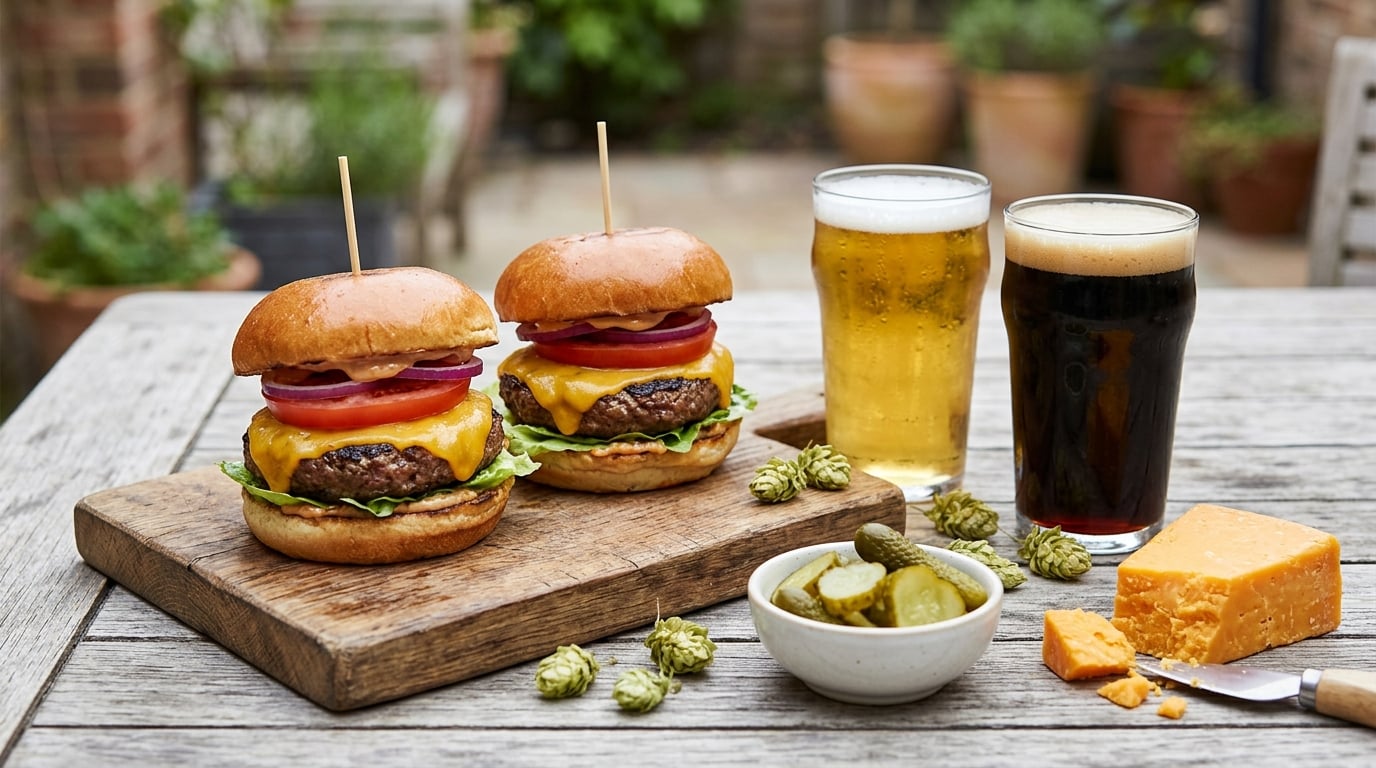
Learning how to pair beer with burgers comes down to one idea: match the beer’s weight and bitterness to how heavy and how bold the burger actually is. A crisp pilsner handles a plain cheeseburger, a hoppy IPA suits a burger with sharp toppings, and a rich stout stands up to a double stack with caramelized onions. Pick the burger first, then pick the beer that can carry it.
Most home cooks fall into the same trap, though. They grab whatever is coldest, usually an IPA, and then wonder why a simple patty tastes flat and the beer tastes harsh. Pilsners and Kolsch come up again and again on burger forums as the most reliable pairing precisely because they are light and crisp enough to cut through the heaviness.
This guide breaks the process into twelve rules you can use at home, whether you are grilling for friends or ordering at a bar. Nothing here needs tasting jargon. If you can tell a lager from an ale, you have everything you need.
Table of Contents
- What You Need
- Step-by-Step: How to Pair Beer With Burgers
- 1. Identify the Burger’s Main Flavor
- 2. Choose a Beer With a Matching Weight
- 3. Balance Richness With Bitterness and Acidity
- 4. Match Toppings Instead of Just the Patty
- 5. Account for Smoke, Spice, and Char
- 6. Serve Beer and Burgers at Compatible Temperatures
- 7. Start With a Flexible Shortlist
- 8. Avoid Pairings That Clash
- 9. Adjust for Your Own Serving Setup
- 10. Taste the Pair Together
- 11. Use a Simple Progression for a Burger Feast
- 12. Make the Pairing Your Own
- Common Mistakes
- Frequently Asked Questions
- Conclusion
What You Need
Before you pick a beer, you need to know six things about the burger in front of you. The first three come from the burger. The last three come from the beer, and they are the part most people skip.
First, the weight of the patty. A single thin patty, a double smash, and a quadruple stack with bacon are three completely different pairing problems.
Second, the burger style: beef, chicken, lamb, salmon, or a plant-based patty. Each carries a different flavor profile, and plant-based patties in particular tend to be milder and more seasoned in the spice direction than beef.
Third, the dominant flavor. Is the burger beefy, smoky, spicy, cheesy, or rich? This decides whether you go toward bitterness, roast, or acidity.
Fourth, the glassware. A heavy stemmed goblet keeps an aromatic stout from warming in your hand, and a wide-rimmed tulip glass gives an IPA room to show its aroma. A pint glass works fine for a lager and for anything you drink fast.
Fifth, the serving temperature. Beer that has been sitting in a fridge door for an hour tastes flat, and so does a warm one. Most lagers want to be noticeably cool, and stouts want to be cool but not cold.
Sixth, the toppings, which we cover in detail in step 4 because they change the pairing more than most people expect.
One safety note before you start cooking: cook ground beef to an internal temperature of 160 degrees Fahrenheit, which is 71 degrees Celsius. Ground lamb and ground poultry follow the same guideline. Use a thermometer rather than pressing the patty with a spatula, and let the finished burger rest for a few minutes so the juices stay in the meat.
Step-by-Step: How to Pair Beer With Burgers
1. Identify the Burger’s Main Flavor
Start by naming the flavor you would describe if someone asked what the burger tastes like. Beefy and gently grilled, or smoky and charred, or hot and spicy, or rich and cheesy.
Beefy and gently grilled points to lagers, pilsners, and pale ales. Smoky and charred points to porters, brown ales, and amber ales. Hot and spicy points to high-ABV hoppy ales and stouts. Rich and cheesy points to stouts and darker lagers.
You will know you got it right when the beer and the burger are arguing about the same thing rather than talking past each other.
2. Choose a Beer With a Matching Weight
Match the body of the beer to the heft of the burger. Light lagers and ales suit simpler burgers, while stouts, porters, and stronger ales handle heavier patties, cheese, and bolder sauces.
A single thin patty with lettuce and tomato wants a light, dry, highly carbonated beer. A double patty with cheddar, bacon, and a rich sauce wants something with more malt weight and more bitterness to stand up to it.
One useful shortcut from brewery advice: for big loaded burgers, reach for something at or above seven percent alcohol by volume, since stronger beers hold their own against that much fat and salt.
3. Balance Richness With Bitterness and Acidity
A rich burger does not need a richer beer. It needs something that clears the palate, which means hop bitterness, roast character, a dry finish, or a bit of acidity.
Carbonation is the main mechanism here. The bubbles physically scrub fat off your tongue between bites, which is why a fizzy beer feels like it resets you every few mouthfuls. A flat beer sitting next to a rich burger just adds weight.
Malt sweetness pushes the other direction and can make a heavy burger feel heavier. Save the sweetest brown ales and stouts for burgers with enough char or pepper to counter them.
4. Match Toppings Instead of Just the Patty
Toppings often matter more than the meat. Here is how the common ones shift the pairing:
- Sharp cheddar or pepper jack: an amber lager or pale ale, whose mild bitterness stands up to the salt and tang without fighting it.
- Bacon and caramelized onions: a brown ale or porter, where malt sweetness and caramel echo the meat.
- Pickles and raw onion: a pilsner or a dry farmhouse ale, because the acidity and snap line up with the crunch.
- Jalapenos and hot sauce: an India Pale Ale with assertive bitterness, which cools the burn instead of amplifying it.
- Mushrooms and Swiss: a German lager or amber lager, neutral enough to let the earthy topping lead.
- Blue cheese: a bold porter or an imperial stout. A delicate lager simply disappears next to this burger.
Notice that jalapeños want bitterness while pickles want acid. Both add heat to the mouth, but they move in opposite directions, and a beer that works for one can be wrong for the other.
5. Account for Smoke, Spice, and Char
Smoked and heavily charred burgers need a beer with its own roasted character. A porter or a stout brings coffee-like roast and dark malt that stands alongside the smoke rather than sitting under it.
For very spicy burgers, bitterness is your best tool. A double India Pale Ale will make jalapeño heat and hot sauce taste almost mild, provided your palate can take the hop load.
The caution worth repeating: an aggressive double IPA can overwhelm a simple chicken burger, and a delicate beer disappears next to an enormous blue cheeseburger. Both directions of mismatch taste flat, just in different ways.
6. Serve Beer and Burgers at Compatible Temperatures
Serve beer cooler than room temperature and closer to fridge temperature than you think. Straight from a fridge door, a lager tastes watery; at room temperature, it tastes dull.
For lagers and pilsners, aim for something noticeably cool, roughly 38 to 45 degrees Fahrenheit. For ales, a touch warmer lets the aroma come through, roughly 45 to 55 degrees Fahrenheit. Stouts and porters want the same range as ales, which keeps their roast character readable.
On the burger side, build so the plate stays balanced as the meal goes on. Melt cheese, toast the bun, and add wet toppings in the last minute so the bun never turns to mush before the last bite.
7. Start With a Flexible Shortlist
If you want dependable options rather than a theory, keep this shortlist in your head:
- Lager or pilsner for a classic cheeseburger with lettuce, tomato, and pickles.
- Pale ale for a bacon cheeseburger, where mild hop bitterness keeps the salt in check.
- India Pale Ale for a burger with jalapenos, pepper jack, or hot sauce.
- Amber lager or amber ale for a barbecue burger with sweet and smoky sauce.
- Porter for a mushroom and Swiss burger or a char-heavy patty.
- Stout for a double stack with blue cheese and caramelized onions.
- Hefeweizen or Belgian witbier for a grilled chicken burger or a salmon burger.
- Saison or blonde ale for a plant-based burger with fresh herbs and pickled vegetables.
A standard IPA and a plain brass burger is the crowd-pleaser combination, and a Pilsner or Kolsch is the most commonly praised pairing on home cooking forums because both are light and crisp.
8. Avoid Pairings That Clash
Most bad pairings come from three specific mistakes. Pairing an overly delicate beer with intense spice or heavy char leaves you with nothing in your glass. Pairing a very sweet beer with a sweet sauce doubles the sweetness and dulls both. Pairing an extremely hoppy beer with delicate toppings turns the burger flat and the beer harsh.
The honest version: not every beer works with every burger. A delicate lager can vanish next to a blue cheeseburger, and a heavy imperial stout can bury a simple lettuce-and-tomato patty.
Two other mismatches worth avoiding. Beer color tells you nothing about flavor, since a pale ale can taste far more bitter than a dark-looking lager. And serving order matters less than people think, but serving everything ice cold at once flattens the whole meal.
9. Adjust for Your Own Serving Setup
Your cooking method changes the flavor profile enough to change the beer. Frozen patties cooked fast produce less char, so a light lager works fine. Cast iron and a long grill contact build a dark crust, which points toward a porter or brown ale.
Restaurant-style double burgers from the flat top come out thin, crisp-edged, and heavily seasoned, so a pilsner or an amber lager is a safe match. A gas grill with a lid gives you smoke flavor without char, which is a good setup for an IPA.
At a restaurant, you do not get a say in the beer, but you do get a description. Saying you want something crisp and dry versus something malty and roasted gets you a better match than naming a style the server may not know.
10. Taste the Pair Together
Take the first bite, then a sip, then a second bite. That is the only honest evaluation, and it takes ten seconds.
If the burger tastes flatter than it did without the beer, the beer is probably too bitter or too hoppy. Move toward something maltier and less aromatic. If the burger tastes thin and the beer seems loud on its own, go lighter and more neutral.
If the beer disappears entirely after one bite, it is too delicate for the burger. Go up in body or up in bitterness until you can still taste it on the second bite.
11. Use a Simple Progression for a Burger Feast
When you are serving several burgers, order the beers from lighter to heavier and serve them in the same order. It keeps the meal from getting heavier with every plate.
A practical sequence runs from a dry pilsner or light lager, through a pale ale or amber lager, then a porter or stout. Finish with a barrel-aged or imperial style only if you are serving a double-stacked burger, and save it for the last burger.
On pacing, there is no universal timing rule that works for every table, and most folk rules you will read about are folklore. Eat slowly, drink water between beers, and remember that a rich burger slows absorption. That is more useful advice than any ratio.
For quantity, plan roughly two beers per person for a two-hour cookout, or one beer and a non-alcoholic drink per person if half your guests are not drinking. Buying a little more than you think you need beats running out mid-burger.
12. Make the Pairing Your Own
Treat all of this as a starting point rather than a rulebook. Regional beers matter, and local pilsners and local ales vary more than the style names suggest. If you enjoy something that is not on any list, drink it with your burger.
Spice tolerance is personal too. Someone who cannot handle jalapenos will find a double IPA punishing rather than refreshing, and the right answer for them is a lighter lager with a squeeze of lime.
There are also good non-beer and alcohol-free options. Dry hard cider cuts through fat almost like a pilsner. Hard seltzer is light, dry, and highly carbonated, which suits a classic cheeseburger. Non-alcoholic beer gives you the malt and hop structure of a real lager or pale ale without the alcohol, and it handles a loaded burger better than most people expect.
Keep the person who is not drinking in the pairing rather than parking them with water. A bottle of dry cider or a non-alcoholic pale ale makes them part of the meal, and that is worth more than any style advice on this page.
Common Mistakes
Defaulting to IPA for everything. An assertive hoppy beer overwhelms a simple cheeseburger or a chicken burger, and the burger ends up tasting flat. Fix: match weight first, intensity second.
Choosing a delicate lager for a heavy burger. A blue cheeseburger or a quadruple stack will erase a thin beer entirely. Fix: go up in body or up in bitterness until the beer survives the second bite.
Serving beer too warm or too cold. Room-temperature lager tastes dull and fridge-door lager tastes watery. Fix: cool for lagers, slightly warmer for ales and stouts.
Ignoring the toppings. Jalapenos and pickles both add bite but pull the pairing in opposite directions, toward bitterness and toward acidity. Fix: decide what the topping does before you pick the beer.
Serving too many styles at once. Four different beers on a burger cookout makes it impossible to tell which one worked. Fix: pick two, one light and one bold, and let guests pour their own.
Pairing by color. A dark beer is not automatically richer or stronger, and a pale one is not automatically milder. Fix: read the style, not the hue.
Forgetting the drinker who is not drinking. Serving only beer quietly excludes the person who chose not to drink. Fix: put dry cider or non-alcoholic beer on the same table and treat it as a pairing, not a substitute.
Frequently Asked Questions
Can I drink beer with a burger?
Yes, and it is one of the easier food pairings there is. Beer’s carbonation scrubs fat off the palate, its hop bitterness cuts through cheese and char, and its malt echoes the bready bun. The only real caution is pacing: a rich burger slows absorption, so drink water between beers and eat before you start rather than alongside the first few.
What beer style is best for a cheeseburger?
A clean pilsner or light lager is the safest answer for a classic cheeseburger with lettuce, tomato, and pickles. It is light, dry, and highly carbonated, so it cuts the fat without adding weight. If the burger is heavier, with bacon, cheddar, and a rich sauce, move up to a pale ale or an amber lager for a bit more malt body.
What beer goes with a spicy burger?
An India Pale Ale with assertive bitterness is the best match for jalapenos, pepper jack, or hot sauce. Hop bitterness cools the burn rather than amplifying it, which is why a double IPA makes hot chicken burgers taste almost mild. If your spice tolerance is low, use a lighter lager with lime instead, and add it on top rather than mixed in.
What should I pair with a veggie or plant-based burger?
A saison or blonde ale works well with plant-based patties, which are usually milder and more herb-forward than beef. Saison brings peppery dryness and high carbonation, both of which handle a soft patty. A dry farmhouse ale, Belgian witbier, or a crisp pilsner also works, especially when the burger carries pickled vegetables or fresh herbs.
What temperature should I serve beer at with burgers?
Cool, but not refrigerator-cold. Lagers and pilsners taste best noticeably cool, roughly 38 to 45 degrees Fahrenheit. Ales, porters, and stouts read better a little warmer, around 45 to 55 degrees, because the extra warmth opens up their aroma. Beer that has sat in a fridge door for an hour tastes flat next to a hot burger.
Can one beer pair with a burger that has lots of toppings?
Yes, as long as the beer is not too delicate and not too sweet. A loaded burger with cheese, bacon, and onions needs a beer with enough body and enough bitterness to survive it, which makes an amber lager or a brown ale the safe middle ground. Avoid very sweet beers, which double up with sweet sauces, and very thin lagers, which disappear.
Conclusion
Start with one decision tonight: cook the burger, name its main flavor, and pick a beer of matching weight. A pilsner for a classic cheeseburger, an IPA for a spicy one, a porter for a charred one.
Then take one sip after the first bite and ask whether the beer is still there on the second bite. That single test will teach you more than any chart, and it takes ten seconds.