

Eating out with a food allergy is manageable once you treat it as a process rather than a reassurance. Research the restaurant, call ahead with your specific allergens, tell your server in plain words, order simply-cooked items, and confirm what was actually used before you take a bite.
One thing up front: no restaurant can promise zero cross-contact. Kitchens run shared fryers, toasters, boards and sinks, and menu wording does not change that. What the steps below do is remove the avoidable exposure points, which is where nearly all of the real risk sits.
This guide is general information. Your own allergist or care plan knows your history, and it should override anything here. If you react to a food, treat the reaction as an emergency until a clinician tells you otherwise.
The approach below was put together from publicly available guidance, including the FDA’s rules on the nine major food allergens, and from how restaurants actually work on a busy line.
Table of Contents
- What You Need
- Step-by-Step: How to Eat Out With Food Allergies Safely
- Common Mistakes
- Frequently Asked Questions
- Can a restaurant guarantee no cross-contact?
- How do I tell if a restaurant is allergy friendly before I go?
- What should I do if I react to food at a restaurant?
- Is a restaurant safe for my allergy if it has a gluten-free menu?
- What is the difference between a food allergy, an intolerance and celiac disease?
- How do I eat out with food allergies safely when someone else picks the restaurant?
What You Need
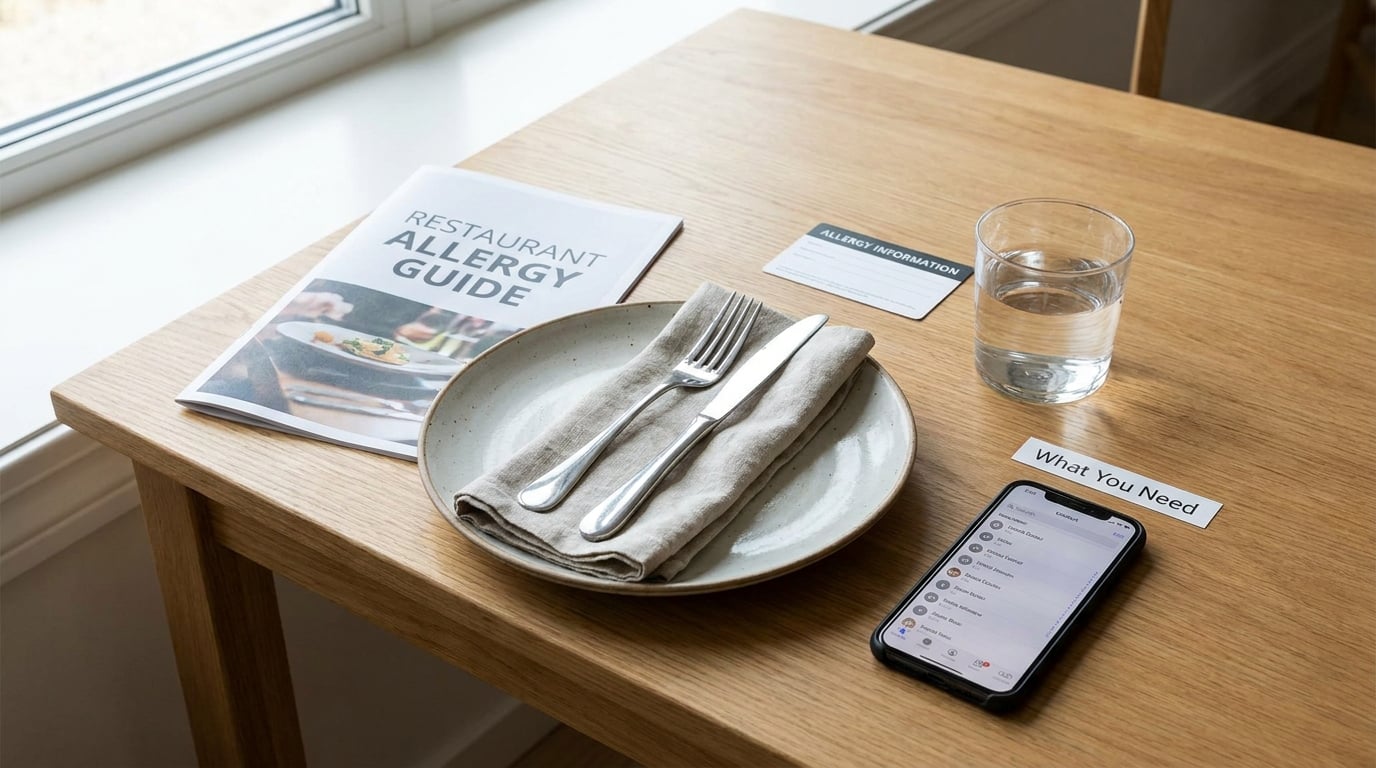
Most problems happen in the ten minutes before you order, when nobody has said anything out loud. Gathering the following first turns a stressful dinner into a short conversation.
Your allergen list, written down
Write out the specific things you react to, using their full names. Peanuts and tree nuts are separate allergens, shellfish and fish are separate, and a restaurant that hears “nuts” may not think to ask about pistachio oil in a sauce.
The FDA requires US food labels to declare the nine major food allergens: milk, egg, fish, crustacean shellfish, tree nuts, peanuts, wheat, soy and sesame. Sesame joined that list under the FASTER Act, and some other countries still handle it differently.
A card the kitchen can actually read
One side, plain text, large enough to read at a glance. Your name, the allergens, the severity, and what a reaction looks like for you. Many people keep one in a photo on their phone and one printed in a bag, because a phone screen is easy for a server to walk to the pass with.
Your epinephrine auto-injector, and a second one if you can
It stays with you, not in a car or a hotel safe. Know the room layout when you sit down: which direction the exit is, where the kitchen pass is, and how long it takes somebody to get a phone. If your care plan calls for a second dose, that is the reason, not a precaution you can skip.
The restaurant’s own information
Before you leave, look for a published allergen guide or a menu allergy chart. Chain allergy guides are worth reading, but users on celiac and food allergy forums consistently report that corporate guides contradict what the local kitchen actually does, so treat them as a starting point rather than a verdict.
A few details to check
Is there a written allergy policy? Does the kitchen run a dedicated fryer? Do they handle a lot of your allergen? People with severe cashew and pistachio allergies avoid vegan, Thai and Middle-Eastern kitchens entirely, and the reasoning is sound: those kitchens work with nut oils and nut pastes by design, so the exposure is constant rather than occasional.
A backup plan
Know one dish you would order and one restaurant you would leave for. Having a second option decided before you sit down is what keeps a conversation with a server from turning into a debate.
Step-by-Step: How to Eat Out With Food Allergies Safely
Five steps, in the order that works best. Do them in sequence and the kitchen has time to adjust before your food hits the pass.
Step 1: Research the Restaurant and Menu
Check the restaurant’s website or menu for allergen information, and look for a printed allergy guide at the location. If neither exists, assume the staff knows less than you do and do the work yourself.
Then read the kitchen, not the menu. A menu tells you what goes in a dish; it does not tell you what touches it on the way to the table. Allergen volume is the signal most people miss. A kitchen that cooks seafood all night is a different risk from one that cooks a little of it, and the same is true for gluten, nuts and shellfish.
| Restaurant type | Risk level | Why |
|---|---|---|
| Seafood houses and raw bars | High for shellfish and fish | Constant shellfish handling, shared shells, shared counters and one sink for everything |
| Nut-oil cuisines such as Thai and Middle Eastern | High for peanut and tree nut | Nut pastes and nut oil are core ingredients, not garnishes, so the whole line works with them |
| Buffets and salad bars | High for any allergen | Self-service means shared spoons, shared trays and no one filtering what lands where |
| Bakeries and pastry shops | High for gluten, nuts, milk | Flour dust settles on everything, and the oven and bench space are shared all day |
| Fried-food chains and pizza joints | Medium to high for gluten | Shared fryers and shared ovens, plus a gluten-free crust handled on the same bench as wheat dough |
| Steakhouses | Medium | Grill cross-contact is manageable with clean surfaces, but the fryer and the butter station are not |
| Dedicated gluten-free bakeries and allergen-aware kitchens | Lower | Separate equipment, separate storage, staff trained to treat allergy orders as its own process |
| Restaurants cooking almost none of your allergen | Lower | Low volume means low chance of accidental contact, and simpler menus mean fewer substitutions |
Menu language deserves its own warning. A gluten-free crust, bun or wrap is frequently prepared on the same surface, with the same scoop, in the same oven, and sometimes in oil that has held glutenous food. For celiac disease that is not a small risk, and the celiac community consensus is that you should expect cross-contact at mainstream restaurants and treat a disclaimer as honest rather than insulting.
Step 2: Contact the Restaurant Before You Arrive
Call during a slow stretch, ideally mid-afternoon, and ask for the person who handles allergy requests. A short call between two and three hours ahead gives the kitchen time to buy something different or change a plan; a call during the dinner rush gets you a rushed answer.
Ask specific questions, because general ones get vague answers:
- Do you have an allergy guide, and how current is it?
- Do you share a fryer with breaded or battered food?
- Can a dish be started on a clean surface with separate utensils?
- Who needs to know, and can the chef be briefed directly?
- Is the manager or shift lead on the floor tonight?
A phrase that works well: “I have a peanut allergy and it is anaphylaxis-level. I am not asking for a substitute, I am asking whether you can prepare the dish without peanut in the kitchen. If you cannot, I would rather order something else.” That last sentence does most of the work, because it gives the honest kitchen a face-saving way to say yes to feeding you.
If the answer is that the kitchen cannot guarantee anything, believe them, and move on. That response is usually accurate rather than a brush-off, and it means you should pick a different dish or a different restaurant.
Step 3: Carry Your Allergy Information and Emergency Plan
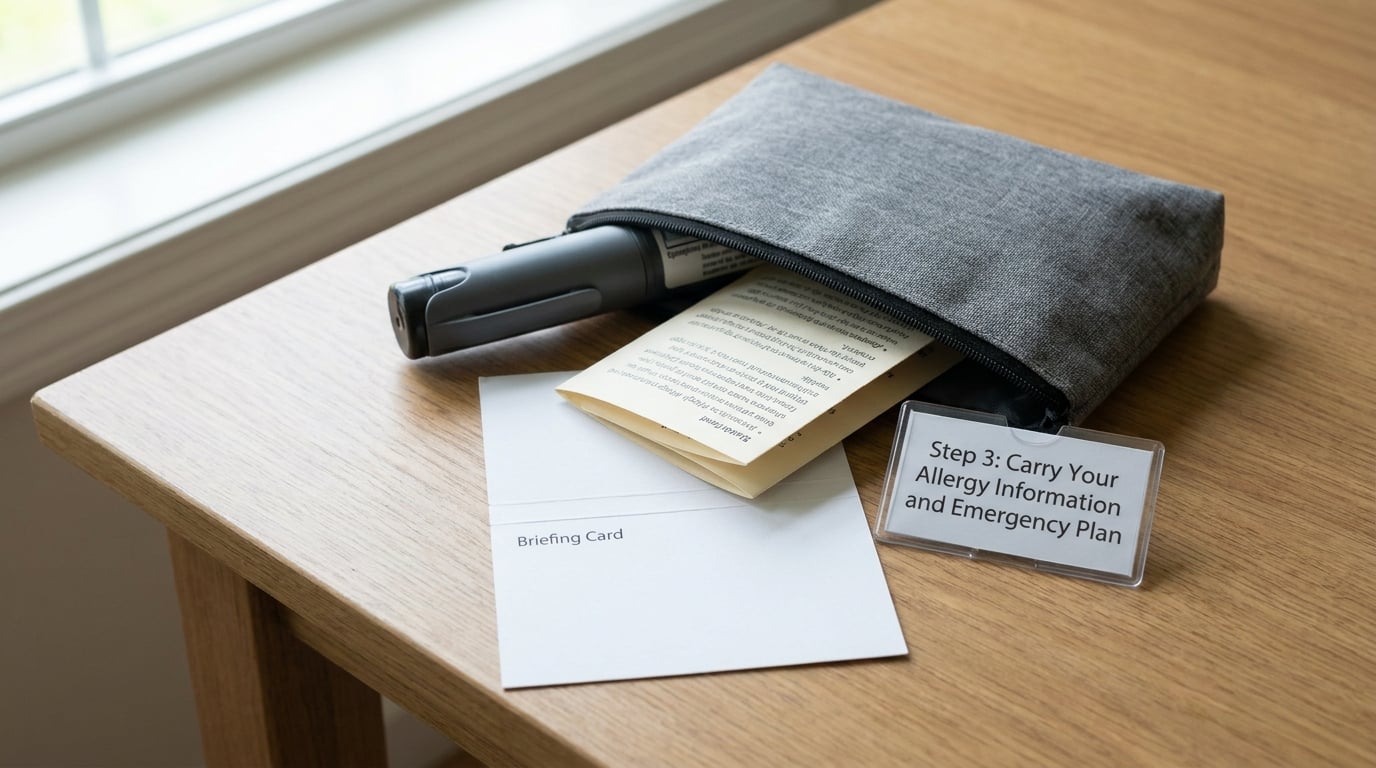
Print the card and keep it with you, then know the plan before the food arrives rather than during it. Your plan should cover what counts as a reaction for you, who calls emergency services, who else needs to be told, and where the second dose is.
Carry a small kit with a travel-sized fork, knife and straw if you want to avoid shared serving utensils and the bread basket. It costs nothing and it removes one shared object from the table.
Reaction symptoms for a food allergy can include hives, swelling of the lips, tongue or throat, trouble breathing, wheezing, a hoarse voice, dizziness, fainting, or vomiting. Timing varies, and some people react to a food they have eaten safely for years. A reaction in two separate body systems, such as hives plus wheezing, is a medical emergency.
Epinephrine is the first-line treatment for anaphylaxis, given into the outer mid-thigh through clothing if you have to. Antihistamines can help mild itching and hives but they do not treat airway or circulation problems and they do not stop a delayed reaction, so they are not a substitute. Call emergency services, use the auto-injector, and tell someone nearby what is happening.
Be aware that a second wave of symptoms, sometimes hours after the first, is documented and is the reason observation after a significant reaction is standard. If you use an auto-injector, that is the end of the decision making: get medical help, not a second opinion from a tablemate.
Afterwards, tell the manager what happened and when. A serious reaction is a medical event and, in the US, it is also the trigger for a report to the local health authority. Knowing the exact dish and the time you ate it helps whoever follows up.
Step 4: Order Clearly and Ask for Confirmation
Say the allergy again when you sit down, even if you called ahead, because the person who took your call is not the person standing in front of you. Name the allergen, name the severity, and name what happens if it is wrong.
Ask your server to repeat it back to you before they walk away. That single request catches the single most common failure in restaurant allergy service, which is a verbal relay that gets garbled on a busy line or never reaches the pass at all. If your server looks uncertain, ask them to get the chef.
Then order for simplicity. A plain grilled protein, a vegetable cooked on its own, rice, a salad with non-marinated components, a dish with nothing to de-construct. Every ingredient someone has to remove is an opportunity to miss one. Regulars on allergy forums reach for the same items for exactly this reason.
A few ordering moves that consistently help:
- Ask for fresh oil rather than shared frying oil, or skip fried food entirely.
- Ask whether the dish can be started on a clean surface with clean utensils.
- Ask for sauces and dressings on the side so you control them.
- Say yes to the simple item even when the interesting dish looks fine. You cannot see hidden ingredients.
Handling the group is part of this step. If someone else picked the restaurant, tell the table early and briefly: “I have a peanut allergy, so I will ask the kitchen about a couple of things. It takes a minute.” You are not asking permission, and you do not need to explain your history. FARE and AAAAI both recommend that adults and parents do the talking themselves rather than relying on a child to report it.
Step 5: Check the Meal and Reduce Cross-Contact
Ask the server to bring the order when it is ready rather than leaving it on the pass. Plates that sit sit near other orders, and that is where a swap or a stray spoon happens.
When the plate lands, check it against what you ordered. If the description was “no peanuts” and the dish is topped with sliced nuts, send it back immediately rather than picking them off, because the rest of the dish has already touched them.
Skip the shared bread basket, the salad bar tongs, the communal butter and the self-serve condiment wall unless the staff brings you a fresh one. Your own fork, your own plate, your own seat is a small amount of control that costs nothing.
If anything about the preparation is uncertain, do not eat. Ordering something else is a small decision you make in two minutes; a reaction is a decision you do not get to make at all. This is also where the honest limit lands: sometimes the correct answer is to order a plain salad and move on, and that is a win rather than a failure.
One last habit. A restaurant that handled it well is worth a note in your phone, along with who you spoke to and what they said. A restaurant you were careful with and never ate at is worth a note too, so the next time you know what to ask.
Common Mistakes
These five patterns come up again and again, and each one has a straightforward correction.
Treating a menu label as a safety guarantee
Gluten-free, vegan and nut-free on a menu describe ingredients, not equipment. The label tells you what went in; it says nothing about the fryer, the board, the toaster or the tongs. Ask what the dish is prepared on and whether shared equipment is involved.
Assuming a previous safe meal still holds
Menus change, suppliers change and staff change. A restaurant that handled your allergy well last year may have a completely different team on a Tuesday night. Re-brief the kitchen on every visit, however many times you have been before, and ask for the current allergen guide rather than trusting last year’s copy.
Explaining the allergy in general terms
“I am allergic to nuts” gets a generic answer. “I react to cashew and pistachio specifically, and it is anaphylaxis-level” gets a real one. Name the exact allergen, state the severity, and ask the question that has a checkable answer: can this be started on a clean surface with separate utensils?
Asking the server to handle it and walking away
Servers relay information in a busy room. Ask them to repeat your allergy back to you, and ask them to pass it to the chef or the kitchen manager, then let the chef come to the table if the answer is complicated. Two minutes of checking is the whole difference.
Leaving the emergency plan to the moment it is needed
People skip the auto-injector, leave it in a bag, or leave it in the car. Find it before you order, and tell one person at the table what your symptoms look like and that you have it. If you need it, you should not be the person who has to go find it.
Frequently Asked Questions
Can a restaurant guarantee no cross-contact?
No. A kitchen that runs a shared fryer, shared toaster, shared boards and one sink cannot promise zero cross-contact, and any restaurant that does promise it is overstating what it controls. What a good kitchen can do is change its process for your order: start it on a clean surface, use separate utensils, and keep your allergen out of the line. Treat an honest cannot-guarantee as a useful answer, because it tells you what to order instead.
How do I tell if a restaurant is allergy friendly before I go?
Look for three things: a current printed or online allergen guide, willingness to answer specific questions about shared equipment, and low volume of your allergen in the kitchen. A restaurant that cooks a lot of nuts, seafood or gluten carries more exposure than one that cooks almost none. Chain allergy guides are a starting point only, because users repeatedly report the local kitchen not matching the corporate document. One short phone call tells you more than an hour of reading.
What should I do if I react to food at a restaurant?
Use your epinephrine auto-injector into the outer mid-thigh straight away and call emergency services. Epinephrine is the first-line treatment for anaphylaxis. Antihistamines can help itching and hives but do not treat airway or circulation problems and do not prevent a delayed reaction, so they never replace the auto-injector. Tell someone at the table what is happening, and stay for observation, because a second wave of symptoms can arrive hours later. Then tell the manager so it can be reported.
Is a restaurant safe for my allergy if it has a gluten-free menu?
A gluten-free menu tells you about ingredients, not equipment. A gluten-free crust is often rolled and topped on the same bench as wheat dough, and gluten-free fries frequently go into oil that has held breaded food. For someone with celiac disease that exposure causes intestinal damage even when no immediate symptoms appear, so the honest expectation at a mainstream restaurant is some cross-contact. Ask directly about the fryer, the toaster and the prep surface before you decide.
What is the difference between a food allergy, an intolerance and celiac disease?
All three change what you order, but for different reasons. A food allergy is an immune reaction that can be life-threatening and needs an auto-injector on hand. An intolerance, such as lactose intolerance, is a digestive difficulty that is uncomfortable rather than dangerous. Celiac disease is an immune condition too: gluten damages the lining of the small intestine over time, so cross-contact matters even when nothing happens right away. The kitchen treats the first as urgent and the last as serious, so say which one you have.
How do I eat out with food allergies safely when someone else picks the restaurant?
Say the allergy at the table early and keep it to one sentence, then move on to the process rather than the explanation. Before ordering, do the same check you would do alone: ask the server to repeat your allergens back, ask whether shared equipment is involved, and order something simple. If the kitchen cannot accommodate you, eating a plain dish or leaving is a normal outcome. Should you tip extra for the extra work an allergy order creates, opinions in server communities are genuinely split, and a few extra dollars is a fair way to settle it.
Start with the call. Pick the restaurant, find out whether it can actually work for your specific allergen, and only then decide the evening. Everything after that is shorter than it sounds once you have done it twice.
Reviewed and updated for 2026. This article is educational and does not replace the advice from your own doctor or allergist. If you have a food allergy, talk with your clinician about your own emergency action plan before you dine out again.