
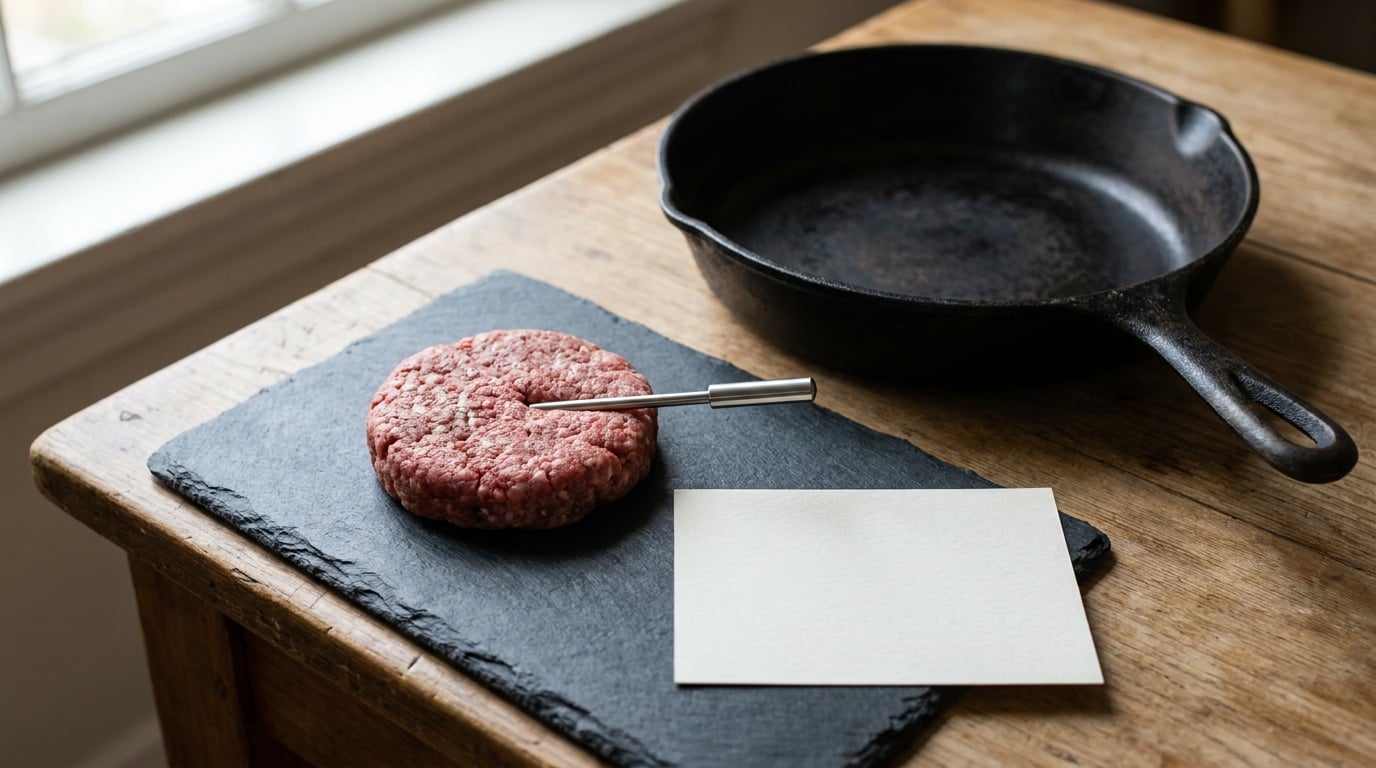
Cook ground beef burgers to an internal temperature of 160°F (71°C) measured in the thickest part of the patty, and use a thermometer rather than color to decide. This burger internal temperature guide for doneness gives you the full chart from rare to well done in both Fahrenheit and Celsius, plus where to place the probe, how long to cook each patty thickness, and why a burger can still be pink at a safe temperature. If you only read one thing, read the table below and the safety section after it.
A few minutes of reading saves the two mistakes home cooks make most: a charred outside with a raw center, or a dry hockey puck they cooked “just to be safe.” Both come from cooking by appearance instead of by number.
Everything here follows USDA and FSIS guidance for ground beef. Updated for 2026, and still accurate when you print it.
Table of Contents
- Burger Internal Temperature Guide for Doneness at a Glance
- How Do You Measure a Burger’s Internal Temperature?
- What Temperature Should You Cook a Burger to?
- Rare vs. Medium-Rare vs. Well-Done Burgers: What Changes?
- Can You Tell Burger Doneness by Color?
- How to Get an Evenly Cooked Burger
- What If Your Burger Is Not Hot Enough?
- Frequently Asked Questions
- How to Use This Guide for Your Next Burger
Burger Internal Temperature Guide for Doneness at a Glance
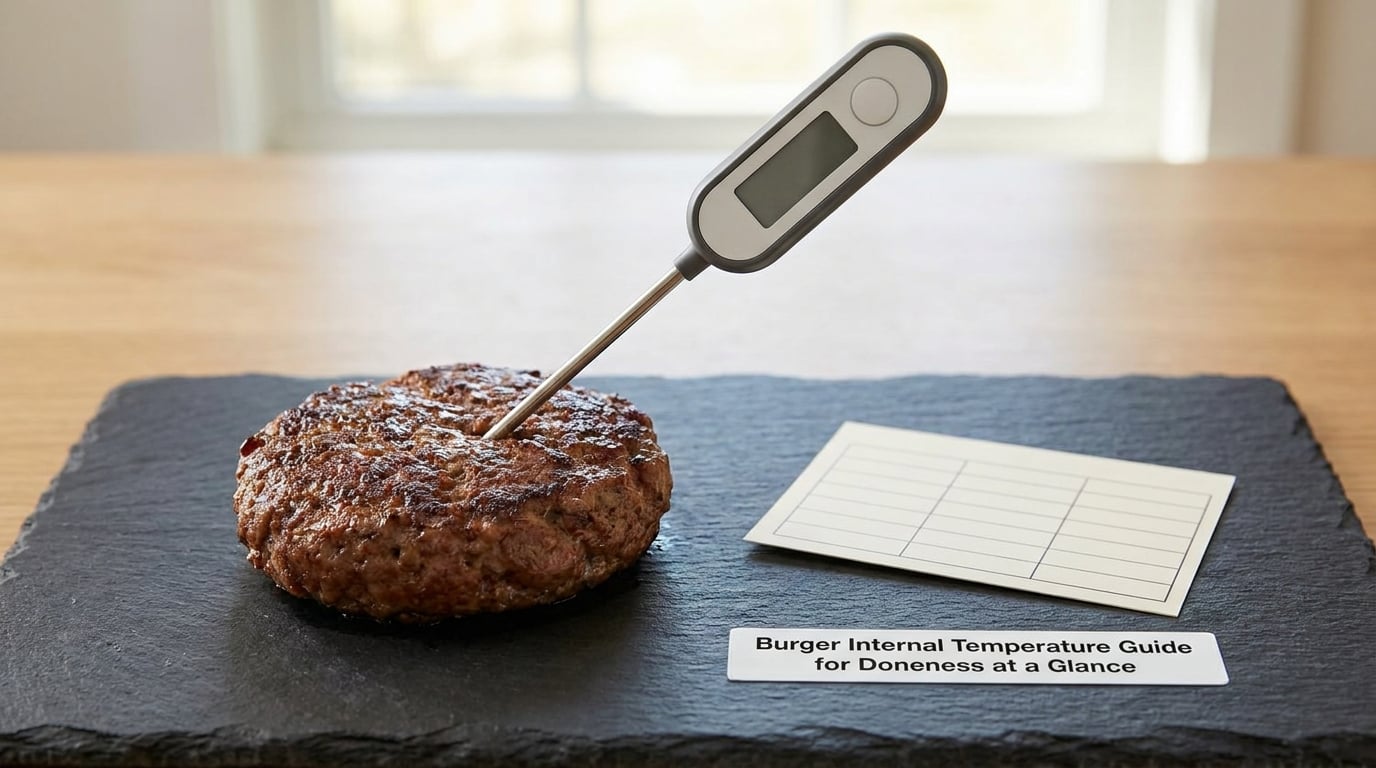
The USDA safe minimum internal temperature for ground beef is 160°F (71°C). Everything below that is a preference, not a safety recommendation.
| Doneness | Temperature (°F) | Temperature (°C) | What the center looks like |
|---|---|---|---|
| Rare | 125–130°F | 52–54°C | Cool to the touch, deep red, soft and almost liquid |
| Medium rare | 130–135°F | 54–57°C | Warm, red-pink center, springs back with a little give |
| Medium | 140–145°F | 60–63°C | Pink to light pink, firmer, juices run clear rather than red |
| Medium well | 150–155°F | 66–69°C | Faint pink trace, noticeably springy, surface firmer |
| Well done | 160–165°F | 71–74°C | Brown throughout, firm to the touch, juices run clear |
One note on the table: medium at 140–145°F matches the temperature used for whole cuts of beef, and you will see that number quoted constantly online. It is not the safe minimum for a burger. The 145°F rule applies to intact steaks and roasts, where the surface is the only place bacteria live. Grinding spreads surface bacteria through the whole batch, so the whole patty has to reach 160°F. That difference is the entire safety story of this guide.
If you are cooking for pregnant guests, children, older adults, or anyone with a weakened immune system, cook to 165°F (74°C). Many home cooks use that as their universal number, and it costs you almost nothing in texture if you manage the heat well.
How Do You Measure a Burger’s Internal Temperature?
A reading is only as good as where you put the probe. Four steps cover it:
- Insert into the thickest part of the patty. Side edges and the flat top cook faster than the middle, and a reading taken there is lower than the real number. Aim for the side of the patty, halfway up, where the meat is deepest.
- Keep the probe off every surface. Touching the pan, the grill grate, the oven wall, or your finger drops the reading by 10°F or more. Thin-tip probes are worth having for exactly this reason.
- Wait for the number to stop moving. Most digital thermometers need 10 to 15 seconds. A reading taken at three seconds can read 15°F low, which is how people convince themselves a burger is pink when it is not.
- Read twice, then clean the probe. Check a second spot on the other side if the patty is uneven, and wipe the probe with hot soapy water before it goes back in the box. Cross-contamination through a dirty probe is a real risk with raw patties.
Pull the patty about 5°F below your target and let carryover cooking finish the job. A quarter-pound patty off the heat will climb roughly 5°F in the three to five minutes it rests, so pulling at 155°F lands you at 160°F with a juicier center than cooking straight through to the number.
For thicker patties, read the temp more than once rather than trusting a single spot. A stuffed or cheese-filled burger cooks unevenly around the filling, and 6-ounce patties can hide a cold pocket right in the middle.
What Temperature Should You Cook a Burger to?
The short answer: 160°F for ground beef, 165°F for high-risk diners
The USDA and FSIS set 160°F (71°C) as the safe minimum internal temperature for ground beef, and 170°F (77°C) for ground poultry like turkey. Poultry burgers need more heat than beef burgers do, which surprises people who assume turkey is the lighter option.
Ground meat is different from steak because of the grinder. On an intact cut, bacteria sit on the outside surface and the inside starts sterile. In a patty, the blade drags that contaminated exterior through the entire batch, so bacteria are distributed everywhere you cut. Heat has to reach the center because the center is no different from the crust.
The pathogens that matter are E. coli and Salmonella, and both survive well below 160°F on undercooked ground meat. That is the whole reason the number is 160 and not 140.
Many experienced cooks land in a reasonable middle: they cook to 160°F because that is the recommendation, and they get their texture back through technique rather than by stopping short. A hot cast iron pan, a thin even patty, and a short rest do more for a burger than cooking it 10°F cooler ever will.
Rare vs. Medium-Rare vs. Well-Done Burgers: What Changes?
Here is what actually shifts as you move up the chart, beyond the number.
Rare, 125–130°F. Almost liquid in the middle, cool on the tongue, minimal sear flavor development because the center never gets hot enough to brown. Cookbooks often quote 120–125°F for this, which is below anything you should serve a child.
Medium rare, 130–135°F. The most requested doneness and the most misunderstood. The center is warm, not hot, and still quite soft. Because the interior stays below about 135°F, most of the fat has not rendered, which is why the patty tastes buttery rather than greasy. This is where a lot of people land after trying medium.
Medium, 140–145°F. Firm enough to hold together in a bun, faintly pink, and noticeably drier than medium rare because more of the intramuscular fat has cooked off and moved to the surface to baste the patty.
Medium well, 150–155°F. A thin pink trace or no pink at all, springy rather than soft. Some people genuinely prefer the tighter texture, though calling it medium well usually signals the transition point rather than a destination.
Well done, 160–165°F. Brown all the way through, firm, and the driest end of the chart. It is also the only zone on this list that USDA guidance considers safe for everyone, which is why so many parents and cautious cooks stop here.
The trade-off is straightforward. Lower temperatures give you moisture and tenderness but no safety margin. Higher temperatures give you a safety margin and take moisture with them.
Can You Tell Burger Doneness by Color?
No. Color is a clue about myoglobin, the protein that holds oxygen in muscle and turns red when it binds to it, and myoglobin levels vary with the animal’s age, diet, and how long the meat has been exposed to air. Ground beef from older cattle is naturally darker than ground beef from young cattle, and a patty that has been sitting open is lighter. You cannot calibrate your eyes against a chart that shifts with every package.
A burger can also still be pink at 160°F. That happens with fresh beef high in myoglobin, and it is why the “any pink means undercooked” rule sends people cutting into patties that were safely cooked. The thermometer is the arbiter, not the cut surface.
Color also lies in the other direction. Ground meat smeared from handling browns on the surface while the interior is still cold, so a gray-looking outside means nothing about the middle. This is the single most common cooking failure people describe: burnt exterior, raw center, no thermometer involved.
If you want a rough backup method, the finger-palm test is the one most home cooks already half-know:
- Touch the raw patty with your thumb and index finger. Note the soft, squishy feeling of cold meat. That is your rare baseline.
- Press your thumb into the center of the cooked patty. A rare burger feels like that cold patty, barely any resistance.
- Compare with your own palm. Firm with a slight give is roughly medium rare, firmer is medium, very firm is medium well, and rock solid is well done.
Treat it as a sanity check rather than a measurement. It cannot tell you 155°F from 160°F, and it does nothing for the safety question.
How to Get an Evenly Cooked Burger
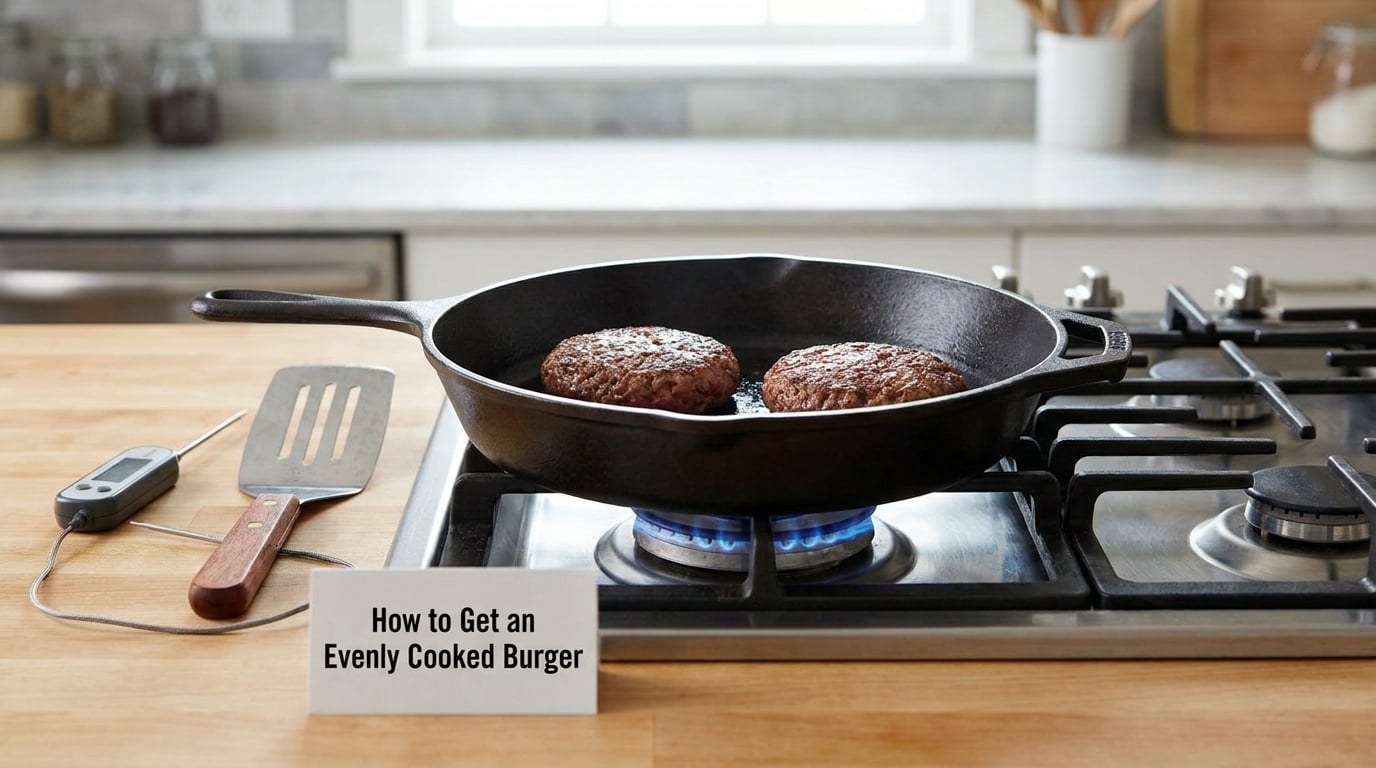
Most uneven cooking comes from the shape of the meat or the shape of the heat. Fix the first, then the second.
Shape an even patty with a shallow indentation in the center using your thumb. The dent makes the middle and the edges finish at the same time, which is the single highest-impact thing you can do before the patty hits heat. Weighing the patty to 1/4 inch thick helps more than people expect.
Use a two-zone grill: a hot direct zone at 450–500°F for the sear, and an indirect zone at 350–375°F to finish. Sear about 90 seconds a side, move the patty to the indirect side, close the lid, and check the temperature there. One flip, not four, keeps the juices in.
Stop pressing the patty with a spatula. Every press squeezes out the juice you then complain about, and it flattens the edges where they crisp. Let the patty tell you when it is ready to move by releasing on its own.
| Patty type | Grill | Cast iron skillet | Air fryer (375°F) | Oven (400°F) |
|---|---|---|---|---|
| Thin smash (1/8 in) | 1.5–2.5 min per side | 1.5–2 min per side | 4–6 min total | 6–8 min |
| Standard (1/4 in) | 3–4 min per side | 3–4 min per side | 8–10 min | 12–15 min |
| Thick (1/2 in or larger) | 4–5 min per side, then indirect | 4–5 min per side, weighed down | 12–14 min | 18–22 min |
| Stuffed or cheese-filled | 5–6 min per side, lid closed | 5–6 min per side, lid on | 12–15 min | 20–25 min |
These are starting points, not targets. Thinner patties finish in a fraction of the time and can go from done to dry in fifteen seconds, so start checking the temperature early and keep the thermometer in your hand rather than in a drawer.
Grill temperature and internal temperature are two unrelated numbers. A 250°F grill zone is a low indirect heat, fine for slow finishing, but a thin patty sitting on it will take so long that it dries out long before the center catches up. High surface heat plus a thermometer is what produces a browned outside and a safe center at the same time. You want 450°F or higher under the patty, not 160°F.
Frozen patties need 3 to 5 extra minutes, and cooking them from frozen is the safer choice against spreading raw meat around the kitchen. Sear the first side without moving them, then finish with the lid or the indirect zone.
What If Your Burger Is Not Hot Enough?
You pull a patty, cut it, and the center is pink. Do not panic, and do not throw it away. Check the actual temperature first, because a pink center at 160°F is safe and a brown crust over a raw middle is the real problem.
If the reading is genuinely low, put the patty back on the heat. Sear 60 to 90 seconds on the cut or uncut side to rebuild crust, then move it to indirect heat or a low burner with the lid on. Check the temperature in the thickest part every 30 seconds, and stop the moment it reaches 160°F.
Two things to avoid. Do not microwave the patty, since it heats unevenly and leaves cool patches. And do not queue the patty in the oven at 400°F for ten minutes as a catch-all, because that dries the outside long before the center moves.
If you are out of clean tongs and plates, the cooked patty can touch a raw patty’s surface briefly without meaningful risk. The bacteria that cause foodborne illness come from the meat itself, not from plate-to-plate transfer, so keep raw patties separate from cooked ones and focus your attention on the temperature.
Frequently Asked Questions
What is the 5 6 7 rule for burgers?
The 5 6 7 rule is a doneness shortcut: 5 is rare, 6 is medium, 7 is well done, and the middle reads as medium rare. Use your fingertip on the cooked patty and compare the feel to a cold raw patty held in your other hand. It is a fast check, not a measurement, so confirm anything near the safety floor with a thermometer reading of 160°F.
Are burgers safe at 145°F?
145°F (63°C) is the USDA safe minimum for whole cuts of beef such as steaks and roasts, not for ground beef. Grinding works surface bacteria from the animal through the entire batch, so a patty must reach 160°F (71°C) throughout. If you have seen 145°F quoted for burgers, that number is carried over from steak guidance. For anyone pregnant, elderly, immunocompromised, or cooking for small children, use 165°F.
Is a cooked burger still pink at 160 degrees Fahrenheit?
Yes, and it is safe. Fresh beef often carries a high myoglobin content, the oxygen-binding protein that gives raw meat its red color, and that pigment does not turn brown as quickly as the rest of the muscle. A patty can read 160°F on the thermometer and still show a pink center. Judge safety by the number from a probe in the thickest part, not by what a cut face looks like.
Will burgers cook at 250 degrees?
A 250°F grill zone will cook a burger, but slowly. That is an indirect finishing heat, not a searing heat, and a thin patty left there long enough will turn dry and gray long before its center reaches 160°F. Sear first on a direct zone at 450–500°F, then move the patty to the cooler side with the lid closed and check the internal temperature there.
Is a little pink inside a burger ok?
A little pink is fine when a thermometer confirms the patty has reached 160°F in its thickest part. Take the reading before you cut the patty open, since cutting and cooling drop the temperature fast. If you cannot verify the number, treat any pink center as undercooked and return it to the heat. Color alone is the least reliable signal in burger cooking.
How long should I cook a burger on a grill?
A standard quarter-inch patty takes about 3 to 4 minutes per side on a hot gas or charcoal grill over direct heat, then one to two minutes on the indirect side to finish. Thin quarter-pound smash patties cook in 1.5 to 2.5 minutes a side, and patties thicker than half an inch need 4 to 5 minutes a side plus indirect time. Start checking early, because the gap between done and overcooked is short.
How to Use This Guide for Your Next Burger
Start here: pick the doneness you actually want, then cook the patty to 160°F anyway. Rare, medium rare, medium, medium well, and well done all sit on this burger internal temperature chart, but only the top of it is safe for everyone.
Before the meat goes on, press a shallow dent in the center of each patty. During cooking, hold a thin-tip probe and check the thickest part every 30 seconds after the first flip. Pull at 155°F, rest three to five minutes, and let the carryover finish the climb.
Keep a 450°F direct zone for the sear and a 350–375°F indirect zone for the finish. That combination, plus a thermometer, is what gets you a browned crust and a safe center in the same bite. Everything else on this page is detail on top of those three moves.