
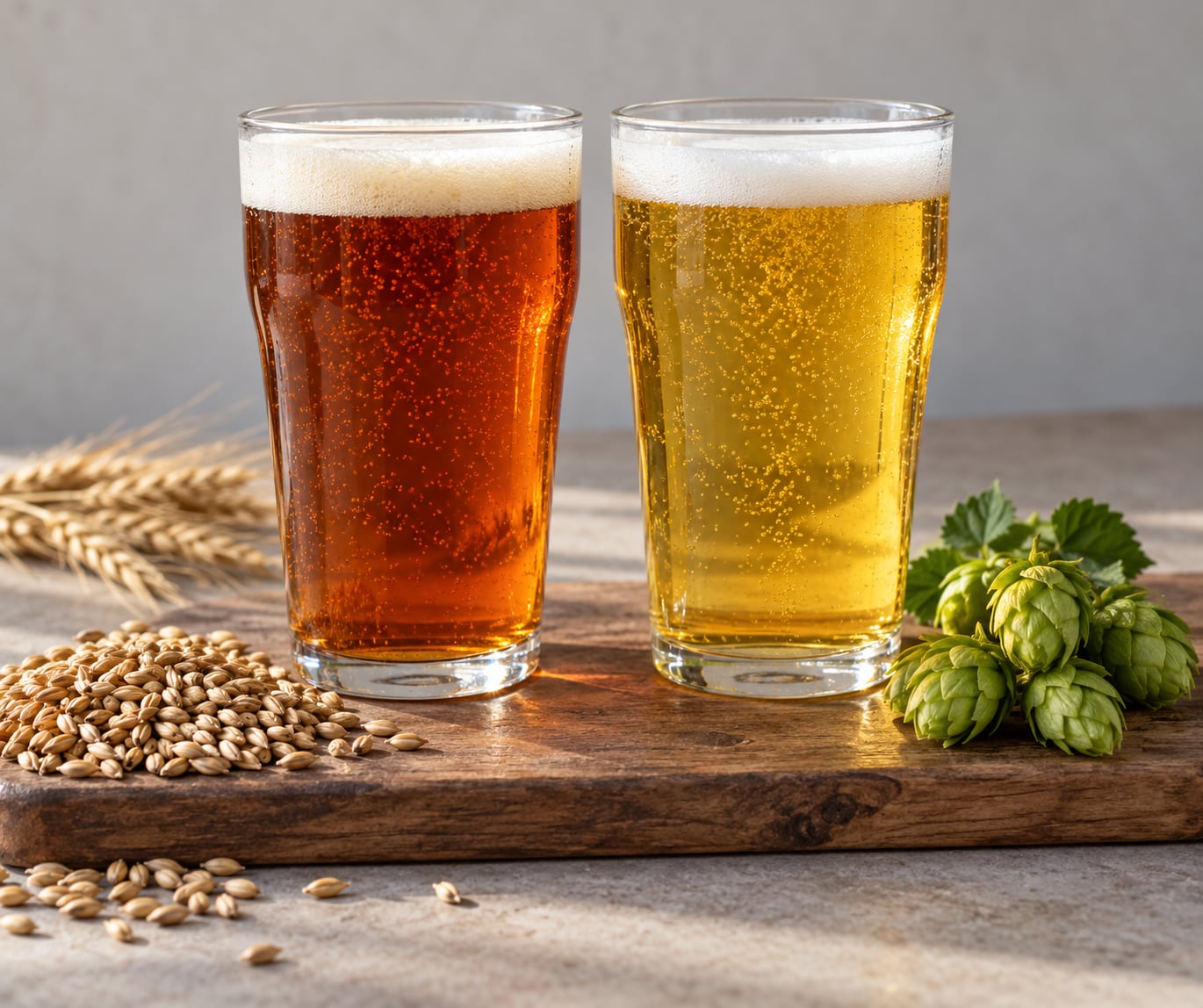
The ale vs lager differences come down to one ingredient: yeast. Ales ferment warm with top-fermenting Saccharomyces cerevisiae and tend to taste fruity and spicy. Lagers ferment cold with bottom-fermenting Saccharomyces pastorianus, then age in cold storage, which gives them a clean, crisp finish.
Everything else people assume ties to the label — color, alcohol level, bitterness — is a recipe choice, not a family trait. A dark lager and a pale ale can be almost identical on paper.
Both start the same way, though. Grain is mashed in hot water to make sugary wort, the wort is boiled with hops, and then yeast gets added. Mashing and boiling are identical for the two families; only what happens next changes.
We looked at brewing sources and bar conversations to put this together, because the shortest explanation of ale versus lager — warm versus cool — leaves out enough detail to cause real confusion at the bar.
Table of Contents
- Ale vs Lager Differences at a Glance
- How Are Ales and Lagers Made?
- What Do Ales Taste and Smell Like?
- What Do Lagers Taste and Smell Like?
- Are Ales Stronger Than Lagers?
- Which Style Is Better with Burgers and Grilled Food?
- Ale or Lager for Beginners?
- Which Should You Choose?
- Frequently Asked Questions
- Bottom Line
Ale vs Lager Differences at a Glance
| Category | Ale | Lager |
|---|---|---|
| Yeast | Saccharomyces cerevisiae, top-fermenting | Saccharomyces pastorianus, bottom-fermenting |
| Fermentation temperature | About 60-75F (15-24C), some styles to 80F | About 45-55F (7-13C) |
| Primary fermentation | Roughly one to two weeks | Roughly two to six weeks |
| After fermentation | Served young, or conditioned warm in the cellar | Cold conditioning (lagering) for weeks or months |
| Flavor | Fruity, spicy, floral, hop-forward, more complex | Clean, crisp, malt and hop defined, restrained |
| Aroma | Esters: peach, pear, banana, pepper, citrus, flowers | Bread-like malt, light grain, subtle hop |
| Body | Medium to full, sometimes soft | Light to medium, often snappy |
| Clarity | Clear to slightly hazy | Very clear, bright |
| Color | Pale to dark brown or black | Pale to dark brown or black |
| Typical strength | About 4-8%, but strong ales run 8-12% and higher | About 4-6%, but bocks and strong lagers run 7-9%+ |
| Origin | Medieval Europe and Britain, ale breweries everywhere | Bavaria, where cold cellars made it possible |
| Serving temperature | About 45-55F, warmer for dark ales | About 37-45F (3-7C) straight from the cooler |
| Shelf life | Months; hop bitterness keeps it stable | Months to a year or more, very stable |
| Examples | Pale ale, IPA, amber ale, brown ale, porter, stout | Pilsner, helles, Vienna lager, bock, dark lager |
Read that table as a set of tendencies rather than rules. Every row marked color, strength or clarity overlaps between the two columns, and only the yeast and temperature rows tell you which family a beer belongs to.
How Are Ales and Lagers Made?
The shared part is short. Breweries crush malted barley, mash it in hot water, strain off the wort, boil it with hops for bitterness and aroma, then cool it and pitch yeast. Brewers on both sides of this divide use the same equipment and the same steps up to that pitch.
From there the paths split. Ale yeast works at cellar and room temperature and finishes in days. Lager yeast works slowly in the cold, and the beer almost always spends extra time in a cold room before it ships or pours.
That extra cold stage is where the word comes from. The German lagern means to store, and Bavarian brewers kept beer in cold cellars for months because of a 16th-century rule that pushed brewing out of the summer months. The beer that came out of storage in spring was paler, clearer and more stable than anything brewed and sold fresh.
The practical difference for anyone drinking the beer: lagering drops out yeast and suspended proteins, so the finished beer tastes cleaner. Fermenting warm with ale yeast produces esters, which read as fruit, spice and flowers.
Ale vs Lager Differences in Yeast and Fermentation
The main difference between ale and lager is a single yeast choice, and everything else follows from it. Ale yeast, Saccharomyces cerevisiae, floats to the top of the wort as it multiplies and prefers roughly 60-75F (15-24C). Lager yeast, Saccharomyces pastorianus, settles to the bottom and works slowly at about 45-55F (7-13C).
Ales also tolerate a wider temperature window, which is why specialty ales like farmhouse saison and Belgian styles push past 75F and even toward 80F without falling apart. Lagers want a narrow, controlled band, which is one reason the word “lager” also implies a controlled environment.
Most ales go straight to the tap once fermentation and packaging are done. Many are served that way deliberately, because hop aroma fades and warm-weather freshness is the point. Conditioning traditions vary: some English ales sit in a warm cellar for months, while American ales are usually packaged young.
Lagers get a named step after fermentation. Cold conditioning, or lagering, runs at cellar temperature for anything from a couple of weeks to several months. Pilsner and helles are usually on the shorter end, while Vienna lager and bock traditionally get longer.
A couple of exceptions keep this honest. Ales fermented with wild or mixed cultures, such as lambic, follow their own path, and a well-made beer may also be blended from beer that was conditioned and beer that was not. The yeast family still decides the category.
What Do Ales Taste and Smell Like?
Warm fermentation gives you esters, and esters smell like ripe fruit, pepper, banana, or bubblegum depending on the yeast strain. That aroma is the first thing people notice in a pale ale, and it is why ales often feel more aromatic from the first sniff.
Within the family the differences are big. A pale ale sits somewhere between 4-6% and leans toward bread crust, light citrus and a soft finish. Amber ales add caramel and toffee malt with a touch of spice. Brown ales go nuttier and rounder, closer to toffee, dried fruit and toasted bread.
Then there are IPAs, which use the same ale yeast but pile on hops. Expect grapefruit, pine resin, and a bitterness that can be gripped between thumb and finger on a napkin. Porters and stouts, also ales, add chocolate, coffee and roasted character through malt rather than hops.
One warning: “ale” is a broad family, not a flavor promise. Plenty of ales are mild, low-bitterness and barely fruity, and the term says nothing about hop intensity. If you order an ale expecting spice and get something soft and cornbready, that is normal.
What Do Lagers Taste and Smell Like?
Lagers are usually clean, crisp and malt-forward, with the fermentation itself barely showing through. Where an ale gives you fruit and phenols, a lager gives you bread, cracker, sometimes a faint sweetness from residual malt and a snappy, dry finish.
Inside the family, pilsner is the benchmark: pale gold, assertive hop aroma with a spicy, floral edge, and enough bitterness to feel lively against a fried side. Helles is softer and maltier, with a rounder body and gentle sweetness. Vienna lager adds amber color and toasty, caramel malt without any roast.
Bock and dark lager move the other direction, toward bread crust, caramel and cocoa-like roast. These are still lagers, fermented cool and conditioned cold, so they keep the lager’s clean line while carrying a heavier malt profile.
Color and roastiness tell you nothing about fermentation type. Guinness is the classic case people get wrong: it is a dry stout built on lager yeast and nitrogenated at the tap, not an ale, despite the black color.
Are Ales Stronger Than Lagers?
No, and this is the biggest myth in the category. Alcohol strength is decided by the recipe, mainly the amount of fermentable sugar you start with, not by which yeast you pitch. A lager and an ale can be brewed to identical strength.
What does happen is a convention drift. Mass-market light lagers cluster around 4-5% ABV, and pale ales land around 4-6%, so casual drinkers have built an association between lager and light. The ranges overlap completely once you move beyond the everyday bottles.
Strong ales reach 8-12% and beyond, including barley wines and imperial stouts. Strong lagers such as bock, doppelbock and bock-style brews sit at 7-9% or higher, and plenty of craft lagers from independent breweries out-punch many ales.
In practice the number that changes your night is serving size, not yeast. A 12-ounce IPA at 7% carries about 5.6 ounces of alcohol, while a 16-ounce pale lager at 4.5% carries about 5.1, and the one in a larger glass will keep going long after the smaller one is gone.
Which Style Is Better with Burgers and Grilled Food?
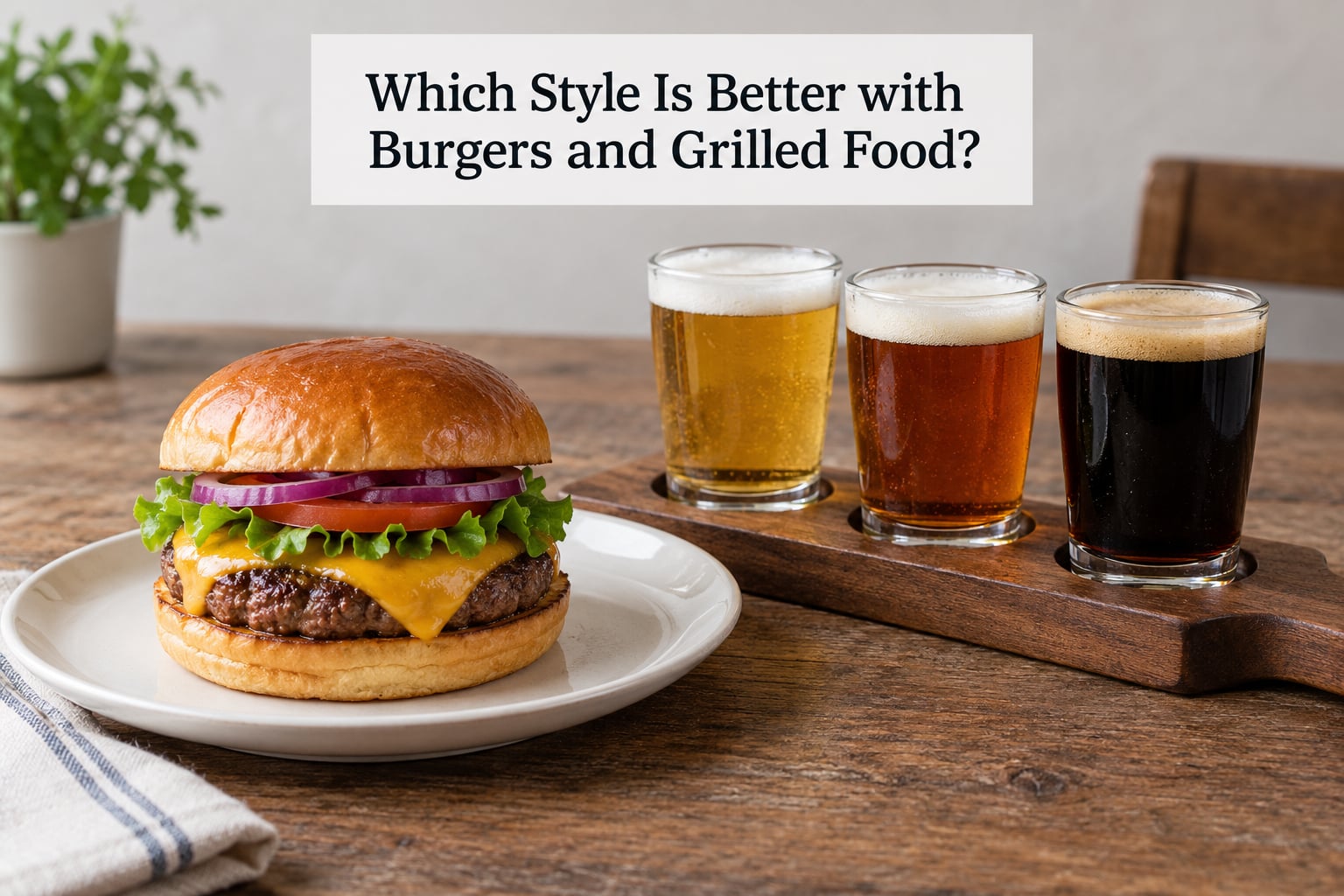
Neither wins outright, because the pairing variables are sweetness, bitterness, roast, acidity, texture and serving temperature. Match the beer that echoes the burger, then check it does not fight the topping.
For a classic cheeseburger with fries and onions, a clean lager is the safe call. Light body and a crisp finish cut the fat, and hop bitterness cleans up after the grease. This is where pilsner or a simple light lager earns its keep.
For a burger built on tomato, raw onion and pickles, reach for a pale ale. A little malt sweetness handles the pickle acidity, and the extra hop aroma and bitterness cut through a tomato-heavy patty better than a neutral lager will.
Brown ales fit mushroom Swiss, caramelized onions and anything with a creamy sauce. Their round, nutty malt matches the richness of the cheese without the roast of a stout, which can take over a grilled beef patty.
IPAs belong with spicy burgers: jalapeno, chipotle, a habanero sauce, or pungent washed-rind cheese such as blue or gorgonzola. That hop bitterness reads as coolness against heat, which is why an IPA tastes less fierce next to a hot burger than it does on its own.
Grilled and roasted meats reward lagers too. A Vienna lager or amber lager brings enough toast to handle char without the fermenter noise, and a dark lager works when the meat is sweet and smoky, like barbecue brisket or caramelized pork.
If you want the hop-versus-crisp debate settled at the grill, our IPA vs Lager With Burgers pairing guide walks through the same matchups with more grill-specific detail.
Ale or Lager for Beginners?
Start with the style that matches how you already drink. If you like things straightforward, cold and uncomplicated, a light lager or pilsner is the easiest starting point. If you enjoy noticing aroma and variation, go straight to a pale ale or a Kölsch-style lager, which sits between both families in personality.
Taste small and compare at different temperatures. A pilsner straight from a 38F cooler and the same beer at 50F taste like two different beers, and that alone answers a lot of the ale versus lager debate without any theory.
Here is the bar cheat sheet, since “which is it” comes up constantly at the counter:
| Beer | Ale or lager | Style |
|---|---|---|
| Guinness Draught | Lager | Irish dry stout, nitrogenated |
| Budweiser | Lager | American pale lager |
| Coors | Lager | American light lager |
| Blue Moon | Lager | Belgian-style witbier |
| Heineken | Lager | Pale lager |
| Peroni | Lager | Italian pale lager |
| Pilsner Urquell | Lager | Czech pilsner |
| Sierra Nevada Pale Ale | Ale | American pale ale |
| Sierra Nevada IPA | Ale | American India pale ale |
Two patterns worth remembering: stouts and porters are almost always ales, and anything pale, gold or dark-brown without obvious fruitiness is usually a lager. Witbiers such as Blue Moon are the exception that confuses people, and they are lagers with coriander and orange peel added.
Which Should You Choose?
Choose an ale when you want aroma, visible fermentation character, hop flavor, or a match for a bold burger. If you pick up the glass, swirl it, and want to smell peaches, citrus and pepper, an ale is doing what you want it to do.
Choose a lager when you want crispness, simplicity, refreshment, and a drink that does not ask for attention. Lagers also carry traditional hot-weather service and pair predictably with fried sides and lighter grilling.
There are moments where the label stops helping. Hybrid beers mix ale yeast with long cold conditioning. Dark lagers and strong lagers carry roast and 8% ABV without looking like an ale. Barrel-aged versions of either family pick up vanilla, oak and tartness that no style guide predicted.
At that point, judge the beer in front of you rather than its family tree. If you enjoy the flavor and you would order it again, the category label never mattered much.
Frequently Asked Questions
Are ales stronger than lagers?
Not necessarily. Strength comes from the amount of fermentable sugar in the recipe, not the yeast. Pale ales often sit at 4-6% and light lagers at 4-5%, so it looks like ale wins by default. Strong ales reach 8-12%, while bocks and strong lagers run 7-9% or more. Compare labels, not names.
Are lagers always lighter in alcohol?
No. Everyday light lagers happen to be lower in alcohol, which is where the idea comes from. A doppelbock or a strong craft lager can match or beat many ales. If strength matters to you, read the ABV on the label, since a large pour of a 4.5% lager can outrun a small pour of a stronger ale.
What is the main difference between ale and lager beer?
Yeast, and the temperature it works at. Ales use top-fermenting Saccharomyces cerevisiae at roughly 60-75F and usually taste fruity and spicy from esters. Lagers use bottom-fermenting Saccharomyces pastorianus at 45-55F and are cold conditioned for weeks, which gives them a clean, crisp finish. Everything else is recipe.
Does beer color tell me whether it is an ale or a lager?
It does not. Color comes from the malt, not the yeast. Guinness is a black lager, and there are dark ales, amber lagers and copper IPAs sitting right next to each other on a menu. You can use a rough hop-and-fruit aroma as a clue, but the only reliable answers come from the style or the brewery’s own description.
Which beer goes best with a cheeseburger?
A clean lager such as a pilsner or light lager is the dependable choice. Its crispness and moderate bitterness cut the fat and wash away salt and grease. Switch to a pale ale for a burger loaded with tomato, pickles and raw onion, or an IPA if the patty is spicy or topped with pungent cheese, where hop bitterness tempers the heat.
Bottom Line
Ale uses ale yeast and usually shows more fermentation character, while lager uses lager yeast and is usually cleaner and crisper. That is the whole rule, and everything else, color, strength, roast, bitterness, follows the recipe rather than the family. Decide from flavor and food pairing first, color and ABV second. When you want the next read, our IPA vs Lager With Burgers: best beer pairing for grills guide covers the hop side, and smash burger vs regular burger differences covers the food.